# building out a case study

prompt used: "an example next to the real thing, a case study, two items next to one another. one is real, one is for study."
## description
To prepare for a course where one might have students show up ready to role play in a case study scenario, instructors can use an AI tool to produce these scenarios (the production of which can be quite time-consuming). Though it will require refining, AI tools like chatGPT can provide instructors with a working draft of case study scenarios that can then be made more nuanced and specific to the course goals.
## activity
1. Log into chatGPT using the Harvard AI Sandbox
2. From search bar at the bottom of the page, specify that you'd like to use GPT 4 32K, since you'll input a significant amount of text (and GPT 3, 3.5, and 4 have word limits in the Harvard AI Sandbox).

3. First, type your questions and/or your prompt for the AI. Remember:
* If you only hit Enter or Return, this will automatically submit your prompt.
* You can also add three ticks (''') to indicate a paragraph break if you prefer.
4. For this activity, you will be asking chatGPT to generate roles and other information for an in-class case study activity.
* any extra information you give will help the LLM to perform best. For example: course description, specific roles, goals of the class, etc.
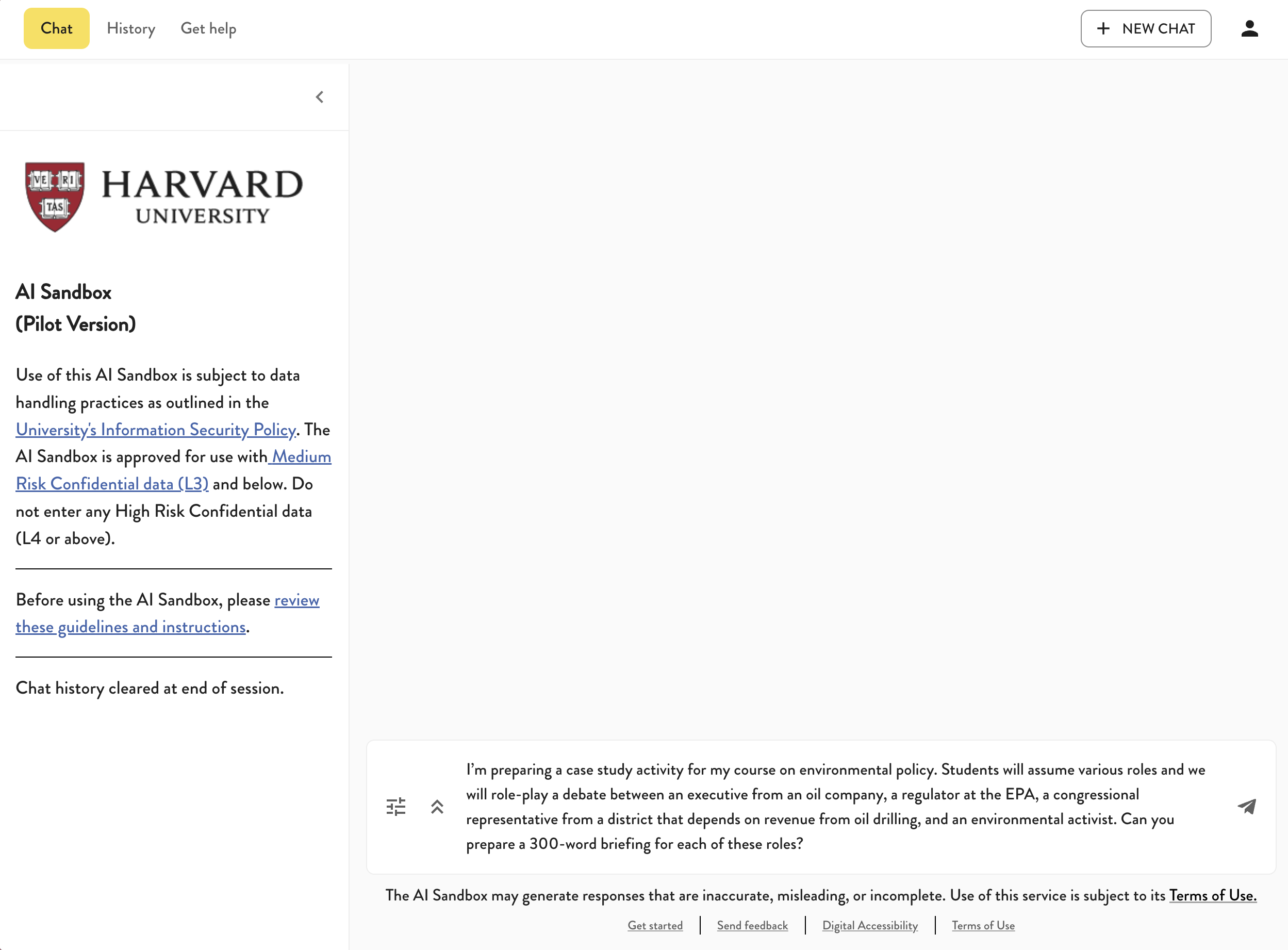
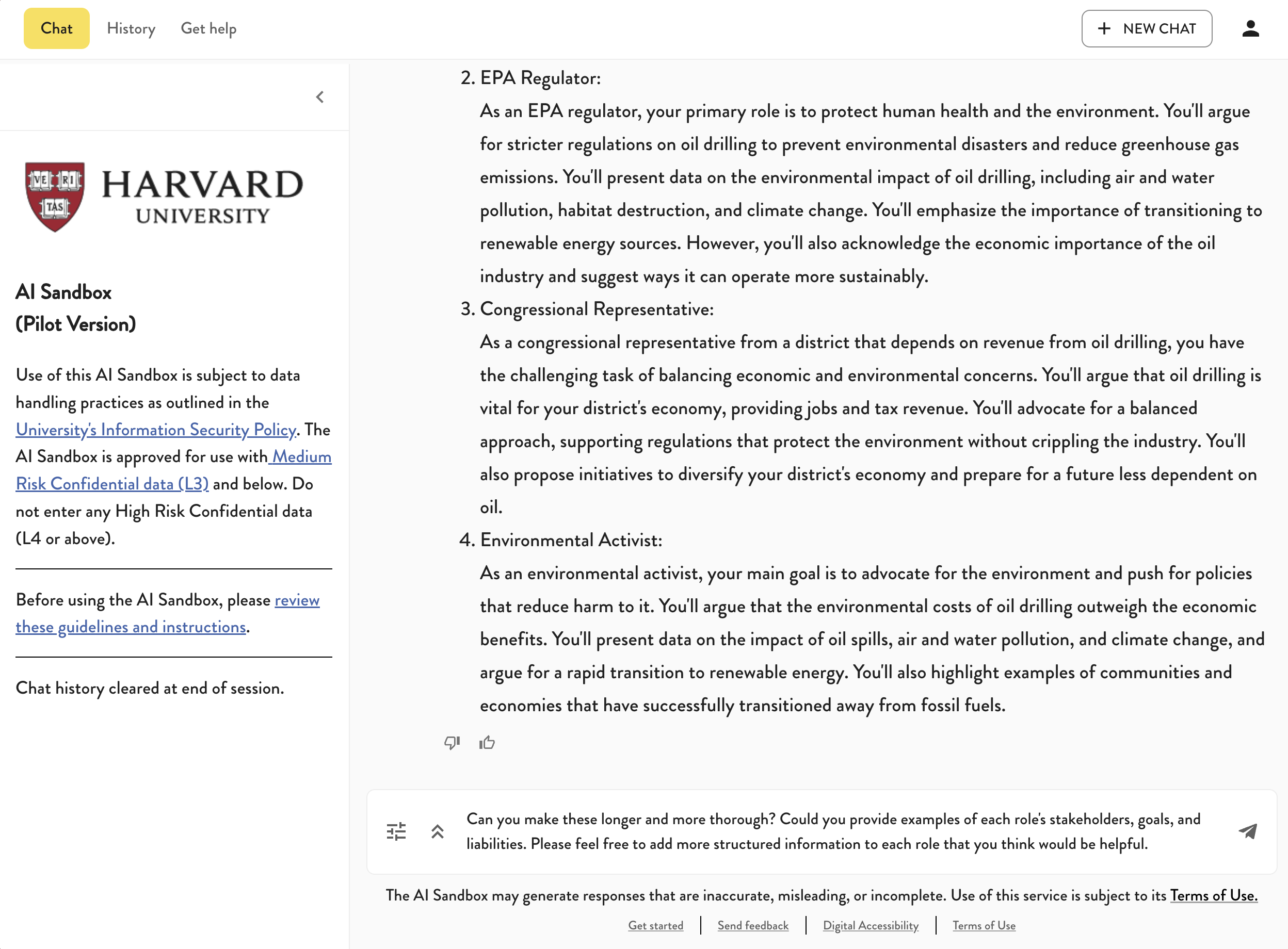
5. You can also prompt chatGPT for more information, structure, and clarity.
---
## TRANSCRIPT OF ACTIVITY EXAMPLE:
* USER:
* I’m preparing a case study activity for my course on environmental policy. Students will assume various roles and we will role-play a debate between an executive from an oil company, a regulator at the EPA, a congressional representative from a district that depends on revenue from oil drilling, and an environmental activist. Can you prepare a 300-word briefing for each of these roles?
* AI:
* Absolutely, here are the briefings for each role:
* Oil Company Executive:
* As an executive in an oil company, you are responsible for the smooth operation of the company, ensuring profitability, and maintaining a positive image. Your main argument will be that oil is a crucial resource, powering industries and homes, and providing countless jobs. You will argue that rigorous environmental regulations can stifle growth and lead to job losses. You'll emphasize the company's efforts to minimize environmental impact and invest in cleaner technologies. Also, you'll highlight the economic benefits of oil, including tax revenues and contributions to local economies.
* EPA Regulator:
* As an EPA regulator, your primary role is to protect human health and the environment. You'll argue for stricter regulations on oil drilling to prevent environmental disasters and reduce greenhouse gas emissions. You'll present data on the environmental impact of oil drilling, including air and water pollution, habitat destruction, and climate change. You'll emphasize the importance of transitioning to renewable energy sources. However, you'll also acknowledge the economic importance of the oil industry and suggest ways it can operate more sustainably.
* Congressional Representative:
* As a congressional representative from a district that depends on revenue from oil drilling, you have the challenging task of balancing economic and environmental concerns. You'll argue that oil drilling is vital for your district's economy, providing jobs and tax revenue. You'll advocate for a balanced approach, supporting regulations that protect the environment without crippling the industry. You'll also propose initiatives to diversify your district's economy and prepare for a future less dependent on oil.
* Environmental Activist:
* As an environmental activist, your main goal is to advocate for the environment and push for policies that reduce harm to it. You'll argue that the environmental costs of oil drilling outweigh the economic benefits. You'll present data on the impact of oil spills, air and water pollution, and climate change, and argue for a rapid transition to renewable energy. You'll also highlight examples of communities and economies that have successfully transitioned away from fossil fuels.
* USER:
* Can you make these longer and more thorough? Could you provide examples of each role's stakeholders, goals, and liabilities. Please feel free to add more structured information to each role that you think would be helpful.
* AI:
* Oil Company Executive:
* Stakeholders: Shareholders, employees, local communities, government regulators.
* Goals: Maximize profits, maintain a positive public image, comply with regulations, invest in sustainable technologies.
* Liabilities: Potential for environmental disasters, public backlash, fines for non-compliance with environmental regulations.
* Expanded Briefing: As an executive, your responsibility is not only to the shareholders but also to the employees and the communities where your company operates. You'll argue that your company provides essential energy, supports local economies, and invests in cleaner technologies. You'll need to present facts about the jobs created, taxes paid, and the economic impact of your company. However, you must also address the environmental impacts and how your company is taking steps to mitigate them.
* EPA Regulator:
* Stakeholders: General public, government, environmental organizations.
* Goals: Protect the environment and public health, enforce environmental laws, promote sustainable practices.
* Liabilities: Failing to prevent environmental damage, public criticism for perceived lax enforcement.
* Expanded Briefing: As an EPA regulator, your duty is to protect the environment and public health. You'll need to present scientific data on the environmental impacts of oil drilling and argue for stricter regulations. You'll also need to explain how these regulations can coexist with a thriving economy. You should also propose ways the oil industry can operate more sustainably and promote the transition to renewable energy.
* Congressional Representative:
* Stakeholders: Constituents, local businesses, government.
* Goals: Represent constituents' interests, promote economic growth, ensure environmental sustainability.
* Liabilities: Job losses, economic downturn, environmental degradation.
* Expanded Briefing: As a congressional representative, your role is to balance the economic needs of your constituents with the need to protect the environment. You'll need to present data on the economic benefits of oil drilling to your district while also acknowledging the environmental risks. You'll advocate for a balanced approach to regulation and propose initiatives to diversify the local economy and reduce dependence on oil.
* Environmental Activist:
* Stakeholders: General public, future generations, wildlife.
* Goals: Protect the environment, advocate for sustainable policies, raise public awareness.
* Liabilities: Being perceived as anti-job or anti-progress, failing to effect policy change.
* Expanded Briefing: As an environmental activist, your role is to highlight the environmental costs of oil drilling and advocate for a rapid transition to renewable energy. You'll need to present data on the impacts of oil spills, air and water pollution, and climate change. You'll also need to provide examples of communities that have successfully transitioned away from fossil fuels and argue that this can be done without sacrificing economic growth.
 Sign in with Wallet
Connect another wallet
Sign in with Wallet
Connect another wallet