---
tags: resources, course support, podcasting, ane197
---
# Bok Support for ANE197: Bible and Empire
Hello friends from Bible and Empire!
## Open Studio Office Hours!
Come to our Open Studios Office Hours, held in our [50 Church Street office](https://bokcenter.harvard.edu/contact-us), now running through the end of the term every:
* Monday through Thursday: 3-5pm
* Friday: 9am-5pm
(with the exception of days our office is closed – 11/11, 11/23, 11/24, and 11/25).
---
Here is the outline of our workshop with some resources, including quick access to those [media assets](https://drive.google.com/drive/folders/1RbQ47y4tiL7uFjKDpfM7UEVGLX7zFZT3?usp=sharing) we shared:
## WORKSHOP OUTLINE
We are excited to work with you on your podcasts! The Learning Lab folks around for the workshop in case you forget:
* Jordan, Assistant Director of the Learning Lab
* Christine, Assistant Director of the Learning Lab
* Luke, Learning Lab Media Coordinator
* Dan, Media Production Assistant
We are all here to help you on your podcasts over the course of the term.
To get us started supporting you, we have a few little activies that will give you a sense of how & why we might communicate our academic ideas through the medium of podcasts.
## The Elements of a Podcast
We'd love to start by taking some time to deconstruct just the first bit of a podcast, and unpack all the elements involved. We will do a close reading (or close listening!) of the first 30 seconds of a podcast called [Serial](https://serialpodcast.org/) and map out how the different audio elements work together temporally.
<iframe width="560" height="315" src="https://www.youtube.com/embed/nMSxiHuDa00?start=28" title="YouTube video player" frameborder="0" allow="accelerometer; autoplay; clipboard-write; encrypted-media; gyroscope; picture-in-picture" allowfullscreen></iframe>
#### The Prompt:
1. Just listen to the first 30 seconds of this podcast and reflect on what you are hearing, and what that evokes.
2. Listen again...
3. And again.
4. As you begin to identify the different elements, start mapping them out. How many elements can you hear? How do they interact/intersect? What functional roles are they playing to support the content?
---
## Communicating to General Audiences
Dejargonifying . . . turning systems into narratives. From statement to story.
### Ira Glass on Story
The anecdote and the moment of reflection.
<iframe width="560" height="315" src="https://www.youtube.com/embed/f6ezU57J8YI" title="YouTube video player" frameborder="0" allow="accelerometer; autoplay; clipboard-write; encrypted-media; gyroscope; picture-in-picture" allowfullscreen></iframe>
### Ken Burns on Story
(1 + 1 = 3)
<iframe src="https://player.vimeo.com/video/40972394?h=e6addfbf29&color=ffffff&title=0&byline=0&portrait=0" width="640" height="360" frameborder="0" allow="autoplay; fullscreen; picture-in-picture" allowfullscreen></iframe>
<p><a href="https://vimeo.com/40972394">Ken Burns: On Story</a> from <a href="https://vimeo.com/redglasspics">Redglass Pictures</a> on <a href="https://vimeo.com">Vimeo</a>.</p>
### Nancy Duarte on Story
What is and what could be.
<iframe width="560" height="315" src="https://www.youtube.com/embed/1nYFpuc2Umk" title="YouTube video player" frameborder="0" allow="accelerometer; autoplay; clipboard-write; encrypted-media; gyroscope; picture-in-picture" allowfullscreen></iframe>
---
### Prompt: Setting Up Your Act 1
Stories start with a mystery, a puzzle, or a problem. Today, your task is to figure out what that initial obstacle or puzzle is and articulate it.
The prompts for your podcast are all about connecting, and really the diffuculty of connecting (connecting past to present, connecting theory to source, etc.). Just like the Hollywood RomCom narrative, it's only interesting if connecting is difficult.
So let's take a look at some text (in audio format) that you've already encountered in this course that reviews Postcolonial Criticism: Charting the Aftermath.
Here you can find a Google Drive folder with the [media assets](https://drive.google.com/drive/folders/1RbQ47y4tiL7uFjKDpfM7UEVGLX7zFZT3?usp=sharing) we will use in this workshop.
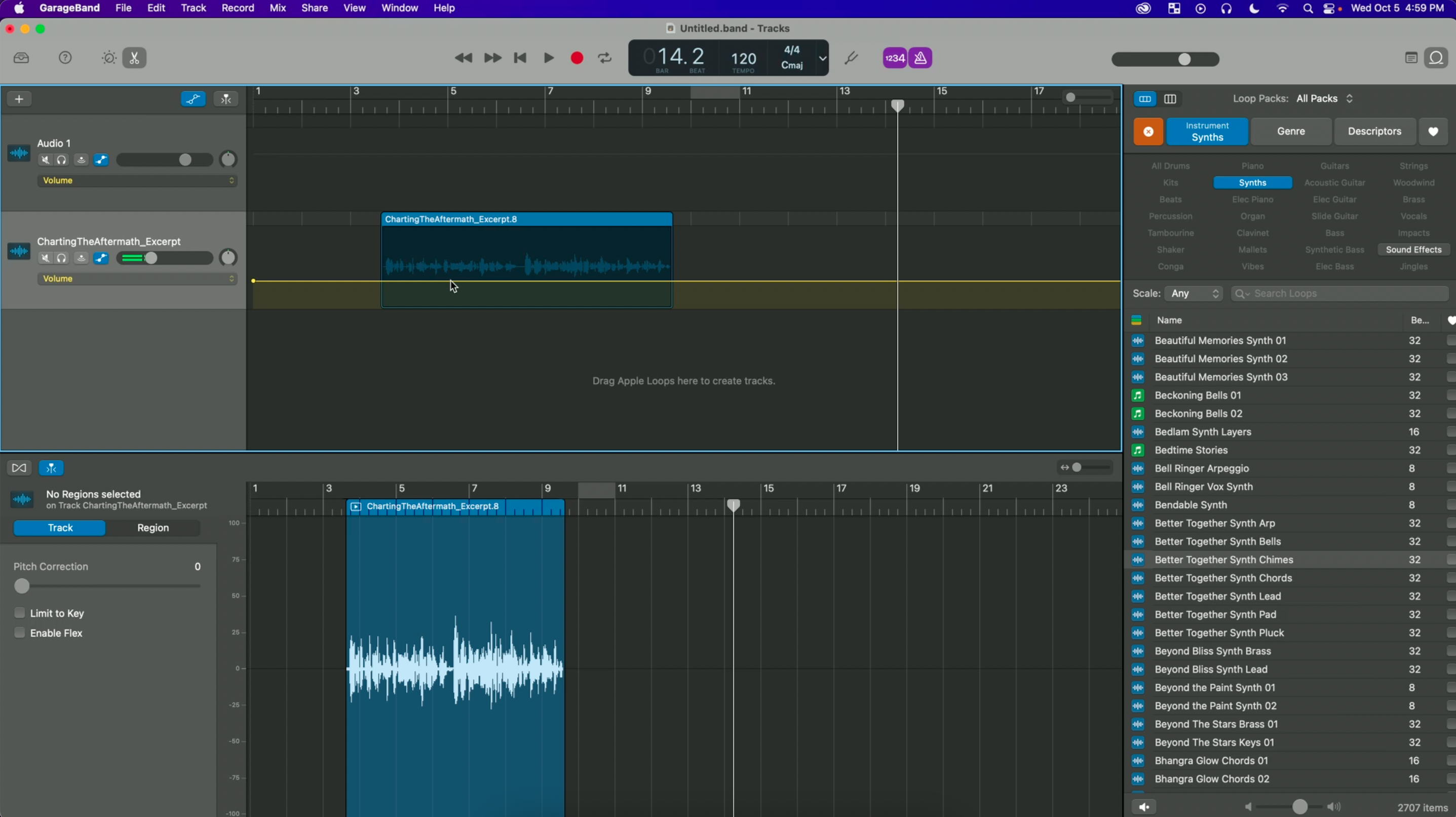
##### 1. Import "Field" Audio
Open up Garageband and import the audio file you would like to use to in your podcast. **You can also find your own excerpt from the reading to record and import.**
##### 2. Trim Audio
Now trim your imported audio down to just the shortened soundbite you want in your podcast.
##### 3. Add Voice Over Narration
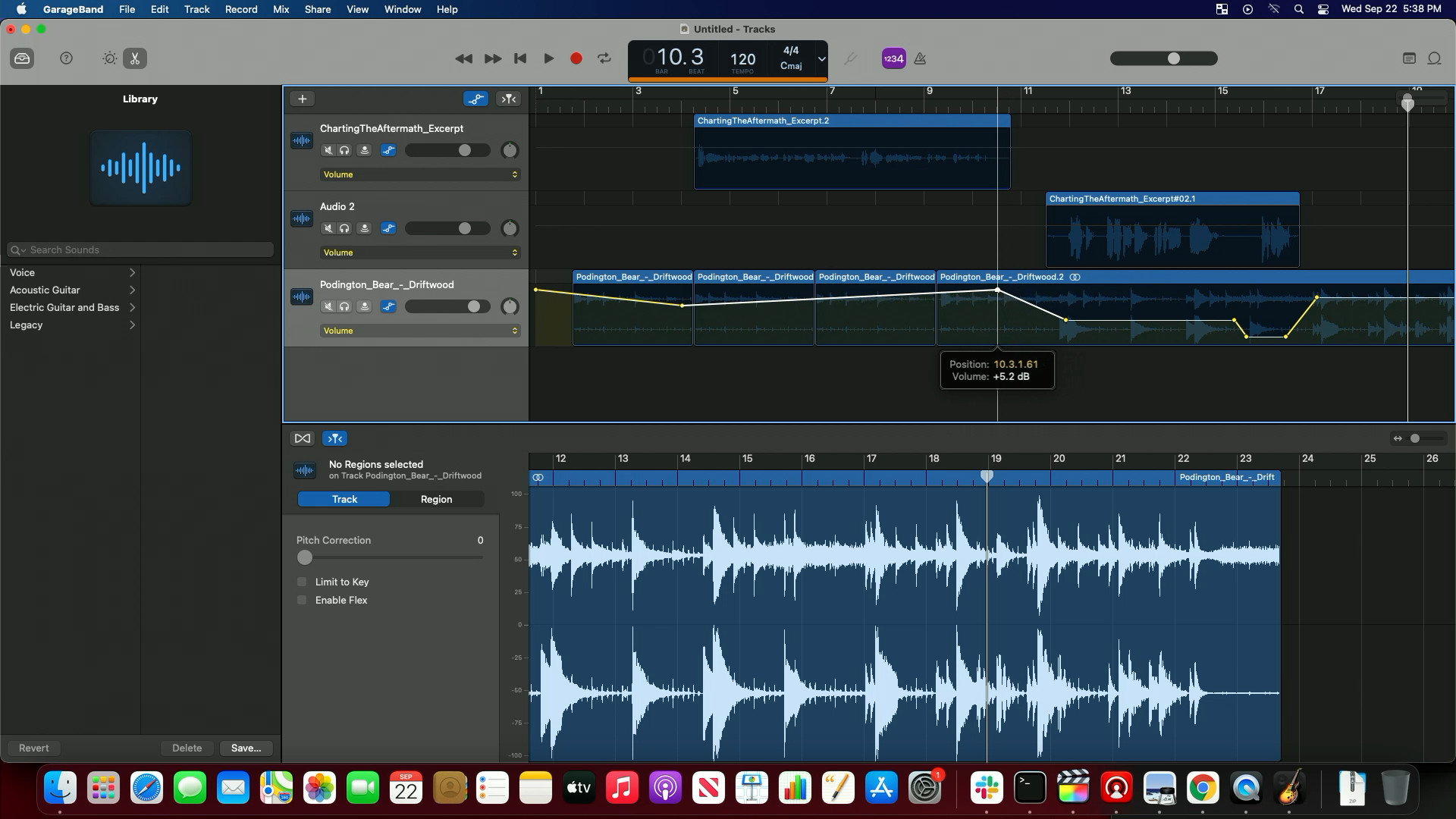
Import a recording from your phone that is crisp and clean or try recording directly into Garageband with one of the microphones hooked up to the computers. The narrative piece of this should really serve to unpack the soundbite for a general audience. Help us see the puzzle, explain what this theoretical text is saying, and explain the difficulty of connecting. ("It may seem weird that...")
##### 4. Add Music Bed
Choose a music bed that supports your content, your argument, and the tone you are aiming for.
Find a moment within your podcast to emphasize with music or a sound effect. Then work on organizing your audio elements and adjusting the levels (automation) so that they blend nicely.
Check out the music beds from the media asset folder or try one of these sites:
* [blue dot sessions](https://www.sessions.blue/)
* [bensound](https://www.bensound.com/)
* [free music archive](https://freemusicarchive.org/)
---
### some additional web-based resources for creating a podcast.
[Podcasting 101.](https://sites.google.com/g.harvard.edu/ll-podcasting)
[LinkedIn Audacity.](https://www.linkedin.com/learning/learning-audacity-2/jump-into-the-world-of-audio-editing?u=2194065)
[Bok Podcast Tips.](https://bokcenter.harvard.edu/podcasts)
 Sign in with Wallet
Connect another wallet
Sign in with Wallet
Connect another wallet