---
tags: jk, essentialsLab
---
# essentialsLab: studio as instrument
## to do asynchronously before the end of the work time week:
Read: [The Studio As Compositional Tool](http://music.hyperreal.org/artists/brian_eno/interviews/downbeat79.htm)
Watch: the first 4ish minutes of [Mike Andrews interviews Brian Eno for Riverside in 1983](https://www.youtube.com/watch?v=ZxDdZ3vRZwc)
Respond: How might this relate to the Learning Lab studio? What connections can you draw? Are you reminded of any other readings or media that you could share? Post a brief textual response along with any youtube video or other piece of media that comes to mind. There's not a wrong answer here, so feel free to follow your excitement.
Make:
## during section:
### welcome to essentialsLab!
#### Tools of the Studio
1. introduction to essentialsLab.
2. create our imaginary gened course. goal: decide on our capstone project or set of assignments.
3. next we will learn to practice the basics and hone our skills with 1) a set of low tech tools and 2) a set of high tech tools:
* Pen & Paper.
* how to use cards and brush pens to create legible and bold visual communciation artifacts. from notes to tiny artwork. pressure experiements with brush pens.
* Cameras and Lenses.
* what camera to grab. cards and batteries. format card. iso, f stop, exposure. determine appropriate lense to shoot with. switch lenses. rack focus. pan, dolly.
---
Responses:
---
### Henry
<iframe width="560" height="315" src="https://www.youtube.com/embed/emXYPRlVBas" title="YouTube video player" frameborder="0" allow="accelerometer; autoplay; clipboard-write; encrypted-media; gyroscope; picture-in-picture" allowfullscreen></iframe>
I really like the idea that all of the instruments, cables, and wires will never give you the idea you want to express- that has to come from inside. At the same time, Eno says that these instruments can change the way we think and go about creation. I think the ultimate goal of what we do in the learning lab when we learn a new piece of technology is not the learning of the technology, but getting to express ourselves in a novel way. For instance, when we learn blender, the ultimate takeaway is not the knowledge of blender, but the new methods of creativity we are teaching our brain. In line with that, here’s a song where a lot of thought and experimentation clearly went into the “technology” of the song (i.e. the percussion, and the recording of that percussion), but it still wasn’t the point of the song — it was all to serve a greater purpose of emotional expression.
### Emmy
I really liked the idea of the instrument being a means to an end in a way. In his interview, Eno suggests that the instrument is never going to give you the “answer” and that the answer is within you and I feel like oftentimes I’ve shared that sentiment. No matter how advanced our tools are, creating something will always come from an idea you have and theres nothing in the instrument or wires thats going to “save you” or come up with that idea for you. I think it’s useful to think of our creativity as the driving force for any project here and the tools available to us as what allow us to carry them out. I also found it interesting to think about what it means to record or document. Especially in the LL, we’re always documenting everything and I’d like to think about that more in the shoes of a producer. As the essay suggested, producers can take one of two roles: they can either record exactly what’s there as perfectly as they can or take apart what’s there to create something new from the “ashes”. Both are valid and useful ways of documenting and I really liked the idea of being intentional about which one of those two are my goal when I record anything.
---
### Anya
<iframe width="560" height="315" src="https://www.youtube.com/embed/HmAXRX4e-k8" title="YouTube video player" frameborder="0" allow="accelerometer; autoplay; clipboard-write; encrypted-media; gyroscope; picture-in-picture" allowfullscreen></iframe>
The first four minutes of this ENO video spoke to the Learning Lab’s desire to present typical information in a variety of ways. Similar to how the Learning Lab uses graphic design elements (Canva, InDesign, Photoshop) and visual essay formats (Adobe premiere, Final Cut) to present information which would typically be transcribed into a written essay or basic powerpoint presentation, ENO uses synthesizers and recorders to “use all instruments in an interesting way.” This also reminded me of the way the musician T-Pain approaches autotune in his work. In [this interview with Berklee School of Music](https://www.berklee.edu/news/berklee-now/t-pain-effect-about-much-more-auto-tune) and [this interview with Genius music](https://www.youtube.com/watch?v=HmAXRX4e-k8), T-Pain discusses how he began using autotune to stand out amongst the Tallahassee rap scene. While this later led to artists deeming him to be less talented (consider Usher telling him he ruined rap music…), his creative use of autotune distinguished him from a somewhat homogenous scene. The discourse around him leaves me wondering — what barriers do artists face as stylistic trailblazers within their field? Do certain artistic (or academic) fields lend themselves better to creative modes of presentation?
___
### Sienna
<iframe width="560" height="315" src="https://www.youtube.com/embed/rLobewuy8bo" title="YouTube video player" frameborder="0" allow="accelerometer; autoplay; clipboard-write; encrypted-media; gyroscope; picture-in-picture" allowfullscreen></iframe>
The article that we read discussed how recording is used as a means of preservation because many moments cannot be repeated. This struck me, especially when the writer described how recording brings something from the time dimension to the space dimension. This related to the Learning Lab’s collaboration with Harvard Dance Center. Though the dancers could perform the same choreography again, one would miss the time, effort, and attention that they invested in perfecting their movements. Recording the dancers’ dedication as well as their shortcomings makes the dance more meaningful. Additionally, this article reminded me about an online course I took with Nathaniel Drew. He is a digital nomad who creates content about intentionally documenting your life. He uses video recordings, audio recordings, journal entries, and photos to preserve the moments that he considers meaningful. Here is his video on remembering your life:
___
### Hannah
<iframe width="560" height="315" src="https://www.youtube.com/embed/KybAvaM3b90" title="YouTube video player" frameborder="0" allow="accelerometer; autoplay; clipboard-write; encrypted-media; gyroscope; picture-in-picture" allowfullscreen></iframe>
I thought what Eno said was pretty enlightening in terms of an instrument being a mode by which you create and feel. By learning an instrument, you are expanding the way in which you can create and express yourself. At the learning lab, I believe that is the goal: to learn creative ways to express yourself and to convey feeling through modes of art. Eno also says that he is not necessarily a fan of synthesizers because they don't allow you to adequately translate your feelings into the music. However, I feel like perhaps music technology is advanced and nuanced enough in the present day that synthesized and manufactured music can evoke lots of feeling and emotion. Much of music today may have some synthetic component, but I think that this can even make a piece "cooler" or put a whole new spin on a song. The use of technological means to create does not in itself mean hands off or unoriginal creation; it's just a different way to create. The learning lab has many technological modes of creativity tied into every aspect of it's work, but such is simply the trend of society.
___
## JK's REPORT:
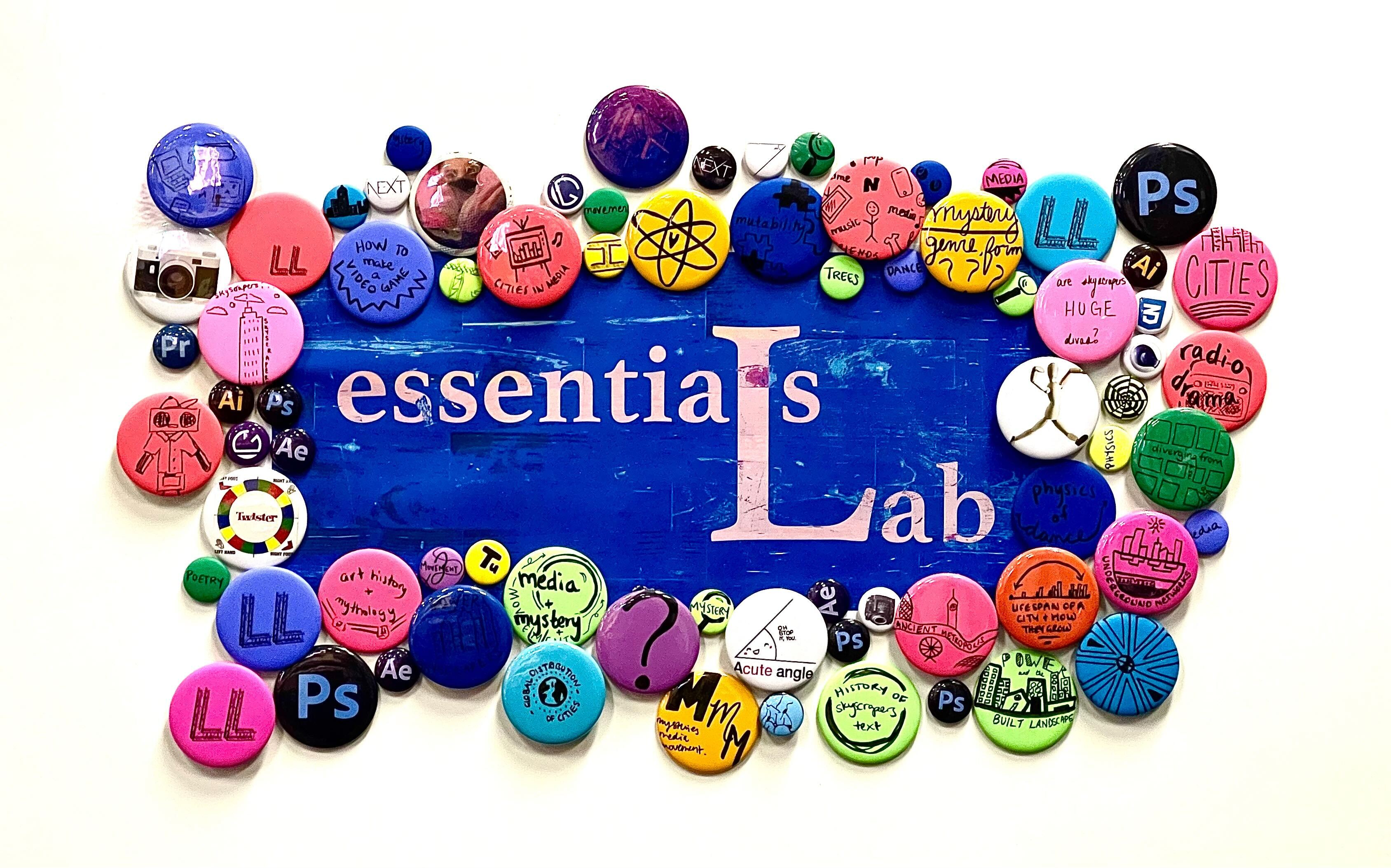
Each essentialsLab discussed and decided on the topic for their imaginary GENED courses. Introducing...
* Mystery, Media, and Movement
* Cities: Power and the Built Landscape
* Creating a Celebrity: Transmedia Construction
We honed our skills with the brush pens, moving our work with paper and pen from notetaking to producing little works of art. We experimented with various shapes and sizes, and how the constraints therein determine the extent to which one distills information to share. Kevin designed an assignment prompt around this idea: [Disks of Varying Size](https://bokcenter.slack.com/files/U94FZP2F8/F0337JSFP6E/disks_of_varying_size.pdf)
Mystery, Media, and Movement
This group was really interested in poetry as a potential topic, and Ammara shared this awesome [website about shifting poetry](https://verses-xyz.github.io/telescopic-poems/).
Ammara an Marcus created [a spin off doc for this week](https://hackmd.io/Z94OkGArRBGkXIfvXiDTeQ), inculding a ton of prompt ideas we might use for course workshops in the future!
For the Asynchronous essentialsLab missions for eventLab, we have some great reflections from our community around Eno's Studio As Instrument. Kevin also shared a link to [Eno’s Ambient 1: Music for Airports](https://www.youtube.com/watch?v=vNwYtllyt3Q), maybe to explore while folks read the text!
 Sign in with Wallet
Connect another wallet
Sign in with Wallet
Connect another wallet