# DEAR PRECEPTORS
We at [the Bok Center's Learning Lab](https://bokcenter.harvard.edu/learning-lab) wanted to put together a quick note on what we can do for you as we all return to campus this term.
If you haven't heard of us before, we work to help faculty from across the FAS who want to implement innovative assignments and activities in their undergraduate courses, frequently assignments modes of communication and creation that go beyond text alone. We support podcasting, filmmaking, oral presentations, AR/VR, 3D modeling, web development, infographics, dance, and much much more.
The basic process is that we
* meet with faculty to collaboratively design the assignments and appropriate support-stack
* test prototypes of the activities on our group of Learning Lab Undergraduate Fellows (LLUFs)
* host class meetings and workshops in our Learning Lab Studio during which students can learn the rhetorical and technical skills required for the assignment
* offer follow-up hackathons, office hours, and/or video-recording time as appropriate for students as they complete their projects
* host capstone events or web galleries to celebrate the students' work
Ironically, while the projects we support tend to include everything *but* academic writing, our approach to supporting our faculty and student clients is *entirely* grounded in the theories and practices of writing pedagogy, making the Harvard College Writing Program one of our closest partners and the Preceptors who teach Expos some of our most valued clients and collaborators.
If you ever decide to assign a multimodal capstone assignment, please get in touch and we can offer you all the support outlined above. But even if you aren't ready to go that far just yet, we've found that many of the oral and visual communication activities we run in our studio can serve as effective scaffolding" for academic essays too (we'll outline a few examples as an appendix to this note).
If you think you'd like to work with us, please get in touch by email Marlon (mkuzmick@g.harvard.edu) & the Learning Lab team (learninglab@fas.harvard.edu). If you want to see a little bit more of the space, just let us know when you'd like to drop by and we'll host you, or check out [our flickr page](https://www.flickr.com/photos/boklearninglab) for photos.
We hope to get a chance to work with you this year!
all the best,
the LL
<img src="https://live.staticflickr.com/4747/38590371560_fab0668c74_b.jpg" alt="20180105_001_StudioBuilding_Photos_Still_046.jpg">
## PS
To give you some concrete examples of the sort of work we can do for you, here are some descriptions of a few Expos projects we've worked on in the past.
### BEAT VISUALIZATION FOR AJ GOLD
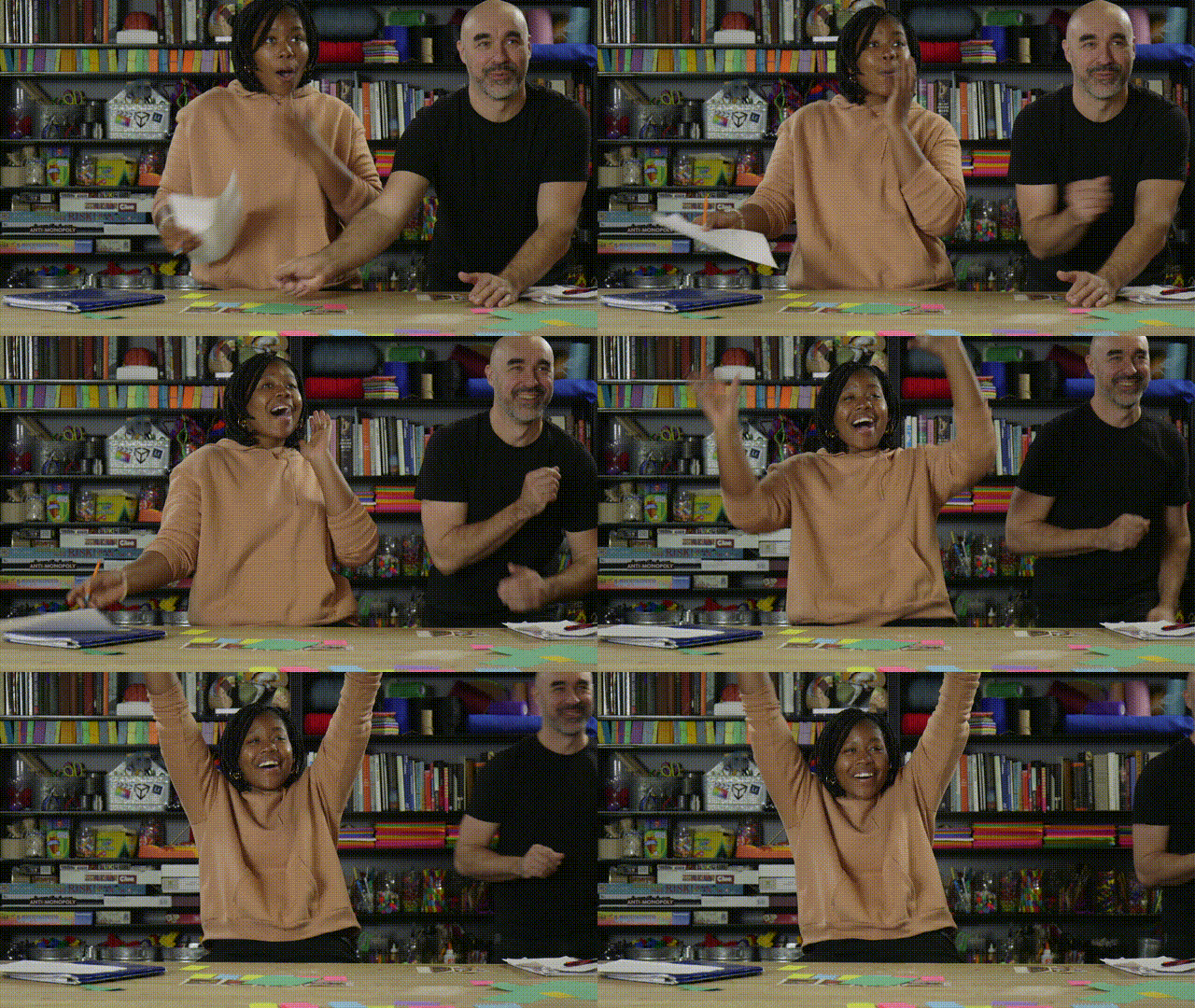
If you know AJ, you'll perhaps know that she uses the "BEAT" schema to help students understand the way sources function in academic work. If novice writers sometimes struggle with research papers, imagining the sources that populate an annotated bibliography or project proposal as a list of relatively equivalent elements (perhaps asking "how many do I need?" as if they are interchangeable widgets), the BEAT framework helps them understand that sources DO things for writers; they play specific functional roles in the development of an argument.
In our studio, AJ gets her students to map out their sources on our colored index cards. And they display them under our overhead camera while performing an impromptu oral "pitch" that explains their web of relationships.
By thinking spatially and visually (rather than holding on to the "shopping list" model of sources), students develop a deeper intuition of the roles sources play in the game of academic writing.
(It's also fun for students to get a chance to play around with our art supplies and cameras)
### PHOTO COMPARE AND CONTRAST
Sarah Case's students prepared for a paper analyzing Boston Common by collecting images to compare and contrast orally in our studio.The students sent the images to us, we printed them up, then the students annotated them and presented some initial ideas about how they would interpret this visual and spatial data in their papers.
<img src="https://live.staticflickr.com/7843/32500687547_d0641bb077_b.jpg" alt="20190311_003_Expos20_Case_Hyper1_001_00472514.jpg">
### FILM ANALYSIS ON 1000 PIECES OF PAPER
For Ramyar Roussokh’s course _Journey to Mars_, students visited during their first unit in which they analyze the film, The Martian. As many folks who’ve taught film know, it is often extremely difficult to get students to move beyond mere plot summary, to force them to analyze the images qualities of the piece rather than a relatively thin version of the story. So, for their visit we printed up two collections of stills from the first 4 minutes of the film. We offered both a computational sampling of the piece—one still every 2 seconds for the first 4 minutes—and a “cinematic” sampling, grabbing a single still from each and every one of the film’s first 200 shots, which is the number of discrete shots we encounter in the first 4 minutes of the film. When the students arrived, they found both sequences of stills lined up next to each other on the tables, tangibly introducing the complexity of film analysis. And in case you’re wondering, yes, even shrunk to an inch in height the stills ran the length of two big LL tables end-to-end. It was quite a sight! For their activity, the students selected stills to compare and contrast using a glossary of film terms we printed out on cards. In their implementation of the pitch genre, students used the images and terms to present insightful, multimodal analyses of the film’s opening scenes, which most certainly did analyze the images qua images rather than mere conveyors of plot points. The concrete materiality of the cut up images—even more than the digital display of clips on the computer—made the film an object or artifact in need of analysis rather than a story, and this had a powerful effect on the students’ work.
### ORAL REFLECTIONS TO CAMERA
For _Narratives of Immigration_, Margaret Rennix’s students first visited the Learning Lab for a session where they developed "elevator pitches" for their research as a way to expose them to the technology and format of their eventual capstone project. In late November, students returned to film their capstone projects in the Learning Lab’s small studio. Over the course of the day, all 29 students filmed multiple takes over 15-minute appointments. After filming was complete, Learning Lab media staff worked with each student to create edited videos for each student. During the capstone event on December 10, all 8 groups from both sections came to the Learning Lab. Their individual videos were loaded onto 8 laptops with headphones, and students took turns visiting each station, watching the videos, and talking with their peers about their projects.
<img src="https://live.staticflickr.com/7852/46522766112_31e18dd9e1_b.jpg" alt="20181210_003_Expos20Rennix_Capstone_Still_229.jpg">
### LANGUAGE, IDENTITY, POWER AND PODCASTS
For Jessie Schwab's course on Language, Identity and Power, we support the scaffolding of a podcast assignment. During our workshops, we teach students the basics of recording with microphones (both phone-based and more professional options) and the basics of editing in apps like GarageBand. But we also work with the students to see analogies between the moves they're learning to make in their academic writing and the moves they might make in podcasts. Just as you help them see that "signposting" might play a crucial functional role in academic writing, so too do we help them see how music beds and shifts in audio texture can add structure and meaning to their podcasts.
<img src="https://live.staticflickr.com/65535/48407299711_8f5e280bf3_b.jpg" alt="20190221_001_MCB64_PodcastingWorkshop_5Db_005_12191416.jpg">
 Sign in with Wallet
Connect another wallet
Sign in with Wallet
Connect another wallet