# 20211001 Myrzinn
## transcript
WEBVTT
1
00:00:02.639 --> 00:00:07.529
Danielle Duke: I was registered to three sessions, he ended up doing too, because no one showed up.
2
00:00:12.870 --> 00:00:29.130
Danielle Duke: And I did one micro teaching, which was absolutely fabulous it was really, really well there was three of us facilitators and three people registered, and that was online yet that was on zoom and then.
3
00:00:31.080 --> 00:00:35.280
Danielle Duke: And just people were very interested they haven't they had a lot of.
4
00:00:36.690 --> 00:00:45.750
Danielle Duke: Self reflection that was very, very interesting and then they were very open to feedback and because there was three of us giving the feedback.
5
00:00:46.980 --> 00:01:01.470
Danielle Duke: We had all very different perspective, and so one of us facilitators and I wasn't me was very focused on how like you organize your work, you know globally and how you know to break it down into.
6
00:01:02.670 --> 00:01:14.700
Danielle Duke: Like a similar will portions and that sort of thing I was more focused on like people being comfortable, because I think that's like an essential part of teaching I think everyone being.
7
00:01:15.240 --> 00:01:24.630
Danielle Duke: Relatively comfortable makes it assimilation, a lot better and and then we had a third person who was very focused on making sure everybody was following.
8
00:01:25.710 --> 00:01:33.270
Danielle Duke: And you know watching out for people who sometimes disengaged and that sort of thing, so all three of us will focus on very different things.
9
00:01:33.720 --> 00:01:49.320
Danielle Duke: And I thought that was very interesting because, at first, when I showed up into the zoom room, I thought oh three facilitators for three people that's maybe a little bit overkill but it's actually like it was useful and maybe you know, next time, if we have a lot of people who sign up.
10
00:01:50.670 --> 00:02:00.240
Danielle Duke: It might be interesting to have quite as many facilitators but we made it work for the better and I thought that was really cool and and then.
11
00:02:01.080 --> 00:02:12.840
Danielle Duke: Then I did the the back again session and which was on Friday think far as I can remember it's been a long time, and it was really interesting I was working with Wesley.
12
00:02:14.100 --> 00:02:17.670
Danielle Duke: And i'm a very anxious public speaker.
13
00:02:19.110 --> 00:02:28.290
Danielle Duke: And he just he chatted me up like right before we started he's like I know I had i've had crippling you know public speaking anxiety before so.
14
00:02:28.590 --> 00:02:41.730
Danielle Duke: If ever you feel uncomfortable acknowledge me and i'll take over and everything and he just made me so comfortable that I could just completely express, and that was I thought that was extremely kind of him, he didn't have to do it.
15
00:02:43.260 --> 00:02:52.680
Danielle Duke: Absolutely didn't have to do it and, but he did it anyway, and that was great and we had, I think we had something like around eight people show up.
16
00:02:53.520 --> 00:03:10.860
Danielle Duke: Which which I was surprised about I didn't expect quite as many people and and they have other words you choose who were starting to teach but had only attended online classes and they had to teach in person, so you could feel how terrified.
17
00:03:11.970 --> 00:03:12.840
Danielle Duke: Which is a bit.
18
00:03:13.920 --> 00:03:22.560
Danielle Duke: A bit nerve wracking for us as well, because we kind of have to answer all of these questions that they have and then answer the questions they have either that ask.
19
00:03:24.060 --> 00:03:26.580
Danielle Duke: So basically we started by just.
20
00:03:27.690 --> 00:03:29.280
Danielle Duke: Like getting them into groups and.
21
00:03:30.990 --> 00:03:37.410
Danielle Duke: asking them, you know you know what's your greatest fear what's your greatest excitement that sort of thing and getting started.
22
00:03:37.920 --> 00:03:47.280
Danielle Duke: Just by talking to each other in groups of three and then they got them started, and then we could get a real big discussion and.
23
00:03:47.700 --> 00:03:59.100
Danielle Duke: And it turns out, they had a lot of questions and and getting them started like right at the beginning was, I think, a good way of getting them to express a bit more than they would have otherwise and.
24
00:04:00.090 --> 00:04:12.840
Danielle Duke: And you know that you have questions like what happens if I get covert and what happens if all of my students get covert but I don't if there's being and is that going to be how you read.
25
00:04:13.260 --> 00:04:16.170
Danielle Duke: Is that not going to be a hybrid and what if.
26
00:04:16.710 --> 00:04:29.790
Danielle Duke: I have one of my student who has a close relative he's not vaccinated and very immunocompromised what happens, can I can I get anyway, and so we discussed all of those sorts of options, and they also had a lot of questions about like.
27
00:04:30.450 --> 00:04:45.030
Danielle Duke: Maybe a bit basic to us who taught for a while, but obviously if you don't know it, you don't know it, the sort of things where what if my student starts disengaging from class to income and what should I do, and so we started talking about how to reach out to the Dean and.
28
00:04:46.260 --> 00:04:56.970
Danielle Duke: We also talked about like what if they're responsible for the whole class or if they have someone you know, a supervisor who's responsible for the class how to deal with that situation and.
29
00:04:57.330 --> 00:05:05.250
Danielle Duke: Who, they should go to first before reaching out to a Dean, and that sort of thing, and so, like the sort of steps that you take before you do anything.
30
00:05:05.760 --> 00:05:15.690
Danielle Duke: And I thought, like they were taking like frantic nodes think that there was something that which is good and then questions lead to one to the other, which I thought.
31
00:05:16.170 --> 00:05:24.900
Danielle Duke: was very interesting because the more we answered the questions and more questions they have and we've sort of tells us that they had a lot of questions I didn't add up.
32
00:05:26.160 --> 00:05:34.770
Danielle Duke: So that that was really interesting, there was a lot of questions about mass breaks and you know this was a really basic stuff but that needs to be addressed.
33
00:05:35.250 --> 00:05:46.980
Danielle Duke: and drinking, what if you have diabetes as a teacher, what do you do, and so you know we just reminded them that he needs to take a break, take a break we're humans.
34
00:05:48.600 --> 00:05:55.320
Danielle Duke: As seems obvious, but sometimes you're a little bit nervous and you think Oh, what if I just like run out of the room in front of all my students.
35
00:05:56.460 --> 00:06:02.400
Danielle Duke: they're adults i'll be fine for two minutes you know, take a break your bodily functions are very important, so.
36
00:06:04.050 --> 00:06:10.950
Danielle Duke: yeah that's that's true if you need if you need to take a sugar like drink a bit like that's.
37
00:06:12.000 --> 00:06:25.170
Danielle Duke: Normal and important, and so I think for them hearing the sort of things that sound basic to us, but like being Richard about that was actually really reassuring and so yeah we had a really great discussion.
38
00:06:26.730 --> 00:06:34.830
Danielle Duke: And I was I had all of these questions before coming to the back against actual session and I had asked them around me a lot.
39
00:06:35.850 --> 00:06:46.890
Danielle Duke: Even sending tons of emails to tons of people being like what if this happens, what do we do I don't know okay next question, what if this happens, what do I do, and so I had like fired up emails.
40
00:06:47.340 --> 00:06:57.300
Danielle Duke: And so I had a lot of the answers that they were looking for and then Wesley was the suit of I have taught for seven years of my life I know so much about Harvard.
41
00:06:58.350 --> 00:07:07.890
Danielle Duke: And so we were kind of complimentary in that aspect is that I had all of the like stupid little questions that everyone has the, no one has to ask, because what if this happens, what the right there.
42
00:07:08.340 --> 00:07:15.810
Danielle Duke: And I had asked them myself these sorts of questions before, so I had the answers for them at least Harvard read the answers and then Wesley had the.
43
00:07:16.290 --> 00:07:27.210
Danielle Duke: Practical I know what sort of things tend to happen at Harvard kind of questions and he he could deal with them very well, and so we sort of you know, took over from time to time.
44
00:07:27.930 --> 00:07:38.010
Danielle Duke: And it worked really well yeah This is great so so it to me, there are a couple of themes emerging from what you've said so far that we might highlight if we were to turn this into a little.
45
00:07:38.520 --> 00:07:43.560
Danielle Duke: two paragraphs right up and i'm wondering if we could all think collectively about what that there's any way of connecting them, I think that.
46
00:07:44.010 --> 00:07:50.640
Danielle Duke: One of them has to do with these things Ts are worried about they're always worried, but, but this year is unusual right and.
47
00:07:51.510 --> 00:07:58.080
Danielle Duke: You might not know what the things you're worried about are kind of on a continuum within this Ts have always had to worry about.
48
00:07:58.680 --> 00:08:06.870
Danielle Duke: forever and it's just merely different in degree, this year, maybe not even different in degree and what what things are actually different in kind of because it is yeah.
49
00:08:07.200 --> 00:08:15.720
Danielle Duke: radically new things there's something happening in that space and then another thing you you highlighted in in both of these is just the role that on collaboration place.
50
00:08:16.110 --> 00:08:28.500
Danielle Duke: On for the pdfs in leading session was in the ways in which you have complementary skill sets or experiences that takes the pressure off of me or wanted you to be the sage on the stage and have every last one of the answers.
51
00:08:29.430 --> 00:08:39.870
Danielle Duke: And, and then also you have used multiple multiple perspectives that sometimes they're just greater than any one individual that could ever have you and if you're the perfect individual that can possibly.
52
00:08:40.620 --> 00:08:51.360
Danielle Duke: offer these three different perspectives, do you do it Would you mind just kind of like talking back through your feelings about those two fanatic things and then, if you on the way find a way that they're connected.
53
00:08:52.410 --> 00:09:01.650
Danielle Duke: They are, I mean Obviously we are different people as pdfs so we have different perspectives different skill sets and different experiences.
54
00:09:02.310 --> 00:09:09.990
Danielle Duke: My background is in language teaching and other people do philosophy and the teaching and philosophy is so different from language teaching.
55
00:09:10.290 --> 00:09:14.430
Danielle Duke: And it's still so different from teaching science or alarm or something like that so obviously have.
56
00:09:14.910 --> 00:09:20.940
Danielle Duke: Different facilitators will give you vastly different spaces and also because we're different people.
57
00:09:21.480 --> 00:09:28.950
Danielle Duke: We have different perceptions of things so, for example, like one of us is a former shy person, so they will be more attentive to.
58
00:09:29.730 --> 00:09:42.780
Danielle Duke: People who are shy to ask questions or what is the perspective of someone who is shy as a teacher and they will be able to give you, and that sort of experience and ways to overcome that that someone who is very outgoing will never even think about.
59
00:09:43.350 --> 00:09:53.760
Danielle Duke: And, and someone who has a lot of social anxiety will will give you a lot of good tips about overcoming them and and also empathy.
60
00:09:54.390 --> 00:10:00.990
Danielle Duke: Because you know, having empathy if you're a very nervous first on tf That is something that feels really good and.
61
00:10:01.650 --> 00:10:04.650
Danielle Duke: What it does like it sounds a bit stupid and very basic but it.
62
00:10:05.190 --> 00:10:14.760
Danielle Duke: Also seems me you're when you're collaborating you're more free to open up, and I think and feel that empathy because you're not stressed with filling all our time on your own.
63
00:10:15.270 --> 00:10:24.240
Danielle Duke: Just freaking out about having all the answers and wesley's talking, you have like some spare cognitive cycles, you can devote to you know checking in with people and feeling what they're feeling and I think that.
64
00:10:24.600 --> 00:10:31.260
Danielle Duke: The collaboration is kind of really connected to them, it is very connected to that, I mean it takes us as you were saying a little bit of the pressure.
65
00:10:31.620 --> 00:10:37.890
Danielle Duke: Because, because we know that the pressure is divided among two people who are usually quite.
66
00:10:38.820 --> 00:10:46.560
Danielle Duke: Who balance each other out quite well and so that, for example, if I have nothing to say about one particular aspect, because I have no experience I won't say anything.
67
00:10:46.860 --> 00:10:53.100
Danielle Duke: Unless there's a huge black and then i'll try to read it right, a little bit it's something I know we're in a not a question.
68
00:10:54.000 --> 00:11:02.220
Danielle Duke: But if I have nothing to say and Wesley has a great many things to say, like i'll let them work because he knows, and he has experience in that.
69
00:11:02.640 --> 00:11:16.590
Danielle Duke: And so I don't have the pressure of talking about something I don't know if he does like it's just so it's a it's also, I think, for the better, because if I want to try to come up with ways of you know what if.
70
00:11:17.100 --> 00:11:28.380
Danielle Duke: This happens in your lab and i've never been in a lab and I I might be tempted to bullshit my way through it, which is a terrible idea, and if someone.
71
00:11:29.880 --> 00:11:34.650
Danielle Duke: has been in the lab and knows, the answer is probably better for them to be doing that father.
72
00:11:36.060 --> 00:11:50.430
Danielle Duke: Imagine, even if you didn't do at least to be camaraderie people, not knowing exactly and we might fire a few ideas back and forth, and we might end up with something that is actually useful as opposed to well I don't know so I guess i'll just keep talking.
73
00:11:52.200 --> 00:11:56.910
Danielle Duke: When it probably sends them, the message that they don't need to like when they're teaching their students, be this crazy.
74
00:11:57.180 --> 00:12:07.230
Danielle Duke: master Hall, and not ever admit that you don't know exactly but that's also the point of collaboration is that it shows them that sometimes people know and sometimes they don't.
75
00:12:07.680 --> 00:12:13.980
Danielle Duke: And sometimes it shows them that the person who doesn't know usually lets the person who knows talk.
76
00:12:14.190 --> 00:12:23.250
Danielle Duke: And it shows them that, as he if they don't have to know everything and that sometimes the Professor who's a supervisor woman more and that's okay to be to give the conversation back and forth.
77
00:12:23.790 --> 00:12:28.710
Danielle Duke: That they don't always have to know everything and that they can collaborate with our fellows yes.
78
00:12:29.130 --> 00:12:36.060
Danielle Duke: How many things, and they have people that they can have people coming into their sections and you're helping out and giving different perspectives and.
79
00:12:36.750 --> 00:12:42.060
Danielle Duke: I think that collaboration in general, when we go back and forth it tells them that it's not just one authority.
80
00:12:42.780 --> 00:12:48.900
Danielle Duke: that many people can have many, many different competencies and that it doesn't always have to be one reference.
81
00:12:49.290 --> 00:12:56.760
Danielle Duke: And I like this idea of of always having one to like two to seven people you know leading one thing is that.
82
00:12:57.600 --> 00:13:05.400
Danielle Duke: You don't have you don't there's not this one top of the pyramid person who is a reference, those are bad, they know everything and.
83
00:13:05.970 --> 00:13:12.690
Danielle Duke: You want to be that person, one day, there are many different people who come from many different backgrounds and excellence can take many shapes.
84
00:13:13.020 --> 00:13:20.490
Danielle Duke: And I like this idea of how collaboration can show to Yes, they don't they don't have to know everything else they don't have to know everything at all.
85
00:13:22.350 --> 00:13:24.090
Danielle Duke: That actually can be the difference.
86
00:13:25.140 --> 00:13:32.850
Danielle Duke: yeah what sort of taught me I guess is that all the things that collaboration i'm heels or fixes or solves.
87
00:13:33.210 --> 00:13:42.000
Danielle Duke: or a set of problems that are especially intense this year, like the lack of complete information, the lack of expertise, because so many problems we're facing this year are newly emerging.
88
00:13:42.240 --> 00:13:47.190
Danielle Duke: And then, a whole host of like emotional and psychological issues just saying anxiety.
89
00:13:47.640 --> 00:13:59.640
Danielle Duke: or fear or isolation, it seems this year is an intensification of all those things which would make sense, then, that things like collaboration and the PF program in general will be especially valuable this year is what the paragraph paragraph.
90
00:14:01.410 --> 00:14:06.810
Danielle Duke: And I guess what i'm asking, not to turn you into like accidental radical but there's like sort of learn why this question.
91
00:14:07.230 --> 00:14:18.330
Danielle Duke: A lot of what you said, seems to have is its logical consequence that there should be far more collaborative teaching across the curriculum that currently is so you were to dream big.
92
00:14:19.110 --> 00:14:24.060
Danielle Duke: What How would things have to change, we just need to hire twice as many Ts are there ways in which they.
93
00:14:25.680 --> 00:14:33.630
Danielle Duke: At least, at times, and what are some of your ideas for because, clearly, it sounds like you are a believer in collaborative teaching, but that doesn't happen everywhere right now.
94
00:14:34.320 --> 00:14:42.870
Danielle Duke: And no it doesn't it doesn't really, and I mean when you have you know when you have sections that are filled up to the brim with 23 students and collaboration would be really useful.
95
00:14:43.530 --> 00:14:48.810
Danielle Duke: and collaboration in general, would be really useful, even if you have a session with five people.
96
00:14:49.080 --> 00:14:57.630
Danielle Duke: And in my son overkill to have two people intervening in one section, with five people but we've seen that three facilitators for three people is actually very useful.
97
00:14:58.140 --> 00:15:05.520
Danielle Duke: And and and because we get like every time you add someone you get a different perspective so every time you add someone you get something new.
98
00:15:06.180 --> 00:15:15.930
Danielle Duke: it's not just you know sacking what chocolate is always not always better, but like stacking more people and more different perspectives it's bring something new every single time.
99
00:15:16.620 --> 00:15:24.120
Danielle Duke: So I do, I do think that collaboration would be so good for improving the teaching and they would probably mean you know.
100
00:15:26.730 --> 00:15:28.020
Danielle Duke: which would not be a bad thing.
101
00:15:29.550 --> 00:15:31.050
Danielle Duke: And, but yeah.
102
00:15:32.640 --> 00:15:41.130
Danielle Duke: I, to be honest, I don't I don't know if having smaller sections wouldn't necessarily be better than having.
103
00:15:41.550 --> 00:15:49.890
Danielle Duke: More people handling the section that seems to be a consequence of some of what you're saying like if you had to make the call between right to seven person sections and having a.
104
00:15:50.310 --> 00:15:59.910
Danielle Duke: 14 person section with this initiative yeah I don't know I don't know which one would be best to be honest, one other question I guess, I was there, there are always already the people like.
105
00:16:00.150 --> 00:16:02.820
Danielle Duke: You know, it takes a village to teach a class and it's already kind of happening.
106
00:16:03.330 --> 00:16:12.510
Danielle Duke: Right now they're kind of atomized but, like you said, the Professor is kind of an invisible presence and section, but maybe there's a way of bringing that in, and then there are the students, there are there any ways in which.
107
00:16:13.020 --> 00:16:24.990
Danielle Duke: Involvement of students could get it, some of the things that collaboration was doing for you, that the Ts might not think of yeah yeah official involving the students is always is always the best and.
108
00:16:25.560 --> 00:16:36.300
Danielle Duke: But they might not feel that you know there's always there's always this authority that's always there and everyone feels it, but you can't put your words to it there's always a you know.
109
00:16:36.570 --> 00:16:44.550
Danielle Duke: shadowy presence of the professor and there's always this this know, but there is like it's not it's not necessarily a bad thing, my professors usually really, really nice.
110
00:16:46.020 --> 00:16:49.380
Danielle Duke: But they're always there and there are the top of the line.
111
00:16:49.980 --> 00:17:01.860
Danielle Duke: The pyramid the top of the pyramids kind of person in that situation and you're you're The next step and students might not necessarily feel that is that place to share some things about learning.
112
00:17:02.340 --> 00:17:04.290
Danielle Duke: In section because you're the tf.
113
00:17:04.950 --> 00:17:09.930
Danielle Duke: And, whereas another tf might feel more comfortable, because there are a fellow to if you're on equal footing.
114
00:17:10.140 --> 00:17:23.610
Danielle Duke: Whereas in class that are saying is that students will refrain from saying, because they feel that it's not their place as a student or we would be taking over your authority which is very sad because if they would share that would be fabulous.
115
00:17:24.930 --> 00:17:29.550
Danielle Duke: But there is, you know, there is that distance which.
116
00:17:30.690 --> 00:17:43.620
Danielle Duke: Which is very helpful as not that helpful and this is where you would wanted, we would want them to share as much of their experience as possible, because they also bring another perspective yeah and that would be fabulous but.
117
00:17:44.040 --> 00:17:53.670
Danielle Duke: There is that distance of authority which might hinder some of them so yeah yeah Well, this is awesome okay Well, this is good, I mean we don't want to give Danny too much text to deal with any.
118
00:17:54.240 --> 00:18:06.600
Danielle Duke: zooming yes Ben cool, so we can see how zoom works out of my record only after your first answer but that's that's fine I can do what you said there the, but this is a amazing I think Thank you so much.
119
00:18:07.860 --> 00:18:10.380
Danielle Duke: for being willing to do this, so what we'll do is we'll write it up.
120
00:18:11.130 --> 00:18:17.310
Danielle Duke: And then we'll try to experiment, a couple of different ways, I think we try one like the classic academic interview style right up or like.
121
00:18:17.790 --> 00:18:23.850
Danielle Duke: There is characters asking questions, but, as you know, if you've ever read one of those things there's a lot of editing that happens after the fact.
122
00:18:24.210 --> 00:18:31.620
Danielle Duke: yeah it wouldn't be literally the words that we said yeah I haven't had an idealized version yeah conversation, or we might just write it up as a new story, where we quote you.
123
00:18:32.040 --> 00:18:36.240
Danielle Duke: But then summarize it and I think we might want to get feedback from pamela what she would really like to have.
124
00:18:36.330 --> 00:18:44.970
Danielle Duke: Yes, so we'll just kind of see but would be your approval before anything would go on the Internet okay yeah no I don't think i've ever done an academic interview before but i've done radio so.
125
00:18:48.750 --> 00:18:50.670
Danielle Duke: All right, well, thank you.
## collecting paragraphs from transcript
Marlon (summarizing): One of them has to do with these things TFs are worried about, they're always worried things, but this year is unusual right and. You might not know what the things, you're worried about are kind of on a continuum within the things TFs have always had to worry about forever and it's just merely different in degree, this year, and maybe not even different in degree. And what what things are actually different in kind, because Covid is introducing radically new things. There's something happening in that space and then another thing you you highlighted in both of these is just the role that collaboration plays for the PFs in leading sessions and the ways in which you have complementary skill sets or experiences that takes the pressure off of one of you to be the sage on the stage and have every last one of the answers.And, and then also you have used multiple perspectives that sometimes are just greater than any one individual could ever have, even if you're the perfect individual that can possibly offer these three different perspectives.
---
Marlon: Also seems to me you're when you're collaborating you're more free to open up, and I think and feel that empathy because you're not stressed with filling all hour of time on your own, just freaking out about having all the answers. And when Wesley's talking, you have like some spare cognitive cycles, you can devote to you know checking in with people and feeling what they're feeling and I think that the collaboration is kind of really connected to that.
Imagine, even if both of you didn't know, at least there'd be camaraderie about people not knowing.
Myrzinn: And we might fire a few ideas back and forth, and we might end up with something that is actually useful as opposed to, well I don't know so I guess i'll just keep talking
I think that collaboration in general, when we go back and forth it tells them that it's not just one authority. That many people can have many, many different competencies and that it doesn't always have to be one reference. there are many different people who come from many different backgrounds and excellence can take many shapes. And I like this idea of how collaboration can show to TFs, that they don't have to know everything right now, they don't have to know everything at all, they don't have to know everything at all, that excellence can be different.
Marlon: What you've sort of taught me I guess is that all the things that collaboration heals or fixes or solves are a set of problems that are especially intense this year, like the lack of complete information, the lack of expertise, because so many problems we're facing this year are newly emerging. And then, a whole host of like emotional and psychological issues, just saying anxiety or fear or isolation. It seems this year is an intensification of all those things, which would make sense, then, that things like collaboration and the PF program in general, will be especially valuable this year.
Just freaking out about having all the answers and wesley’s talking, you have like some spare cognitive cycles, you can devote to you know checking in with people and feeling what they’re feeling and I think that.
he collaboration is kind of really connected to them, it is very connected to that, I mean it takes us as you were saying a little bit of the pressure.
Because, because we know that the pressure is divided among two people who are usually quite, who balance each other out quite well and so that.
## draft space
### Draft Story Title-- Fall 2021: Back Again
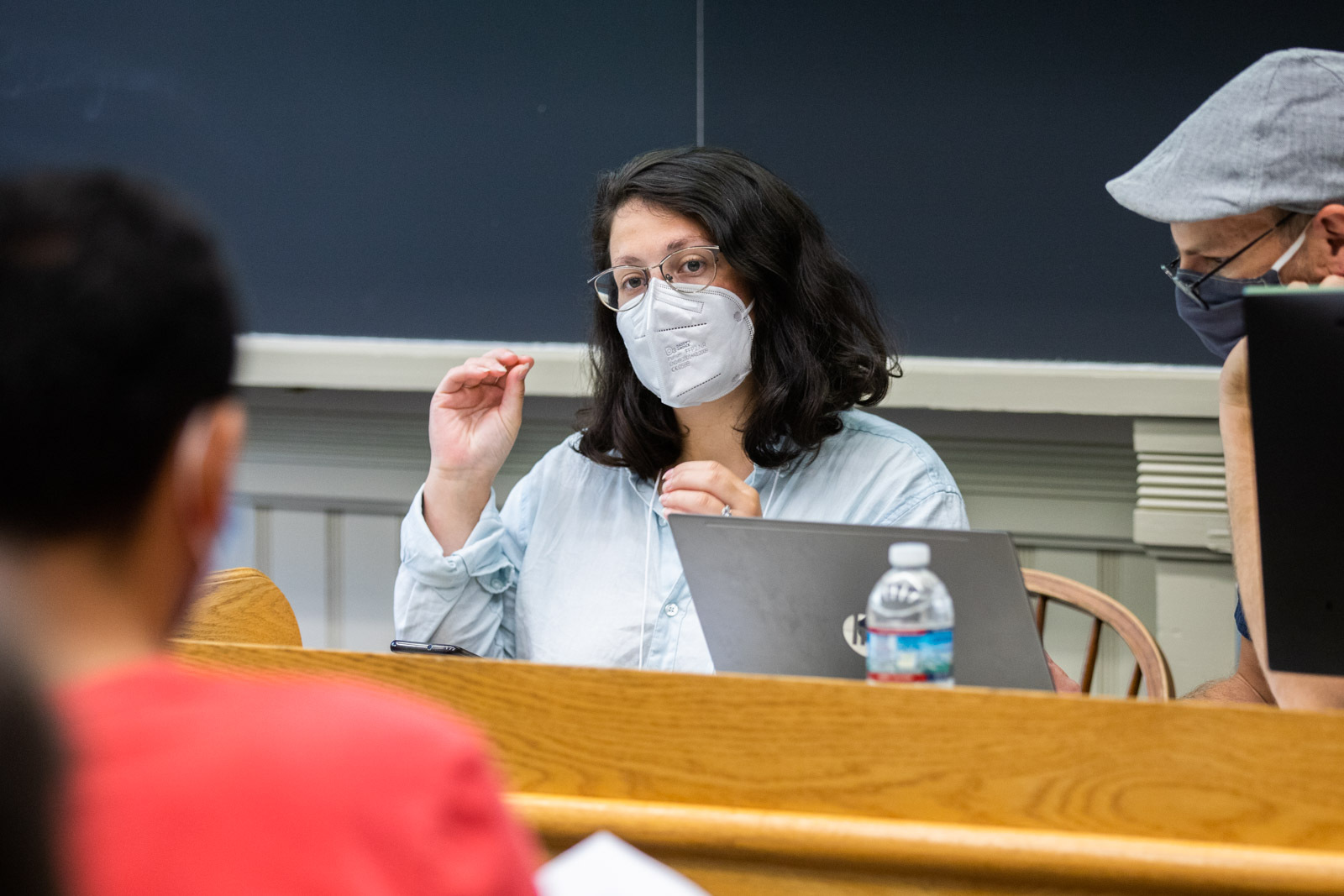
As part of the Bok Center's annual Fall Teaching Conference, newly designed “Back Again” sessions allowed TFs to explore resources and ideas as we all re-adjust to in-person teaching. These sessions were led by the Bok Center's Pedagogy Fellows, our cohort of 31 graduate student teachers from departments across GSAS.
TFs joined together to discuss their excitement and their worries on a continuum - discussing quintessential things that TFs have always had to worry about, in addition to some radically different concerns brought on by challenges associated with Covid.
The collaborative facilitation by PFs with complementary skillsets and experiences helped take some of the pressure off of Myrzinn Boucher-Durand, Pedagogy Fellow in Celtic Languages and Literatures to be the sage on the stage and have every last one of the answers. While co-facillitatingg with Wesley Simon, Pedagogy Fellow in Art, Film, and Visual Studie, Boucher-Durand had more space to open up and tune in with what TFs were feeling, because when collaborating one does not need to stress with filling all hour of time on their own, worrying about having all the answers. And when things come up that both facilitators don't know, there is at least camaraderie about not knowing.
Boucher-Durand reflected on the meta meaning of the way the sessions were structured, "I think that collaboration in general, when we go back and forth it tells [TFs] that it's not just one authority. That many people can have many, many different competencies and that it doesn't always have to be one reference. There are many different people who come from many different backgrounds and excellence can take many shapes."
All of the things that collaboration heals or fixes or solves are a set of problems that are especially intense this year - such as the lack of complete information, the lack of expertise, because so many problems we're facing this year are newly emerging. And then there's of course a whole host of like emotional and psychological issues, such as anxiety or fear or isolation. It seems this year is an intensification of all those things, so it makes sense, then, that things like collaboration and the PF program already feel especially valuable this year.
"I like this idea of how collaboration can show TFs that they don't have to know everything right now, they don't have to know everything at all."
 Sign in with Wallet
Connect another wallet
Sign in with Wallet
Connect another wallet