---
link: https://leetcode.com/problems/lowest-common-ancestor-of-a-binary-search-tree/
tags: tree, bst, easy
---
# 235. Lowest Common Ancestor of a Binary Search Tree
## Question
Given a binary search tree (BST), find the lowest common ancestor (LCA) of two given nodes in the BST.
According to the [definition of LCA on Wikipedia](https://en.wikipedia.org/wiki/Lowest_common_ancestor): “The lowest common ancestor is defined between two nodes p and q as the lowest node in T that has both p and q as descendants (where we allow **a node to be a descendant of itself**).”
Given binary search tree: root = [6,2,8,0,4,7,9,null,null,3,5]
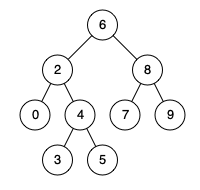
**Example 1:**
```
Input: root = [6,2,8,0,4,7,9,null,null,3,5], p = 2, q = 8
Output: 6
Explanation: The LCA of nodes 2 and 8 is 6.
```
**Example 2:**
```
Input: root = [6,2,8,0,4,7,9,null,null,3,5], p = 2, q = 4
Output: 2
Explanation: The LCA of nodes 2 and 4 is 2, since a node can be a descendant of itself according to the LCA definition.
```
**Note:**
- All of the nodes' values will be unique.
- p and q are different and both values will exist in the BST.
## Solution: Python
```python=
# Definition for a binary tree node.
# class TreeNode(object):
# def __init__(self, x):
# self.val = x
# self.left = None
# self.right = None
class Solution(object):
def lowestCommonAncestor(self, root, p, q):
"""
:type root: TreeNode
:type p: TreeNode
:type q: TreeNode
:rtype: TreeNode
"""
self.lca = None
self.helper(root, p, q)
return self.lca
def helper(self, node, p, q):
if node is None:
return
if p.val < node.val and q.val < node.val:
self.helper(node.left, p, q)
elif p.val > node.val and q.val > node.val:
self.helper(node.right, p, q)
else:
self.lca = node
def helper_p_q_may_not_exist(self, node, p, q):
if node is None:
return False, False
l_found_p, l_found_q = (
self.helper(node.left, p, q)
if (p.val < node.val or q.val < node.val) else
(False, False)
)
r_found_p, r_found_q = (
self.helper(node.right, p, q)
if (p.val > node.val or q.val > node.val) else
(False, False)
)
n_found_p, n_found_q = node == p, node == q
found_p = (l_found_p or r_found_p or n_found_p)
found_q = (l_found_q or r_found_q or n_found_q)
if found_p and found_q:
self.lca = node
return False, False
return found_p, found_q
```
## Solution: Java
```java=
```
 Sign in with Wallet
Connect another wallet
Sign in with Wallet
Connect another wallet