# The Truth About Buying G2 Reviews for SaaS Companies
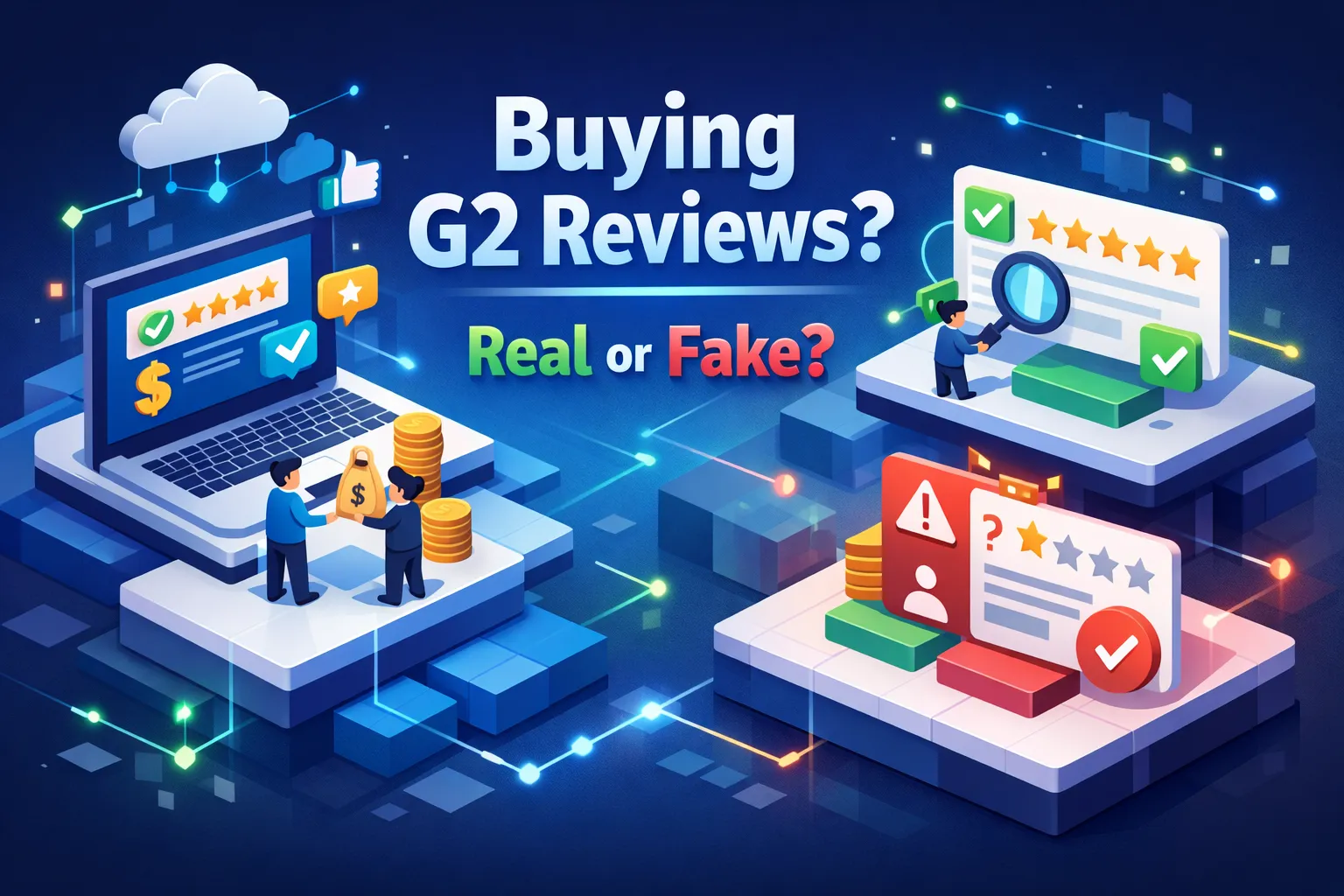
Many SaaS companies face a version of the same problem: a G2 profile sitting in single-digit reviews, a direct competitor in the same category at 60+, and a quarterly report window approaching. The gap feels impossible to close through organic outreach alone, which is why teams often look for shortcuts before report deadlines hit. The phrase "buy G2 reviews" covers a surprisingly wide spectrum, though. At one end sits G2's own sanctioned incentive program. At the other end are third-party vendors operating completely outside platform rules, collecting payment and leaving your profile exposed to enforcement action. Most coverage treats both ends of that spectrum the same way, and that conflation is where the real damage starts.
The goal here is to separate what G2 actually permits from what gets profiles flagged, suspended, or banned permanently. Understanding that distinction is the difference between a review strategy that compounds over time and one that wipes out everything you've built. Compliant G2 reputation management campaigns — built on paced, platform-aligned delivery — are already helping SaaS companies close the review gap without the enforcement risk. Services like [OrderBoosts](https://orderboosts.com/g2-reviews) exist precisely for this: structured G2 review growth that doesn't put your listing at risk. But first, you need to understand what you're navigating.
---
## Why the Race for G2 Reviews Puts SaaS Companies Under So Much Pressure
G2 review counts don't just signal credibility to buyers. They directly determine where a product appears inside category Grid reports, which B2B buyers use to build vendor consideration lists before they ever reach a sales team. A product at 8 reviews against a competitor at 60 doesn't just look weaker in a side-by-side comparison. It ranks lower, gets filtered out of segment-specific reports, and may not appear at all when buyers use G2's category filters to narrow their shortlist. That's not a perception problem. It's a structural exclusion from the buying cycle before contact is even made.
The pressure compounds because G2 weights review recency using exponential decay — roughly 3% per month. A strong cluster of reviews from 18 months ago carries significantly less scoring weight than a consistent recent stream. This means a company can have a respectable aggregate rating and still slip in Grid placement because no new reviews came in over the past two quarters. The problem isn't the old reviews. It's the absence of new ones.
This is exactly the gap that a managed campaign from [OrderBoosts](https://orderboosts.com/g2-reviews) is designed to fill — steady, ongoing review volume that keeps your recency score from eroding between internal outreach sprints.
### How G2 Shortlists and Category Reports Work
G2's Grid placement uses a composite score combining Market Satisfaction and Market Presence, with both components normalized relative to other products in the same category. Market Presence incorporates review volume, recency, web presence, employee count, and growth signals. A product needs at least 10 approved reviews for live Grid category pages to include it, and quarterly Grid reports require categories to have six or more products each meeting that 10-review threshold. Fall below it, and you're not just ranked lower. You're simply not in the report.
### The Recency Problem That Makes Urgent Shortcuts Tempting
For companies sitting at 5 or 6 reviews, the gap to shortlist eligibility feels close but stays frustratingly out of reach. That's the pressure point where urgency overrides judgment and where the search for paid G2 review services typically begins.
Review age degrades faster than most SaaS marketers realize. A company that ran a successful review push in 2022 and then paused outreach may have watched its Grid position erode steadily since then, even without any negative reviews arriving. The scoring model rewards ongoing activity, not past effort. This creates a recurring pressure cycle that peaks around G2's quarterly report windows, when teams suddenly need recent reviews fast and internal customer outreach pipelines can't fill the gap in time.
---
## What G2's Review Policy Actually Allows (and Where It Draws the Line)
The assumption that any form of incentivized G2 review is prohibited is simply wrong. G2 explicitly permits incentivized reviews and runs its own structured program to facilitate them. Understanding what's sanctioned versus what's banned determines whether your review strategy builds long-term profile credibility or puts the entire listing at risk. For a concise summary of the platform rules, see [G2's community guidelines](https://legal.g2.com/community-guidelines).
### What G2's Official Incentive Program Actually Looks Like
G2's own program offers reviewers $10 gift cards to Amazon or Starbucks for each review that passes moderation. Companies can set up self-service review campaigns directly inside the G2 platform with customizable incentive amounts. Billing is tied to approved reviews only: if a submission fails moderation or stays pending, no charge applies. Every reviewer must verify their identity through LinkedIn authentication or a verified business email address, and all incentivized reviews are publicly labeled as such within the platform. The framework is transparent by design, which is what makes it compliant.
Managed services like [OrderBoosts](https://orderboosts.com/g2-reviews) operate within the same compliance framework — working with verified users and pacing delivery to align with what the platform expects from organic growth patterns.
### The Practices G2 Explicitly Bans
G2's community guidelines draw clear hard lines that go well beyond "don't buy fake reviews." Conditioning incentives on positive-only submissions is prohibited. So is any practice that filters out potentially negative reviewers before the request goes out. Running undisclosed third-party review exchanges, using unverified or fabricated profiles, and suppressing negative feedback all fall into the same enforcement category. These are defined violations that can trigger enforcement actions — not gray areas where the platform issues courtesy warnings first.
---
## The Enforcement Risk Most G2 Review Vendors Won't Mention
Third-party vendors selling G2 reviews outside the platform's sanctioned framework rarely explain what happens when G2's moderation system catches the activity. The answer is: a lot. G2 moderates every review submission manually using over 43 data points, including AI content detection, LinkedIn authentication, plagiarism checks, behavioral analysis, and conflict-of-interest screening. A single wave of inauthentic reviews doesn't just get removed — it can trigger a pattern investigation that leads to broader account-level enforcement across the product's entire review history.
This is why the vendor you choose matters as much as the decision to run a campaign at all. OrderBoosts structures delivery specifically to avoid the bulk submission patterns that trigger G2's detection — a meaningful operational difference from vendors who batch and dump.
### What G2 Actually Does When It Catches Fraudulent Review Activity
G2's documented enforcement ladder runs from review removal at the mild end to full product bans at the severe end. In between, enforcement includes blocking new review submissions, preventing new product listings, revoking access to the my.G2 vendor portal, and adding a warning banner to the product profile. That warning banner is visible to every prospective buyer who lands on the listing. It states explicitly that fraudulent reviews were detected and removed, and it advises buyers to proceed with caution. In a B2B buying cycle where credibility drives shortlist decisions, that banner is arguably more damaging than a thin review count.
### FTC Exposure and the Credibility Damage That Outlasts Any Penalty
Since October 2024, the FTC's Rule on the Use of Consumer Reviews and Testimonials explicitly prohibits fake reviews, purchased reviews, and insider reviews without proper disclosure. Civil penalties for knowing violators reach approximately $53,000 per violation. The FTC has indicated active enforcement intentions, with initial warning letters issued as of late 2024. Even when G2 enforcement doesn't surface immediately, the credibility damage from a flagged B2B profile compounds over time: buyers communicate within buying committees, deal cycles stall when due diligence turns up a flagged G2 listing, and that reputational damage is difficult to reverse.
---
## Red Flags That Reveal a G2 Review Vendor Isn't Trustworthy
If you're evaluating any service that promises to grow your G2 reviews, a handful of signals immediately separate a compliant operation from one that will leave your profile exposed. The clearest red flag is a "non-drop" guarantee. No legitimate service can promise that G2 won't remove a review, because G2's moderation is ongoing, algorithmic, and retroactive. Any vendor making that claim either doesn't understand how G2's infrastructure works, or does understand and is lying anyway.
### Content and Profile Patterns That Expose Fake Reviewers
G2's moderation catches many inauthentic submissions before they go live, but the patterns that trigger removal are also visible to sophisticated B2B buyers who read profiles carefully. Generic phrasing that could describe any software product, no verifiable LinkedIn presence, review-to-profile timing clusters, multiple accounts submitting on the same day, and zero helpfulness votes from other users — these aren't just technical flags. They're trust signals that sharp procurement teams and technical evaluators notice and discount immediately.
### What to Ask Any G2 Review Service Before Committing
Before working with any G2 review service, ask three direct questions. Does the service disclose its reviewer verification process? Does it operate within G2's community guidelines and use disclosed incentive structures? Does it require full payment upfront before showing any campaign progress? A "yes" on that last question is a serious risk signal. Services that demand full commitment before delivering anything have no accountability to perform, and you carry all the exposure if their methods trigger enforcement.
OrderBoosts operates on a pay-after-delivery basis — you see campaign progress before full payment is required, which changes the risk equation entirely for teams that have been burned before.
---
## How SaaS Companies Earn 20–50 Legitimate G2 Reviews in 60 Days
The fastest path to meaningful G2 review volume isn't a shortcut. It's a structured workflow that most SaaS companies have the raw materials for already. These are the tactics B2B SaaS teams use to reach review thresholds in 60 days or less without putting their profile at risk.
- **Mine NPS data for ready-made promoters.** Run NPS surveys, isolate 9 and 10 scorers, and treat that list as your highest-conversion review outreach pool. Personalized requests with a direct G2 link and a clear explanation of why the review matters consistently outperform generic blast emails by a wide margin.
- **Time outreach to milestone moments.** Ask right after onboarding completion, post-renewal, following a positive support interaction, or after a customer achieves a measurable success. These moments have the highest emotional resonance and produce the highest response rates.
- **Build a running hit list with follow-up cadence.** Compile your promoters in a single tracker, prioritize by NPS score and recency, and follow up once or twice on non-responders. Many responses come after the second or third touch rather than the first.
- **Use G2's self-service campaign tools inside the platform.** G2's own incentive framework handles gift card delivery and moderation compliance within the platform.
- **Engage customer success and support teams as outreach channels.** CSMs and support reps who have built genuine relationships with accounts are the most effective messengers for review requests. A note from a known contact outperforms a cold marketing email every time.
- **Set sub-goals and communicate progress publicly.** Announce internal milestones — 5 reviews, 10 reviews, Grid eligibility — to the team. Momentum creates accountability, and team-wide visibility on progress keeps the outreach effort from stalling between sprints.
- **Segment by timing, not just sentiment.** Happy customers who just onboarded three weeks ago may not feel qualified to write a detailed review yet. Timing outreach to moments when customers have enough product experience to write substantive responses improves both review quality and approval rates.
For teams without a dedicated customer marketing function to run this workflow internally, [OrderBoosts](https://orderboosts.com/g2-reviews) handles the coordination — pacing, reviewer outreach, and delivery monitoring — so the campaign runs without pulling internal bandwidth away from other priorities.
### Building a Review-Ready List from NPS Data and Customer Milestones
The NPS-to-G2 workflow is the most reliable organic path to early review volume. After identifying promoters, the outreach email should be short, personal, and specific: explain the exact review count goal, include a direct link to the G2 submission page, and frame the request around the customer's experience rather than your marketing needs. Track every outreach in a shared spreadsheet and follow up on non-responders within 7–10 days. SaaS teams running this workflow consistently report hitting their first 20 reviews within 60 days without any paid incentives.
---
## Why a Managed G2 Campaign Is the Risk-Reduced Path Forward
For SaaS companies that need G2 review growth without the internal resources to manage it correctly, a managed campaign built around platform-safe delivery removes the compliance guesswork entirely. [OrderBoosts](https://orderboosts.com/g2-reviews) runs paced G2 campaigns structured around compliant delivery timing, with attention to reviewer verification and gradual rollout windows. Campaigns are scoped within 24 hours and the first delivery window begins within 3–7 days from kickoff.
### What Paced, Platform-Aligned G2 Review Delivery Looks Like in Practice
Paced delivery means reviews arrive gradually, in patterns that align with natural platform behavior rather than dropping in a single bulk batch that triggers G2's pattern detection. OrderBoosts provides planning tools including a [TrustScore Calculator](https://www.orderboosts.com/trustscore-calculator) and a Review Velocity Planner that maps the timeline from your current review count to meaningful Grid ranking thresholds — turning goal-setting from guesswork into a trackable projection.
### The Review-First Model That Reduces Upfront Risk
OrderBoosts operates on a review-first model: clients see campaign delivery begin before full payment is required. For SaaS companies that have already been burned by G2 review vendors who overpromised and underdelivered — or worse, left their profile flagged — a payment structure tied to visible progress changes the risk equation. Progress should be visible before full commitment is made. That's the standard any compliant G2 review service should be held to.
---
## The Safer Path to G2 Review Growth
The pressure driving searches for ways to buy G2 reviews is legitimate. A thin review count genuinely excludes products from the buying cycle, and ignoring the gap doesn't make it close on its own. But the risk doesn't lie in the concept of incentivized reviews — G2 allows them. The risk lies entirely in how those reviews arrive: outside G2's sanctioned structure, through vendors who don't understand or don't care how platform moderation actually works.
The warning banner that appears on a flagged G2 profile signals to every prospective buyer that fraudulent reviews were detected and removed. In a B2B purchase decision where multiple stakeholders are validating the shortlist, that signal ends conversations before they start. The profiles that grow steadily, reach Grid placement, and stay there are the ones built on paced, platform-aligned delivery with verified reviewers inside a compliant framework.
If your G2 review count is holding your listing back, [OrderBoosts' G2 campaign service](https://orderboosts.com/g2-reviews) is built specifically for SaaS companies that need review growth that compounds over time without risking the listing itself. That's where the work starts.
 Sign in via Facebook
 Sign in via X(Twitter)
 Sign in via GitHub
 Sign in via Dropbox
 Sign in with Wallet
Connect another wallet
Sign in with Wallet
Connect another wallet