# Pairings and applications
<!-- Put the link to this slide here so people can follow -->
slide: https://hackmd.io/@jVkDzwsSRbCqx36bM2T_dA/rk_XGdnVT
---
## Prime finite field
* A prime field consists of numbers $0,1,2,...,p-1$ where $p$ is prime
* Math operations are defined as follows:
* $a+b: (a+b)\pmod{p}$
* $a\cdot b: (a\cdot b)\pmod{p}$
* $a-b:(a-b)\pmod{p}$
* $a/b:(a\cdot b^{p-2})\pmod{p}$
* Notation for such field is $F_p$
---
### Why primes?

Multiplication table $\pmod{12}$
---
### Why primes?

Multiplication table $\pmod{7}$
---
### Discrete log problem
* Given $A=g^a\pmod{p}$.
* Recover $a$ only knowing $A$ and $g$
---
## Diffie-Hellman key exchange
How to generate a shared secret key?
Fix prime $p$ and $g \in F_p$

---
### Computational Diffie-Hellman (CDH) problem

Eavesdropper sees: $p$, $g$, $A=g^a \pmod{p}$, and $B=g^b\pmod{p}$
**CDH**: given $(g,g^a, g^b)$ **compute** $g^{ab}\pmod{p}$
In DH key exchange CDH problem is hard
---
### Decisional Diffie-Hellman (DDH) problem
* Given $(g,g^a, g^b, g^c)$
* **check if** $g^c\pmod{p}=g^{ab}\pmod{p}$
* DDH is considered to be hard problem
---
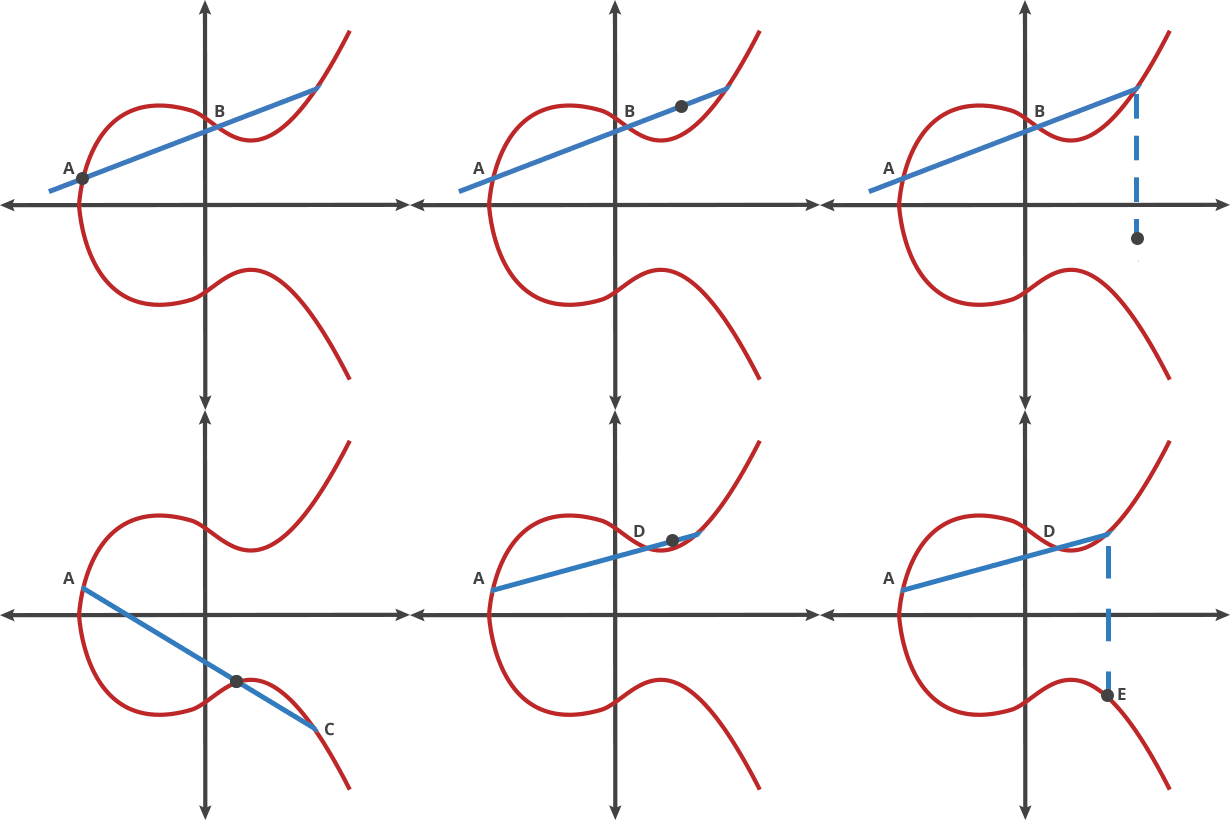
## Elliptic curves
* Elliptic curve is a set of points solving the following equation:
$E$: $y^2+a_1xy+a_3y=x^3+a_2x^2+a_4x+a_6$
* In practice majority of applications use *short Weierstrass equation*:
$E$: $y^2=x^3+ax+b$
---
## Elliptic curves

---
### Elliptic curve additions
<!--  -->

---
### What if P == Q

---
### Elliptic curve additions

---
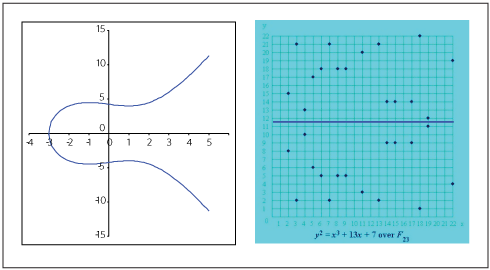
* For our purposes we will always use elliptic curve defined over a set of integers belonging to finite field $F_p$:
* $y^2=x^3+ax+b\pmod{p}$
<!--  -->
---
### Hasse-Weil bound
For all primes $p$ and $a,b$: number of points on $y^2=x^3+ax+b \pmod{p}$ is "about" p
---
### Elliptic curve scalar multiplication
* Given field element $u\in F_p$ and elliptic curve $P \in E$.
* Scalar multiplication is an addition of point $P$ to itself $u$ times:
* $uP=\overbrace{P+P+...+P}^{u\text{ times}}$
---
### Elliptic curve group
$\mathbb{G}$ defines a group over a set of elliptic curve as follows:
* A chosen $P\in E$ is called a generator
* element $x\in F_P$ is represented in group $\mathbb{G}$ as $xP$
* Notation:
* $[x]=xP$
* $\mathbb{G}=\langle P \rangle$
---
### Elliptic curve discrete log problem
Given $P\in E$ and $A=aP$ where $a\in F_p$
Recover $a$ only knowing $P$ and $A$
---
### Elliptic curve Diffie-Hellman (ECDH) key exchange
* Fix prime $p$,
* curve $y^2=x^3+ax+b\pmod{p}$
* and point **P** on curve

---
### Elliptic curve CDH problem
* **CDH**: given (P, uP, vP) **compute** (uv)P
* In ECDH key exchange CDH problem is hard

---
### Elliptic curve DDH problem
* Given (P,uP, vP, hP)
* **check if** hP=uvP
* In ECDH key exchange DDH problem is hard

---
### Elliptic curve signatures
TODO
---
## Bilinear Pairings
* Consider groups $\mathbb{G}_1$,$\mathbb{G}_2$, and $\mathbb{G}_T$
* We call operator $e=\mathbb{G}_1 \cross \mathbb{G}_2 \rightarrow \mathbb{G}_T$ bilinear pairing if it satisfies the following properties:
* $\forall P,S \in \mathbb{G}_1$ and $\forall Q,R\in \mathbb{G}_2$,:
$e(P,Q+R) = E(P,Q)\cdot E(P,R)$
$e(P+S,Q) = E(P,Q)\cdot E(S,Q)$
* This implies
$e(aP,bR)=e(P,R)^{ab}$
* sometimes $\mathbb{G}_1$ and $\mathbb{G}_2$ are the same
---
### Bilinear pairing over a simple integers
* If $P,Q,R,S$ were simple integers instead of elliptic curve points, then making pairing is easy
* We can do $e(x,y)=2^{xy}$. Then we can see:
* $e(3,4+5)=2^{3\cdot 9} = 2^{27}$
* $e(3,4)\cdot e(3,5)=2^{3\cdot 4} \cdot 2^{3\cdot 5}=2^{12}\cdot 2^{15}=2^{27}$
* However, such simple pairings are not suitable for us because these integers are too easy to divide or compute logarithms
---
### Discrete log problem using bilinear pairings
* Consider $Q=aP$ where $a$ is unknown and $Q$ and $P$ have the following relation:
* $e(P,Q)=e(P,aP)=e(P,P)^a$
* DLT problem is to compute $a$ from $e(P,Q)$
* Discrete log problem is still hard
---
### DDH in bilinear pairings (BDDH)
* Given $G,P,Q,R\in \mathbb{G}_1$ where
* $P=pG$, $Q=qG$, $R=rG$
* Checking whether or not $p\cdot q = r$ is **easy** by knowing $G,P,Q,R$ by checking pairing equation:
* $e(P,Q)=e(R,G)$
* $e(G,G)^{pq}=e(G,G)^{r}$
---
### CDH in biliniear pairings (BCDH)
* Given $G,P=pG,Q=qG$, compute $e(G,G)^{pq}$
* CDH problem is still hard
---
## Pairing protocols
---
### Three party key exchange
* Let's extend ECDH key exchange to 3 party (Alice, Bob and Chris)
* corresponding private keys are $a,b,c\in F_p$
* Parties use $\mathbb{G}=\langle P \rangle$
* To calculate shared secret $K=abcP$ at least two round of communications are required

---
### Three-party one-round key exchange
* In parallel:
a. $Alice\rightarrow Bob,Charlie: aP$
b. $Bob\rightarrow Alice,Charlie: bP$
c. $Chris\rightarrow Bob,Charlie: cP$

---
### Three-party one-round key exchange
* In parallel
* Alice computes $e(bP,cP)^a=e(P,P)^{abc}$
* Bob computes $e(aP,cP)^b=e(P,P)^{abc}$
* Chris computes $e(aP,bP)^c=e(P,P)^{abc}$
* $e(P,P)^{abc} \in \mathbb{G}_2$ is a shared key
---
### Multi-party key exchange
* To perform Multi-party one-round key-exchange we need the existence of pairing with arbitrary number of arguments
* Otherwise is standard 2-argument pairing is used, we will need $log(n)$ rounds where $n$ is number of participants
---
### BLS Signatures (short signatures)
* Boneh, Lynn and Shacham proposed signature scheme in which signatures are comprised of a single group element
* Given:
* $\mathbb{G}_1=\langle P \rangle$
* pairing $e=\mathbb{G}_1 \cross \mathbb{G}_1 \rightarrow \mathbb{G}_T$
* Alice's private key $a\in F_p$
* Alice's public key is $A=aP$
* Message $m\in \{0,1\}^*$
* We need Alice to sign message $m$
---
### BLS Signatures (short signatures)
* Alice calculates hash $M=H(m)$
* Alice's signature on a message $m$ is a single group element $S=aM$
* Anyone posessing Alice's public key can verify $S$ by computing:
* $e(P,S)=e(A,M)$, because:
* $e(P,aM)=e(aP,M)$
* $e(P,M)^a=e(P,M)^a$
* This is exactly the instance of Bilinear DDH problem
---
### BLS signature aggregation
* Assume now we have $n$ parties $A_1, A_2, ..., A_n$ who wish to sign the same message
* Aggregated signature is $S_{aggr}=\sum_{i=1}^{n} S_i$
* Aggregated pubkey is $A_{aggr}=\sum_{i=1}^{n}A_i$
* Verification is:
* $e(P,S_{aggr})=e(A_{aggr},M)$, because:
* $e(P,\sum S_i)=e(\sum A_i,M)$
* $e(P,\sum a_iM)=e(\sum a_iP,M)$
* $e(P,M)^{\sum a_i}=e(P,M)^{\sum a_i}$
---
## Resources
---
* Good short intro: [link](https://courses.csail.mit.edu/6.897/spring04/L25.pdf)
* Good longer intro: [link](https://www.math.uwaterloo.ca/~ajmeneze/publications/pairings.pdf)
* Good even longer intro: [link](https://static1.squarespace.com/static/5fdbb09f31d71c1227082339/t/5ff394720493bd28278889c6/1609798774687/PairingsForBeginners.pdf)
* Good Vitalik's article: [link](https://www.vitalik.ca/general/2017/01/14/exploring_ecp.html)
* Good summary of all above: [link](https://hackmd.io/@benjaminion/bls12-381#Roots-of-unity)
* Vitalik's presentation on BLS aggregation: [link](https://www.youtube.com/watch?v=DpV0Hh9YajU&t=510s)
* Dan Boneh's presentation about DH and elliptic curves: [link](https://www.youtube.com/watch?v=4M8_Oo7lpiA&t=3368s)
* 20-hours youtube course on pairings: [link](https://www.youtube.com/playlist?list=PL8Vt-7cSFnw2V2Wpf4MpwtSJvLvZo1ADB)
{"title":"Pairings KSS","breaks":true,"description":"View the slide with \"Slide Mode\".","slideOptions":"{\"theme\":\"white\"}","contributors":"[{\"id\":\"8d5903cf-0b12-45b0-aac7-7e9b3364ff74\",\"add\":18800,\"del\":12771}]"}