# The Potential of Smart Treaties
_Consensus networks in international law for a globally coordinated demos_
Drafted 1 June 2020
Governance emerges when communities of sentient individuals interact. The tools and conventions of governance — rules, laws, traditions, morals, agreements and the like — serve to harmonize behavior and enable the stable functioning of the community.
These rules work by manipulating incentive structures to encourage individual actors to behave in ways that are more conducive to the successful functioning of the whole. Without governance, violence is the most effective form of control, and the most violent actors are often the most successful. Rule of violence denies individuals the rights to life and equality of opportunity we have come to understand as fundamental to human existence. Governance structures subvert this rule of violence, replacing it with more equitable, transparent and consensual forms of rule.
Nation states are individuals that exist in a community. They are motivated by their individual aims and obligations, which are affected by a complex blend of factors including culture, history, religion, leadership and so on. Forms of governance on the international scale have developed over centuries — even millennia — to promote the (relatively) harmonious co-existence of sovereign ethno-political entities, nation states. Agreements between nation states serve to formalize rules of interaction of their governments, firms and citizens / subjects to improve the functioning of international affairs, which affect every facet of life on this planet.
Treaties are formal agreements between sovereign states and international organizations. They enable these entities to coordinate in their affairs and improve their capacity to ensure the security and improve the welfare of their subjects, a core responsibility of states. Treaties offer a legally-binding mechanism that transcends any single state’s sovereignty.
But law, and especially international law, is an inherently subjective domain. It relies on language, understanding and interpretation. Built with pre-21st century information technologies, legal treaties are blunt instruments. Enforcing or disputing treaties is an expensive, long and fuzzy human process. This is necessary: humans must always be involved in international rule-making and interpretation. I am not advocating a pure algocracy.
Rather, I am exploring some questions. How might the use of 21st century information technologies expand the toolkit of international governance? What gains could be made in improving international cooperation and reducing conflict between states by formally entering into transparent and objective algorithmic agreements? How could smart contracts be used to shore up some of the inadequacies of international lawmaking and enforcement?

_The Ratification of the Treaty of Münster, 15 May 1648 (1648) by Gerard ter Borch. [Wikipedia](https://en.wikipedia.org/wiki/Peace_of_Westphalia)._
## The Opportunity
Blockchains are useful in situations where untrusting agents need a transparent and global way to share information and make formal agreements.
Consensus networks are networks of computing nodes coordinating to agree on the state of a distributed ledger, which is often a blockchain. Healthy and properly decentralized consensus networks afford a number of assurances to users, including high guarantees of informational integrity and availability, as well as correctness in the execution of smart contracts. If properly designed and implemented, no individual actor can easily game or subvert a consensus protocol. This is because the protocol is enshrined in the programs running on the nodes maintaining the ledger: break protocol and your contribution to the network is rejected. What’s more: developers can evolve and strengthen consensus protocols over time, thus adapting these systems to weaknesses and vulnerabilities as they become known.
A smart contract is a script stored on a blockchain maintained by a consensus network, executed in the network’s virtual machine. Once instantiated, smart contracts exist independently of any external actor, and can hold and transfer funds and other informational assets based on conditional logic. Smart contracts are infinitely programmable, and can be configured such that only authorized actors are entitled to submit data to the algorithm, which can reliably and correctly process the information and act autonomously. In this sense they are “self-executing”, existing outside the control of even their creators. When the entities interacting with a smart contract are nation states, the term “smart treaty” may fit.
In the Web3 paradigm, account holders are “self-sovereign”. This means that they control their digital identity, including their funds and personal information, independent of any other actor. This is possible because they create and hold the private keys that allow them to compute the digital signatures required to authenticate themselves when invoking smart contracts, in which users submit transactions directing computation to be performed and ledger state be updated. Authentication is objectively impossible without the correct private key, per the system protocol and the mathematical properties of digital signature algorithms.
As it is composed of nation states that do not fully trust each other, the international political arena is a situation where blockchains might be incredibly useful. Acknowledging the technical and legal complexity of the issue, I ask: what if governments started using smart contracts as a tool to hold one another accountable in their international agreements? How would this work? Where might smart contracts or smart treaties be especially useful to improving coordination amongst nation states? What risks exist? What principles should guide political actors in the design, adoption and management of Web3 technologies?
## Smart treaties in practice
These questions may be best answered by examining potential use cases. This is far from an exhaustive list, rather, it is a glance at the areas where smart treaties may create the greatest opportunities for supporting international agreements.
## Environmental monitoring
The good health of the Earth is necessary for our ability to thrive. We survive because the local environmental conditions to our bodies stay within a range we can tolerate — if we are too hot or too cold or too dry or too wet for too long, we will die. This is true of every living object. We are aware of this, but much of our behavior continues to run counter to this knowledge. We are degrading the environment in an intolerable way.
It seems sensible, then, to consider how smart contracts might help us to re-align the incentives of the agents in this complex adaptive system to promote the preservation and restoration of the natural health of our biosphere.
What if we tied very clear incentives to behavior that promotes environmental health? With smart treaties and existing and emerging earth observation technologies, we have a robust and evolving way for monitoring local and global environmental health. Information extracted from the analysis of remote sensing and drone imagery of the Earth could serve as inputs to smart contracts. Funds could be automatically transferred to national governments or other stakeholders when environmental conditions reach some target threshold within their territory.
These incentives could be applied an any level, from the individual person or synthetic agent (like a vehicle or appliance) to states and multi-national parties — even to global institutions or yet un-imagined organizational entities.
“We can create smart contracts between a smallholder farmer and a funder where the payment is unlocked if the tree is still there” (Caldecott, The Economist 2020). At the hyper-local level a farmer might be paid to keep a tree alive, or perhaps more appropriately, to manage the health of a forest or some land area. This could be measured using a diverse multitude of objective (and perhaps subjective) measurement and assessment techniques. It could be as simple as measuring summertime canopy cover of a fixed area to more sophisticated multispectral synthetic aperture RADAR and drone-captured imagery. Connected sensors monitoring urban air quality could submit their empirical measurements — ideally digitally signed in secure enclaves installed on edge devices— to smart contracts that analyze the area covered by the network.
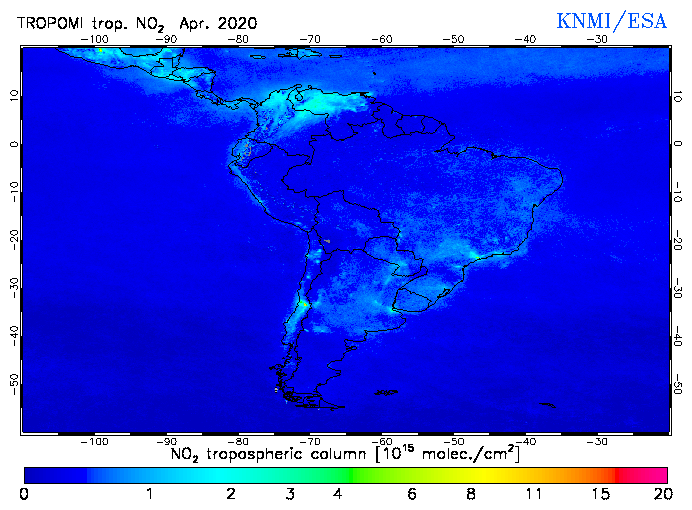
_Monthly mean tropospheric NO2 from TROPOMI, April 2020, [TEMIS0](http://www.temis.nl/airpollution/no2col/no2month_tropomi.php?Region=3&Year=2020&Month=04)._
On an organizational or project level, It could mean using a network of trained human analysts to provide their expert assessments based on inspection of evidence. Outputs from machine learning algorithms trained to recognize measures of environmental well-being from a variety of inputs could serve as arguments in smart contract invocation — measure carbon capture and storage, nitrous oxide emissions, surface temperature, moisture content, ocean pH.
With all these examples, if a target threshold was met, funds could be transferred to those who played a role in meeting the target. This money could be transferred to the relevant city government, national environmental agency — or even to individual households with low or reduced emissions.
Furthermore, if consumers of carbon offsets could investigate the efficacy of carbon offset projects in reducing emissions based on analysis of captured by connected sensor networks, the efficiency of offset market would improve, ultimately making efforts to reduce emissions more effective.
On a national, supranational, and global level, countries and organizations could be paid if climate targets are met. This data-driven incentivization regime could — if properly designed — create the conditions for the most rapid and least disruptive transition to a sustainable global demos and mechanos. We could decide to pay ourselves in the future if we meet certain goals, a sort of conditional savings account.
Perhaps more controversially, smart treaties would enable nation states to put incentives in place based on sensed environmental conditions without the consent of the state administering a land area. An example comes to mind: it is in the interest of every human to protect the health of the Amazon. This is a tricky problem: a global public good is governed by a few individual nation states, subject to their own political tides.
With smart treaties, state and multinational actors around the world could tie financial incentives to the measured health of the rainforest, to be transferred to relevant governments - or even citizens - if certain metrics are met, such as reductions in deforestation rates. Even if the prospective beneficiary is unwilling to participate in discussions on protecting the Amazon’s health, these incentives could be put in place. I of course am merely asking what if — the legality and ethics of such an action is a topic for deeper investigation.
In addition to larger institutions like government entities and firms, target beneficiaries for achieving goals in the collective effort to counter climate change could be individual citizens holding accounts with their central banks. This could be a sort of conditional universal basic income — if we make progress towards our mutually-identified goals, we each get more money. This could be a powerful tool in enrolling the general public in the enormous task we collectively face. Even autonomous vehicles and other software-controlled agents could be rewarded for pro-environmental behavior.
## A metaprotocol for central bank digital currencies
Many central banks around the world are looking closely at issuing fiat currencies using information technologies including distributed ledgers, and some have already created these central bank-issued digital currencies. I believe that this impending transition in the fundamental architecture of the global financial system is one of the greatest opportunities for fixing the structural injustices that have accumulated within it, by oversight or by design.
At Jackson Hole in August 2019, then Bank of England governor Mark Carney spoke of a “synthetic hegemonic currency”, which would sit at the center of a new “multipolar international monetary and financial system” ([Carney 2019](https://www.bankofengland.co.uk/-/media/boe/files/speech/2019/the-growing-challenges-for-monetary-policy-speech-by-mark-carney.pdf)).
I believe that decentralized and trustless technologies should play a key role in the creation of a new, adaptable and just international monetary and financial system. If properly designed, such a system could be significantly more resilient, adaptable and ethical than the current manifestation.
An interoperability protocol would enable not only inter-state fund transfers (central bank to central bank) and auditing, but also the global enforcement of policies made through some multilateral decision-making mechanism. In this way the financial system could retain its ability to disincentivize illicit activity, but in a much more balanced, fair and transparent way.
I understand that adopting such an interoperability protocol at this level would require unprecedented agreement by the key players in the global financial system, and would probably be more a more significant achievement than the Bretton Woods agreement. For clarity: this interoperability protocol is more of a metaprotocol, inclusive of the diverse DLT platforms and consensus protocols being employed by central banks around the world. Diversity is important — but so is interoperability.
Tax havens could become a relic of a time when information traveled inscribed on paper, rather than light. Currently, illicit actors take advantage of the complexities of living on a world with fragmented sovereignty — even a single permissive jurisdiction can provide a hiding place for all manner of ill-gotten capital. And beyond identifying money launderers and criminals, an interlocking constellation of fiat digital currencies governed by smart treaties would enable the application of instant and hyper-targeted sanctions. This has proven to be a potent tool in efforts to suppress human rights abuses. And such a system is is fertile ground for experimentation with green finance initiatives contingent on spatial data analytics. I agree with Satoshi's vision of an uncensorable peer-to-peer system of cash, but there is a limit: when the participants in a transaction pose an existential threat to humanity.
In our increasingly interconnected world, central bank digital currencies represent an entry point for employing algorithmic tools towards creating a system of global governance. If fiat digital currencies included in this synthetic hegemonic currency adhere to a protocol which enables an [all-seeing eye](https://twitter.com/asvanevik) to gaze upon the world’s financial activity, hiding places for corrupt actors could become fewer.
I am a proponent of respecting the individual’s right to privacy while taking action to ensure pro-social behavior, and believe that the privacy — security trade-off is proving [a false one](https://medium.com/@juvenalis/the-benevolent-panopticon-259cf648ede8). I urge policymakers and system designers to err towards just, privacy-preserving surveillance technologies. If designed properly, only those suspected of illegal behavior would find their right to privacy waived while proper authorities investigate. If no law breaking is found, privacy should be reinstated. Privacy is a fundamental human right, but we must be pragmatic and opportunistic in promoting a just and transparent system of embedded supervision.
An interoperability metaprotocol for central bank digital currencies would formalize the capabilities of these systems and the way messages were exchanged, and enable unbreakable and collectively-guided governance mechanisms to be put in place enabling the coordination of central banks and nation states. The protocol could establish unbreakable rules governing monetary policy - Satoshi's vision, adapted. The metaprotocol itself could be governed by a decentralized organization consisting of key global stakeholders. This organization tasked with coordinating the world’s central banks would be a fundamental institution in a new global governance architecture.
The opportunity this idea offers for us to stamp out the large-scale corruption, organized crime and money laundering that is fueling much of the human conflict in the world means further research and viability testing is worthwhile. It may be that this protocol would result in a more resilient social fabric, a global society where the social contract is upheld in ways we cannot even imagine today.
It is difficult to conduct business internationally if a firm or other entity is excluded from participating the mainstream financial system, a reason why sanctions enforced by the United States have such global reach. Many major banks operate in the US — the prospect of losing an American banking license serves as a strong disincentive for serving sanctioned customers. This quirk of the financial system has been used to great effect to counter organized criminal networks, terrorist activity and the like — but it does confer disproportionate power to US lawmakers and policymakers.
Of course, the ethics of this potential arrangement are contingent on its implementation. With smart contracts, policies designed to affect behavior change could achieve much more nuance than traditional law, meaning actors that have historically been excluded outright from the financial system might be brought into the fold — the first step, in my eyes, towards reconciliation and peace.
If thoughtfully designed, and adopted with genuine buy-in, a metaprotocol for central bank digital currencies could drastically improve the fairness of how our global financial system is governed, and act as a key feature of a peaceful global society.
## Arms control
Another area where smart contracts and other emerging information technologies might support international efforts for coordination deals with the production, transport and disposal of weapons and munitions. This is a tricky problem: rational behavior for one actor depends on the actions of others. In contexts of incomplete information, the rational action is often to increase arms stocks. Yet durable systems of coordination that maintain a balance in the relative destructive capacities of adversarial militaries can make the choice to engage in armed conflict less likely, and support progress towards disarmament. The prospect of mitigating an enormous threat to life and the planet makes this a worthwhile topic of enquiry.
Emerging trustless and privacy-preserving technologies offer opportunities to improve the verification of adherence to treaty terms by parties.
Again, earth observation networks make high resolution monitoring of surface activity, as well as some underground and subsea activity, possible. Currently, human and machine analysts from government, NGO, academia and even the public form a diverse network of observers working to find consensus on the international security situation, and open source intelligence techniques are improving. As the scale of these surveillance networks increases, the ease with which treaty participants can evade detection will diminish.
Smart treaties could offer a system that could serve as a global reporting and enforcement mechanism. If the collective intelligence of these sources converged on a global data storage and computing system, actors dedicated to preserving the peace could have more complete and timely information. With smart contracts, tangible incentives and disincentives could be programmatically tied to the informational inputs of these analytical sources. In a simple example, if a few different information sources submitted evidence to a smart contract that a country was violating an international agreement by, say, building ballistic missile installations, funding to that country could be revoked, or some staked funds could be slashed. Similarly, access to data or payment streams could also be canceled. Money and knowledge are two significant forms of power. They are both now programmable, and should be used to undermine the logic of violence.
Beyond the growing ability of connected sensor networks to aid in the monitoring and verification of adherence to arms control treaty terms, emerging privacy-preserving information technologies hold great promise to enhance cooperation and provide robust assurances that adversaries are playing by the rules. More on this soon, but at a glance:
- [Secure multiparty computation](https://en.wikipedia.org/wiki/Secure_multi-party_computation). Untrusting parties submit encrypted information into a secure computing environment. “Data and code inside the enclave will remain secret at all times.”
- [Zero-knowledge protocols](https://en.wikipedia.org/wiki/Zero-knowledge_proof), including zkSNARKs. Autonomous weapons governed by algorithms registered on chain, executed in on-board secure enclaves. Zero-knowledge proofs on nuclear disarmament (Glaser).
- [Proxy re-encryption](https://en.wikipedia.org/wiki/Proxy_re-encryption). Encrypted information can be re-encrypted for a new party [based on conditional logic](https://twitter.com/MacLaneWilkison/status/1265390029204946945), such as adherence to treaty terms. No intermediary party can view the plaintext. Similarly, access to data feeds could be revoked on treaty violation.
- Multisignature contracts governing military action including declaration of war, nuclear missile launch, etc.
- [Compute to data](https://blog.oceanprotocol.com/ocean-protocol-launches-compute-to-data-efb89990ce1), enabling analysis of private datasets in situ, without revealing strategic secrets to adversaries.
These technologies hold promise to upend a timeless problem at the root of adversarial conflict: enemies do not trust one another. They are quite reasonably unwilling to share detailed information about themselves, their plans, positions and so on. Intelligence gathering is a core function of the state, required to fulfill its obligation to improve the security of its citizens.
With these technologies, it is becoming possible for adversarial nation states to coordinate in unprecedented ways, without revealing strategic secrets. Imagine encoding shared rules into algorithms auditable by two adversaries, then executing those algorithms inside secure enclaves with encrypted data submitted by the adversarial parties. Two warring nations might agree that conflict should not take place near a neutral neighbor’s border. If information about the locations of military assets and warfighters were to be sent to an enclave validator, both sides could have assurance of the opponent’s compliance, without either side revealing any strategic information about their military activities. What’s more — if one side violates the terms of the agreement, substantial penalties could automatically be applied through invocation of smart contracts. I understand that immense technological, social, legal and political questions must be answered before such a system might be experimented with — but the potential gains in improving peace and international security make the answers to those questions worth pursuing.
War may never be eradicated. By improving trust between adversarial militaries in the scope of the opponent’s destructive capacity, and by designing appropriate incentive mechanisms to ensure compliance with mutually-agreed rules of engagement, the scale of future wars might be reduced, averting incalculable human and environmental harm. Monitoring systems collecting machine and human intelligence coupled with programmable incentivization mechanisms enabled by smart contracts hold promise to improve the potential scope and efficacy of international arms control and conflict governance.
---
## Towards smart treaties
For the most part, Web3 technologies are not mature enough to be adopted by state actors in any significant way. It has only been 11 years since the first block was mined. Thankfully, public blockchains are open by their nature, meaning the concepts and code are able to be scrutinized and improved upon by anyone. This fact - along with an overwhelming thirst for change - gives me hope that these technologies will develop and mature very rapidly.
That said, governments are already looking at where consensus networks and smart contracts might be useful. It is not too soon to begin research and prototyping on applications of smart contracts in international law. Trustless and privacy-preserving information technologies hold great promise as tools in helping us achieve our potential as a species — to create the society we deserve.
 Sign in with Wallet
Connect another wallet
Sign in with Wallet
Connect another wallet