---
tags: 機器學習基石上:數學篇
---
Ch7 VC Dimension
===
## Content
[TOC]
## [Slides & Videos](https://www.csie.ntu.edu.tw/~htlin/mooc/)
## [Definition of VC Dimension](https://www.coursera.org/learn/ntumlone-mathematicalfoundations/lecture/AnYJ6/definition-of-vc-dimension)
### Recap: More on Growth Function

- 成長函數的上限的上限是 $N^{k-1}$
### Recap: More on Vapnik-Chervonenkis (VC) Bound

### VC Dimension Definition
<!--  -->

- **最大的 non- break point 為 $k-1$,即 VC Dimension,$d_{VC}$**
- $d_{VC} = \min(k) - 1$
- $H$ 能夠 shatter 的最多 input
<!-- 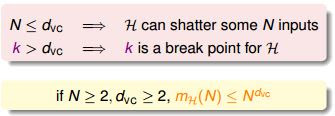 -->

- $\mathcal H$ 可以 shatter 最多 $d_{VC}$ 個資料點,但不是任意 $d_{VC}$ 個資料點都能被 $\mathcal H$ 給 shatter
- 比 VC dimension 大,就是 break point 所以叫 $k$
- 當 $N$ 夠大且 $d_{VC}$ 也夠大時,成長函數會比 $N$ 的 VC dimension 次方來得小
- 當 $N\geq 2$ 且 $\min(k)\geq 3$(即 $d_{VC}\geq 2$),$m_\mathcal H(N)\leq N^{d_{VC}}$
> Q: 感覺教授這附近對 $k$ 的定義有時候是 minimum break point,有時候是任何 break point...
### VC Dimensions: 4 examples

- 之前我們說,有露出一線曙光的點 (break point),才是好的 hypothesis set
- 對應到這裡就是,VC dimension 是 finite 的 hypothesis set 才是好的 $\mathcal H$

### Fun Time: VC Dimension

## [VC Dimension of Perceptrons](https://www.coursera.org/learn/ntumlone-mathematicalfoundations/lecture/l89CH/vc-dimension-of-perceptrons)
### 2D PLA Revisited

### 證明 PLA 在資料維度為 d 時, VC Dimension 是 d+1

- 證明 $d_{VC} \geq d+1$, 只要找到一種 $d+1$ 筆的資料是可以被 PLA 給 shatter 的即可
- 證明 $d_{VC} \leq d+1$, 需要證明對於任何 $d+2$ 筆的資料, PLA 都不能夠 shatter
### 證明 $d_{VC}\geq d+1$

- 剛剛我們說,證明 $d_{VC} \geq d+1$, 只要找到一種 $d+1$ 筆的資料是可以被 PLA 給 shatter 的即可
- 我們現在找到這組特別的 input,使得 $X$ 是可逆矩陣
- 注意這裡插入了常數項 $x_0=1$

- 想要 shatter 這 $d+1$ 個點,代表 $y$ 不論長什麼樣子都要成立 $\text{sign}(Xw)=y$
- 既然 $X$ 是可逆的,那其實就可以直接解 $w$ 使得 $Xw=y$ 因為這樣也可以成立 $\text{sign}(Xw)=y$
- 不論 $y$ 是多少,都能解得 $w=X^{-1}y$
- 所以這 $d+1$ 個點可以被 shatter,代表 $d_{VC}\geq d+1$
### 證明 $d_{VC}\leq d+1$
- 剛剛我們說,證明 $d_{VC} \leq d+1$, 需要證明對於任何 $d+2$ 筆的資料, PLA 都不能夠 shatter
- 先來看 2D 的 case
- 
- 現在 $x_1=\begin{bmatrix}0\\0\end{bmatrix}, x_2=\begin{bmatrix}1\\0\end{bmatrix}, x_3=\begin{bmatrix}0\\1\end{bmatrix}$ 這三個點可以 shatter
- 但是加入了第四個點 $x_4=\begin{bmatrix}1\\1\end{bmatrix}$ 就沒辦法 shatter 了,因為以圖為例的話,它(問號)是 x 的情況是沒辦法被 perceptron 分開,但是數學上為什麼沒辦法做出這種 dichotomy 呢?
- 我們知道 $x_4=x_2+x_3-x_1$,所以 $w^Tx_4=w^Tx_2+w^Tx_3-w^Tx_1$
- 那麼當 $w^Tx_2>0$ 且 $w^Tx_3>0$ 且 $w^Tx_1<0$ 的時候,$w^Tx_4$ 就一定大於 0,它不可能小於 0,所以第 4 個點它沒辦法 shatter
- 結論是 linear dependence 限制了 dichotomies 的數量
- 但這只是一個特殊的例子,我們要證明對所有 $d+2$ 筆資料都不能 shatter
- 推廣到 $d$ 維的 case
- 
- 現在列出來可以發現 $X \in \mathbb R^{(d+2)\times (d+1)}$,$X$ 有 $d+2$ 個 rows、$d+1$ 個 columns
- 線性代數告訴我們,這時候會有 linear dependence,$x_{d+2}$ 一定可以表示成其他 $x_1,...,x_{d+1}$ 的 linear combination $x_{d+2}=a_1x_1+...+a_{d+1}x_{d+1}$
- 所以 $w^Tx_{d+2}=a_1w^Tx_1+...+a_{d+1}w^Tx_{d+1}$
- 觀察一下會發現(圖較清楚),我們沒辦法產生這種 dichotomy $(\text{sign}(a_1),\text{sign}(a_2),...,\text{sign}(a_{d+1}),-1)$,因為若前面的 sign 條件都滿足了,那麼 $w^Tx_{d+2}$ 一定會大於 0。
- 所以我們證明了 $d$ 維 perceptron 沒辦法 shatter 任何 $d+2$ 個 datapoint。
## [Physical Intuition of VC Dimension](https://www.coursera.org/learn/ntumlone-mathematicalfoundations/lecture/z3Caf/physical-intuition-of-vc-dimension)
### Degrees of Freedom

- VC dimension 的物理意義
- 對 binary classification 來說,有多少個旋鈕是我可以自由操控的
- **effective 'binary' degrees of freedom**
- 這個 hypothesis set $\mathcal H$ 到底強不強

- 實務上,如果想要估計 VC dimension,那麼去看看有多少個可調的旋鈕會是一個不錯的方式。
### $M$ and $d_{VC}$
<!-- 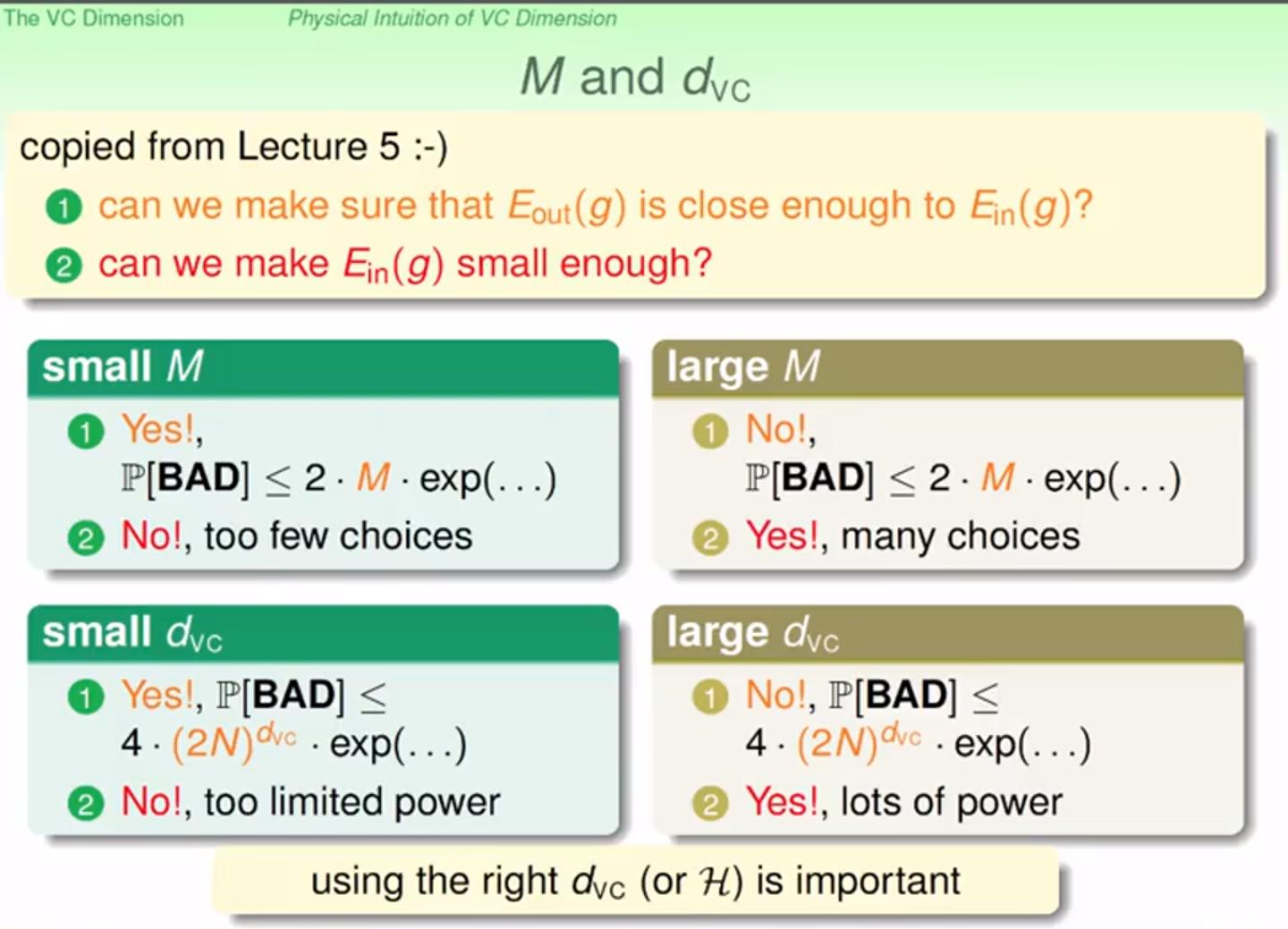 -->

- 和 M 一樣, VC Dimension 不論太大或太小都不好, 因此要選擇一個好的 VC Dimension
### Fun Time: Degrees of Freedom

- 用自由度的角度看 VC dimension,馬上可以知道答案
## [Interpreting VC Dimension](https://www.coursera.org/learn/ntumlone-mathematicalfoundations/lecture/KAg9C/interpreting-vc-dimension)
<!-- 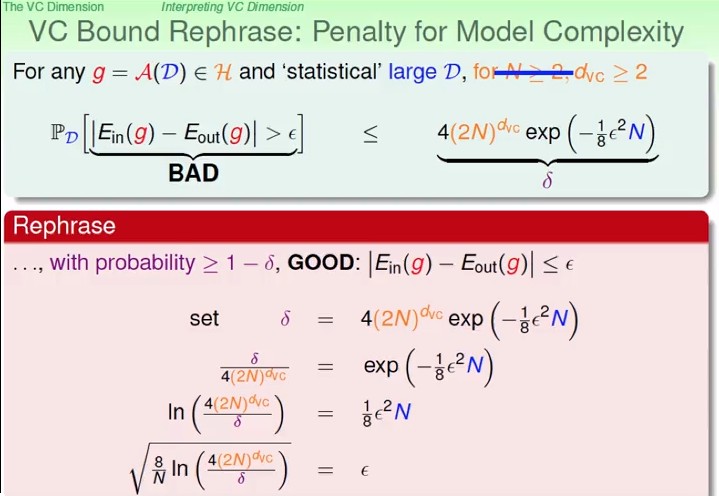 -->

- 假設壞事情($E_{in}$ 和 $E_{out}$ 差很多) 發生的機率為 $\delta = 4(2N)^{d_{VC}}exp(-\frac{1}{8}\epsilon^2N)$
- 我們可以推導出 $\epsilon=\sqrt {\frac{8}{N}ln(\frac{4(2N)^{d_{VC}}}{\delta})}$

- 我們在乎的 **generalization error** $|E_{in}(g)-E_{out}(g)|$ 有 $1-\delta$ 的機率小於等於 $\epsilon$
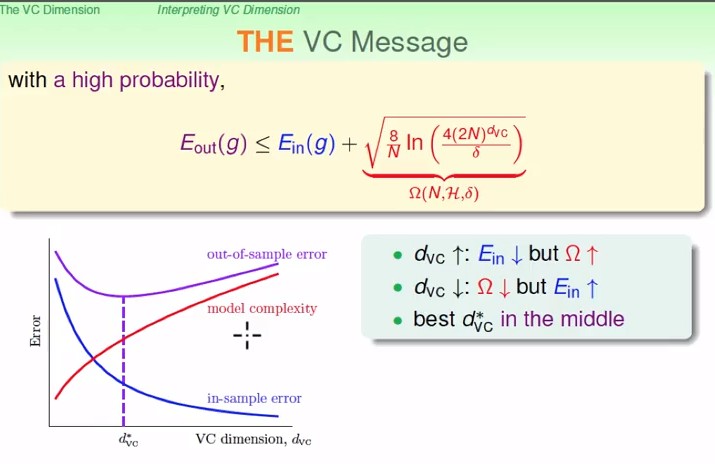
- 也就是說我們有 $1-\delta$ 的**信心水準**使得 $E_{out}$ 會落在 $[E_{in}-\sqrt {\frac{8}{N}ln(\frac{4(2N)^{d_{VC}}}{\delta})}, E_{in}+\sqrt {\frac{8}{N}ln(\frac{4(2N)^{d_{VC}}}{\delta})}]$ 內
- 那通常我們比較在意 worst case,所以只看右邊那項。
- 根號裡面那些東西,我們通常叫它 **model complexity**
- 教授說 $\Omega(N,\mathcal H,\delta)=\sqrt {\frac{8}{N}ln(\frac{4(2N)^{d_{VC}}}{\delta})}$ 那也就是說 $\epsilon=\Omega(N,\mathcal H,\delta)$ 的意思囉
- 這裡的 $\sqrt {\frac{8}{N}ln(\frac{4(2N)^{d_{VC}}}{\delta})}$ 也就是我們付出的penalty, 而這個penalty會隨著 model的強大(VC Dimension的提高)而變得更大
<!--  -->
<!--  -->

- 隨著 VC dimension 越來越大,
- model complexity 也會越大
- in-sample error $E_{in}$ 會越小
- $E_{out}$ 先減後增
- **powerful $\mathcal H$ is not always good!**
### VC Bound Rephrase: Sample Complexity

- VC Bound 還有另外一個意思,樣本複雜度(sample complexity) 或稱資料量的複雜度
- 如果今天老闆開給你一個 spec 說,我只容許 0.1 的誤差,然後希望壞事情的機率不要超過 0.1,然後用 perceptron 來做,那多少 data 才夠呢?
- 真的去套公式算這個 $N$ 大約會是 10000倍的 VC dimension 才夠
- 但實務上我們發現 10 倍的 VC dimension 基本上就夠了,所以我們發現 VC bound 其實是非常非常寬鬆的
### 為何 VC Bound 這麼寬鬆?

- 我們用了 Hoeffding
- 它適用任何 distribution 以及任何的 target function
- 我們用了 growth function
- 適用任何 data
- 用了 $N^{k-1}$
- 適用任何 minimum break point 是 $k$ 的 hypothesis set $\mathcal H$ ($d_{VC}=k-1$)
- 用了 union bound
- 計算 worst case,說我們不準讓 algorithm 踩到雷(回想 BAD 表),但其實偶爾踩到也沒關係的(?)
### Summary
<!-- 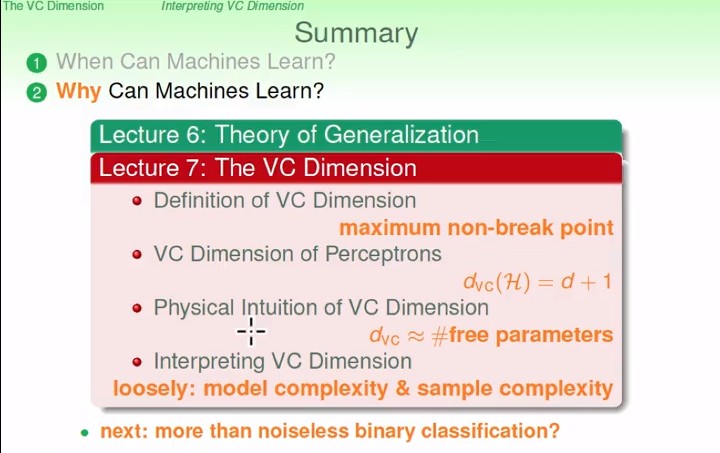 -->

- 本週重點
- VC dimension = **maximum non-break point**
- $d_{VC}(\mathcal H)$ for perceptron is $d+1$
- VC dimension is approximate to **# free parameters**
- **model complexity**: how strong is $\mathcal H$ proper?
- **sample complexity**: how many data do we need?
- 目前都是在做 **沒有 noise 的 binary classification**,下周會延伸到更多的 learning 問題上。
 Sign in via Google
 Sign in via Facebook
 Sign in via X(Twitter)
 Sign in via GitHub
 Sign in via Dropbox
 Sign in with Wallet
Connect another wallet
Sign in with Wallet
Connect another wallet