# Reading Responses (Set 2)
- Checklist for a [good reading response](https://reagle.org/joseph/zwiki/Teaching/Best_Practices/Learning/Writing_Responses.html) of 250-350 words
- Begin with a punchy start.
- Mention specific ideas, details, and examples from the text and earlier classes.
- Offer something novel that you can offer towards class participation.
- Check for writing for clarity, concision, cohesion, and coherence.
- Send to professor with **“hackmd”** in the subject, with URL of this page and markdown of today’s response.
<br/>
## 5 out of 5 Responses
### Mar 01 Fri - Collapsed context
It’s hard to say that [BeReal](https://1ft.io/proxy?q=https%3A%2F%2Fwww.wired.com%2Fstory%2Fbereal-doomed-online-authenticity%2F) is actually real. While the company tries to differentiate themselves from mainstream social media as a purely “real” medium; I’d say its far from reality. While I don’t have the app, I have witnessed instance and instance again BeReal pictures being sculpted to fit a narrative. Never is the picture taken immediately – people run to choreograph their friends into the ideal photo. Never truly authentic. In my opinion, authenticity online involves representing yourself honestly, without pretense or artificiality, and expressing your thoughts, feelings, and opinions in a way that reflects who you truly are. [Boyd](https://www.tiara.org/wp-content/uploads/2018/05/Marwick_boyd_TweetHonestly.pdf) reflects this in her article by exclaiming that “The authentic is always manufactured.”
Because of this manufactured nature, it is absolutely possible to have more than one persona online. A classic example of this is the idea of *finsta* – fake Instagram account. People will have a public account that represents the best version of themselves – one that is designed with publicity and appearance in mind. The finsta, is the complementary type of account to this. They instead focus on pictures that the poster actually likes and enjoys – ones that best represent the personality of the poster.
The Marwick Twitter example opened my eyes to how twitter users view their audience – and I found that I can often reflect the same traits in my posts. Sometimes I will curate my various social media with one or more specific users in mind (like parents or friends), to keep them updated about on life and what I have going on.
### Mar 12 Tue - TikTok, fakes, and appropriation
Apparently, the digital medium has **a lot** more influence on our identities than I thought. While I initially understood digital’s influence on our online identities to be one of bolstering truths or trolling, hiding behind a screen, it turns out to be much more than that. Instead of just hiding behind a blank screen, individuals have the ability to change what their persona/identity is. I am no longer myself, no longer even a blank profile picture. I can be represented by an avatar that I fully customize, or something more sinister. As I learned throughout [Cherid](https://journals.sagepub.com/doi/10.1177/15327086211029357) and [Kim’s](https://reallifemag.com/on-techno-orientalism/) readings, people’s online identities can take a dark turn into falsifying race – through mediums such as Blackfishing and Asianfishing.
In the case of Blackfishing, the target is financial gain. A good example of this is Arianna Grande (despite growing up as a white actress and singing as a white woman) who began shifting her music towards hip-hop, and began changing her appearance along with the music shift. In the video, Grande is wearing a spray tan, much darker than her standard skin color. This “allows the singer to position herself within Black culture in a way that allows her to capitalize from it.”
<iframe width="560" height="315" src="https://www.youtube.com/embed/QYh6mYIJG2Y?si=5QxnhjakrIdJpMOf" title="YouTube video player" frameborder="0" allow="accelerometer; autoplay; clipboard-write; encrypted-media; gyroscope; picture-in-picture; web-share" allowfullscreen></iframe>
<p/>
When it comes to Asian appropriation, the motives are less clear. Leo Kim points to the reader that it is more along the lines of idolization of the Asian world, to the point of idolizing the body. The admiration of the East Asian world has been going on through different lenses, such as anime and K-Pop (fueled by artists like BTS).
<br/>
>**QUESTION:** What are some of the implications for celebrities and their persona when they decide to go after financial gain using these unethical tactics? How do you go about stopping it?
### Mar 15 Fri - Finding someone & living alone
It’s worse than I thought. Nothing online can be trusted. As we learned the past few weeks, people are inherently inauthentic online, and are willing to so much as fake their race for financial or attention gain. I thought the online dating space would be safe, and I couldn’t have been further from correct. An [OkCupid](https://theblog.okcupid.com/the-big-lies-people-tell-in-online-dating-a9e3990d6ae2) blog post found that both men and women bolster their heights by 2”, inflate their salaries, and intentionally choose very outdated pictures of themselves. However, the choices to do so are unfortunately justified by the results.
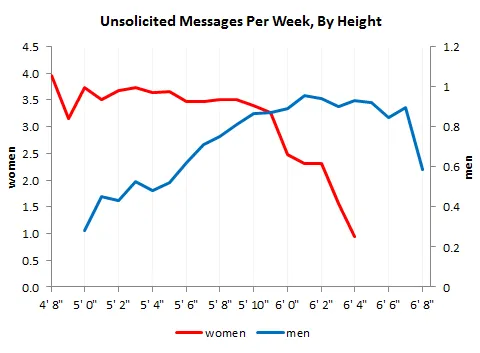
Clearly, inflating your height to be closer to the 6’ minimum yields more activity. And the importance of this comes even further into the picture when you look at the dating scene as a whole. While meeting through friends is still the most common way to start dating, it has drastically [taken a nosedive](https://web.stanford.edu/~mrosenfe/Rosenfeld_How_Couples_Meet_Working_Paper.pdf). Meeting online is now responsible for more than 20% of relationships, causing the percentage of couples meeting through friends to drop by 10%. In a world where 1/5 of people are meeting online, there’s a need to conform to the normalcy of lying.
This lying and manipulation doesn’t come free of its pains, finds author [Robyn Vinter](https://www.theguardian.com/lifeandstyle/2023/oct/28/its-quite-soul-destroying-how-we-fell-out-of-love-with-dating-apps). She notes that “It is a problem that seems likely to get worse for those companies, as more than 90% of gen Z feel frustrated with dating apps.” She pointed out that for many users, the apps feel like work – leading people to burnout or an otherwise unenjoyable experience.
The question for some, is whether or not they should conform to this new digital dating medium. As found by [The Hill](https://thehill.com/opinion/finance/563786-living-alone-in-america/), one out of 7 adults lives alone, amounting to more than a quarter of US households. The consequences of catfishing are very real and very meaningful.
> I am curious if there is a way to quantify a correlation between digital media in the dating scene and the number of adults who are single or the delays in marriage. Could it possibly be attributable to other things, economically or otherwise?
### Mar 22 Fri - Manipulated
Since March 1st, my replies to these articles have portrayed me atypically compared to how my friends and family perceive me. I am typically very optimistic and always see the best in everything, but at a glance, it certainly doesn’t seem that way. Instead, I feel as if nothing is to be trusted and everything is manipulated or falsified.
Unfortunately, online reviews, ratings, rankings, and comments are very manipulatable and more so than I naively imagined. As explained by Joseph Reagle in [Reading the Comments](https://readingthecomments.mitpress.mit.edu/pub/1cubrkat/release/2), there are three types of manipulators: fakers, makers, and takers. Fakers will praise their own work or maliciously attack the work of others. Makers will do so for a fee and takers who make use of such services. I work as an operations supervisor in a hotel in Cape Cod, and I am all too familiar with the faker dilemma. We have received fake negative reviews where the available details don’t line up with any potential guests, suggesting falsified reviews. Unfortunately, reporting the reviews doesn’t always make them go away.
And in the hotel industry, false reviews aren’t the only problem. Guests are more than willing to try to utilize blackmail, attempting to garner financial gain. And on the contrary, we obviously want to aim for as many five-star reviews as possible – so it is challenging to navigate while ensuring compliance with both our own high ethical standards as well as different regulations such as [FTC guidelines](https://www.seattletimes.com/business/technology/those-10000-5-star-reviews-are-fake-now-theyll-also-be-illegal/). We utilize different guest satisfaction metrics to determine which of our guests had the best stay and encourage them to write a review.
Even though perpetrators can manipulate reviews, ratings, and rankings positively and negatively with pay-to-win mentalities, there are still hopes for trust. As mentioned in the article, the most reputable sources are the ones that do the best at mediating. Strong bot deterrence (using [reCAPTCHA](https://www.google.com/recaptcha/about/) or otherwise), AI detections, and systems to filter and reorganize content to avoid “stuffing ‘the ballot box.’”
### Apr 02 Tue - Artificial intelligence
The next literary masterpiece or breathtaking artwork could be crafted not by humans but by complex computer algorithms. As AI rapidly advances in creative realms, the consequences for humanity are vast and, frankly, a little unsettling. As described by [Heilweil](https://www.vox.com/recode/2023/1/5/23539055/generative-ai-chatgpt-stable-diffusion-lensa-dall-e), in this new age of artificial intelligence, it is “now possible for anyone to create new, original illustrations and text by simply sending a few instructions to a computer program” (2023). This capability offers both benefits and consequences. On the one hand, it opens up exciting opportunities for task automation and different efficiency improvements. Tasks like writing emails or drafting simple legal documents could be easily replaced.
However, this new technology has clear risks and ethical worries. As Heilweil explains, “Generative AI’s results aren’t always perfect,” and there are instances of flawed or inappropriate creations. This was a concern that the developers behind Stability AI were all too familiar with. James Vincent of [The Verge](https://www.theverge.com/2022/11/24/23476622/ai-image-generator-stable-diffusion-version-2-nsfw-artists-data-changes) noted that the developers made it more difficult to generate “nude and pornographic output, photorealistic pictures of celebrities, and images that mimic the artwork of specific artists” (2022).
As best explained by [Tyler Gold](https://goldsguide.com/sydney-spotify-speedy/), the consequences of these constantly improving AI tools will be limited to what we humans dictate. If we choose to adhere to concrete & simple rules like those proposed by Isaac Asimov in 1942, then we will succeed in limiting the potential damages that AI can commit. However, if we use guiding principles such as those put forth by Google or Microsoft, we leave AI and its developers open to wide interpretation. Software like Spotify yields closer to the rules of Asimov – disallowing the AI to have a voice and keeping its functionality constrained to the low-stakes activity of playing music.
I envision a future in which, rather than worrying about the potential replacement of human creativity, humans and AI can collaborate together artistically. We have strong abilities to conceptualize and understand cultural context, and AI could act as an extension of our abilities.
 Sign in with Wallet
Connect another wallet
Sign in with Wallet
Connect another wallet