# Basic Physics-Based Fluid Simulation Methods in Computer Graphic
## 0. Post Details
- Reference: [Wang et al., Physics-based fluid simulation in computer graphics: Survey, research trends, and challenges, 2024.](https://link.springer.com/article/10.1007/s41095-023-0368-y)
- Post by: Jedd Yang
- Date: 2025-08-12
- Keywords: computer graphics, physical simulation, fluid simulation, fluid coupling
## 1. Simulation strategies
### i. Eulerian Schemes (domain divided into evenly-distributed cells)
- **Finite Volume Method**

- **Collocated grid**: Stores all velocity components and pressure at the same grid points.
- **Staggered grid**: Stores velocity components at cell faces and pressure at cell centers, improving stability for incompressible flows.
### ii. Lagrangian Schemes (domain discretized into a set of particles)
- **Smoothed Particle Hydrodynamics (SPH)**: A particle-based method for fluid simulation.
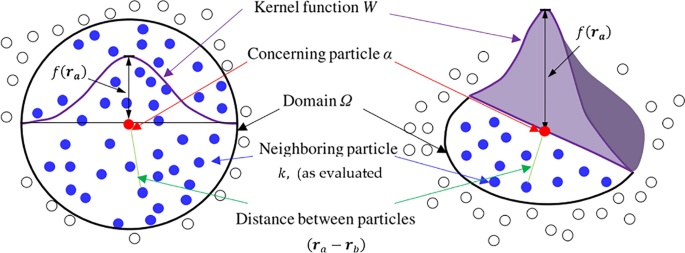
- **Position-Based Dynamics (PBD)**: Handles various physical phenomena including fluids, deformable solids, and cloth by directly manipulating particle positions instead of computing forces and accelerations.
### iii. Hybrid schemes
- **Particle-In-Cell (PIC)**: Basic hybrid particle–grid method combining Lagrangian particles and Eulerian grids.
- **Fluid Implicit Particle (FLIP) method**: Transfers momentum differences rather than absolute values, improving dynamic effects at the cost of some stability.
- **Material Point Method (MPM)**: Incorporates the deformation gradient along with momentum to capture solid–fluid interactions and elastic effects.
- **Affine Particle-In-Cell (APIC) method**: Uses affine velocity fields for particles, reducing numerical dissipation and improving stability.
- **Polynomial Particle-In-Cell (PolyPIC)**: Extends APIC by incorporating higher-order polynomial velocity fields for more accurate momentum transfer.
- **Moving Least Squares Material Point (MLS-MPM)**: Employs moving least squares for grid interpolation and differentiation, enhancing accuracy and robustness in simulations.
## 2. Advanced computational approaches
### i. Adaptive solutions
- **Temporal adaptivity**
- **Global time stepping**: Determing time step size by CFL condition as shown below, the $\lVert \mathbf{u}_c \rVert$ represents the speed of the information propagation, and the Courant number $C_{max}$ varies case by case.
$$ C \equiv \frac{\lVert \mathbf{u}_c \rVert \Delta t}{\Delta x} < C_{max}$$
- **Regional time stepping (Asynchronous time integration)**: Subdivides doamin into smaller regions using octrees, with independent time steps, aim for scenarios with both vigorous and calm regions exist.
- Spatial adaptivity (Multiscale)
- **Eulerian grids**: Uses an octree data structure for adaptive resolution.

- **Lagrangian methods**: Adjusts particle sampling via local merging or splitting to adaptively refine particle resolution.

- **Hybrid methods**: Combine Eulerian and Lagrangian adaptivity.
- **Particle splitting–collapsing scheme**: Adjust particle size in FLIP simulations based on distance to the fluid surface (larger particles further from the surface).
- **Hollow scheme**: Lagrangian representation for outer flow, Eulerian for inner flow.
- **Adaptive merge/split octree grids for FLIP**: Dynamically refine grid resolution where needed while maintaining coarser resolution elsewhere.
### ii. Parallelization
- **Single processing unit**
> [!Tip]
> Pure Eulerian and Lagrangian scheme can be readily parallelized. The hybrid methods is the pain in the ass due to the different nature of particles and grids.
- [**Voxel Data Block (VDB) method**](https://www.researchgate.net/publication/259288658_VDB_High-Resolution_Sparse_Volumes_with_Dynamic_Topology): Stores sparse volumetric data, resolves the parallel particle-to-grid rasteriza inherent in hybrid methods.
- [**Schur complement method**](https://dl.acm.org/doi/10.1145/3092818): Divides the simulation domain into subdomains with face edges and cross-points.
- [**New data-oriented programming language—Taichi**](https://www.taichi-lang.org/): Manipulate sparse data structures with a compiler designed to automatically optimize and parallelize code.
- **Multiple processing units (Multi-GPU)**
>[!Tip]
> Challenge lies in CPU-GPU data exchange.
- [**Schur complement method**](https://dl.acm.org/doi/10.1145/2980179.2982430): Partitions the simulation domain across multiple GPUs, with CPU coordinating interactions between regions.
- [**Restructured MPM algorithm**](https://sites.google.com/view/siggraph2020-multigpu): Redesigns particle data structures to enable coalesced memory access and avoid atomic operations during particle-to-grid transfers.
- [**Multi-kernel launch methodology**](https://arxiv.org/abs/2101.11856): Optimizes GPU kernel execution by managing multiple launches to reduce CPU–GPU synchronization overhead.
- **Distributed systems**
- [**Parallel data transfer driver**](https://pubmed.ncbi.nlm.nih.gov/22350196/): Enables efficient I/O for large-scale Hierarchical Data Format Version 5 (HDF5) datasets.
- [**Multi-core cloud computing**](https://dl.acm.org/doi/10.1145/3173551): Exploits parallelism across multiple CPU cores in cloud environments.
- [**Load-balancing scheme**](https://onlinelibrary.wiley.com/doi/abs/10.1111/cgf.13510?msockid=0c12b1d856696b5e19c0a40d52696d54): Dynamically distributes computational workload in sparse fluid simulations to reduce bottlenecks.
- [**Micro-partitioning**](https://onlinelibrary.wiley.com/doi/full/10.1111/cgf.13809?msockid=0c12b1d856696b5e19c0a40d52696d54): Subdivides simulation domains into fine-grained partitions to improve load balance and minimize communication overhead.
### iii. Data-driven approaches
> [!Tip]
> With parallelization, fluid simulation using traditional physical methods still requires high computational resources, specifically, on time steps for stability. Data-driven approaches provide an alternative solution for real-time interactive fluid simulation.
- **Model reduction**
- [**Galerkin projection**](https://dl.acm.org/doi/10.1145/1141911.1141962): Precompute a low-dimensional basis for fluid dynamics and project the high-dimensional fluid equations onto this reduced space.
- **Machine learning**
- [**Convolutional Neural Networks (CNN)**](https://ieeexplore.ieee.org/document/8478400): Introduced to learn mappings for fluid dynamics, e.g., predicting velocity or pressure fields from previous states.
- [**Artificial Neural Networks(ANN)**](https://onlinelibrary.wiley.com/doi/abs/10.1111/cgf.14010?af=R&msockid=0c12b1d856696b5e19c0a40d52696d54): Applied to approximate the pressure projection step in incompressible fluid simulations.
- [**ScalarFlow**](https://arxiv.org/abs/2011.10284): The first large-scale volumetric dataset for real smoke reconstruction using computer graphics and machine learning.
 Sign in via Google
 Sign in via Facebook
 Sign in via X(Twitter)
 Sign in via GitHub
 Sign in via Dropbox
 Sign in with Wallet
Connect another wallet
Sign in with Wallet
Connect another wallet