---
tags: java_se
---
# Java SE Notes
## Learning resources
[Java SE 8 Tutorials | Oracle](https://docs.oracle.com/javase/tutorial/)
## Java raw String literals and Text Box
- https://www.vojtechruzicka.com/raw-strings/
- https://www.vojtechruzicka.com/java-text-blocks/
- https://www.jrebel.com/blog/using-text-blocks-in-java-13
## Scanner Class
`java.util.Scanner`
`Scanner` class 是一個簡單的 text scanner 可以讀取並 parse 具 `Readable` interface 物件的內的文字串流, 之後轉換成不同的 primitive types.
讀取過程中若發生 `IOException`, 則認為已至輸入結尾.
若該物件類別具有 `Closeable` interface, `Scanner` 物件類別也可代為執行關閉動作.
分隔字元預設為空白, 但也可使用 regular expression.
有實作 `Readable` interface 的物件類別:
使用上, 可從:
- `String`
- `InputStream`
- `Path`
- `File`
- `Readable`
等物件讀取文字內容。
Ref: https://docs.oracle.com/javase/8/docs/api/java/util/Scanner.html
## System class
The System class contains several useful class fields and methods. It cannot be instantiated.
Among the facilities provided by the System class are:
- standard input, standard output, and error output streams;
- access to externally defined properties and environment variables;
- a means of loading files and libraries; and
- a utility method for quickly copying a portion of an array.
[`System.arraycopy(Object src, int srcPos, Object dest, int destPos, int length):void`](https://docs.oracle.com/javase/8/docs/api/java/lang/System.html#arraycopy-java.lang.Object-int-java.lang.Object-int-int-)
Ref: https://docs.oracle.com/javase/8/docs/api/java/lang/System.html
## Nested Classes
Nested classes are divided into two categories: static and non-static. Nested classes that are declared static are called static nested classes. Non-static nested classes are called inner classes.
Ref: https://docs.oracle.com/javase/tutorial/java/javaOO/nested.html
## Java Variables
The Java programming language defines the following kinds of variables:
* Instance Variables (Non-Static Fields)
* Class Variables (Static Fields)
* Local Variables
* Parameters
Ref: https://docs.oracle.com/javase/tutorial/java/nutsandbolts/variables.html
## Local Variable 的宣告
A local variable declaration statement declares one or more local variable names.
```
int a, b, c=0;
```
Declare three variables: `a`, `b`, and `c`. The `c` has been initialized to value 0.
Ref: https://docs.oracle.com/javase/specs/jls/se8/html/jls-14.html#jls-LocalVariableDeclaration
## Constructor Chain
Constructor 可以呼叫其它的 constructor. 呼叫時必須符合以下規則:
1. 所有建構子必須明確宣告, 無法呼叫 default construct.
2. 使用 `this` 呼叫建構子
3. 多個建構子中, 至少有一個建構子沒有再呼叫其它的建構子, 做為 constructor chain 中的 base case.
4. 建構子的執行順序由呼叫的順序決定, 和建構子在程式碼中的位置無關。
Ref: https://www.geeksforgeeks.org/constructor-chaining-java-examples/
Example:
底下程式碼在 n1 及 n2 的地方產生編譯錯誤.
```java=
public class Ch11_q14 {
String name;
int age = 25;
public Ch11_q14(String name) {
this(); // line n1
setName(name);
}
public Ch11_q14(String name, int age) {
Ch11_q14(name); // line n2
setAge(age);
}
public void setName(String name){
this.name = name;
}
public void setAge(int age){
this.age = age;
}
public String show(){
return name + " " + age;
}
public static void main(String[] args) {
Ch11_q14 p1 = new Ch11_q14("Duke");
Ch11_q14 p2 = new Ch11_q14("Jim", 52);
System.out.println(p1.show());
System.out.println(p2.show());
}
}
```
## UnannType
What is the "UnannType"?
UnannType is unannotated type. For example, `int`, `String` etc.
See: https://www.reddit.com/r/java/comments/2mf2jq/what_is_an_unanntype_exactly/
## Benefits of the Java exception handling mechanism
- Advantage 1: Separating Error-Handling Code from "Regular" Code
- Advantage 2: Propagating Errors Up the Call Stack
- Advantage 3: Grouping and Differentiating Error Types
Ref: https://docs.oracle.com/javase/tutorial/essential/exceptions/advantages.html
## How many objects have been created?
How many objects have been created when the line / / do complex stuff is reached?
```java=
class Duke {
Duke () {
try {
throw new Exception("Exception in Duke constructor");
} catch (Exception e) {
System.out.println(e);
}
}
}
/**
* Ch13_q16
*/
public class Ch13_q16 {
public static void main(String[] args) {
Duke d1 = new Duke();
Duke d2 = new Duke();
Duke d3 = d2;
System.out.printf("%s %s %s", d1, d2, d3);
}
}
```
共有 4 個 objects 被建立, 2 個 `Duke`, 2 個 `Exception`. 注意程式中 `new` 出現的位置.
Ref: http://www.briefmenow.org/oracle/how-many-objects-have-been-created-when-the-line-do-complex-stuff-is-reached-2/
## Java time api (java.time)
### 下星期二是幾月幾號?
```java=
import java.time.LocalDate;
import java.time.format.DateTimeFormatter;
import java.time.temporal.TemporalAdjusters;
import java.time.DayOfWeek;
import java.time.format.DateTimeFormatter;
LocalDate now = LocalDate.now();
LocalDate nextTue = now.with(TemporalAdjusters.next(DayOfWeek.TUESDAY));
System.out.println("Next Tue is " + nextTue.format(DateTimeFormatter.ISO_LOCAL_DATE));
```
Try in [jShell](https://tryjshell.org/)
### 給一個 time zone offset, 找出該時區中的所有 Zone ID
找出 UTC+08:00 下的所有 Zone ID:
```java=
import java.time.ZoneId;
import java.time.ZoneOffset;
import java.time.format.TextStyle;
import java.util.List;
import java.util.Locale;
import java.util.stream.Collectors;
import java.time.Instant;
public class TimeZone {
public static void main(String[] args) {
ZoneOffset taipeiOffset = ZoneOffset.of("+8");
ZoneId taipeiZoneId = ZoneId.ofOffset("UTC", taipeiOffset);
System.out.println(taipeiZoneId);
//Ref: https://stackoverflow.com/questions/51045064/how-to-get-timezone-by-utc-offset
// 由 Zone offset 找出該時區中的所有 Zone ID
final List<ZoneId> timeZoneByUtc = ZoneId.getAvailableZoneIds().stream().map(ZoneId::of)
.filter(z -> z.getRules().getOffset(Instant.now()).equals(taipeiOffset))
.collect(Collectors.toList());
timeZoneByUtc.stream().forEach(zid -> System.out.println(zid));
}
}
```
### 某個地方的 Daylight Saving Time 的轉換時間
夏令時間 Daylight Saving Time 簡稱為:DST,基本上都開始於春季,並於同年的秋季結束。
北半球的夏令時間每年開始於年初,也就是春季的 2~4 月之間。結束於年底,也就是秋季的 9~11月之間。
因南半球的春秋兩季正好與北半球相反,所以南半球的夏令時間於當年的年底 ( 南半球的春季 ) 開始,再於次年的年初 ( 南半球的秋季 ) 結束。
夏令時間開始實施,必須將當地的時間撥快一個小時,也就是以當地的 GMT 標準時間 + 1小時,直到夏令時間結束就恢復到當地原來的標準時間。
澳洲(南半球) 2020年夏令時間 DST
- 開始: 10月4日(日)02:00上午
- 結束: 4月5日(日) 03:00上午
Ref: https://time.artjoey.com/australia.htm
```java=
import java.time.zone.*;
import java.time.*;
ZoneId zoneId = ZoneId.of("Australia/Sydney");
ZoneRules rules = zoneId.getRules();
ZoneOffsetTransition nextTransition = rules.nextTransition(Instant.now());
System.out.println("Next transition at: " +
nextTransition.getInstant().atZone(zoneId));
ZoneOffsetTransition nextNextTransition =
rules.nextTransition(nextTransition.getInstant());
System.out.println("Next transition after that at: " +
nextNextTransition.getInstant().atZone(zoneId));
```
Output
```
nextTransition ==> Transition[Overlap at 2020-04-05T03:00+11:00 to +10:00]
Next transition at: 2020-04-05T02:00+10:00[Australia/Sydney]
nextNextTransition ==> Transition[Gap at 2020-10-04T02:00+10:00 to +11:00]
Next transition after that at: 2020-10-04T03:00+11:00[Australia/Sydney]
```
Ref: https://stackoverflow.com/a/38737097
### offsetDateTime.atZoneSimilarLocal() 的使用
Ref:
- https://www.logicbig.com/how-to/code-snippets/jcode-java-8-date-time-api-offsetdatetime-atzonesimilarlocal.html
- https://docs.oracle.com/javase/8/docs/api/java/time/OffsetDateTime.html#atZoneSameInstant-java.time.ZoneId-
### 由 LocalDateTime 取得 Instant
取得 `LocalDateTime` 後, 再提供 Zone 資訊, 以取得 time Instant.
```java=
import java.time.LocalDateTime;
import java.time.ZoneId;
LocalDateTime.now().atZone(ZoneId.of("Asia/Taipei")).toInstant();
```
Ref: https://stackoverflow.com/questions/44569202/java-8-create-instant-from-localdatetime-with-timezone
## java.nio
[nio2 file attributes | dzone.com](https://dzone.com/articles/java-nio2-file-attributes)
[Walking the File Tree | Java SE 8 Tutorial](https://docs.oracle.com/javase/tutorial/essential/io/walk.html)
[Watching a Directory for Changes | The Java Tutorials](https://docs.oracle.com/javase/tutorial/essential/io/notification.html)
# Java Virtual Machine
## JVM Run-Time Data Areas
[Java JVM Run-time Data Areas @ javapapers.com](https://javapapers.com/core-java/java-jvm-run-time-data-areas/)
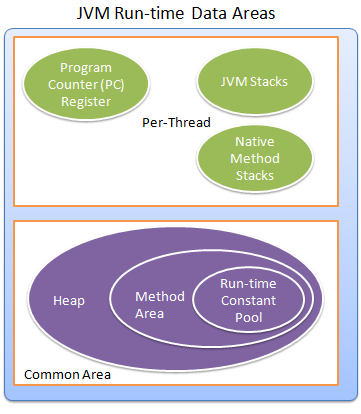
- program counter (PC) register keeps track of the current instruction executing at any moment
## Class.forName() 的用途
> The big difference with the traditional `new` is that `newInstance()` allows to instantiate a class that you don't know until runtime, making your code more dynamic.
[What is the difference between `Class.forName()` and `Class.forName().newInstance()`?](https://stackoverflow.com/a/2093100)
[`Class` object | Java SE 8 Document](https://docs.oracle.com/javase/8/docs/api/java/lang/Class.html)
## Java Memory Model

[Java (JVM) Memory Model – Memory Management in Java 7](https://www.journaldev.com/2856/java-jvm-memory-model-memory-management-in-java)
## Java 8 standard and advanced options
[Java Synopsis and options](https://docs.oracle.com/javase/8/docs/technotes/tools/windows/java.html#BABDJJFI)
## Garbage Collection
Anatomy of a Garbage Collection Log Statement

[Garbage Collection log](https://dzone.com/articles/understanding-garbage-collection-log)
 Sign in via Google
 Sign in via Facebook
 Sign in via X(Twitter)
 Sign in via GitHub
 Sign in via Dropbox
 Sign in with Wallet
Connect another wallet
Sign in with Wallet
Connect another wallet