# RELINQUISH - A Game of Math & Magic
v2.2
Created by: Kevin Nguyen @lightandluck
Thanks to: Andrew W., Jaime D., Dizzle, A. Wesley, Benedict L., Scott M., Curtis WM, dcwalk, MT, Oren R., Bear, Viktor S., Guillem, Matthias, Magic: The Gathering, Radlands - and Adam
- For 2-4 people.
- You will need one - 78-card Tarot deck. Though you could play with a tarot deck with any design, one with easily visible suits and Arabic numerals makes things easier because Relinquish depends on a lot of addition and subtraction. See recommendations below.
## What is a tarot deck?
A 78-card tarot deck is a superset of the regular 52-card playing decks that most people are familiar with. It contains all the cards in a 52-card deck and more. Like a normal deck, there are 4 suits, but in Relinquish they are named: Wands, Cups, Swords, and Pence.
There are numbered cards from 1 to 10 of each suit. Instead of the 3 face cards we're used to, in a tarot deck there are 4 face cards of each suit. In Relinquish they are called (in increasing rank): Page, Knight, King, Queen. The numbered cards and face cards, which total 54 cards, make up what is called the Minor Arcana. The rest of the 22 cards are called the Major Arcana. They usually are numbered with roman numerals and are what people think of when they hear of tarot cards like "Death", "The Empress", or "The Fool".
## Card types and Definitions
There are 3 card types in Relinquish
1) COMMON - These are numbered 1 to 10 and are suited. These are the main resources in the game. They are used to pay the cost for summoning Court cards. They are also used to activate special abilities.
2) COURT - These are also suited and are named (in increasing rank): Page (these may be named Knave in your particular tarot deck), Knight, King, Queen. The are used in Battle to try and capture Standing Common cards.
3) TAROT - These are numbered from 0 to 21 with roman numerals, and have specific names (i.e. The World, Strength, The Hanged Man, etc.) They have multiple effects like SCRYing for cards, murdering Court cards, and capturing Resting Common cards.
In Relinquish, instead of drawing cards, certain cards and abilities allow you to SCRY. You also SCRY when receiving an ACCEPTANCE at the end of your turn.
To <a id="scry">SCRY</a> means to draw 2 cards from the scry pile, then put one into your hand and the other into the discard pile.
## Deck Recommendations
- Recommended decks: These are recommended because there is a clear delineation between the 3 types of cards: Commons, Courts, and Tarots. And the numbers allow easy counting and are in a uniform place. There are other decks that have this format that can be used.
The Avalon deck is nice because it has large icons for the suits. Unfortunately, it's out-of-print and hard to find. (Fun fact: It was the deck that was used in the creation of Relinquish!) The Universal Tarot is easier to find and is also nice because it is a revamp of the traditional Rider-Waite-Smith tarot decks that people are familiar with.
http://www.aeclectic.net/tarot/cards/avalon/

http://www.aeclectic.net/tarot/cards/universal-lo-scarabeo/

http://www.aeclectic.net/tarot/cards/golden-klimt/
  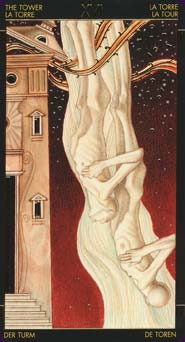
- Not-recommended examples: Though there are many varieties of decks that are amazing and beautiful, they make it difficult to play Relinquish.

## Objective
Play cards using different maneuvers and abilities and be the person (or team) with the highest total value of Commons at the end of the game.
## Setup
0) There are 3 different piles for the game.
- Scry pile - cards are scryed from here
- Discard pile - cards that are not accepted during scrys are placed here. Also, cards that are used in combat are placed here
- Exile pile - The cards used to determine first player go here. Also, Tarot that are used go here. These cards can not be brought back into the game.
1) Shuffle the whole deck and then deal 13 cards to each player.
- Then to determine who goes first, flip a card for each player. Highest card goes first.
- These cards are put into exile and can be used as blind cards for clashes (see Battle).
- For 1st player purposes, cards are ranked: Tarot > Court > Commons
- If there's a tie, flip additional cards to break the tie
2) Flipped cards then create the exile pile. The undealt cards create the scry pile. If the scry pile ever runs out, shuffle the discards to create a new scry pile.
- For a shorter or teaching game, deal 16 cards to the scry pile and put the rest of the deck in exile.
4) Play happens in whatever direction players agree to. If playing teams, make sure teammates sit across from each other.
## Quick Reference
**Tips:**
- Lots of distinctions revolve around the number 13.
- 13 is the number of cards dealt per player.
- Tarot cards with value >= 13 (Death card) can be exiled to perform a MURDER.
- Tarot cards with value < 13 can be exiled to SCRY twice.
- Standing - card is upright. Resting - card is turned sideways.
- Commons are what count towards victory points at the end of the game. Court cards allow you to capture *Standing* Commons. Tarot cards allow you to capture *Resting* Commons. Commons remain in the position they were captured. Captured Standing Commons can still be used to pay costs or activate abilities.
- When Tarots are played, they are exiled. Exiled means they are removed from the game. They go into the exile pile. They cannot be recovered or used again for the rest of the game.
- At the beginning of your turn, ARISE (turn upright)
- At the end of your turn you can choose to DEFEND (rest 1 common)
- At the end of your turn you receive an ACCEPTANCE (scry once). Once the scry pile has been reshuffled, there are no more Acceptances. You can still scry using Tarot abilities or the Cups arcana ability.
**Quick play rules:**
- **I) Player Turn** - At the beginning of your turn (Arise), STAND (turn upright) all of the cards in your tableau. Then, perform up to 1 of each Maneuver in any order and then pass turn. Each Maneuver is optional. Cards start upright (Standing), and then turned sideways (Resting) when performing some maneuvers or activating special abilities.
Maneuver | Description
:---: | ---
Populate | Place 1 Common card greater than or equal to highest standing Common already in your tableau.
Summon | Place 1 Court card, paying for it's cost by Resting the required number of Common cards. The rank of the Court card must be greater than or equal to the highest standing Court card already in your tableau.
Magick | Exile 1 Tarot card for different effects: <br/>• Enchant - capture Resting Commons whose total value equal the Tarot used. This can be countered by opponent by playing a Tarot of their own (Negate). <br/>• Augur - Scry by exiling a Tarot of value < 13 <br/>• Murder - Send a Court card to the discard pile by exiling a Tarot of value >= 13. This can be countered by the opponent by playing a Tarot of greater value (Foil).
Battle | Declare battle and resolve in series of clashes between Court cards
Fortify | Rest 1 Common card at the end of your turn.
At the end of your turn (Acceptance), Scry once from the scry pile. When the scry pile is empty, shuffle the discard pile to create a new scry pile. THERE ARE NO MORE ACCEPTANCES FOR THE REST OF THE GAME. You will only be able to scry further cards either using the Augur ability of Tarot cards or the special ability of the Cups (Lavish).
- **II) Battle** - Courts attack and try to capture opponents Standing Commons. Battle happens in series of Clashes between your Court card and opponent's Court card.
- The attacking player designates which Court cards are attacking by Resting them.
- Winner is determined by greatest Strength (optionally Rally-ed with Common card). If attacking player wins, the Common card that is captured is determined by the rank of the winning Court card.
Court Rank | Strength | Which Common to capture
:---: | --- | ---
Page | 0 | lowest standing value
Knight | 1 | lowest standing value
King | 2 | highest standing value
Queen | 3 | highest standing value
- You can Rally (add to) the Strength of Clashing Court cards with a Common from your hand. Use the blind cards to hide from your opponent whether you're choosing to Rally or not. Rallies (the Common cards used) are discarded at end of the Clash.
- The losing Court card is also discarded. The winning Court card remains. If you're attacking and win, capture a Common from opponent's village according to table.
- If you're defending, your Court card CAN defend against another attacker in another Clash. The defending Court card is not Rested.
- This means that a single Court card can defend against multiple attackers as long as it keeps winning.
- *One can defend many*
- **III) Special Abilities** - Rest 2 cards of matching suit or type to perform effects on other cards, scry, or play extra cards.
**Arcana** - Matching suits
Suit | Name | Description
:---: | --- | ---
Wands | Glamour | Rest or Stand a Common card
Swords | Coerce | Rest or Stand a Court card
Pence | Bounty | Add or subtract to the value of another Common card with one of the values of the Pence cards. The value of a Court card is its Strength.
Cups | Lavish | Scry once
**Finesse** - Matching type
Type | Name | Description
:---: | --- | ---
Common | Congregate | Put onto your tableau a Common card equal to the value of cards used
Court | Conscript | Put onto your tableau another Court card
# Full Rules
## Player Turn
The current player who is taking their turn is known as the ACTIVE player. Other player's who are not their partner, are their opponents.
At the beginning of your turn (Arise!), Stand all cards in your Kingdom.
A player's turn involves playing up to 1 of each type of card: Common, Court, Tarot. Common and Court cards will remain in their tableau, while Tarots are exiled after resolving their effects.
You can also declare battle, which is resolved in a series of clashes. Special abilities allow you to affect other cards and play additional cards.
As you place cards you'll build up your tableau.
Common and Court cards are played Standing, aka upright. They are Resting, aka turned sideways, when paying for costs, battling, or using abilities.
### Use Maneuvers in *any order* during a turn. Each one is optional:
- I) POPULATE: Place a Common card. It's value must be greater than or equal to the highest Standing Common in your Village.
- Example: You have a Standing 5 and 7 in your tableau. You want to play a 4 from hand. You cannot unless you can Rest the 5 and 7, either by using them to pay for a Summon or by using a Finesse or Arcana ability.
- II) SUMMON: Place a Court card. You must pay for the cost of the court card by either resting a certain number of cards with the same suit as the court card or a greater number of cards that don't match the suit. The court card must be greater or equal in rank to the highest Standing court card.
- Example: You want to play Page of Wands. If there are any standing Knight, King, or Queen in your tableau, you cannot do so. If there are no other court cards or only Pages, you can pay for the Page of Wands cost with a single Common that is also Wands or two Commons of different suits.
- To play a King of Swords, you can rest two Commons that are Swords or three Commons of any combination of suits. It must be higher rank than any other standing court card.
# of Commons of Matching Suit | # of Commons of Unmatched Suit | Court
:---: | --- | ---
1 | 2 | Page
1 | 2 | Knight
2 | 3 | King
2 | 3 | Queen
- III) MAGICK: Play a Tarot card for one of the effects below. Tarots are exiled from the game after use and GO INTO THE EXILE PILE.
- ENCHANT - Capture Resting Common cards from a single opponent. The combined value of the Commons must be equal to the value of the tarot's value. You must point out specifically which cards you are targeting because there may be multiple combinations that can add up to the tarot's value.
- NEGATE - The opponent (or their partner) can counter an Enchant with a tarot of a lower value if they can make a combination of Commons of those targeted, that have a value equal to their tarot instead.
- Beware! The Fool card has a value of 0 and it's possible to negate the total Enchant maneuver.
- Example: You have Resting 3, 4, 9. Your opponent tries to take all of them with The Tower (XVI = 16). You negate that with The Empress (III = 3) and they take the 3 only instead.
- AUGUR - Exile a Tarot of value < 13 and Scry twice.
- MURDER - Tarot cards with value >=13 can kill any court card. The murdered Court is put into the discard pile.
- FOIL - The opponent (or their partner) can counter a Murder with a tarot card of greater value than the one used by the ACTIVE player. Nothing happens to the Court card, both Tarots are exiled from the game. Players can continue countering each other with sequentially higher Tarot cards.
- IV) [BATTLE](#battle): Battle allows the active player to capture an opponent's Standing Common cards. Battle is a series of Clashes between Court cards belonging to the player and an opponent (known as the DEFENDER). Battle can only happen once per turn, so all attacking Court cards must be declared together. The active player declares attackers by Resting participating Court cards and picking which opponent they want to attack with which Court card.
- V) FORTIFY: At the end of your turn, Rest 1 Standing Common card in your tableau.
You do not have to use every Maneuver (i.e. play every type of card) during your turn. When you are finished, declare end of turn and pass the turn to the next player.
### <a id="battle">Battle</a>
- All attackers must be declared at the same time. You can split attackers (some Court cards attacking one opponent, other Court cards attacking a different opponent). If attacking multiple opponents, the active player decides the order of who to resolve CLASHES with.
- If there are multiple Court cards attacking an opponent, the defender decides which ATTACKER they are defending against with their DEFENDER.
- The opponent then chooses whether or not to defend with one of their Court cards and a Clash begins to decide who wins.
- <a id="clash">CLASH</a> - Comparing the Strength + Rallies of Court cards to determines who wins the Clash
- Court cards have a strength value depending on their rank
Court | Strength
:--- | :---:
Page | 0
Knight | 1
King | 2
Queen | 3
- Players can then augment their court card's strength with a Common card from their hand. This is called a RALLY.
- To do so, each clashing player picks up a blind card (cards that are in the exile pile) and puts it into their hand. Players use the blind cards to hide whether they are using a Rally or not.
- Each player then chooses a Common card if they're using a Rally, or chooses the blind card if not, and places it facedown.
- Once both have decided, reveal the facedown cards.
- If a Common is revealed, add it's value to your Court card's strength. Add 0 if the blind card is revealed.
- The player with the highest combined value of Strengh + Rally wins the Clash.
- If the attacking Court wins a Clash, the defending Court card is discarded. Once they win or the DEFENDER declines to Clash, they capture one of the defender's Standing Common cards. Which one to capture is dependent on the rank of the winning Court card. The captured card is placed in their tableau.
Court | Which Common to Capture
:--- | :---:
Page, Knight | Lowest value among opponent's standing Commons
King, Queen | Highest value among opponent's standing Commons
For example: The defender has Standing Common cards of value: 1, 4, 6, 9.
If the attacking player wins a clash with a Page, they would take the defender's 1-Common card. If they win with a King, they would take the 9-Common card.
If there are multiple cards with the same value, the attacker chooses which Common among them to capture.
- If the defending Court card wins, no cards are captured. Their court card remains, and the attacking Court card is discarded.
- If it's a tie, then both Court cards are discarded and the attacking playing captures the corresponding ranked card according to the Court discarded.
- Battle continues resolving in CLASHES with the other Court cards that were declared attacking.
- A winning defender *can* use the same Court card to defend against other attackers in additional Clashes.
- This means that a single Court card can defend against multiple attackers as long as it keeps winning.
- *One can defend many*
### Special Abilities
Special abilities are additional actions you can use during your turn. They are activated by resting 2 Standing cards of the same suit or type. *Their effect can not be used on the cards that activated the ability.* You can use special abilities as long as you have enough Standing cards to activate them.
- #### <a id="arcana">ARCANA</a> (matching suits)
- GLAMOUR (Wands): Stand or Rest a Common card. This can only be used if it changes the position of the targeted card. (You can't Rest an already Resting card.)
- COERCE (Swords): Stand or Rest a Court card. This can only be used if it changes the position of the targeted card. (You can't Rest an already Resting card.)
- BOUNTY (Pence): Until end of turn, change the value of a Common by adding or subtracting either of the values of the cards used in the Bounty to the Common. Cards can end up with negative values. The value of Court cards is equal to their strength.
- Example: You can the 4 and 6 of Pence. The opponent has a 10 Common. You can add or subtract 4 from 10 to change its value to 6 or 14. You could instead add or subtract 6 from 10 to change its value to 4 or 16.
- LAVISH (Cups): Scry once. You can still use Lavish after Acceptances are done (the scry pile has been cycled through once).
- #### <a id="finesse">FINESSE</a> (matching type): Do not use these for a beginner game.
- CONGREGATE (Common): Place onto your tableau a common from hand by Resting 2 other common cards that sum up to the value of the played card.
- CONSCRIPT (Court): Place onto your tableau a court card from hand by Resting any 2 other court cards.
### End of turn
ACCEPTANCE - Scry once from the scry pile at the end of turn to get an additional card. Once the scry pile is empty, you shuffle the discard pile and create a new scry pile. THERE ARE NO MORE ACCEPTANCES FOR THE REST OF THE GAME. You can only scry from the new scry pile using Lavish (special ability of cup cards) or Augur (using a Tarot).
## Game End
The game ends when a player ENDS their turn and has no more cards in hand. It does not end if someone other than the active player has 0 cards in hand at the end of the turn. The active play can still perform any abilities or battle without cards in hand before choosing to end their turn.
The game also ends if all players PASS consecutively in a row.
Once the game has ended, each player or team adds up the total value of all Commons in their tableau(s). The player (or team) with the highest score wins the game!
If there is a tie, the player (or team) with the most number of Court cards in their tableau is the winner.
If there is still a tie, the win is shared.
## Variations
1. 2v2 - 4 players, with 2 partners on a team. Partners sit next to each other. Play happens in a zig-zag pattern rather than a circle, so that players from opposing teams alternate turns.
2. For an easier beginner game, don't use FINESSE abilities to start. Also, don't end turns with an Acceptance. Play only with the cards dealt and obtained through special actions to get used to the mechanics of the game.
## Things to playtest
- Should ENCHANTs be able to affect cards from multiple players?
- Should the ARCANA abilities be able to be used during another player's turn somehow?
- How much information can partners share?
- Can partners add to RALLIES? How would that be communicated?
- What powered up abilities can be used if a Court card is involved?
- What mechanic could we add to put cards back into a player's hand?
### Feedback from playsesh 2020-08-07
- dcwalk:
- enjoy the broad strokes and mechanics!
- battle dynamic a little confusing -- not clear what calculations you should be make about whether worth it, the resolution of card order adds a complexity that seems like it could be streamlined. Right now seems a little underpowered of a mechanic, as someone who failed every (?) attack I'm not sure why I would attack anyone in the future
- *** A lot of moving parts that can be hard to hold together in mind. Wonder if there is a simpler "base version" and extra aspects can be considered like "variations" once the basics are mastered? are there ways to streamline components?
- Multiple different ways that calculations are done seems to add some difficulty, e.g., how you look at numbers to lay down, scry, battle. Maybe reduce one "stream" of these calculations?
- Some visual guide about the suits powers in the commons seems important -- found difficult to keep them all straight. but also tho, can this mechanic maybe be part of a variation?
- closeness to magic but different terminology a little confusing as someone moderately familiar. I wonder how to avoid that? Never mention magic? or lean into it and only use magic terminology?
 Sign in with Wallet
Connect another wallet
Sign in with Wallet
Connect another wallet