# Creative Commons for Academic Librarians: a starter
Raphaël Grolimund
March 2024
----
**hint**
press `esc`
to switch between
a single slide and the presentation overview
----
:::info
cite as
"[Creative Commons for Academic Librarians: a starter](https://hackmd.io/@grolimur/rkYZlJVJC)" by Raphaël Grolimund is published under [CC BY 4.0](https://creativecommons.org/licenses/by/4.0/deed) license
:::
---
## Open Access (OA)
----
:::info
"[...] free availability on the public internet, permitting any users to read, download, copy, distribute, print, search, or link to the full texts of these articles, crawl them for indexing, pass them as data to software, or use them for any other lawful purpose, without financial, legal, or technical barriers other than those inseparable from gaining access to the internet itself." (Chan *et al.* 2002)
:::
----
Important components of the OA model include:
1. Authors keep their copyright.
2. Zero embargo period.
3. Share the research data with the article.
4. Add a Creative Commons license to the research article that enables text and data mining (any of the licenses work, but CC BY is preferred).
"[Open Access to Scholarship](https://certificates.creativecommons.org/cccertedu/chapter/6-1-open-access-to-scholarship/)" by [Creative Commons](https://creativecommons.org/). [CC BY 4.0](https://creativecommons.org/licenses/by/4.0/deed).
----
### Open Access Main Roads
1. **Green** Open Access
2. **Gold** Open Access
3. **Diamond** Open Access
----
1. **Green Open Access** (aka self-archiving)
Publication made freely available **by the authors** in a thematic (e.g. [arXiv](https://arxiv.org) or [bioRxiv](https://www.biorxiv.org/)) or institutional (e.g. [at my institution](https://arodes.hes-so.ch/)) repository.
**Fun fact**: The [CERN Document Server](https://cds.cern.ch/) is both thematic and institutional. :wink:
Green OA usually relies on the traditional publication process, where the author published for free, but the libraries may have to pay for access.
-----
2. **Gold** Open Access
Publication freely available immediately upon publication **by the publisher** (e.g. [PLoS](https://www.plos.org))
Gold OA makes scientific publications available for free for readers, but researchers usually have to pay an article processing charge (APC) to publish ther articles.
----
3. **Diamond** Open Access
Publication made freely available **by the journal** for free for authors and readers (e.g. [University of Fribourg-led platform](https://www.soap2.ch/our-journals/)).
Diamond OA journals are founded by community and academic initiatives.
----
### IMPORTANCE OF OA
Open Access is important because it facilitates the dissemination of scientific findings to students, teachers and people all around the world, including low-income countries where highly expensive subscriptions to scientific databases are not affordable.
----
[VIDEO BONUS]
----
{%youtube L5rVH1KGBCY %}
----
“[Open Access Explained!](https://phdcomics.com/tv/?v=L5rVH1KGBCY)” animation by Jorge Cham, narration by Nick Shockey and Jonathan Eisen, transcription by Noel Dilworth Produced in partnership with the Right to Research Coalition, the Scholarly Publishing and Resources Coalition and the National Association of Graduate-Professional Students. [CC BY 3.0](https://creativecommons.org/licenses/by/3.0/deed).
---
## Open Educational Resources (OER)
----
:::info
"Open Educational Resources (OER) are teaching, learning, and research materials that are either (a) in the public domain or (b) licensed in a manner that provides everyone with free and perpetual permission to engage in the 5R activities (retain, reuse, revise, remix, redistribute)."
"[OER, Open Textbooks, and Open Courses](https://certificates.creativecommons.org/cccertedu/chapter/6-2-oer-open-textbooks-open-courses/#footnote-128-3)" by [Creative Commons](https://creativecommons.org/). [CC BY 4.0](https://creativecommons.org/licenses/by/4.0/deed).
:::
----
Open Educational Resources was coined by UNESCO in 2002. (Chiu 2016, p. 411)
----
The 5Rs include:
1. Retain
2. Reuse
3. Revise
4. Remix
5. Redistribute
"[OER, Open Textbooks, and Open Courses](https://certificates.creativecommons.org/cccertedu/chapter/6-2-oer-open-textbooks-open-courses/#footnote-128-3)" by [Creative Commons](https://creativecommons.org/). [CC BY 4.0](https://creativecommons.org/licenses/by/4.0/deed).
----
### 1
`Retain` – permission to make, own, and control copies of the content (e.g., download, duplicate, store, and manage)
"[OER, Open Textbooks, and Open Courses](https://certificates.creativecommons.org/cccertedu/chapter/6-2-oer-open-textbooks-open-courses/#footnote-128-3)" by [Creative Commons](https://creativecommons.org/). [CC BY 4.0](https://creativecommons.org/licenses/by/4.0/deed).
----
### 2
`Reuse` – permission to use the content in a wide range of ways (e.g., in a class, in a study group, on a website, in a video)
"[OER, Open Textbooks, and Open Courses](https://certificates.creativecommons.org/cccertedu/chapter/6-2-oer-open-textbooks-open-courses/#footnote-128-3)" by [Creative Commons](https://creativecommons.org/). [CC BY 4.0](https://creativecommons.org/licenses/by/4.0/deed).
----
### 3
`Revise` – permission to adapt, adjust, modify, or alter the content itself (e.g., translate the content into another language)
"[OER, Open Textbooks, and Open Courses](https://certificates.creativecommons.org/cccertedu/chapter/6-2-oer-open-textbooks-open-courses/#footnote-128-3)" by [Creative Commons](https://creativecommons.org/). [CC BY 4.0](https://creativecommons.org/licenses/by/4.0/deed).
----
### 4
`Remix` – permission to combine the original or revised content with other material to create something new (e.g., incorporate the content into a mashup)
"[OER, Open Textbooks, and Open Courses](https://certificates.creativecommons.org/cccertedu/chapter/6-2-oer-open-textbooks-open-courses/#footnote-128-3)" by [Creative Commons](https://creativecommons.org/). [CC BY 4.0](https://creativecommons.org/licenses/by/4.0/deed).
----
### 5
`Redistribute` – permission to share copies of the original content, your revisions, or your remixes with others (e.g., give a copy of to a friend)
"[OER, Open Textbooks, and Open Courses](https://certificates.creativecommons.org/cccertedu/chapter/6-2-oer-open-textbooks-open-courses/#footnote-128-3)" by [Creative Commons](https://creativecommons.org/). [CC BY 4.0](https://creativecommons.org/licenses/by/4.0/deed).
----
### IMPORTANCE OF OER
Open Educational Resources remove cost barriers and grant people required permissions to share and remix knowledge.
It enables students to learn anywhere in the world, including in poor countries, based on quality content.
----

"[OER-Enabled Pedagogy](https://fr.slideshare.net/opencontent/oerenabled-pedagogy)" (slide 16) by David Wiley. [CC BY 4.0](https://creativecommons.org/licenses/by/4.0/deed).
---
## OA & OER
----
:::warning
As you have probably guessed, Open Educational Resources are open access, but not all Open Access publications are Open Educational Resources.
The NoDerivatives clause is incompatible with the OER defintion, because it makes it impossible for others, including teachers, to remix or translate the content.
:::
----
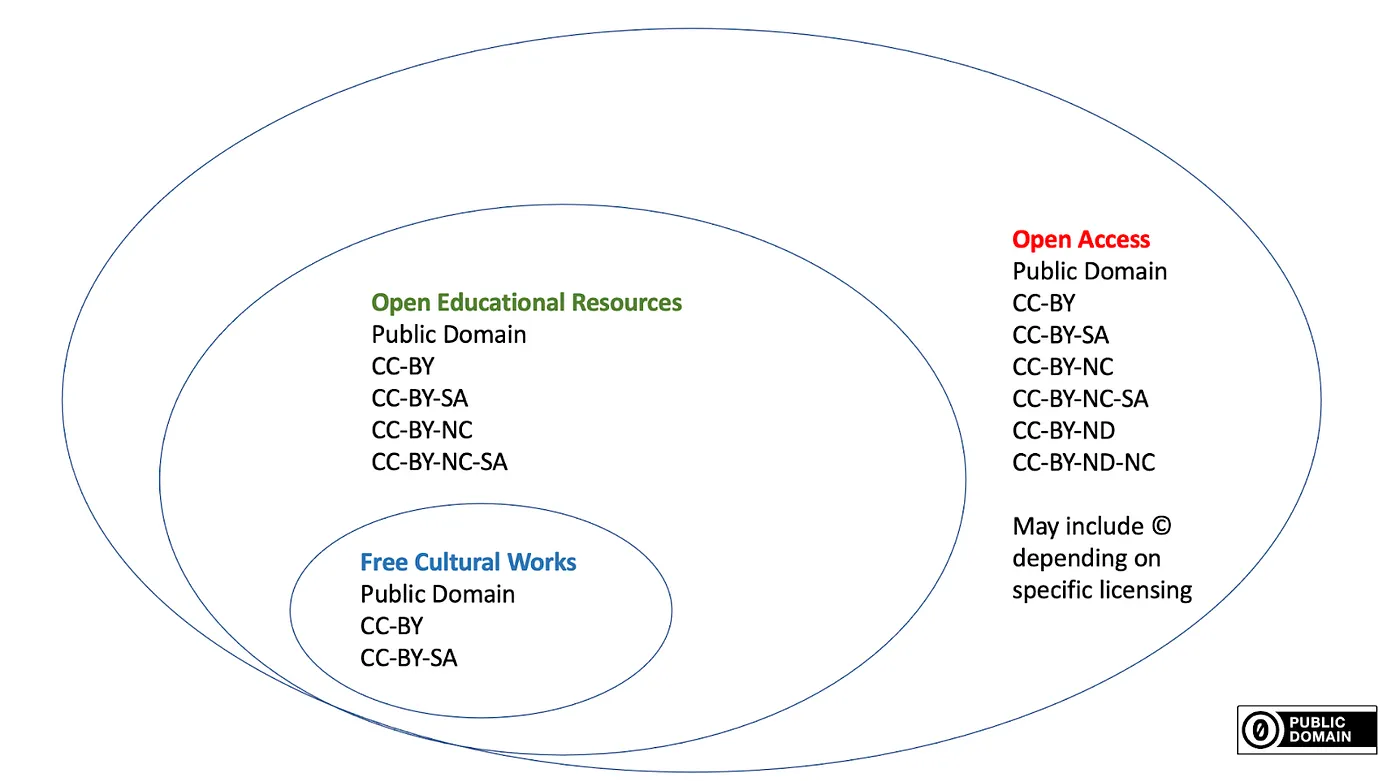
"[Clarification of Free Cultural Works, Open Educational Resources and Open Access](https://medium.com/creative-commons-we-like-to-share/clarification-of-free-cultural-works-open-educational-resources-and-open-access-ff03e3b594af)" by Paul G. West. [CC BY 4.0](https://creativecommons.org/licenses/by/4.0/deed).
----
OER are important because they
1. increase access to knwoledge
2. improve quality of the material
3. reduce costs for students
... making knowledge accessible and affordable to everyone (with an Internet connexion) all around the world.
"[Open Education Matters: Why is it important to share content?](https://youtu.be/dTNnxPcY49Q)" by Nadia Mireles, [CC BY 3.0](https://creativecommons.org/licenses/by/3.0/deed).
---
## References
CHAN, Leslie et al., 2002. Read the Budapest Open Access Initiative. *Budapest Open Access Initiative* [online]. 14 February 2002. Retrieved from : http://www.opensocietyfoundations.org/openaccess/read [accessed 29 March 2024].
CHIU, Mei-Hung (éd.), 2016. *Science Education Research and Practice in Asia: Challenges and Opportunities*. Singapore : Springer. ISBN 9789811008474.
{"title":"Creative Commons for Academic Librarians","description":"===","contributors":"[{\"id\":\"67c45135-2d65-4482-9470-75e7c4fbf33d\",\"add\":9748,\"del\":1117}]"}