# EIP-8025: The Missing Trust Anchor for Proof Load
> **Status:** draft for discussion
> **Related:** [consensus-specs#5055](https://github.com/ethereum/consensus-specs/pull/5055)
> **Author:** `@frisitano`
---
## TL;DR
Current Ethereum has an implicit **trust anchor** — a single proposer per slot — that bounds how much *block*-validation work a peer can be forced to do per slot. EIP-8025 introduces optional execution proofs and anchors them via **validator signatures** (each proof is stake-bound to a validator key). The open question this doc raises is whether that is sufficient: because **any** validator can sign **any** proof, there is no equivalent per-slot cap on proofs, and an attacker with multiple validators can amplify proof-validation load at will — creating a denial-of-service vector against proof-verifying nodes.
This doc frames the problem, lays out two candidate answers — **p2p peer-level banning** and **validator-level banning** — and argues that the key open question is whether peer-layer banning alone is *sufficient*.
---
## Terminology
- **Trust anchor** — an in-protocol mechanism that bounds a per-slot quantity by tying it to a stake-bound, rate-limited choke point.
- **Proof validating node** — a validator that opts into validating execution proofs.
- **Resigning** — replacing the signature carried with a gossiped proof so that the propagating validator, not the original signer, is accountable for what they forwarded.
---
## 1. Background: the implicit trust anchor
In the current Ethereum protocol:
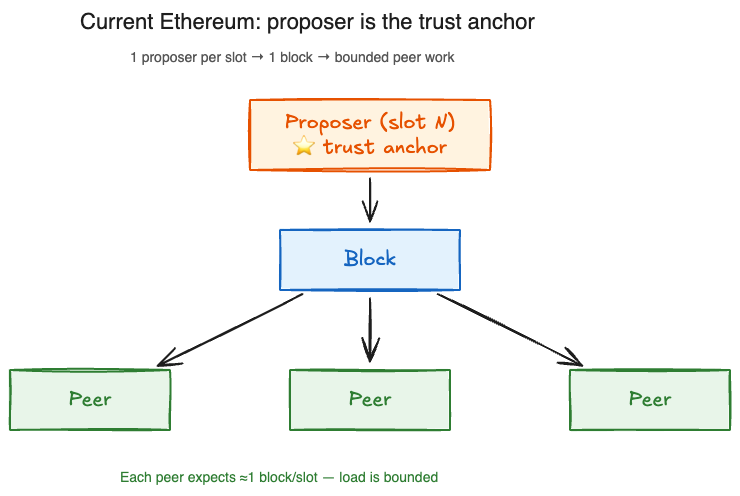
- Each slot has **exactly one** designated proposer.
- Honest nodes only accept blocks from that proposer for the slot.
- Therefore, the number of distinct blocks a peer expects to process per slot is bounded at ≈1 (with occasional forks).
The proposer selection mechanism is the trust anchor: it is *in-protocol*, it is bound to stake, and it is rate-limited by the slot schedule. Everything downstream — block validation, state transition , etc— inherits a bound from this single choke point.
[](https://raw.githubusercontent.com/frisitano/slides/main/writeups/diagrams/01-current-trust-anchor.png)
> *Figure 1 — One proposer per slot → one block per slot → bounded peer work per slot.*
---
## 2. What changes under EIP-8025
EIP-8025 makes proof generation **optional**:
- Block builders are not required to produce proofs.
- Any validator may produce and sign a proof for any block.
- Proofs propagate over the p2p network and are consumed by proof validating nodes (and other interested consumers).
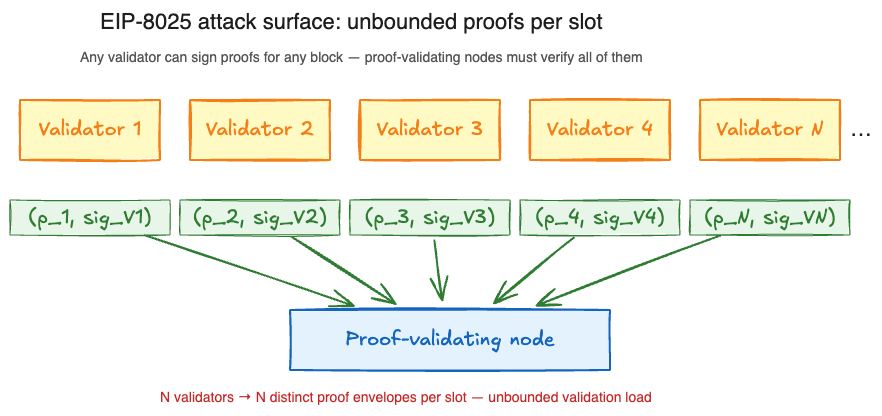
Critically, **there is no protocol-level constraint on how many distinct proofs exist per slot**. If the trust anchor in §1 bounded the number of *blocks*, nothing bounds the number of *proofs*.
---
## 3. The attack
An adversary with access to stake can:
1. Acquire M validators by depositing stake.
2. Use each validator to sign **invalid** proofs for blocks.
3. Gossip those invalid proofs over the p2p network.
4. Honest proof validating nodes who receive these proofs must verify them (~80-200ms each)
The attacker's cost is O(stake); the victims cost scales with proof validation time.
[](https://raw.githubusercontent.com/frisitano/slides/main/writeups/diagrams/02-eip8025-no-anchor.png)
> *Figure 2 — N validators at the top, each producing its own envelope `(p_i, sig_Vi)` that fans into the proof-validating node. With no in-protocol cap, an attacker controlling many validators can amplify this load at will.*
---
## 4. Candidate answer A: p2p peer-level banning
**Mechanism:**
- Invalid proofs are detected at the p2p layer.
- The *peer* (not the validator) is scored down / banned.
- Attacker gains no persistent ability to force work; they can churn peer identities but not validator stake.
**Argument for sufficiency:**
- Peer-level banning is already the standard tool for gossip-layer abuse.
- No new consensus-layer machinery is needed.
- Validator-level accountability is heavier than the problem calls for.
**Open question this leaves:**
- Can an attacker with M validators produce invalid proofs faster than peer-banning can propagate identity bans? If peer identity is cheap to rotate but *validator-to-peer* binding is not enforced, the attacker may simply rotate peer identities while continuing to abuse validator signatures.
---
## 5. Candidate answer B: validator-level banning
**Mechanism.** If a validator signs an invalid proof, peers ignore further proofs signed by that validator key (possibly with time-based expiry). Attacker cost now scales with invalid proofs issued — each validator burns its key after one.
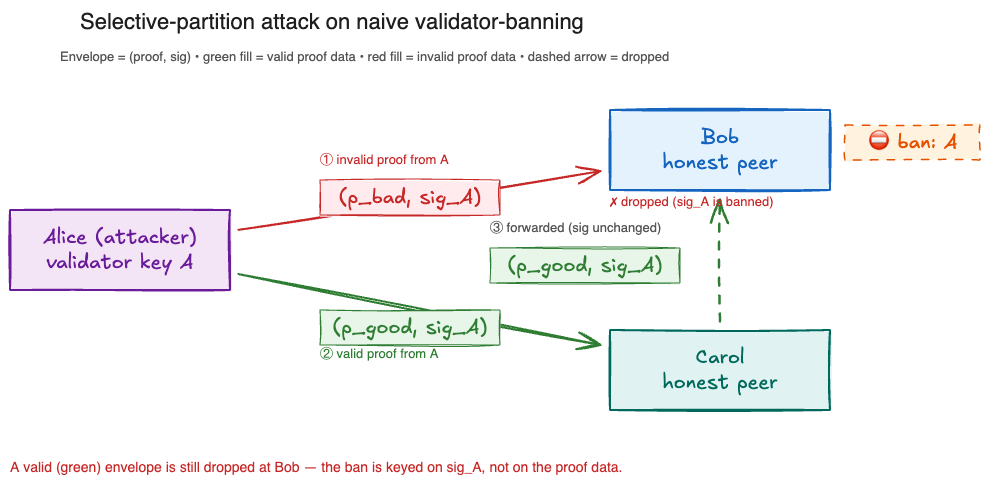
**Problem — partition via selective gossip.** Because banning keys off the *original* signature, an attacker can weaponise it: Alice sends `(p_bad, sig_A)` to Bob (Bob bans key A), then `(p_good, sig_A)` to Carol; when Carol forwards Alice's valid envelope to Bob, Bob drops it — `sig_A` is banned. One invalid proof has censored a valid one, and scaled up this partitions which honest peers see which valid proofs.
[](https://raw.githubusercontent.com/frisitano/slides/main/writeups/diagrams/03-selective-partition-attack.png)
> *Figure 3 — Alice sends `(p_bad, sig_A)` to Bob (invalid, red envelope) and `(p_good, sig_A)` to Carol (valid, green envelope). When Carol forwards `(p_good, sig_A)` to Bob, Bob drops it: the ban is keyed on `sig_A`, not on the proof data.*
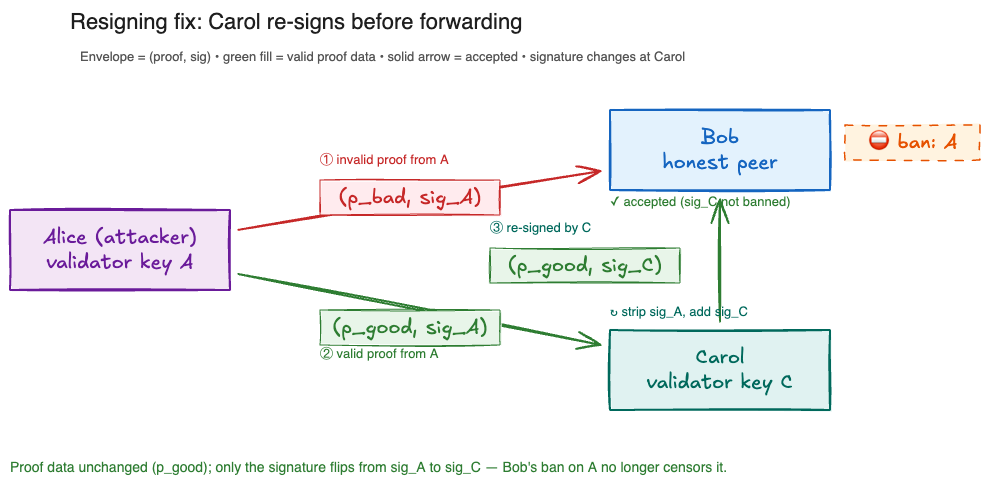
**Proposed fix — resigning at each hop.** Each forwarding validator replaces the signature on the gossiped envelope with their own before forwarding. Bob evaluates the proof against *Carol's* signature, not Alice's, so a ban on the originator cannot suppress valid content an honest validator chose to forward. Accountability follows the last signer, and validators stake their own key on what they re-sign.
[](https://raw.githubusercontent.com/frisitano/slides/main/writeups/diagrams/04-resigning-fix.png)
> *Figure 4 — Same scenario with resigning. Carol strips `sig_A` and adds `sig_C`, so the envelope Bob receives is `(p_good, sig_C)`. Proof data is unchanged; only the signature flips, and Bob's ban on key A no longer censors it.*
**Open questions:**
- Protocol complexity cost.
- Per-hop latency and bandwidth overhead.
- Net effect on signature-verification load vs the DoS surface it closes.
---
## 6. Future context: mandatory proofs restore the trust anchor
Under **mandatory proofs**, proof generation moves into the block-building pipeline itself: the builder constructing a block for a given slot is also responsible for producing its execution proof. With exactly one builder per slot, the **builder key becomes the trust anchor** — analogous to how the single proposer bounds blocks per slot today. Honest nodes accept only proofs signed by the slot's builder key, and the number of proofs a peer expects to attempt to verify per slot collapses back to O(1).
The DoS surface described in §3 therefore exists **only while EIP-8025 is optional**. It dissolves naturally once proofs are mandatory: without the ability for an arbitrary validator to sign a proof for any block, the attacker can no longer amplify verification load. Both candidate answers — peer-level banning (§4) and validator-level banning (§5) — should be read as **transitional mechanisms** that buy time between the optional-proof rollout and mandatory proofs, not as long-term protocol additions.
 Sign in via Google
 Sign in via Facebook
 Sign in via X(Twitter)
 Sign in via GitHub
 Sign in via Dropbox
 Sign in with Wallet
Connect another wallet
Sign in with Wallet
Connect another wallet