# 64. Minimum Path Sum
###### tags: `leetcode`
## Description
Given a `m x n` grid filled with non-negative numbers, find a path from top left to bottom right, which minimizes the sum of all numbers along its path.
Note: You can only move either down or right at any point in time.
Example 1:
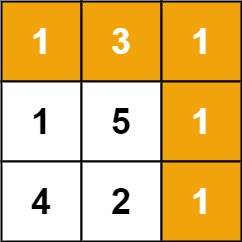
>Input: grid = [[1,3,1],[1,5,1],[4,2,1]]
Output: 7
>>Explanation: Because the path 1 → 3 → 1 → 1 → 1 minimizes the sum.
- Example 2:
>Input: grid = [[1,2,3],[4,5,6]]
Output: 12
- Constraints:
>m == grid.length
n == grid[i].length
$1 \leq m, n \leq 200$
$0 \leq grid[i][j] \leq 100$
## Solution
- The problem can be solved by using dynamic programming. To recurse for all the combination would bee a waste of time, so use an array to store all the information
- When the end is reached, just put the value in the dp set, and if it has only one direction left (either down or right), iterate to that direction
```cpp=
if (y == r)
{
if (x == c) dp[y][x] = grid[y][x];
else
{
if (grid[y][x + 1] != -1) minSubPathSum(grid, y, x + 1);
dp[y][x] = grid[y][x] + dp[y][x + 1];
}
}
else if (x == c)
{
if (grid[y + 1][x] != -1) minSubPathSum(grid, y + 1, x);
dp[y][x] = grid[y][x] + dp[y + 1][x];
}
```
- Else check the two direction if they are visited, go there and update the value. Choose the smaller one and update the table
```cpp=
else
{
if (grid[y][x + 1] != -1) minSubPathSum(grid, y, x + 1);
if (grid[y + 1][x] != -1) minSubPathSum(grid, y + 1, x);
dp[y][x] = grid[y][x] + min(dp[y][x + 1], dp[y + 1][x]);
}
```
- After updating the value, turn itself as `-1`, showing that it is finished and the value can be straightly used
```cpp=
grid[y][x] = -1;
```
 Sign in with Wallet
Connect another wallet
Sign in with Wallet
Connect another wallet