# 1547. Minimum Cost to Cut a Stick
###### tags: `leetcode`
## Description
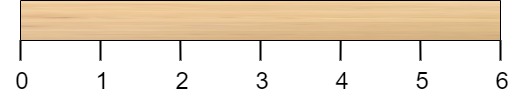
Given a wooden stick of length n units. The stick is labelled from 0 to n. For example, a stick of length 6 is labelled as follows:
Given an integer array cuts where cuts[i] denotes a position you should perform a cut at.
You should perform the cuts in order, you can change the order of the cuts as you wish.
The cost of one cut is the length of the stick to be cut, the total cost is the sum of costs of all cuts. When you cut a stick, it will be split into two smaller sticks (i.e. the sum of their lengths is the length of the stick before the cut). Please refer to the first example for a better explanation.
*Return the minimum total cost of the cuts.*
- Example 1:
>Input: n = 7, cuts = [1,3,4,5]
Output: 16
>>Explanation: Using cuts order = [1, 3, 4, 5] as in the input leads to the following scenario:
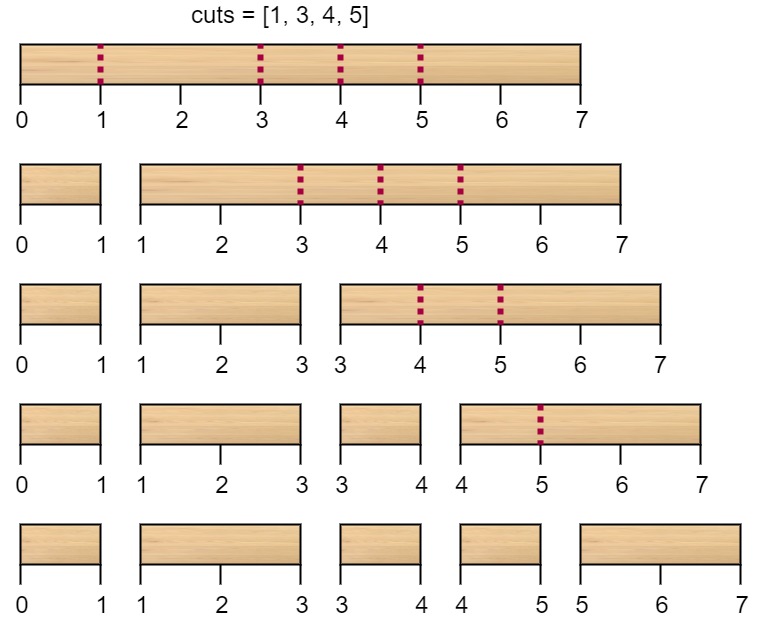
The first cut is done to a rod of length 7 so the cost is 7. The second cut is done to a rod of length 6 (i.e. the second part of the first cut), the third is done to a rod of length 4 and the last cut is to a rod of length 3. The total cost is 7 + 6 + 4 + 3 = 20.
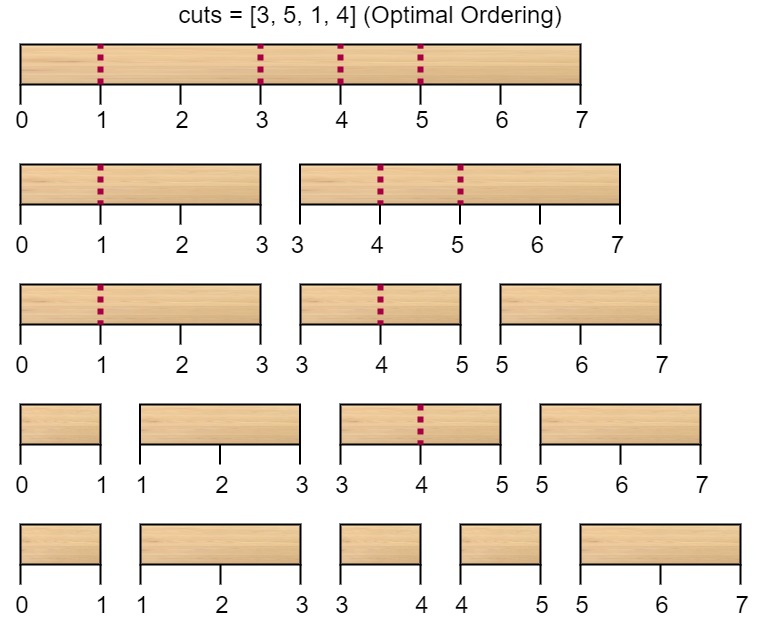
Rearranging the cuts to be [3, 5, 1, 4] for example will lead to a scenario with total cost = 16 (as shown in the example photo 7 + 4 + 3 + 2 = 16).
- Example 2:
>Input: n = 9, cuts = [5,6,1,4,2]
Output: 22
>>Explanation: If you try the given cuts ordering the cost will be 25.
There are much ordering with total cost <= 25, for example, the order [4, 6, 5, 2, 1] has total cost = 22 which is the minimum possible.
- Constraints:
>2 <= n <= 106
1 <= cuts.length <= min(n - 1, 100)
1 <= cuts[i] <= n - 1
All the integers in cuts array are distinct.
## Solution
- The problem is solved by `dynamic programming`, with each of the value in 2-dimensional array as the cost for curring from sub-index cuts
- To make the cut easier for implementation, sort the cut sequence and append the front and back into the array
```cpp=
sort(cuts.begin(), cuts.end());
cuts.insert(cuts.begin(), 0);
cuts.push_back(n);
```
- For the cutting, return the vector value if it has already been calculated or the cutting distance does not need to be calculated (no cut needed)
```cpp=
if (dp[l][r] != 0 || r - l < 2) return dp[l][r];
```
- For the normal case, add the original distance for two ends for the first cut. Iterate through all the possibilities for the cutting costs and use the smallest one for the two separation subcut
```cpp=
dp[l][r] = cuts[r] - cuts[l];
if (r > l + 2)
{
int temp = INT_MAX;
for (int i = l + 1; i < r; i++) temp = min(temp, minSubCost(cuts, l, i) + minSubCost(cuts, i, r));
dp[l][r] += temp;
}
```
 Sign in with Wallet
Connect another wallet
Sign in with Wallet
Connect another wallet