# 1035. Uncrossed Lines
###### tags: `leetcode`
## Description
You are given two integer arrays nums1 and nums2. We write the integers of nums1 and nums2 (in the order they are given) on two separate horizontal lines.
We may draw connecting lines: a straight line connecting two numbers nums1[i] and nums2[j] such that:
nums1[i] == nums2[j], and
the line we draw does not intersect any other connecting (non-horizontal) line.
Note that a connecting line cannot intersect even at the endpoints (i.e., each number can only belong to one connecting line).
Return the maximum number of connecting lines we can draw in this way.
- Example 1:
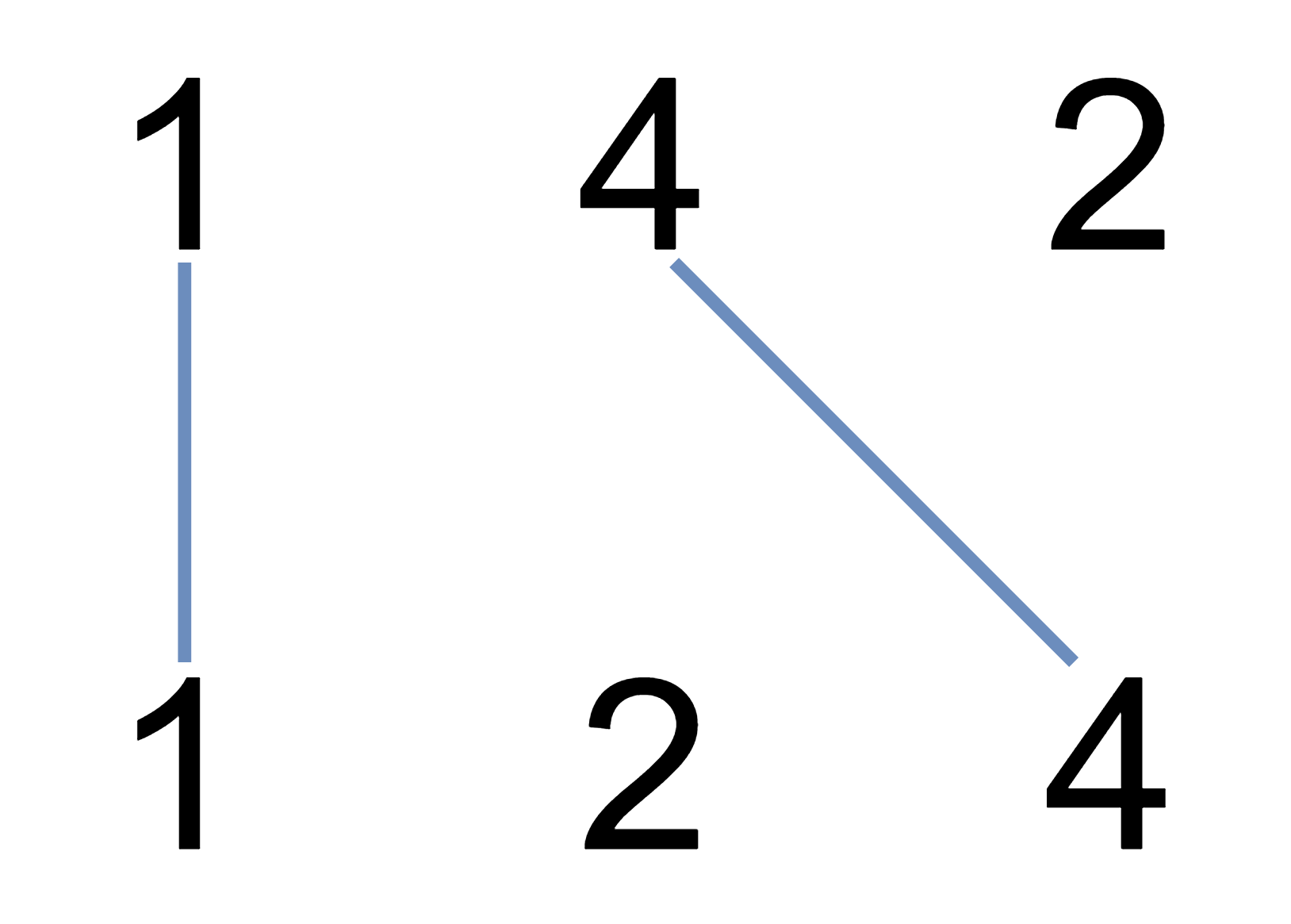
>Input: nums1 = [1,4,2], nums2 = [1,2,4]
Output: 2
>>Explanation: We can draw 2 uncrossed lines as in the diagram.
We cannot draw 3 uncrossed lines, because the line from nums1[1] = 4 to nums2[2] = 4 will intersect the line from nums1[2]=2 to nums2[1]=2.
- Example 2:
>Input: nums1 = [2,5,1,2,5], nums2 = [10,5,2,1,5,2]
Output: 3
- Example 3:
>Input: nums1 = [1,3,7,1,7,5], nums2 = [1,9,2,5,1]
Output: 2
- Constraints:
>1 <= nums1.length, nums2.length <= 500
1 <= nums1[i], nums2[j] <= 2000
## Solution
- The problem is relevant to dynamic programming
- To compute the value, we can calculate from the end to the whole string
- If the value for the tip of two substrings are the same, the count of crossing lines can add one with the left substring
```cpp=
if (nums1[i-1] == nums2[j-1]) dp[i][j] = dp[i-1][j-1] + 1;
```
- If the tip does not match, the possibility should be the two substrings with one tip missing
```cpp=
else dp[i][j] = max(dp[i-1][j], dp[i][j-1]);
```
 Sign in with Wallet
Connect another wallet
Sign in with Wallet
Connect another wallet