# 2316. Count Unreachable Pairs of Nodes in an Undirected Graph
###### tags: `leetcode`
## Description
You are given an integer `n`. There is an undirected graph with `n` nodes, numbered from `0` to `n - 1`. You are given a 2D integer array edges where `edges[i] = [ai, bi]` denotes that there exists an undirected edge connecting nodes `ai` and `bi`.
Return the number of pairs of different nodes that are unreachable from each other.
- Example 1:
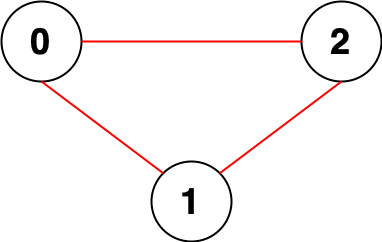
>Input: n = 3, edges = [[0,1],[0,2],[1,2]]
Output: 0
>>Explanation: There are no pairs of nodes that are unreachable from each other. Therefore, we return 0.
- Example 2:
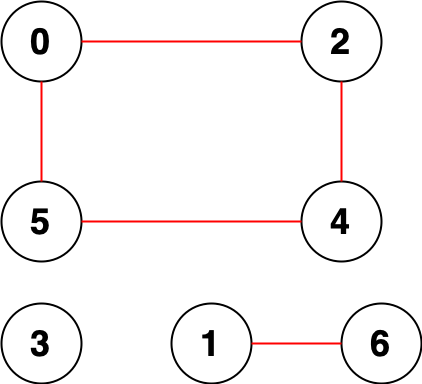
>Input: n = 7, edges = [[0,2],[0,5],[2,4],[1,6],[5,4]]
Output: 14
>>Explanation: There are 14 pairs of nodes that are unreachable from each other:
[[0,1],[0,3],[0,6],[1,2],[1,3],[1,4],[1,5],[2,3],[2,6],[3,4],[3,5],[3,6],[4,6],[5,6]].
Therefore, we return 14.
- Constraints:
>$1 \leq n \leq 10^5$
$0 \leq edges.length \leq 2 \times 10^5$
$edges[i].length == 2$
$0 \leq a_i, b_i < n$
$a_i \neq b_i$
There are no repeated edges.
## Solution
- The problem is to find the subset for each connected group
- By using `DFS`, we can simply group those connected graph together
```cpp=
void dfs(int i)
{
if (visit[i] == 0)
{
++cnt.back();
visit[i] = 1;
for (auto &j : graph[i])
dfs(j);
}
}
```
- Iterate through all the nodes and find the one that has not been iterated yet, dfs it
```cpp=
for (int i = 0; i < n; i++)
{
if (visit[i] == 0)
{
cnt.push_back(0);
dfs(i);
}
}
```
- For those that only have one connected set, the cross cost is `0`, which is an exceptional case
```cpp=
if (cnt[0] == n) return 0;
```
- To count for each two sets, the trick is to group the other counted set together and count it for one time in avoidance of two for loop
```cpp=
long long int ans = 0, temp = 0;
for (int i = 0; i < cnt.size(); i++)
{
ans += cnt[i] * (n - temp - cnt[i]);
temp += cnt[i];
}
return ans;
```
 Sign in with Wallet
Connect another wallet
Sign in with Wallet
Connect another wallet