# image-2-code
## 1
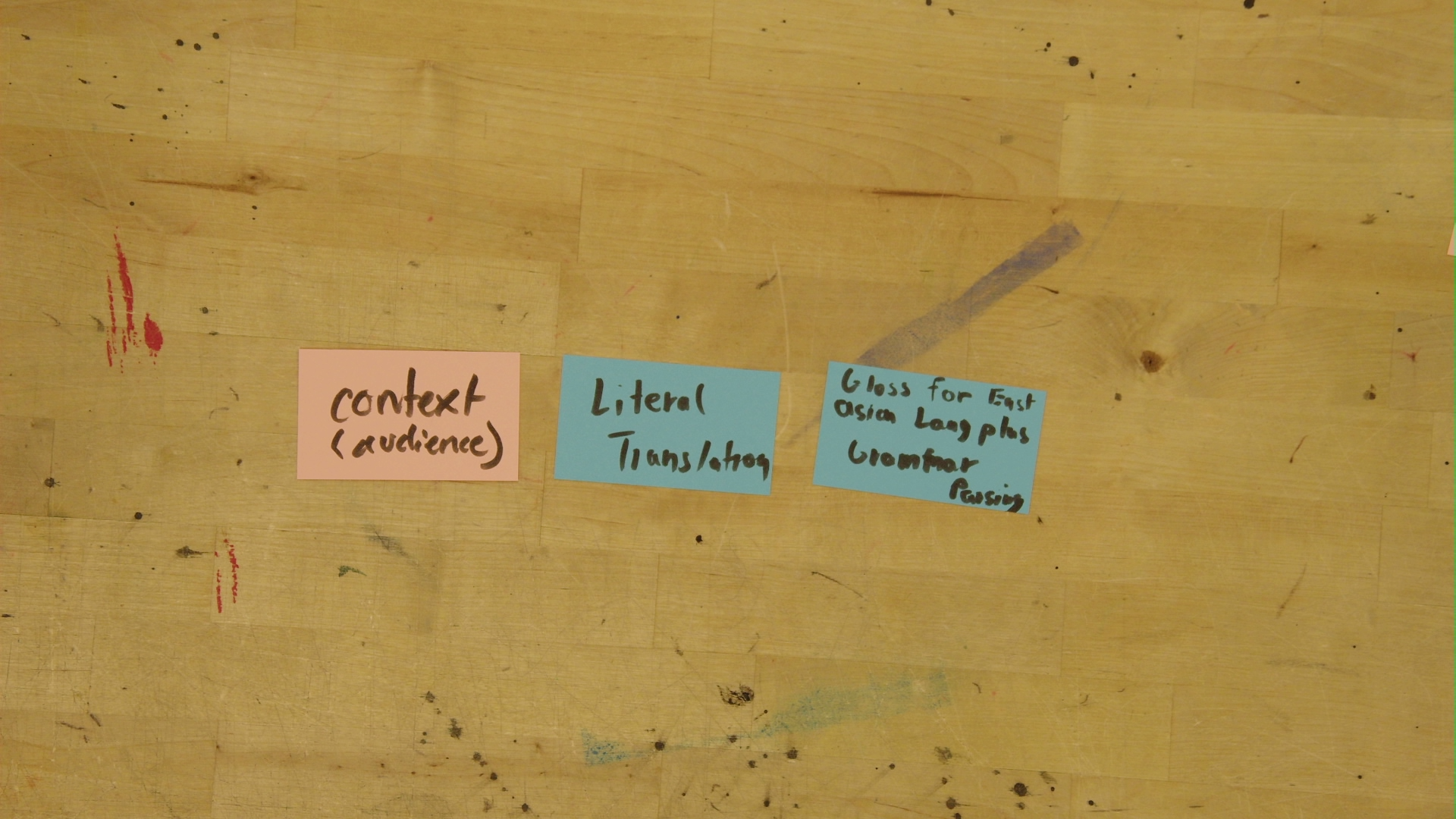
1. **Context (Audience)** → defines who the translation is for.
2. **Literal Translation** → generates a faithful, word-level translation.
3. **Gloss + Grammar Passing (for East Asian Languages)** → refines translation to include cultural/grammatical cues for pedagogy.
---
```python
# 🟧 CARD 1: CONTEXT (AUDIENCE)
def define_context(src_text: str, target_audience: str) -> str:
"""
Ask the model to analyze the source text and extract key context features
relevant to the target audience (e.g., tone, register, cultural references).
"""
prompt = f"""
You are preparing to translate a passage for a specific audience.
Source text:
{src_text}
Audience description:
{target_audience}
Step 1: Identify the intended communicative goals, tone, and cultural nuances.
Step 2: Suggest translation strategies to preserve those features.
Output only a short prose paragraph describing the translation approach.
"""
resp = client.responses.create(
model=MODEL_MAIN,
input=prompt
)
return resp.output_text.strip()
context_summary = define_context(SOURCE_TEXT, "English-speaking undergraduate students in a world literature course")
print(context_summary)
```
---
```python
# 🟦 CARD 2: LITERAL TRANSLATION
def literal_translation(src_text: str, context_notes: str) -> str:
"""
Perform a literal, close translation that preserves word order and syntax
as much as possible while remaining grammatical in English.
"""
prompt = f"""
Translate the following passage as literally as possible into English.
Use the context notes as interpretive guidance but avoid paraphrase.
<context>
{context_notes}
</context>
<source>
{src_text}
</source>
Output only the English translation text.
"""
resp = client.responses.create(
model=MODEL_MAIN,
input=prompt
)
return resp.output_text.strip()
draft_translation = literal_translation(SOURCE_TEXT, context_summary)
print(draft_translation)
```
---
```python
# 🟦 CARD 3: GLOSS + GRAMMAR PASSING (for East Asian Languages)
def gloss_and_grammar_pass(src_text: str, literal_english: str) -> str:
"""
Add interlinear glosses, key grammar notes, and minimal cultural annotations.
Especially suited for pedagogical translation of East Asian languages.
"""
prompt = f"""
You are producing a glossed translation for students learning about East Asian languages.
Starting from the literal English translation, provide:
• A brief interlinear gloss (word or phrase-level alignment)
• Grammar notes (e.g., particle usage, verb aspect, honorifics)
• Minimal commentary on cultural/idiomatic choices
Keep the gloss compact and suitable for classroom use.
Return as Markdown with the following sections:
### Gloss
### Grammar Notes
### Commentary
"""
resp = client.responses.create(
model=MODEL_MAIN,
input=prompt
)
return resp.output_text.strip()
annotated_translation = gloss_and_grammar_pass(SOURCE_TEXT, draft_translation)
display(Markdown(annotated_translation))
```
---
```python
# OPTIONAL: FEEDBACK + REVISION LOOP (reuses your sample functions)
feedback = judge_translation(SOURCE_TEXT, draft_translation)
revised_translation = revise_translation(SOURCE_TEXT, draft_translation, feedback)
print(revised_translation)
```
---
### 🧩 Summary of the Workflow
| Step | Card | Function | Purpose |
| ---- | ----------------------- | ---------------------------------------------- | -------------------------------------------- |
| 1 | 🟧 Context (Audience) | `define_context()` | Establish communicative and cultural frame |
| 2 | 🟦 Literal Translation | `literal_translation()` | Produce raw literal translation |
| 3 | 🟦 Gloss + Grammar Pass | `gloss_and_grammar_pass()` | Pedagogical refinement for language learners |
| 4 | (Optional Loop) | `judge_translation()` + `revise_translation()` | Iterative feedback/refinement chain |
---
## 2 (Jonah?)
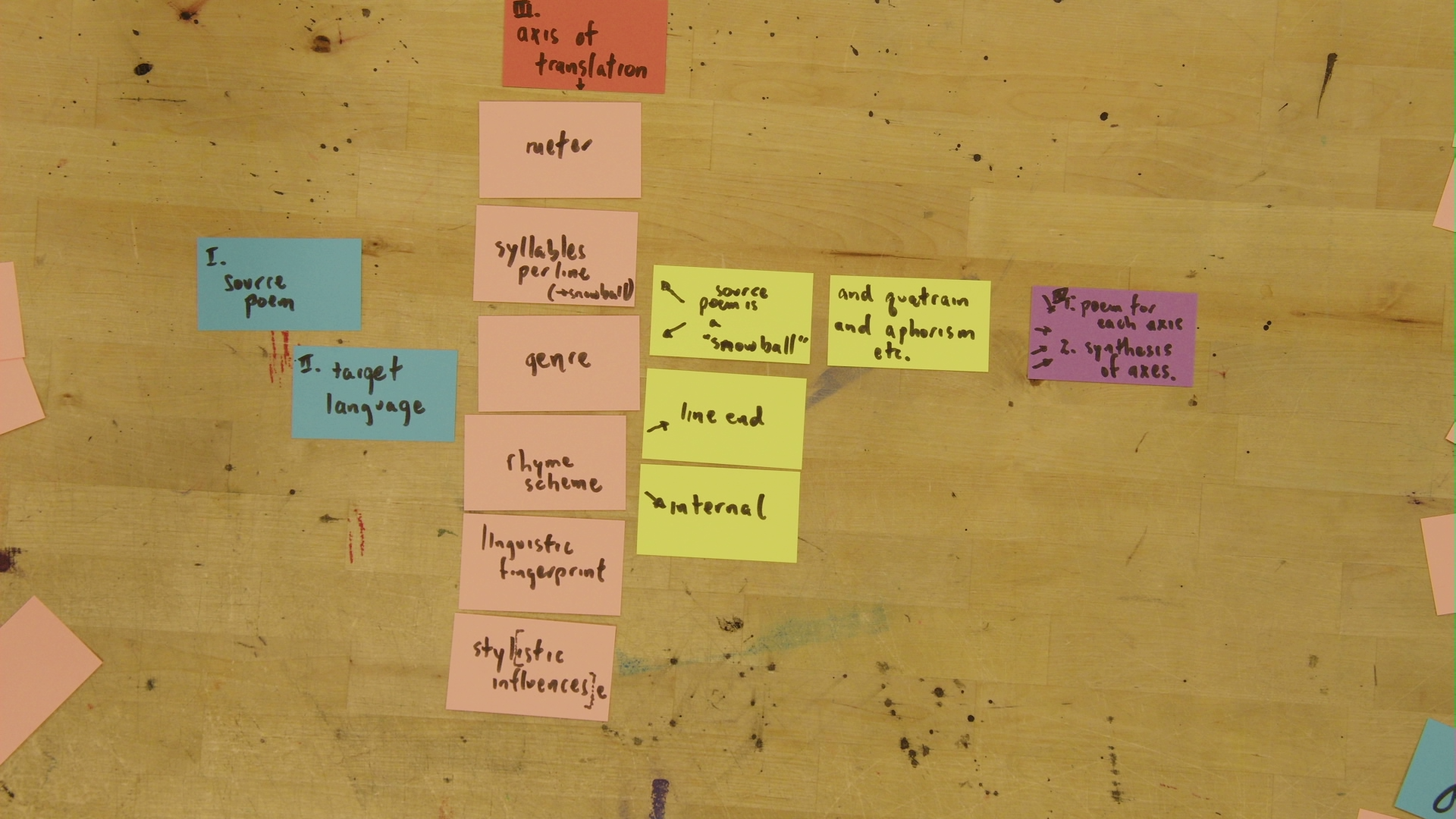
* **I. source poem**
* **I. target language** (2nd blue card—implicitly “II.”)
* **III. axes of translation** (column header)
* meter
* syllables per line *(+ “snowball” option)*
* genre
* rhyme scheme
* linguistic fingerprint
* stylistic influences
* Side notes (yellow cards):
* “source poem is a ‘snowball’ ”
* “line end”
* “internal”
* “and quatrain and aphorism etc.” *(forms/containers)*
* Purple card (tasks):
1. poem for each axis
2. synthesis of axes
Below are **drop-in cells**. They assume you already have `client` and `MODEL_MAIN` defined (same API pattern as in your sample `judge_translation`/`revise_translation` cells).
---
```python
# CELL 1 — Setup: source & target
# Required: define these upstream or here.
SOURCE_TEXT = """<PASTE YOUR SOURCE POEM HERE>"""
TARGET_LANGUAGE = "English" # e.g., "English", "French", etc.
# Optional: form containers spotted on cards
FORMS = ["quatrain", "aphorism"] # extend as needed
# Optional: the source poem is a snowball?
SOURCE_IS_SNOWBALL = False # set True if the original grows syllables per line
```
---
```python
# CELL 2 — Axis schema (from the cards)
from dataclasses import dataclass, asdict
from typing import Optional, List, Dict, Any
@dataclass
class Meter:
# e.g., "iambic pentameter", "7+5 mora", "free verse but rhythmic periodicity"
pattern: Optional[str] = None
@dataclass
class SyllablesPerLine:
# explicit counts or a rule ("snowball": increment each line)
counts: Optional[List[int]] = None
snowball: bool = False # True → 1,2,3,4… or custom progression
@dataclass
class Genre:
# e.g., "lyric", "didactic", "elegy", "satire", "haiku-like", etc.
label: Optional[str] = None
@dataclass
class RhymeScheme:
# e.g., "ABAB", "AABB", "none", internal vs line-end tendencies
scheme: Optional[str] = None
line_end_bias: bool = True
internal_bias: bool = False
@dataclass
class LinguisticFingerprint:
# lexical + syntactic habits (alliteration, particles, honorifics, verb-final, etc.)
notes: Optional[str] = None
@dataclass
class StylisticInfluences:
# e.g., authors/movements/devices to echo
influences: Optional[List[str]] = None
@dataclass
class TranslationAxes:
meter: Meter = Meter()
syllables: SyllablesPerLine = SyllablesPerLine()
genre: Genre = Genre()
rhyme: RhymeScheme = RhymeScheme()
fingerprint: LinguisticFingerprint = LinguisticFingerprint()
style: StylisticInfluences = StylisticInfluences()
forms: List[str] = None # e.g., ["quatrain", "aphorism"]
axes = TranslationAxes(
meter=Meter(pattern=None), # keep None for model to infer/decide
syllables=SyllablesPerLine(counts=None, snowball=False),
genre=Genre(label=None),
rhyme=RhymeScheme(scheme=None, line_end_bias=True, internal_bias=False),
fingerprint=LinguisticFingerprint(notes=None),
style=StylisticInfluences(influences=None),
forms=FORMS or []
)
```
---
```python
# CELL 3 — Context builder (source poem + target language + axis briefing)
import json
import textwrap
def build_axis_brief(axes: TranslationAxes) -> str:
d = asdict(axes)
# tidy JSON for visibility inside prompts
return json.dumps(d, ensure_ascii=False, indent=2)
def plan_from_cards(src: str, target_lang: str, axes: TranslationAxes, source_is_snowball: bool=False) -> str:
brief = build_axis_brief(axes)
prompt = f"""
You are planning a literary translation with explicit constraints derived from workshop cards.
<source_poem>
{src}
</source_poem>
<target_language>{target_lang}</target_language>
<cards_axis_brief>
{brief}
</cards_axis_brief>
Additional notes:
- If the source poem is a "snowball" (syllables increase per line), preserve that constraint if feasible.
- "line end" vs "internal" refers to rhyme placement preference.
Task:
1) Summarize the translation plan in 5–8 bullet points mapping each axis to concrete constraints.
2) Flag any impossible combinations or tradeoffs.
Return ONLY Markdown with:
### Plan
- bullet points...
### Risks
- bullet points...
"""
resp = client.responses.create(model=MODEL_MAIN, input=prompt)
return resp.output_text.strip()
plan_md = plan_from_cards(SOURCE_TEXT, TARGET_LANGUAGE, axes, SOURCE_IS_SNOWBALL)
```
---
```python
# CELL 4 — Literal pass (baseline), agnostic to axes
def literal_pass(src: str, target_lang: str) -> str:
prompt = f"""
Translate the source poem as literally as possible into {target_lang}.
Keep source line breaks where possible. Avoid paraphrase, additions, or omissions.
Output ONLY the translation text (no commentary, no Markdown).
<source>
{src}
</source>
"""
resp = client.responses.create(model=MODEL_MAIN, input=prompt)
return resp.output_text.strip()
literal_translation = literal_pass(SOURCE_TEXT, TARGET_LANGUAGE)
```
---
```python
# CELL 5 — Variant generator: "poem for each axis"
def axis_instruction(axis_name: str, axes: TranslationAxes) -> str:
"""Produce a concise, enforceable instruction for a single axis."""
a = axes
if axis_name == "meter":
return f"Conform to meter: {a.meter.pattern or 'infer appropriate meter; justify implicitly via rhythm'}."
if axis_name == "syllables":
if a.syllables.snowball:
return "Use a SNOWBALL pattern: increase syllables line-by-line (e.g., 1,2,3,4, ...)."
if a.syllables.counts:
return f"Enforce syllables per line: {a.syllables.counts} (strict)."
return "Keep roughly constant syllable counts per line; avoid major fluctuations."
if axis_name == "genre":
return f"Adopt genre conventions of: {a.genre.label or 'closest fitting genre'}."
if axis_name == "rhyme":
bits = []
bits.append(f"Rhyme scheme: {a.rhyme.scheme or 'subtle approximate rhyme'}")
if a.rhyme.line_end_bias: bits.append("Favor line-end rhyme.")
if a.rhyme.internal_bias: bits.append("Favor internal rhyme.")
return " | ".join(bits) + "."
if axis_name == "fingerprint":
return f"Linguistic fingerprint: {a.fingerprint.notes or 'echo syntactic/lexical habits from the source'}."
if axis_name == "style":
return "Stylistic influences: " + (", ".join(a.style.influences) if a.style.influences else "tastefully echo source-era/style") + "."
if axis_name == "forms":
return "Conform to one of these containers: " + (", ".join(a.forms) if a.forms else "no strict container") + "."
return ""
AXES_ORDER = ["meter", "syllables", "genre", "rhyme", "fingerprint", "style", "forms"]
def generate_axis_variant(src: str, target_lang: str, axes: TranslationAxes, axis_name: str, base: str=None) -> str:
"""
Create a 'poem for each axis' variant: enforce ONE axis strongly, keep others minimal.
If `base` is provided, treat it as the starting draft (e.g., literal pass).
"""
inst = axis_instruction(axis_name, axes)
prompt = f"""
Produce a translation in {target_lang}.
Enforce the following axis **strongly**: {axis_name.upper()}.
Constraint: {inst}
Keep all other axes minimal and non-contradictory.
<source>
{src}
</source>
{"<starting_draft>\n" + base + "\n</starting_draft>" if base else ""}
Output ONLY the poem (no commentary, no Markdown).
"""
resp = client.responses.create(model=MODEL_MAIN, input=prompt)
return resp.output_text.strip()
axis_variants = {
axis: generate_axis_variant(SOURCE_TEXT, TARGET_LANGUAGE, axes, axis, base=literal_translation)
for axis in AXES_ORDER
}
```
---
```python
# CELL 6 — Axis-fit judge (JSON) to score each variant for its axis
def judge_axis_fit(axis_name: str, src: str, draft: str, axes: TranslationAxes) -> dict:
"""
Return ONLY JSON:
{"score": 0-10, "positives": [...], "negatives": [...], "evidence": "..."}
"""
inst = axis_instruction(axis_name, axes)
prompt = f"""
Evaluate how well the DRAFT satisfies the AXIS constraint.
AXIS: {axis_name}
CONSTRAINT: {inst}
<source>{src}</source>
<draft>{draft}</draft>
Return ONLY a JSON object with keys:
- "score" (integer 0-10)
- "positives" (list of short strings)
- "negatives" (list of short strings)
- "evidence" (short prose justification)
"""
resp = client.responses.create(model=MODEL_MAIN, input=prompt)
try:
return json.loads(resp.output_text)
except json.JSONDecodeError as e:
raise ValueError("Model did not return valid JSON for axis judge.") from e
axis_reviews = {ax: judge_axis_fit(ax, SOURCE_TEXT, axis_variants[ax], axes) for ax in AXES_ORDER}
axis_reviews
```
---
```python
# CELL 7 — Improve each axis variant using your existing critic/reviser
# re-use your provided judge/revise or plug in here.
# Example using your functions:
improved_axis_variants = {}
for ax in AXES_ORDER:
critique = {
"positives": axis_reviews[ax].get("positives", []),
"negatives": axis_reviews[ax].get("negatives", [])
}
improved_axis_variants[ax] = revise_translation(SOURCE_TEXT, axis_variants[ax], critique)
improved_axis_variants
```
---
```python
# CELL 8 — Synthesis: combine axes (purple card #2)
def synthesize_axes(src: str,
target_lang: str,
axes: TranslationAxes,
ingredients: Dict[str, str]) -> str:
"""
Create a single poem that satisfies ALL axes simultaneously,
using the improved per-axis variants as style/material references.
"""
references_md = "\n\n".join(
f"### {k}\n{v}" for k, v in ingredients.items()
)
brief = build_axis_brief(axes)
prompt = f"""
Create a final translation in {target_lang} that **synthesizes all axes**.
<axis_brief>
{brief}
</axis_brief>
Use the following improved axis-specific drafts as references (do not copy verbatim; resolve conflicts with best judgment):
{references_md}
<source>
{src}
</source>
Output ONLY the final poem (no commentary, no Markdown).
"""
resp = client.responses.create(model=MODEL_MAIN, input=prompt)
return resp.output_text.strip()
final_translation = synthesize_axes(
SOURCE_TEXT,
TARGET_LANGUAGE,
axes,
improved_axis_variants
)
final_translation
```
---
```python
# CELL 9 — Optional: final quality pass using your judge/revise loop
feedback = judge_translation(SOURCE_TEXT, final_translation)
final_translation_v2 = revise_translation(SOURCE_TEXT, final_translation, feedback)
final_translation_v2
```
---
```python
# CELL 10 — (Optional) East Asian gloss & grammar (if you want to keep this available)
def gloss_for_east_asian(src: str, translation: str, target_lang: str) -> str:
prompt = f"""
Produce a compact classroom-ready gloss/grammar note for a translation into {target_lang}.
Include:
### Gloss
### Grammar Notes (e.g., particles, honorifics, word order, aspect)
### Commentary (idiom/culture)
Return Markdown only.
<source>{src}</source>
<translation>{translation}</translation>
"""
resp = client.responses.create(model=MODEL_MAIN, input=prompt)
return resp.output_text.strip()
# gloss_md = gloss_for_east_asian(SOURCE_TEXT, final_translation_v2, TARGET_LANGUAGE)
# display(Markdown(gloss_md))
```
---
### How this maps to your cards
* **I. source poem / I. target language** → Cells 1 & 3 inputs.
* **III. axes of translation** → `TranslationAxes` dataclass + `AXES_ORDER`.
* **meter / syllables per line (snowball) / genre / rhyme scheme / linguistic fingerprint / stylistic influences** → enforced via `axis_instruction()` and judged in Cell 6.
* **line end / internal** → toggles in `RhymeScheme`.
* **“source poem is a ‘snowball’ ”** → `SOURCE_IS_SNOWBALL` and `SyllablesPerLine.snowball`.
* **“and quatrain and aphorism etc.”** → `FORMS` / `forms` axis.
* **Purple tasks** → Cell 5 (“poem for each axis”) + Cell 8 (“synthesis of axes”).
## 3
---
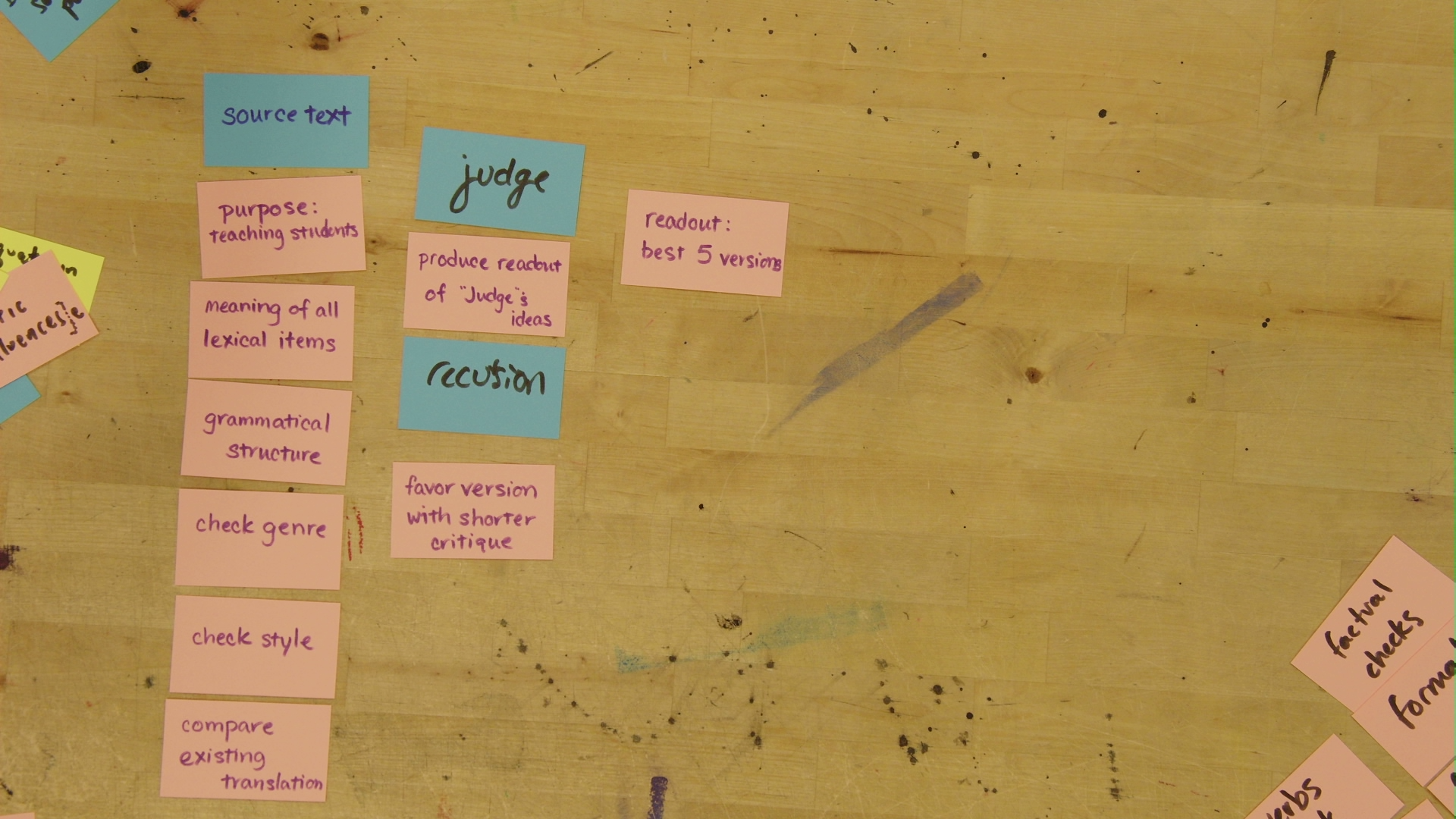
### 🩵 Blue cards
* **source text**
* **judge**
* **recursion**
### 🩷 Pink cards (left column)
* **purpose: teaching students**
* **meaning of all lexical items**
* **grammatical structure**
* **check genre**
* **check style**
* **compare existing translation**
### 🩷 Pink cards (right middle)
* **produce readout of “Judge’s ideas”**
* **favor version with shorter critique**
* **readout: best 5 versions**
### 🩷 Pink cards (bottom right corner)
* **factual checks**
* **formal checks**
---
This iteration emphasizes:
* **Multiple recursive rounds** of improvement.
* **Selective judgment:** choose *best N* versions.
* **Pedagogical readability:** shorter, more digestible critiques for students.
---
Here’s a **Python notebook chain** implementing this updated workflow.
It extends the earlier recursion code with:
1. Generation of **N recursive improvements**.
2. **Judging & ranking** each version.
3. Producing a **readout summary of top 5** for classroom discussion.
4. Optional final **factual & formal validation**.
---
```python
# CELL 1 — Setup
SOURCE_TEXT = """<PASTE YOUR SOURCE POEM OR TEXT HERE>"""
TARGET_LANGUAGE = "English"
PURPOSE = "Teaching students translation principles through iterative, judged improvements."
CHECKPOINTS = [
"meaning of all lexical items",
"grammatical structure",
"check genre",
"check style",
"compare existing translation"
]
N_VERSIONS = 10 # total recursion loops to run
TOP_K = 5 # number of best versions to summarize
```
---
```python
# CELL 2 — Initial translation
def initial_translation(src: str, target_lang: str) -> str:
prompt = f"""
Translate into {target_lang} as faithfully as possible.
Purpose: teaching students, so preserve transparency of lexical and grammatical choices.
Return only the translation text.
<source>{src}</source>
"""
resp = client.responses.create(model=MODEL_MAIN, input=prompt)
return resp.output_text.strip()
base_translation = initial_translation(SOURCE_TEXT, TARGET_LANGUAGE)
print(base_translation)
```
---
```python
# CELL 3 — Pedagogical judge (multi-criterion JSON)
import json
def judge_translation(src: str, draft: str, checkpoints: list) -> dict:
prompt = f"""
Evaluate this translation according to the following checkpoints:
{', '.join(checkpoints)}
Return valid JSON of the form:
{{
"<criterion>": {{
"positives": [...],
"negatives": [...]
}},
"overall_score": <0–10 integer>
}}
<source>{src}</source>
<translation>{draft}</translation>
"""
resp = client.responses.create(model=MODEL_MAIN, input=prompt)
try:
return json.loads(resp.output_text)
except json.JSONDecodeError:
return {"overall_score": 0}
```
---
```python
# CELL 4 — Recursive improvement loop (favor concise critique)
def improve_translation(src: str, draft: str, judgment: dict) -> str:
"""
Improve translation based on negatives; keep positives.
Produce a concise revision suited to teaching.
"""
prompt = f"""
You are revising a translation after receiving critique.
Keep positives intact, fix negatives, and favor brevity and clarity.
Output only the revised translation.
<source>{src}</source>
<judgment>{json.dumps(judgment, ensure_ascii=False, indent=2)}</judgment>
<draft>{draft}</draft>
"""
resp = client.responses.create(model=MODEL_MAIN, input=prompt)
return resp.output_text.strip()
def recursive_versions(src: str, base: str, n: int) -> list:
"""
Produce n recursive versions by judging and improving repeatedly.
"""
versions = [base]
for i in range(n-1):
j = judge_translation(src, versions[-1], CHECKPOINTS)
improved = improve_translation(src, versions[-1], j)
versions.append(improved)
return versions
versions = recursive_versions(SOURCE_TEXT, base_translation, N_VERSIONS)
len(versions)
```
---
```python
# CELL 5 — Judge and rank all versions
def rank_versions(src: str, versions: list, checkpoints: list) -> list:
"""
Evaluate each version with the same judge and rank by overall_score.
"""
scored = []
for idx, v in enumerate(versions):
j = judge_translation(src, v, checkpoints)
score = j.get("overall_score", 0)
scored.append({"index": idx+1, "score": score, "text": v, "judgment": j})
scored.sort(key=lambda x: x["score"], reverse=True)
return scored
ranked = rank_versions(SOURCE_TEXT, versions, CHECKPOINTS)
top5 = ranked[:TOP_K]
```
---
```python
# CELL 6 — Generate short critiques for teaching ("favor shorter critique")
def shorten_critique(judgment: dict) -> str:
prompt = f"""
Summarize the judge's critique briefly for students (≤150 words).
Keep pedagogical clarity; highlight improvement focus areas.
<judgment>{json.dumps(judgment, ensure_ascii=False, indent=2)}</judgment>
"""
resp = client.responses.create(model=MODEL_MAIN, input=prompt)
return resp.output_text.strip()
for t in top5:
t["short_readout"] = shorten_critique(t["judgment"])
```
---
```python
# CELL 7 — Readout: best 5 versions
def best_versions_readout(top: list) -> str:
readout = "# Readout: Best 5 Versions\n"
for v in top:
readout += f"\n## Version {v['index']} (Score: {v['score']})\n"
readout += v["text"] + "\n\n"
readout += f"**Short critique:** {v['short_readout']}\n\n"
readout += "---\n"
return readout
readout_md = best_versions_readout(top5)
display(Markdown(readout_md))
```
---
```python
# CELL 8 — Factual and formal checks (optional QA)
def qa_factual_formal(src: str, translation: str) -> dict:
prompt = f"""
Perform factual and formal checks on this translation.
Return JSON:
{{
"factual_issues": [list],
"formal_issues": [list]
}}
<source>{src}</source>
<translation>{translation}</translation>
"""
resp = client.responses.create(model=MODEL_MAIN, input=prompt)
try:
return json.loads(resp.output_text)
except json.JSONDecodeError:
return {"factual_issues": [], "formal_issues": ["JSON parse error"]}
qa_results = qa_factual_formal(SOURCE_TEXT, top5[0]["text"])
qa_results
```
---
### 🧩 Mapping of Cards → Notebook Steps
| Card | Cell / Function | Description |
| -------------------------------------------------------- | ----------------------------------------- | ------------------------------- |
| **source text** | `SOURCE_TEXT` | Base input |
| **purpose: teaching students** | `PURPOSE` | Pedagogical frame |
| **meaning / grammar / genre / style / compare existing** | `CHECKPOINTS` | Criteria for the judge |
| **judge** | `judge_translation()` | Evaluation per round |
| **produce readout of judge’s ideas** | `shorten_critique()` | Classroom summary |
| **recursion** | `recursive_versions()` | Iterative self-improvement loop |
| **favor version with shorter critique** | `shorten_critique()` used for readability | |
| **readout: best 5 versions** | `best_versions_readout()` | Markdown summary for teaching |
| **factual checks / formal checks** | `qa_factual_formal()` | Final QA stage |
---
 Sign in with Wallet
Connect another wallet
Sign in with Wallet
Connect another wallet