#20251021-presentation
## mw draft:
Becca will introduce Bok Center + LL as a "skunkworks"
mw: I am part of the intergenerational team at the Learning Lab. Our team comprises of six full time staff, two postdocs in Generative AI research, sixteen graduate student fellows, and fifteen undergraduate fellows.
The LL started during the MOOC era. We were tracking shifts in communication patterns, the role of devices in students' lives, and what new literacies might look like. For instance, in these example, you can see students doing films, making data visualizations in the sciences, performances, etc. Our studio and team was built to support every tool for communication in every discipline.
We were also tracking growing awareness of "data" in education as both measurement tool and medium. When AI became available, we had infrastructure in place to respond to it.
Our first AI asks were for tutor bots. Faculty wanted "AI" loaded with course materials that could answer student questions. The mental model was one of anthropomorphism.
I spent many days helping Faculty upload PDFs and write 8000 character system prompts. When the number of documents exceeded the RAG limits (either due to platform or performance), we atomized. We got down from "teacher bots," to bots for different units, to different weeks, to different assignments.
In some that meant 54 "bots" for each class.
The limitations of this model pointed toward a new need: tools that could occupy any position in the teaching-learning ecosystem-- not just the teacher's position, and possibly not a human position at all.
(rosie roomba)
Here are some examples:
1) Classroom Activties
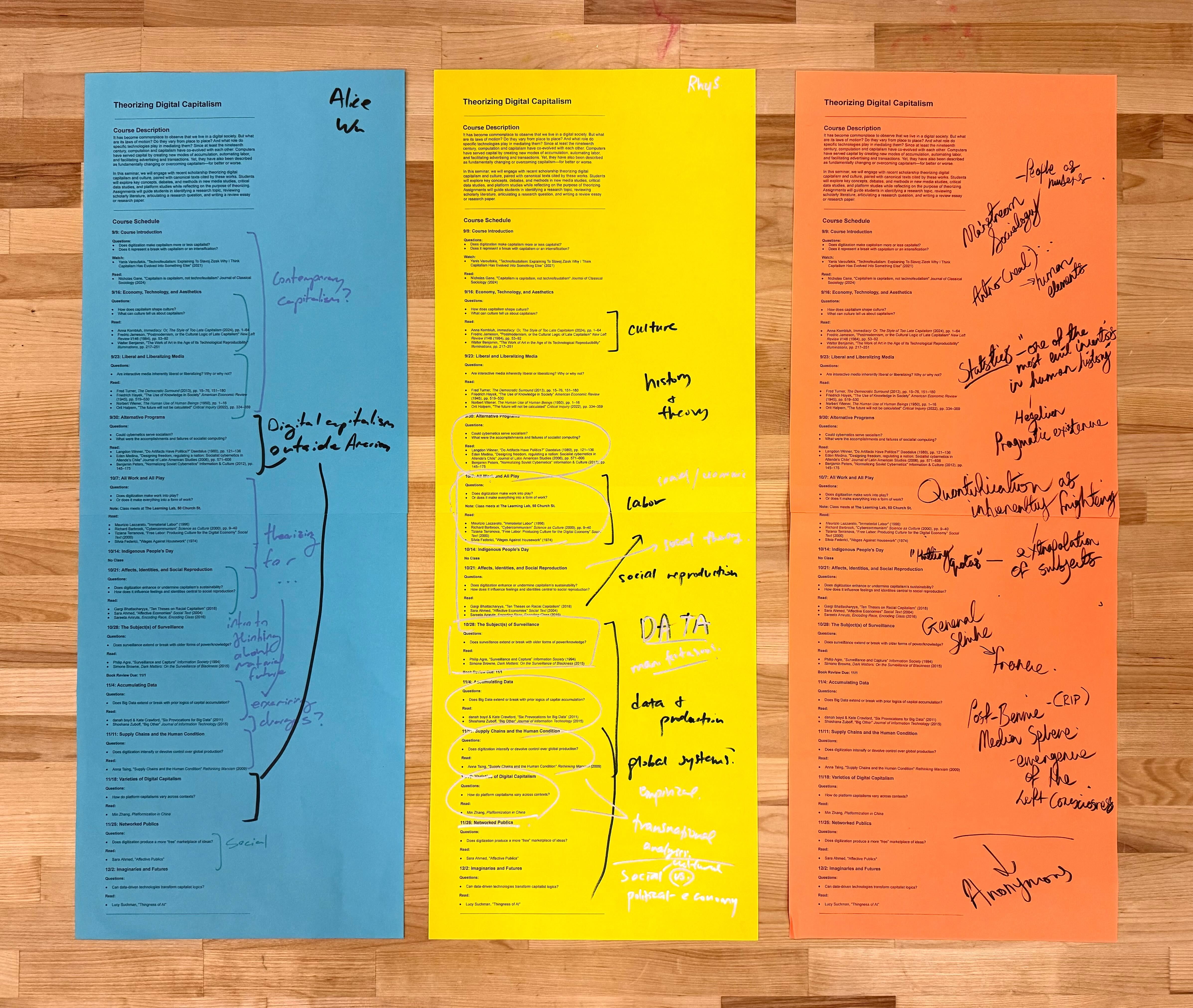
In a course on Digital Capitalism, students annotated 3-foot-long physical printouts of their syllabus by hand. We captured the annotated syllabi and used a vision API to generate class-wide reflections in real time. No human teacher can read what every student in the room is thinking all at once, but AI can.
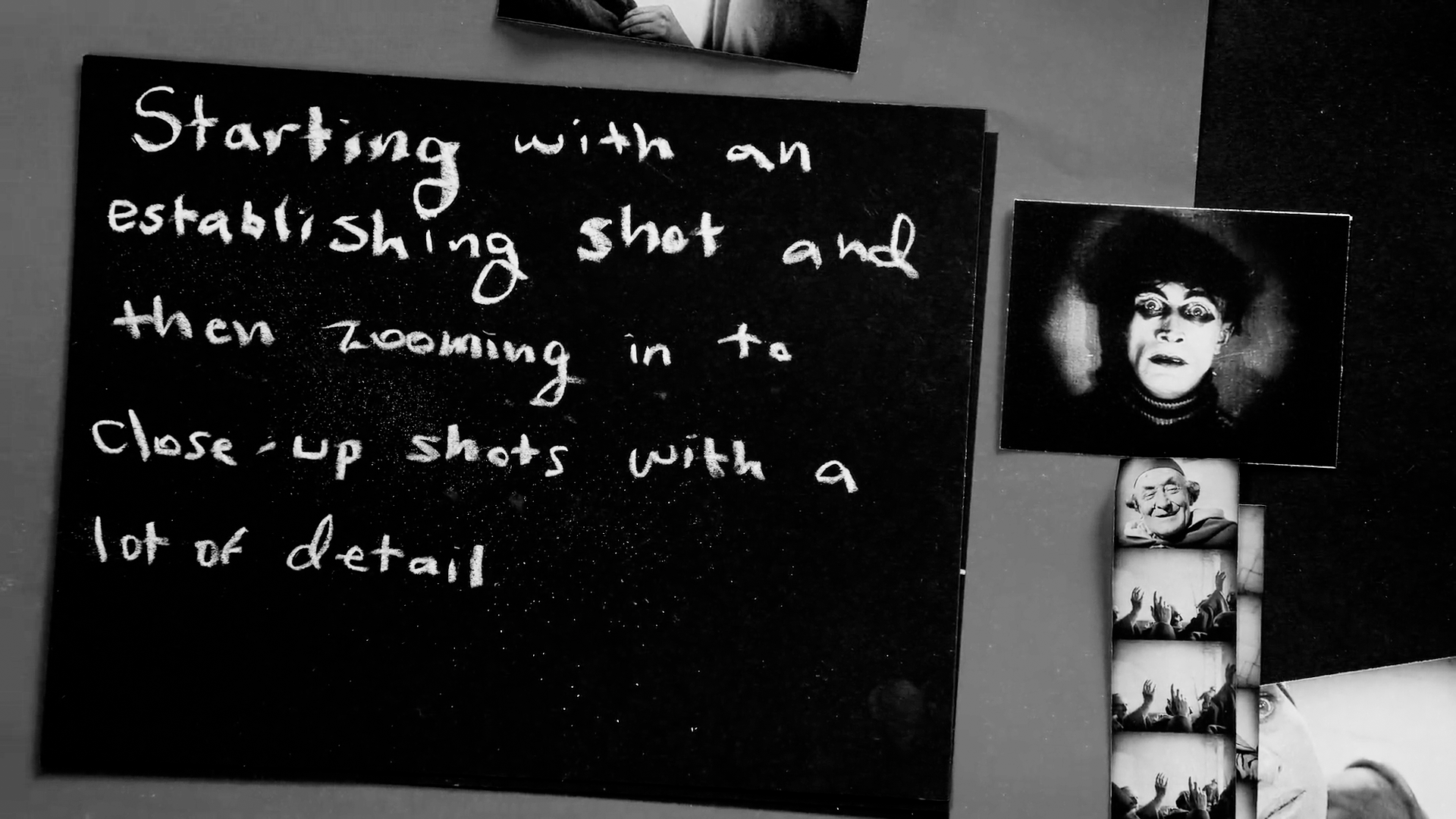
This is done in multiple modalities. In a course on Silent Film, we captured (perhaps ironically) audio-- as well as video-- from a workshop and generated resources and study guides, timelines, and concept maps, again, in real time.
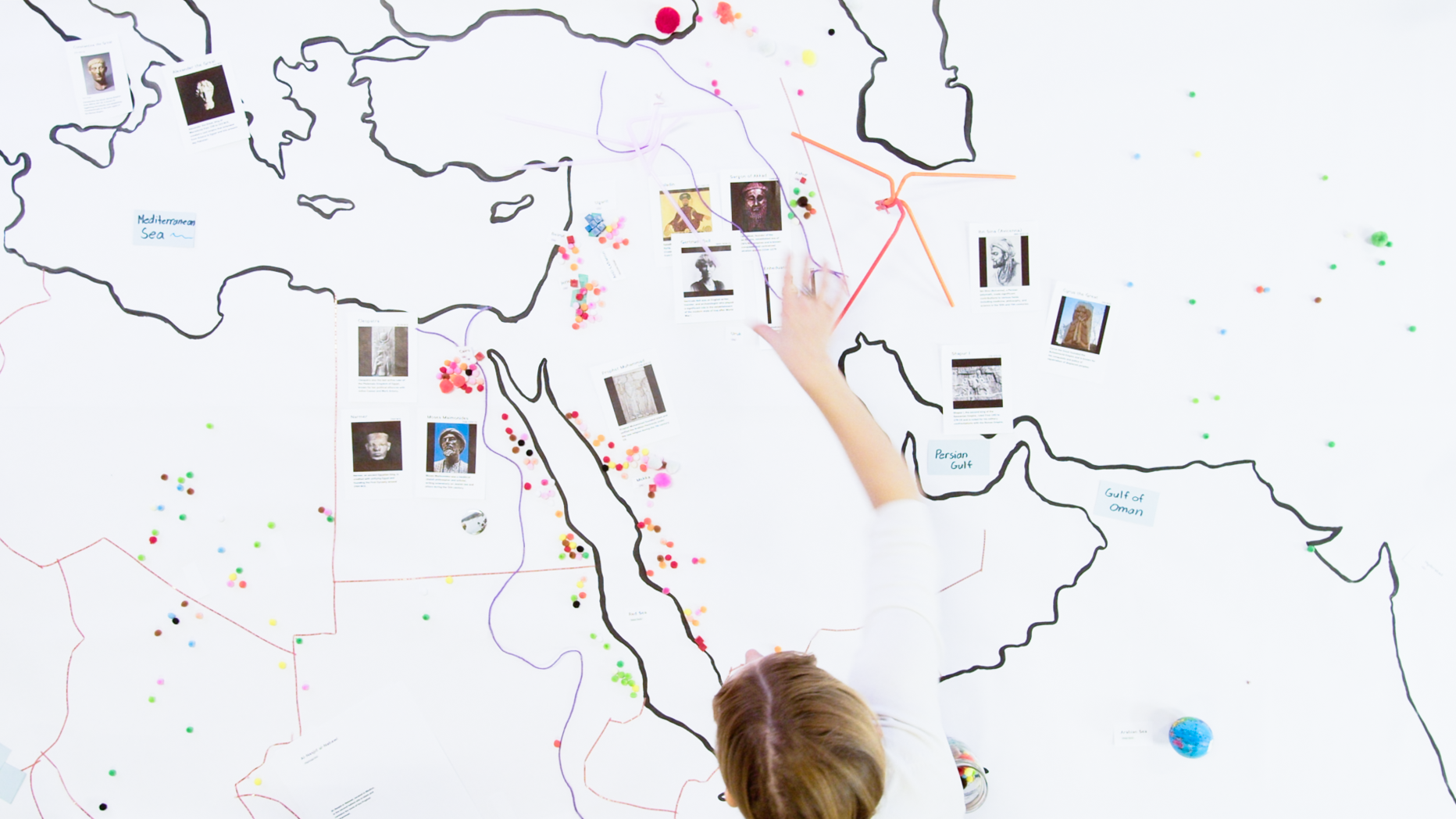
In another course, records from a database became cards on a physical map, and that map and new handwritten annotations were re-added to the database. So for any devs in the audience, the paper WAS the front end of a "ui" in this case.
This can be done in small courses, but also big ones.
Something as simple as taking a csv from a natural language poll can generate a dataset professors can parse and transform in-class.
What began as classroom utilities soon turned into prototypes for entirely new assignments.
2) Project-Based Assignments
Every year one of our favorite classes is a Japanese cinema class. Here, you can see their past workshops where they recreate a layered shot from godzilla, but in the end students turned in traditional essays analyzing such visual metaphors. This year, they went further. Using the Learning Lab’s AI-augmented studio, students prototyped scrolling digital essays that combined text, moving image, and interactivity to frame their analytical argument. And since we're here, just so you know, we have them use Gemini's canvas feature to prototype a visual essay on film in react components.
In a course on fairytales, students applied a similar methodology to narrative itself. Students were asked to invent entire folklore corpora for imagined communities-- without relying on pre-existing tales. Working with code, they used multiple LLMs to simulate oral tradition: producing variants, mutations, and commentaries that evolved through recursive storytelling loops. The goal was cybernetics.
The theme of recursion continued in a translation seminar for graduate student. Here, students explored prompt chaining and loops. The Learning Lab provided example notebooks and prompt libraries. Rather than seeking perfect equivalence, they studied how meaning shifted with each pass through a model.
3) Oral Presentations
Finally, oral exams. What I like to refer to as our "AI for me, but not for thee" category. Here, we're "AI-proofing" the assignment on the stuent side, while using AI to make it scalabale for teachers.
Large courses struggle to implement oral exams for all sorts of reasons-- time, norming grading, keeping records. So, we created our own oral exam rig? structure? Essentially, we made a card game, then created a UI for students and a proctor, plus a backend with agents that listen to the oral exam, send information to a database, then and ask follow-up questions based on what students say. I could go on and on, but our goal is to elevate in-person teaching and learning experiences.
Learning Centers often preach backward design-- start with learning objectives, then work backwards to the assignments that achieve them. But right now, the world we're preparing students for is changing so rapidly that it's genuinely hard to know what those objectives should be. What skills will a knowledge worker need in 2031? What education will we hope our leaders have had by 2037?
It's hard to know where to begin when tackling a problem like this. But the courses that seem to be nudging in the right direction are the ones where faculty are going all in—allowing students to use AI in any way they can to achieve any result they can.
Just yesterday, a foundational course in the medical humanities came in with a simple premise: if your goal is to intervene in the world to redress health challenges, structural violence, and inequity, then use every tool available to you. Not *whether* to use AI, but *how* to use it with good judgment.
This shift is happening across disciplines.
AI lets us revive what places like Harvard and Exeter do best-- a kind of education that helps students become proficient at the human things that matter: having a conversation, working through a proof on paper, fixing what's broken, making something with their hands.
The goal, in these contexts, isn’t to scale those experiences by headcount, but by depth.
we want to challenge students to do more than ever before. Not just to do what they've done in the past (and policing them to make sure they aren't cheating at it) but asking them to do much much more.
What we ask of our students has shifted from "translate this poem" to "build a translation system." From "analyze this film" to "analyze a thousand films" From "create one dialogue" to "characters capable of generating infinite dialogues." From writing about data in one location, to create an interactive game or website where people cna interact with any location on earth.
They're not producing one thing. They're building systems...
(Though, we still may need to prototype them first)
Thank you.
----
## mk notes:
### potential structure
- this is the LL
- what was evident even in the MOOC era is that something was changing. the way people communicate. the role of media and devices in students lives. the intersection of data and education--even the intersection of data and lived experience
- the LL was born of this moment
- and this is why we were ready to help with AI
- (MK) here are 5 projects in 5 min
- everyone's initial mental model is that AI is like the teacher--like, we want to create a custom "tutor bot" that knows the course materials and can stand in for the teacher.
- in year one I spent LOADS of hours helping faculty upload PDFs and arrive at 5000-character system prompts
- and if they had courses that exceeded ChatGPT's 10-doc limit for the RAG, well, then we'd create MULTIPLE bots, like one for each week if needed
- the silliness of that model gestures towards the next step, where we don't think of "custom bots" as anthropomorphic teacher-like-entities, and think a bit more about AI as a tool that can occupy literally ANY position in the complex teaching-learning ecosystem. for instance
- we can scrape the course's old website, use whisper to transcribe every lecture, harvest the faculty's messing g-drive folders, look up every comparable syllabus across america and then use this data lake to help generate new courses, problem sets, and activities
- AI can expand the teacher's observation skills, as in the in-class polling and annotation-parsing experiments we've undertaken. (no human teacher can know what each student in the case is thinking at one time, because they can't all speak at once, and if they type, then the teacher can't read all that typing at once. BUT... AI CAN DO THIS. In Moira's course students all took 15 minutes to annotate the syllabus with handwritten notes, and we INSTANTLY had this data, and Moira could ask follow-up questions base on it)
- or, similarly, in large courses involving oral presentations, it's impossible for the prof to be there for each and every oral presentation, so we have a bot listen and ask follow-up questions based on a carefully crafted agent that we built with the prof, one that listens to the students and asks appropriate followup questions (show lots of video and photo of madeleine demo-ing)
- now--you see the cards in that last video--I have to take a bit of a detour here and tell the story of those, because this gestures towards yet another MAJOR impact AI is going to have on teaching and learning
- Elisa built a Python notebook that generated those mofos
- staff are going to augmented like you can't even believe
- and what was impossible to afford on academic budgets in the past will be easily possible in the future
- we're not just generating cards. we're transcribing everything that teachers and students say, whipping up on the fly realtime handouts, notes, reports for donors--whatever we need.
- and hopefully you're seeing a theme emerging. we are, again and again, using AI in order to elevate the quality of in person teaching and learning experiences.
- again back to the MOOC analogue . . . When TV took off, movies had to make themselves bigger through widescreen and cinemascope (and even kisthcy 3d) to differentiate themselves and keep people coming to the theatres. And in the actual theatre, they had to lean in to ever more spectacular and interactive performances to keep the customers coming in...
- so what is it going to look like over the next 2-3 years? in 2027, or 2029, how are we going to encourage students to keep coming to class? encourage parents to keep paying for those students to come to class? and how can we make sure that coming to class is going to yield the sort of transformational education that prepares these gifted students to become leaders in an AI world?
- so--this brings me to my last case studies, which are REALLY hot off the presses because we are just figuring this thing out.
- the puzzle is this: we've all been taught "backward design"--where we, as teachers and instructional designers, begin with the learning objectives and then think backwards to the courses, assignments and activities that will help students achieve these learning objectives. But right now the world we're preparing our students for is changing so rapidly and so drastically that it's really hard to know what these learning objectives will be. What skills are needed for a knowledge worker in 2031? What undergraduate or graduate school education will we hope that our leaders have had in 2037? The terrain is shifting quickly :)
- it's hard to know where to begin when tackling a problem like this
- but if there are courses that seem to us to be nudging in this direction, they're the courses where faculty are going all in. Allowing students to use AI in any way they can to achieve any result they can
- in consulting with one faculty member where we memorably looked each other in the eyes and had this moment of recognition and said "this is scary, but we have to do it" (that was KT)
- just yesterday a foundational humanities course came in (on the medical humanities) that challenged students to use any tools at their disposal to intervene in the world to redress health challenges, structural violence, inequity.
- (insert MK explanation of HUM 2 assignment and then list loads and loads of the most extreme vibe coding courses)
- in an English course on video game narratives, students are creating their own interactive games
- in a Global Japanese Cinema course where students write about film, they are vibe coding websites that reimagine what academic work will look like within the next 5 years
- in Theatre Dance and Media courses, studenst aren't simply writing one dialogue between characters, they are designing systems of characters and scenarios that can be used to generate infinite scenarios and worlds
- in a comp lit translation course, they aren't just translating one poem, they are building systems, workflows, algorithms for translating anything into anything
- etc etc
-
- (MW) here are 5 projects in 5 min
- project categories:
1) Classroom activity (examples of brick and mortar, but augmented by AI):
- annotations on paper:
- syllabi
- code
- Audio capture to resource
- analyzing student data in realtime
2) Project-based assignments (taken to another level)
- Datavis vs. essay
- Treating it as human versus as tools
- Custom bots vs. python notebooks
- Listening versus speaking
3) Embodied presentation/performance/oral exam:
- "AI for me, not for thee"
- to sum up...
## mw notes:
could talk about the catch 22/paradox:
"takeaway: your teachers may realize that they have a lot to do. but they already have a full time job. they would benefit from a skunkworks of people."
[2025 projects to pull from](https://docs.google.com/document/d/1SPrSUmUjPr7ej52dwjMApkoxrHKLdaG2DldpVUM3EtM/edit?tab=t.0#heading=h.wilp3dbmxjlr)
-
## mw text:
The Bok Center’s Learning Lab is a studio space and intergenerational team that supports creative, innovative, and rigorous approaches to teaching, learning, and the communication of academic work.
We work with faculty across the College to design and prototype course activities and assignments that promote meaningful student engagement — not just in content mastery, but in how students express and refine their ideas, listen to others, and take part in productive, intellectually vital dialogue.
Many of the projects we support encourage students to learn and present their ideas in new media: video essays, podcasts, infographics, oral presentations, and more. But students are not merely learning to create in these media; they are learning *through* filming, podcasting, coding, 3D modeling, and more. These formats help students build arguments, test perspectives, and contribute to public-facing conversations — all within a framework that values clarity, reasoned disagreement, and collaborative exploration.
The expertise our staff and fellows develop through this work with the most advanced tools and techniques for learning and communication has made us valuable to high stakes initiatives and programs in the FAS: from the support we offer GSAS’s Harvard Horizons scholars and others on high profile public communication of academic research to our central role in responding to or opportunities and challenges presented by AI.
You can also read more about us in a [book chapter we wrote](https://bokcenter.harvard.edu/news/new-bok-center-publication-learning-lab), or explore images of our space on [our Flickr page](https://www.flickr.com/photos/boklearninglab/albums/72157688059831350).
## Studio Capabilities
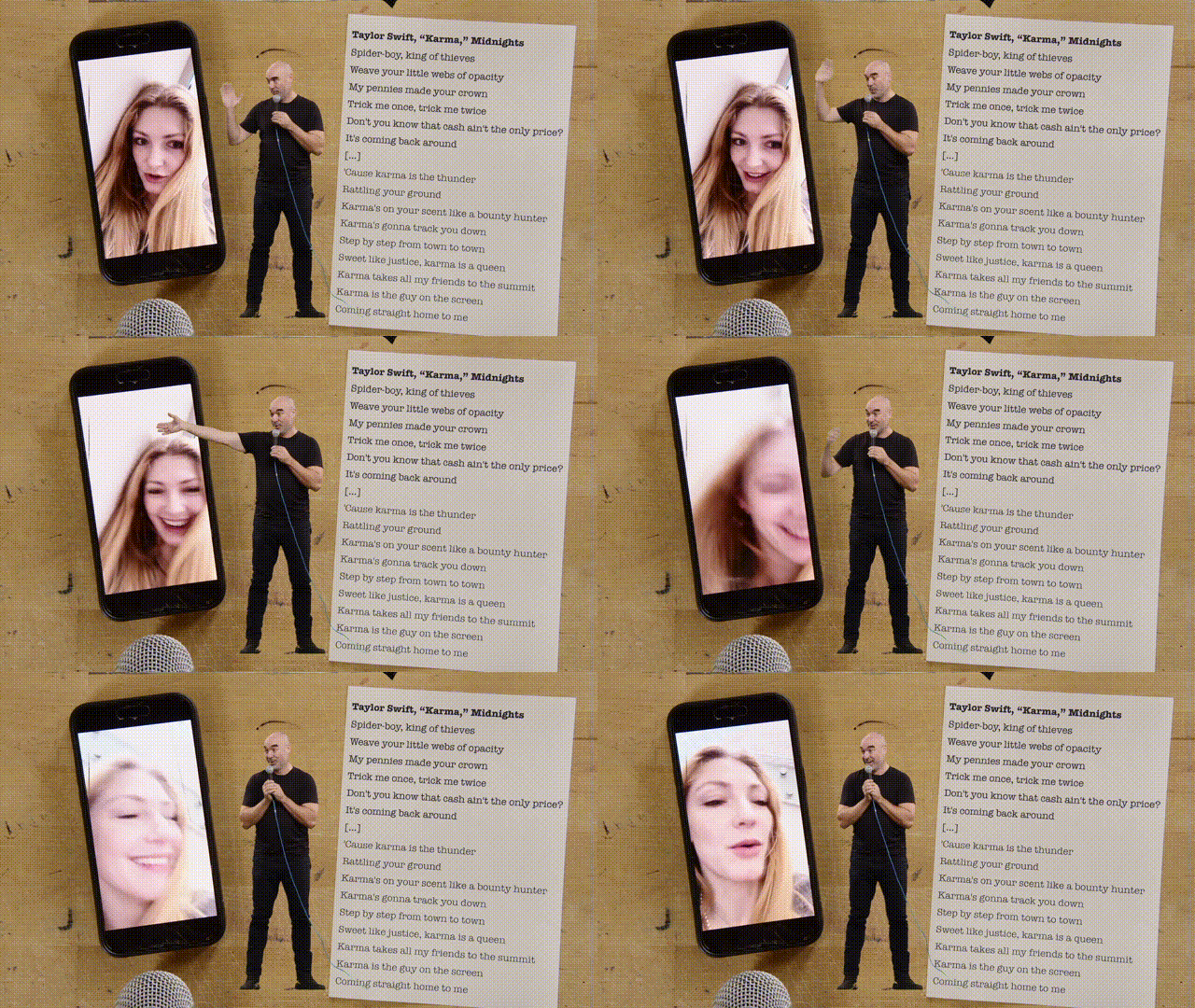
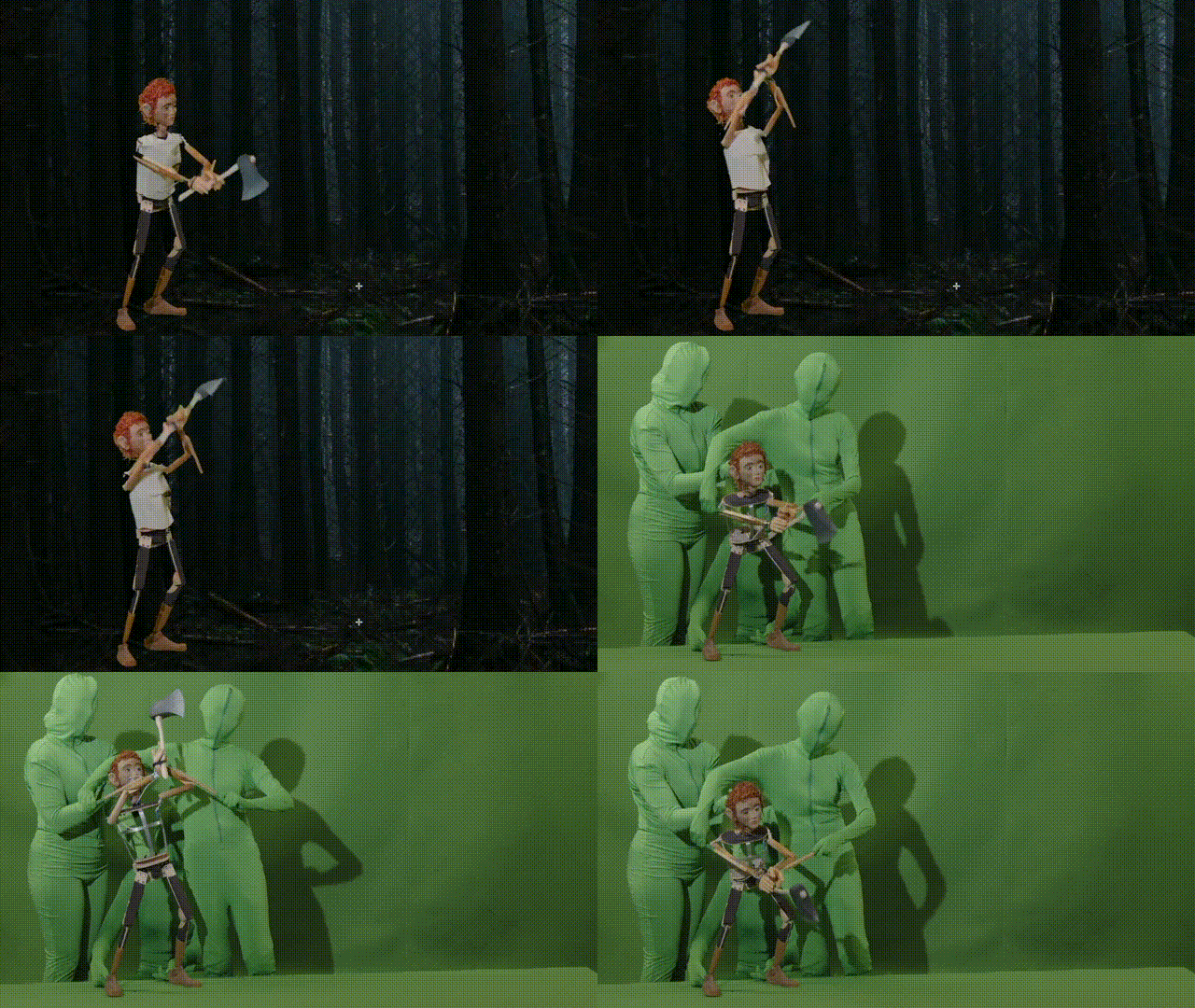
The Learning Lab Studio itself is a cross between a classroom, a video studio, a black box theatre and a maker space. We can move dynamically from hosting a group of PhD students from Physics improving their public speaking skills in the morning to teaching Theatre students to code their own AI bots for avant-garde creative projects. We can teach professional lighting techniques to students in a course on Japanese cinema (above) and then help an Expository Writing course use visual argument-mapping as a way to understand core moves in academic writing.
One key feature of the studio is the tight relationships between
* the equipment and materials of the space
* the staff that works in the space, and
* the teaching and learning that takes place there
Usually the experts that design a space, the staff that procures and maintains the equipment, and the teachers and students that use the space are quite separate. And this can slow the pace of innovation.
But in the Learning Lab, we possess in-house skills (running across the entire team) in media production, full stack development, data visualization, oral presentation, set design, and, most crucially, in teaching and learning. And this sets us up to move very rapidly in response to new developments.
If we hear of a new AI tool for transcription on Monday, we can write the code for a prototype Tuesday, hang the microphones and route the cables on Wednesday, then design and deliver a workshop designed to take advantage of it on Thursday (and usually it moves more quickly than this\!).
Our team comprises
* 6 full-time staff
* 2 Postdocs in Generative AI
* 16 Bok Graduate Fellows in Media, Design, and Generative AI
* 10 Learning Lab Undergraduate Fellows (who help prototype and then support the launch of assignments as tutors, facilitators, or guides)
## AI Course projects:
### Oral Exams
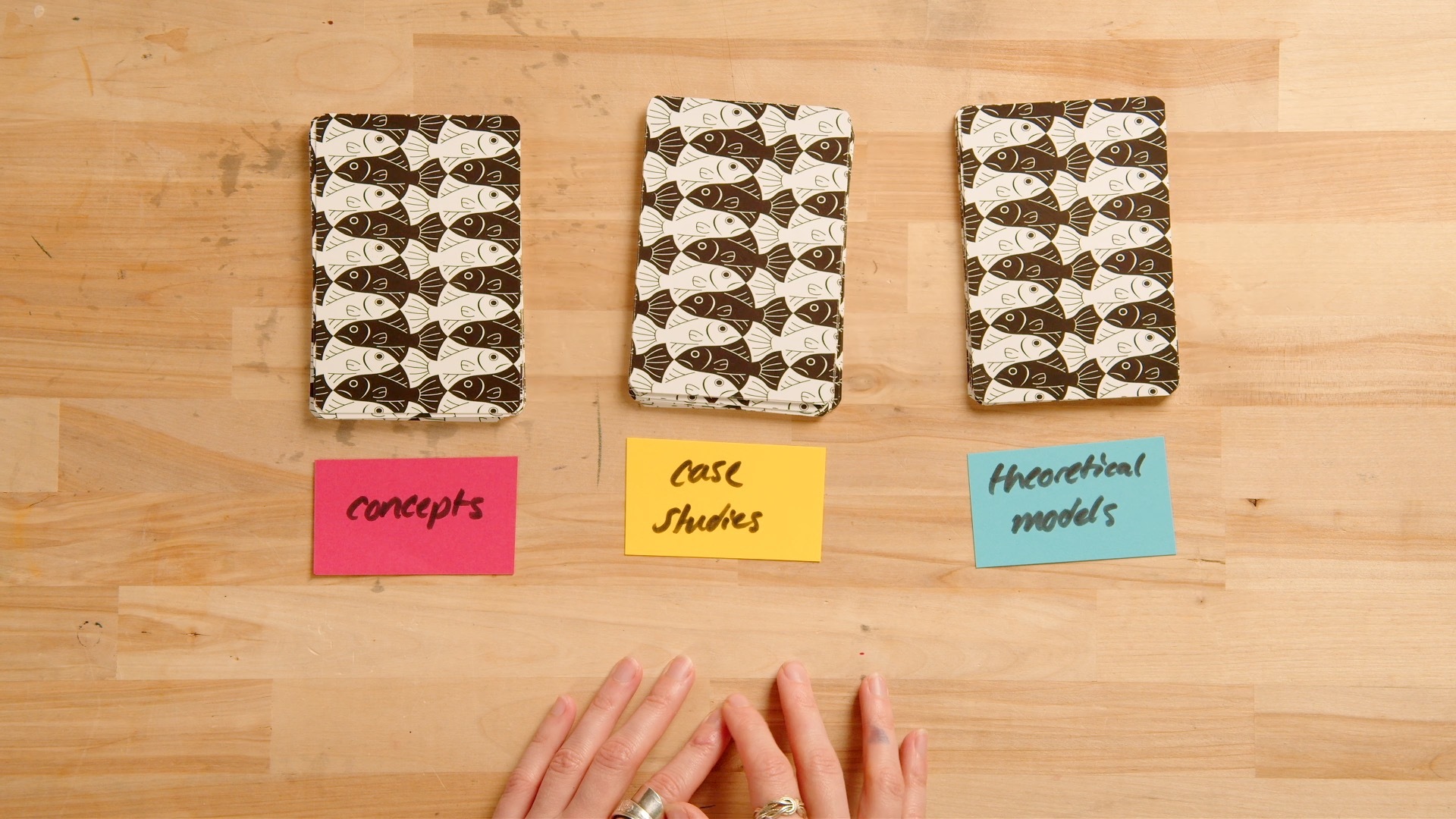
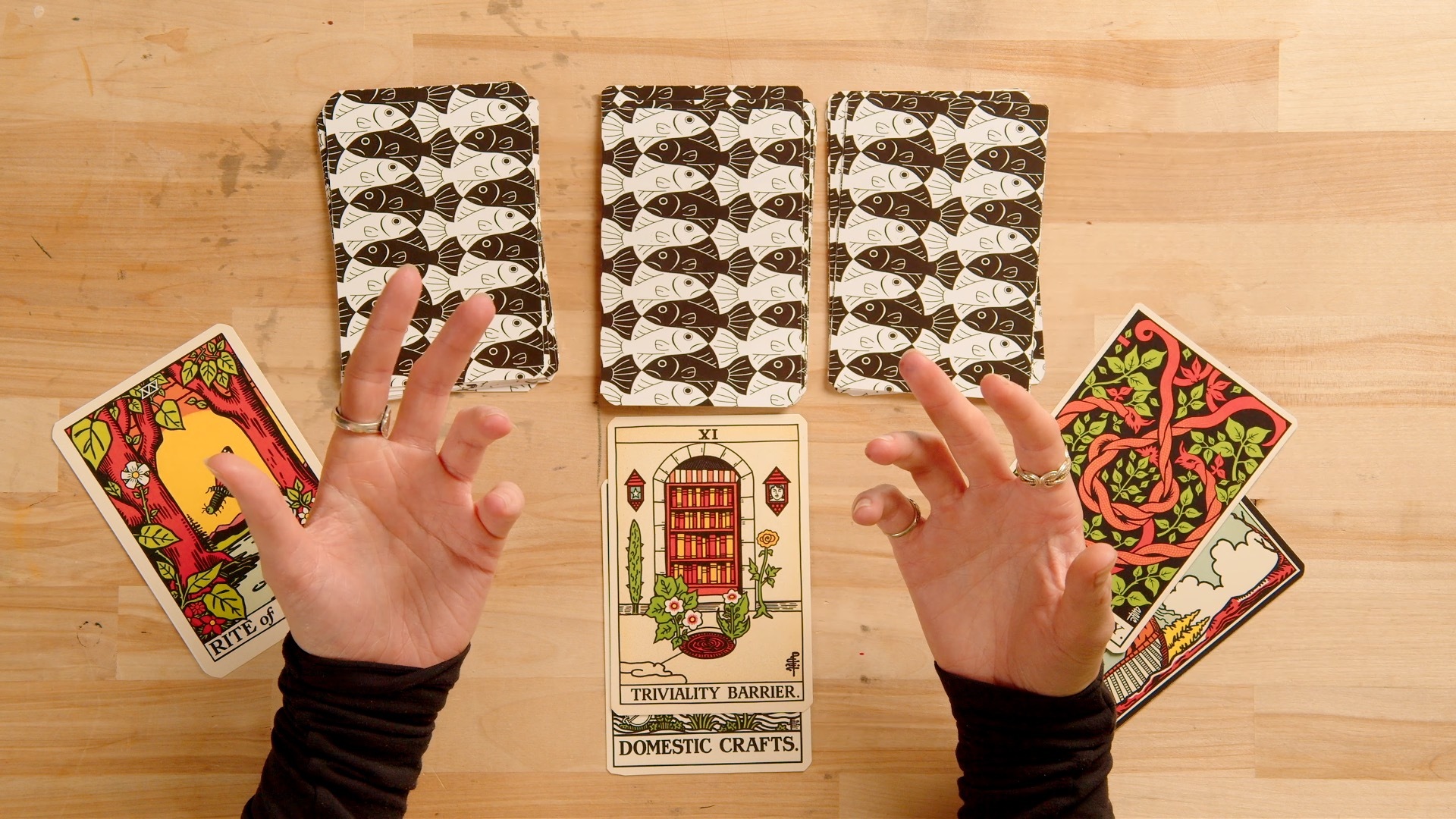
To test the scaling of oral exams, the Learning Lab will prototype a low-tech card-based activity to support student preparation for the GENED 1196 oral midterm exam. This activity will guide students in drawing connections between core course concepts—such as group, genre, tradition, and transmission—and applying them to case studies or personal experiences. The goal is to encourage spontaneous academic dialogue in an inclusive, low-stakes format. The Learning Lab will share an early version of the game with Sarah Craycraft and her teaching team to gather feedback for further refinement.
### Class Resources
Based on multimodal inputs (audio, video, etc.), the Learning Lab prototypes live resource generation with AI from a class or workshop. Example here fom a [silent film cours](https://hackmd.io/sxsWV09vSmm5gXlJW190og?view):
### Media Production
The Learning Lab works with courses and other Harvard entities to provide workshop son using AI for media production. Workshops could include deep dives into AI’s potential role in both visual analysis and creative production, as well as the use of AI to assist with storyboarding, build visual intuition, and prompt critical reflection by offering a “defamiliarizing mirror” of popular cinematic tropes.
### Maps and Timelines
We collaborated with Professor Céline Debourse to design a large-scale, interactive workshop for students in “Historical Background to the Contemporary Middle East.” To move beyond the traditional lecture format, we transformed our studio into a collaborative mapping space: projecting dynamic visuals across a 30-foot blackboard wall and equipping students with chalk, post-its, and tape to annotate and layer historical data. Students worked in rotating teams to build and narrate both a regional map and an interactive timeline, each augmented in real time using AI-generated content. By combining analog interaction with real-time digital input, the session invited students to explore the complex intersections of geography, history, and narrative construction.
### Slackbots
In courses, slackbots have been made to answer student questions, translate live audio, recusively comment on posts, summarize channels, save links, and more:
### Python Notebooks
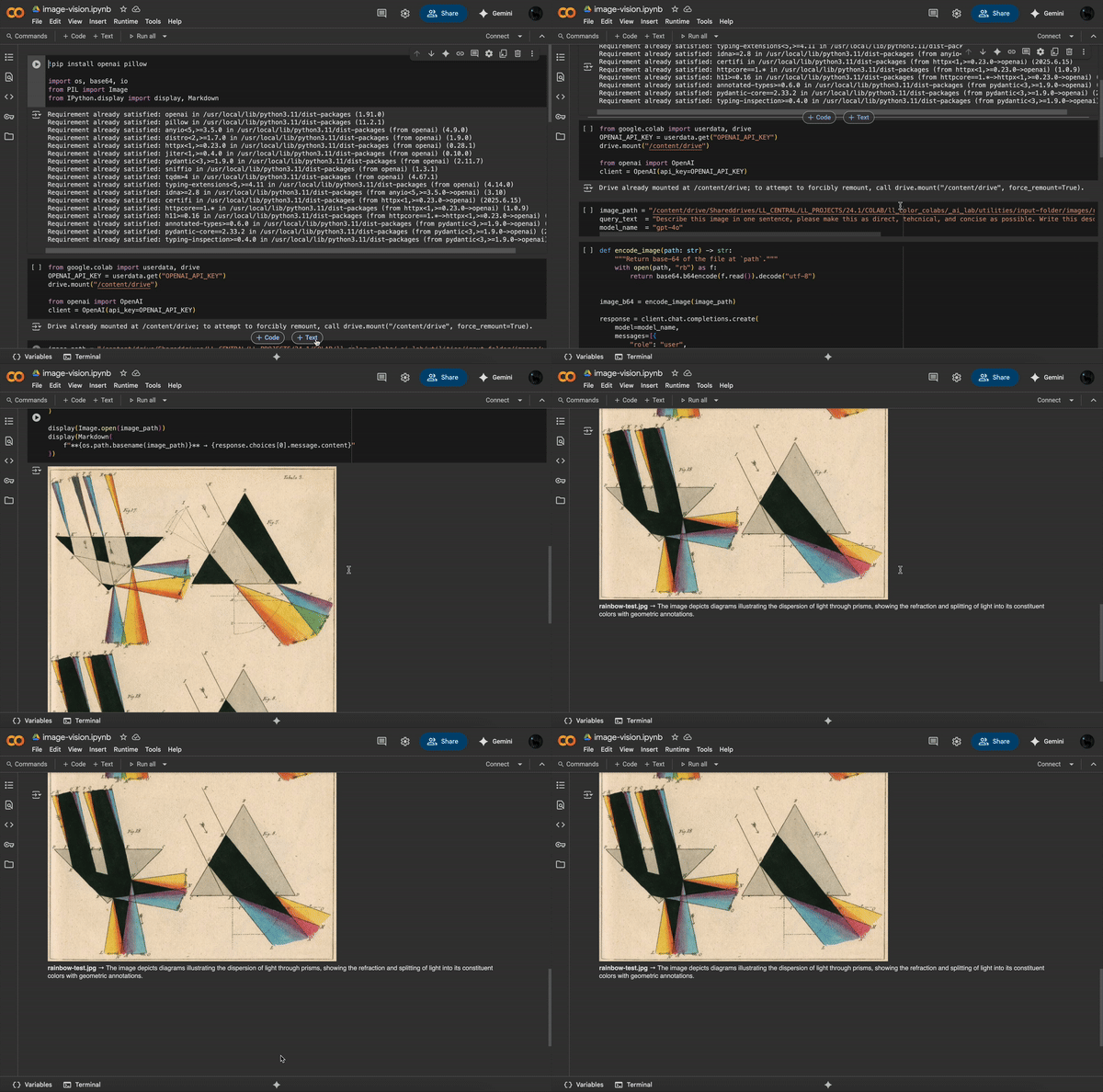
Python notebooks are similarly versatile to Slackbots as UIs for students to interact with AI. However, python noebooks also give students agency to build or edit tools themselves (even with limited coding experience). Python notebook functions have included: fairytale generation, recursive image generation, prompt-chain translations, RAG experiments, and more:
### Vibe Coding
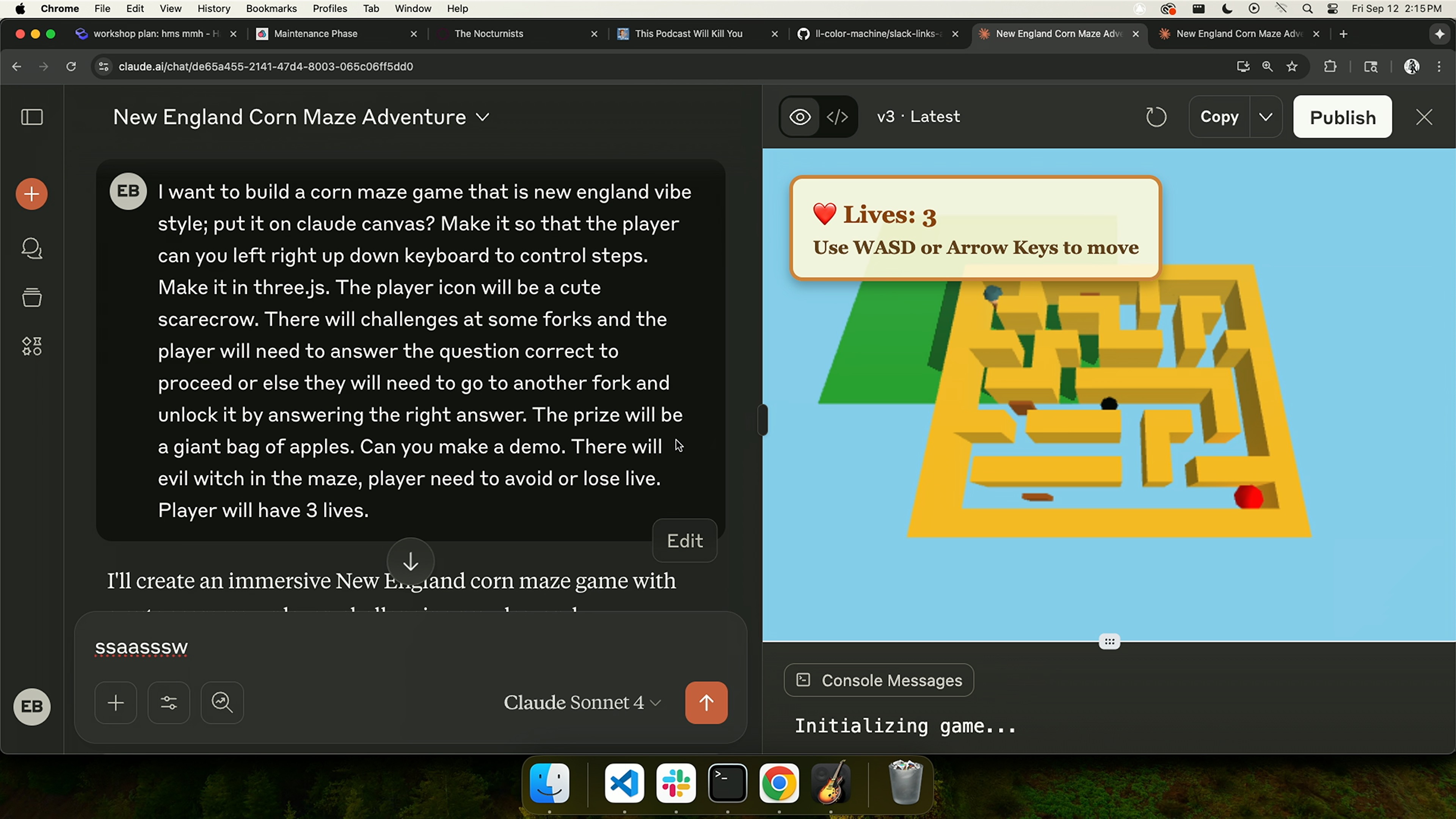
Helping students use code to build tools, assets, and websites, even in fields and courses where coding has been very limited in the past, is increasingly requested as a service. We are building out a series of "vibe coding" experiments and workshops to test the structure of such activities and their efficacy within the classroom.
### Paper Annotations
We collaborated closely with Moira Weigel to design AI-driven tools and multimodal activities for this theory-heavy course. For the capstone, we ran a full-class studio session where students annotated 3-foot-long physical printouts of the syllabus while interacting with a cloned voice of their professor, generated using ElevenLabs. We captured the annotated syllabi and used the OpenAI Vision API to generate class-wide reflections in real time, prompting deeper discussion. The session ended with tactile making activities, including button-making and block printing, using the students’ own digital artifacts.
---
## AI Lab
In this community of practice, hosted by the Bok Center, members meet over the course of several meetings to discuss novel applications of AI to education (both preventing and encouraging use). Across open workshops and working hours, members produce resources for use internally and externally.
There is also an async way to get involved, via our [Slack Workspace]().
> ### Daily
> #### Generative AI Office Hours
> *Monday through Friday 10am–1pm, Pierce Hall Room 110*
> Teams from the Bok Center and HUIT ATG are available for one-on-one consultations. Stop by with questions about assignment design, pedagogical strategies, troubleshooting tool access, or general AI integration advice.
>
> ### Wednesdays
> #### Bok AI Lab Workshops (Learning Lab Studio)
> *3–5pm, 50 Church Street, Suite 374*
> The Wednesday Workshops will be hands-on explorations of AI tools and workflows for teaching, learning, coding, artmaking, media production, and more. Sessions often use Python notebooks or other technical tools, but no prior coding experience is required. We will be teaching participants whatever they need to know to take part. Themes are still being finalized, but the following sessions are scheduled:
>
> - October 1 – The [Timeless Art](https://www.thewayofcode.com/) of "Vibe Coding": AI-coding tools for non-coders, teachers and academic writers
> - October 8 – Media & AI Lab 1: Preproduction *co-hosted with VPAL*
> - October 15 – AI for Data Visualization and Graphics
> - October 22 – Media & AI Lab 2: On Set / Live Capture and Generation *co-hosted with VPAL*
> - October 29 – AI & Translation
> - November 5 – Media & AI Lab 3: Postproduction *co-hosted with VPAL*
> - November 12 - AI for Teaching in Media-Rich Courses
> - **Tuesday**, November 18 – AI for Teaching Media Production **(5–6:30pm)** *In collaboration with the AFVS Department*
> - November 19 – Using LLMs to process qualitative data (for both research and classroom purposes)
> - December 3 – Media & AI Lab: Celebration *co-hosted with VPAL*
>
> ### Fridays
> #### Bok AI Lab Coffee Hour, Pierce Hall Room 100F*
> Friday morning’s AI Lab is a weekly coffee chat for faculty focused on AI news and discussion. We’ll share notable developments and open conversation about AI’s impact on teaching, learning, and research.
---
## AI workshops
Hands-on workshops guide faculty through activities that demystify large language models and provide practical ways to direct their output. Attendees will connect to Harvard-supported tools, pose increasingly complex questions about course material, and observe how model settings (web search, code interpreters, file uploads, etc.) shift speed and accuracy. In-person labs and sections are more important than ever, and in the midpoint of the session, small groups design and test an AI-resilient (or AI-enhanced) assignments. The workshop ends with a look at more advanced AI tools for teaching and maps out ongoing support from the Bok Center AI Lab.
### Designing and Grading Assignments in the Age of AI [workshop](https://hackmd.io/NUFfTbdWTdmvnK0U10DPfQ):
Jonah, Madeleine, Jungyoon, and Dongpeng led a workshop for faculty and teaching fellows in the Government Department focused on designing and evaluating assignments in the age of generative AI. The session began with a hands-on “norming” activity that introduced participants to current GAI tools and helped build shared intuitions about their affordances and limitations. Participants then worked through real-world examples, collaboratively exploring how to adapt essay prompts and problem sets to increase engagement, improve clarity, and strengthen alignment with learning goals—while also minimizing opportunities for uncritical or dishonest AI use. The final portion of the session featured practical guidance from the Honor Council on recent trends in AI-related cases, with time for discussion of institutional policies and best practices.
### [Mittal Institute workshop](/CjPl3W38Sl-iCt4SlfiiRQ)
Madeleine and Jungyoon facilitated a 2-hour “Teaching with AI” workshop for the Lakshmi Mittal and Family South Asia Institute’s Graduate Student Associates. Designed for an interdisciplinary cohort—including scholars from education, design, and data science—the session provided an overview of the generative AI landscape and its implications for teaching and learning.
---
## Async Resource Examples
### Videos:
<iframe width="560" height="315" src="https://www.youtube.com/embed/ZBXTRRqM3so?si=B62i9LSI-otTuYB_" title="YouTube video player" frameborder="0" allow="accelerometer; autoplay; clipboard-write; encrypted-media; gyroscope; picture-in-picture; web-share" referrerpolicy="strict-origin-when-cross-origin" allowfullscreen></iframe>
### Website Materials:
- [designing assignments in the age of AI](https://bokcenter.harvard.edu/courses-and-assignments-in-age-of-ai)
 Sign in with Wallet
Connect another wallet
Sign in with Wallet
Connect another wallet