---
robots: noindex, nofollow
---
# Q2 Report
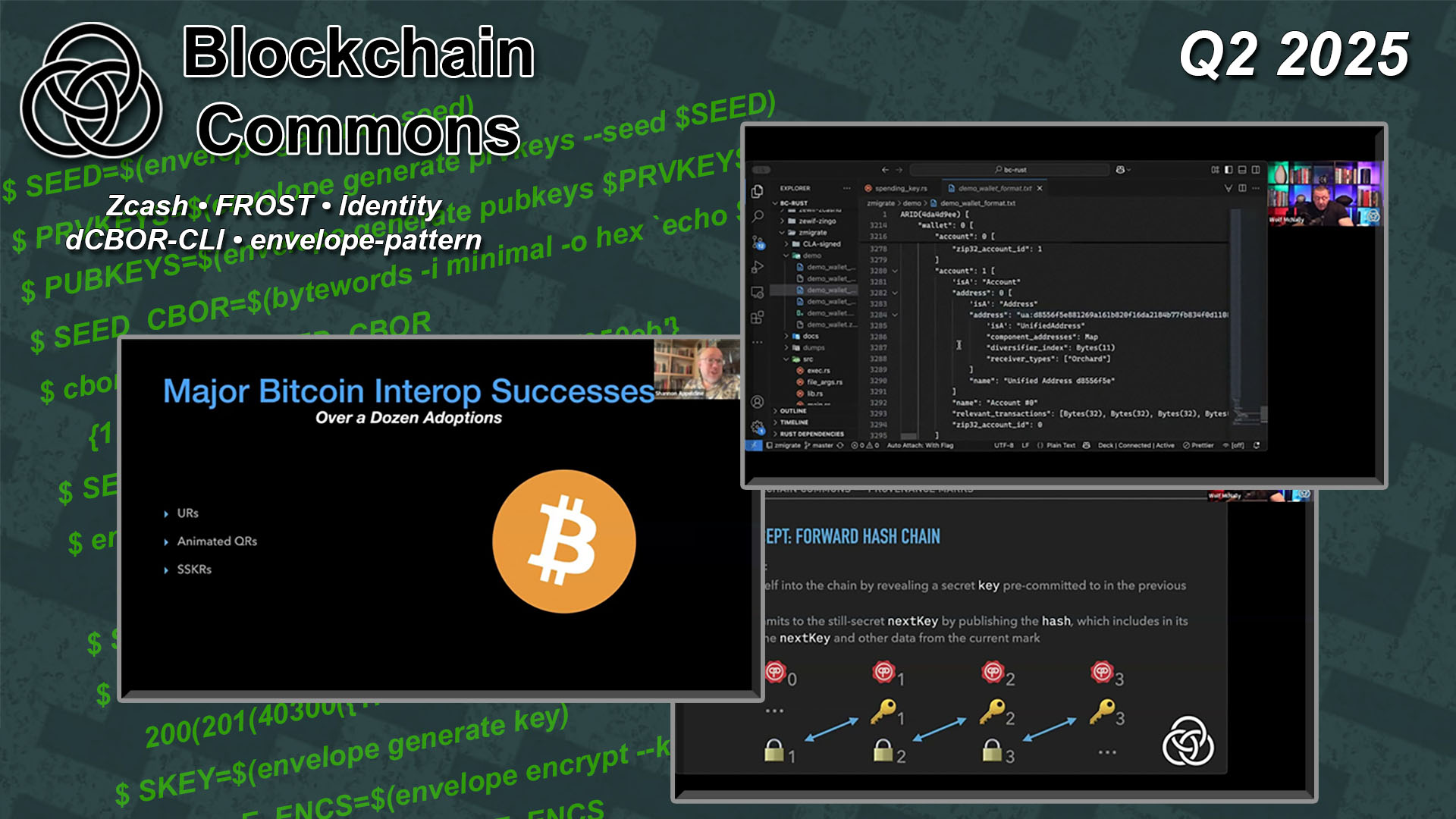
Not only did Blockchain Commons close out its major Zcash project in Q2 and start work on a big, new FROST push, but we also did continued work on many other initiatives:
* Working with Partners
* Zcash
* Zingo Labs
* FROST
* Ethereum
* Articles & Presentations
* Interoperability
* Provenance Marks
* Post-Quantum URs
* Permits in Gordian Envelope
* Thinking about Identity
* HackerNoon
* No Phone Home
* XID Core Concepts
* Fair Witness
* Bitcoin Policy Summit
* Web Updates
* Updated Projects Page
* New Envelope Seeds Page
* CLI Updates
* dCBOR-CLI
* Envelope-CLI
* Library Updates
* Mass Crate Update
* Argon2ID
* envelope-pattern
* dcbor-parse
## Working with Partners
_Blockchain Commons is supported by [patronage](https://github.com/sponsors/BlockchainCommons) and by grants. (If you want to become a major patron and partner with us on a project, [let us know](mailto:team@blockchaincommons.com), and if there are grants that you think would allow us to fulfill our [Gordian Principles](https://developer.blockchaincommons.com/principles/), that we may not be applying to, again drop us a line.) In Q1, some of our major projects were closely related to grants that we'd applied for last year._
**Zcash.** The Zcash [ZeWIF](https://developer.blockchaincommons.com/chains/zcash/zewif/) project took up the majority of the our Q1. The goal was to create an interchangeable wallet format that would make Zcash wallets more interoperable and so give users more freedom to move their funds to an app of their choice. We continued that work in April and then closed it out in May.
Our work product for Q2 of the ZeWIF project included the final drafts of our [best practices for importing & exporting wallet data](https://github.com/BlockchainCommons/zewif/blob/master/docs/bestpractices.md) and [our doc on using Envelope attachments for ZeWIF](https://github.com/BlockchainCommons/zewif/blob/master/docs/attachments.md). We also held our [fourth and final (to date) ZeWIF meeting](https://developer.blockchaincommons.com/chains/zcash/zewif/meeting4/), which included a demo of our [zmigrate-cli tool](https://github.com/BlockchainCommons/zmigrate). Our final [two](https://forum.zcashcommunity.com/t/grant-proposal-zcash-extensible-wallet-interchange-format-zewif/49730/41) [reports](https://forum.zcashcommunity.com/t/grant-proposal-zcash-extensible-wallet-interchange-format-zewif/49730/44) from May give all the details on the apps, crates, and docs that we published as we closed out the project.
{% include video id="oXm2FsR4KTs" provider="youtube" %}
**Zingo Labs.** We were proud to do our Zcash work with [Zingo Labs](https://zingolabs.org/), who provided us with some of the Zcash-chain knowledge we needed to extend our interoperability expertise into the Zcash community. (We also got lots of support from other experts in the community through meetings, which is the same way we advance standards in all the ecosystems we work with.) We hope to continue that partnership in the future, and to support that we offered a presentation to Zingo Labs in Q2 highlighting our technologies, how they work, and why they're useful. We focused on some of the low hanging fruit such as [SSKR](https://developer.blockchaincommons.com/sskr/), which allows for the secure backup of secrets, and [OIB](https://developer.blockchaincommons.com/oib/), which makes it easier for users to see what they're doing. We'll let you know if anything comes of this!
**FROST.** As soon as we closed out work on our Zcash grant, we began work on a new [FROST grant](https://www.blockchaincommons.com/news/HRF-FROST-Grant-2025/) that we received from [HRF](https://hrf.org/). This grant's work will come in three parts: creating new FROST signing tools; writing "Learning FROST from the Command Line"; and holding FROST meetings. We've been pushing hard on this work in July and August, so we'll be writing more about it in the Q3 report.
**Ethereum.** Though most of Blockchain Commons' work has traditionally been on the Bitcoin blockchain, our [principles](https://developer.blockchaincommons.com/principles/) of independence, resilience, privacy, and openness apply to all blockchains. Our recent work with Zcash proved that, and so in Q2 we also had some talks with a variety of parties in the Ethereum ecosystem about possibly doing work with them on securing secrets at the level zero of their stack. We're still waiting to see if anything gels, but generally: if you know of a blockchain that might be looking for interoperability or resilience support, let us know!
## Articles & Presentations
_Blockchain Commons' major articles and presentations demonstrate our fundamentals and highlight our newest work. Here's what that included in Q2._
{% include video id="kD2PV8bLFhw" provider="youtube" %}
**Interoperability.** We talk a lot about ecosystem "openness" and user "freedom", or more generally "interoperability." This is a pretty important foundation of Blockchain Commons' work, so in Q2 we explored it more with the article ["Interop, What Is It Good For?"](https://www.blockchaincommons.com/musings/musings-interop/) and [slides and video](https://developer.blockchaincommons.com/meetings/2025-05-interop/) at our May Gordian Meeting. We encourage you take a look at the article or the meeting presentation to gain some more insight into one of the core principles of Blockchain Commons' work.
{% include video id="vKAK6j4mqgE" provider="youtube" %}
**Provenance Marks.** One of our newest innovations is "provenance marks," which allow for the creation of a cryptographically-secured chain of marks. We gave a [presentation](https://developer.blockchaincommons.com/meetings/2025-06-provenance-marks/) at our June Gordian meeting and also have a [research paper](https://github.com/BlockchainCommons/Research/blob/master/papers/bcr-2025-001-provenance-mark.md) on the technology. We additionally presented in provenance marks to the W3C Credentials Community Group, who is forming a working group on provenance technology of this type: Blockchain Commons' provenance marks are one of three possibilities under consideration.
**Post-Quantum URs.** [Post-Quantum Cryptography support](https://developer.blockchaincommons.com/meetings/2025-03-pqc/) was one of our most exciting expansions in Q1. We've now published a new research paper on [integrating PQC with URs](https://github.com/BlockchainCommons/Research/blob/master/papers/bcr-2025-003-post-quantum.md).
**Permits in Gordian Envelope.** Gordian Envelope is a more mature technology at Blockchain Commons, but we're still exploring its fullest capability. Part of that capability is the "permit," which is a way to lock your Gordian Envelope. The great thing about permits is that you can apply multiple permits to an Envelope, so that it can be opened by different people in different ways! We wrote a research paper on ["Permits in Gordian Envelope"](https://github.com/BlockchainCommons/Research/blob/master/papers/bcr-2025-004-permit.md) to offer more insights into the possibilities.
## Thinking about Identity
_Christopher Allen has been long associated with digital identity, dating back at least to his authorship of ["The Path to Self-Sovereign Identity"](https://www.lifewithalacrity.com/article/the-path-to-self-soverereign-identity/) and his founding of [the Rebooting the Web of Trust workshops](https://www.weboftrust.info/). Blockchain Commons did a variety of scattered work on identity in Q2._
**HackerNoon.** Christopher talked to Hackernoon about how ["We've Lost the Privacy Plot"](https://hackernoon.com/the-co-writer-of-tls-says-weve-lost-the-privacy-plot), which generally discusses privacy and the internet.
<img src="https://www.blockchaincommons.com/images/nph.png" width=250 style="float: right">
**No Phone Home.** Digital identity is closely associated with digital credentials, which detail who and what an identity represents. Unfortunately, credential design is growing problematic because much of it is phoning home: alerting issuers when and where credentials are used. That's why Blockchain Commons recently signed on to the [No Phone Home initiative](https://www.blockchaincommons.com/news/No-Phone-Home/), to try and bring attention to this fundamental problem in digital identity.
**XID Core Concepts.** Blockchain Commons has its own answer for self-sovereign identity: the [XID](https://developer.blockchaincommons.com/xid/), or extensible identifier. We've been working on a tutorial course to show everything about how XIDs work. So far, we've developed a set of [core concepts docs](https://github.com/BlockchainCommons/XID-Quickstart/blob/main/concepts/README.md), which not only overview how XIDs work, but also how they link into Blockchain Commons' larger architecture. This is still a work in progress. (We're about to begin work finalizing the linked tutorials.) But, if you want to take an early look, the core concepts files have all been closed out as revised drafts.
<img src="https://www.blockchaincommons.com/images/posts/fw-stranger.jpg" width=150 style="float: right">
**Fair Witness.** Some of Blockchain Commons' work is advocacy (like our discussion with Hackernoon and our signing on to No Phone Home) and some is pragmatic (like our XID work). But we also try to be future-looking. That's what Christopher's ["Fair Witnessing" Musings](https://www.blockchaincommons.com/musings/musings-fair-witness/) was about. It's a new look at Verifiable Credentials that focuses on the limitations of what we actually can perceive.
**Bitcoin Policy Summit.** We're thrilled to see some of our thinking about identity starting to have an effect on the larger world. A few of Christopher's identity articles were referenced in the Bitcoin Policy Institute's recent white paper on ["Building a Trustworthy Digital Future"](https://cdn.prod.website-files.com/627aa615676bdd1d47ec97d4/687a499421889311e03d759e_Digital%20IDentity%20in%20the%20land%20of%20the%20free%20June%205%202025.pdf) and as a result, Christopher was asked to talk at the Bitcoin Policy Summit in Washington D.C. this June. (More on the results of that in the coming quarters!)
## Web Updates
_Our [web pages](https://www.blockchaincommons.com/) are intended as a resource for [developers](https://developer.blockchaincommons.com/) so that they can understand and implement our technologies. Here are some of the updates we made this quarter:_
**Updated Projects Page.** Our [projects](https://www.blockchaincommons.com/projects/) page has always been a central index to our most important work, but that type of thing gets out of date as priorities change, so we've done a big update to align it with our most recent iteration of our [developer pages](https://developer.blockchaincommons.com/) and to otherwise highlight important recent work like our [meetings for FROST](https://www.blockchaincommons.com/projects/#frost-round-table). Take a look at what we consider our most relevant work as of early 2025!
**New Envelope Seeds Page.** We also released a new page on [Seeds in Gordian Envelope](https://developer.blockchaincommons.com/envelope/seed/): how and why you'd want to store seeds in envelopes, complete with examples of how to use [`envelope-cli`](https://github.com/BlockchainCommons/bc-envelope-cli-rust) for experimentation. (This was also the heart of the demo we made to Zingo Labs, so you can take a look at several of our easiest-to-implement technologies here.)
## CLI Updates
_As usual, we've been making updates to our apps and libraries. In Q2 that included two CLI releases:_
**dCBOR-CLI.** We have a new [CLI for dCBOR](https://github.com/BlockchainCommons/bc-dcbor-cli)! It validates dCBOR input (using CBOR diagnostic as its default input) and produces output in several formats (using hex as its default output).
**Envelope-CLI.** Our [Envelope CLI](https://github.com/BlockchainCommons/bc-envelope-cli-rust) now has new pattern matching to make it easier to find specific leaves.
## Library Updates
_There were also lots of updates to our libraries, focusing on our Rust stack._
**Mass Crate Update.** The vast majority of our Rust crates have been updated to support new developments that occurred while we were working on ZeWIF. This includes:
- bc-rand 0.4.0
- bc-crypto 0.9.0
- bc-shamir 0.8.0
- dcbor 0.19.0
- bc-tags 0.2.0
- bc-ur 0.9.0
- sskr 0.8.0
- bc-components 0.21.0
- known-values 0.4.0
- bc-envelope 0.28.0
- provenance-mark 0.8.0
- bc-xid 0.8.0
- bc-envelope-cli 0.14.0
- gstp 0.8.0
**Argon2id.** Argon2id support has been added to `bc-crypto` and `bc-components`, as well as the `EncryptedKey` type.
**envelope-pattern.** The new [envelope-pattern crate](https://github.com/BlockchainCommons/bc-envelope-pattern-rust) is a pattern matcher and text syntax pattern parser for Gordian Envelope, allowing you to match specific structures within envelopes.
**dcbor-parse.** The new [dcbor-parse crate](https://github.com/BlockchainCommons/bc-dcbor-parse-rust) parses and composes the CBOR diagnostic notation into dCBOR (deterministic CBOR) data items.
Here are our major dcbor crate updates:
- dcbor-parse 0.1.1 (NEW)
- dcbor-cli 0.7.1 (heavy update)
- dcbor 0.19.1 (minor changes)
---
_Coming up, we have work on FROST, XID, and more. Sign up for the [Gordian Developer Meeting announcement-list](https://www.blockchaincommons.com/subscribe/) to be informed of our upcoming presentations, and please consider becoming a [patron](https://github.com/sponsors/BlockchainCommons) of Blockchain Commons or talking with us about partnering on a specific project._
 Sign in with Wallet
Connect another wallet
Sign in with Wallet
Connect another wallet