---
tags: Presentations
title: 3D Printing in Healthcare- Technological Context & Applications
author: Azad Mashari
details: Beth Israel Deaconess Medical Center, Anesthesia Grand Rounds; August 4, 2021; 40 minutes presentation. 20 minutes discussion.
---
# 3D Printing in Healthcare: Technological Context & Applications
[ToC]
## Meta
### To Do
[] Clinical trials, large case series or reviews (in main journal set) on 3DP models used in surgical/procedural planning (e.g. Sick Kids CHD group; Trial in ACHD)
[] Past 5 years on bio-printing and tissue engineering in high tier journals; High quality single review.
[]Past 10 years phantoms for procedural education with evaluation data/validation (not just decribing the manufacture of the phantom)
[] 3D printing, environmental impacts; Toxicity (occupational exposure, material toxicity) ~ not biocampatibility of materials
[] 3DP Market: How is the market divided, who are the big players in each sector, size/valuation, growth projections
[] Printing with salt (not anealing plastic in salt but salt as print material, e.g. https://karlijnsibbel.com/portfolio/3d-printing-salt-2/)
## Introduction
Good morning...
Thank you ...
Disclosures
### Objectives
1. Provide a technical and historical context for 3D printing and its current applications
* Technological context - capabilities, interactions with other technologies, drivers of development
* Historical context
2. Present an overview of current applications, discuss available evidence, gaps in evidence and guidelines
* Medical applications: potential, actual
4. Discuss current limitations, potential hazards, and barriers
## Technical Context
Rapid Prototyping
Desktop Manufacturing
On-demand Manufacturing
Distributed Manufacturing
Solid Freeform Manufacturing
Layer Manufacturing
Direct Manufacturing
### Digital Fabrication
3D Printing technical constellation
Digital Representation of object (3D Model) >> Physical Object
3D printing is part of a constellation of **Digital Fabrication** technologies that take a digital representation of an object and produce a physical object in a semi-automatic fashion.
Digital Fabrication systems traditionally include [traditional "subtractive" CAM/CNC systems](https://en.wikipedia.org/wiki/Numerical_control) such as
* Mills
* Lathes
* Drills
* Watjet/Plasma/laser cutters
These systems start with a block of materials and remove the excess.

Because they don't require customized hardware (e.g. injection mould) digital fabrication systems are much more time- and cost-effective for production of **prototypes, one-offs or small-medium volume production** of high precision components.
#### 3D Printing: Key Features
What sets 3D printing apart *technically* from other digital fabrication techniques is that it builds up the object **layer by layer**. Hence "Additive Manufacturing".
This, theoretically
* Removes nearly all *geometric* restrictions on component design
* A single system to make the entire part and
* Create parts that cannot be created by any other technique.
~
Layer-by-layer
Image: Slicing view of heart from Cura/Slic3r; Kuin Amann; Mille Feuille
Image: Examples of complex geometry that can only be made by 3D P (planetary gears, interlocking components
Image: Example of complex part machined and the list of systems it required vs. the part 3DPrinted

[Planetary Gear Video](https://youtu.be/BCWImsbFycU)
But there is no free lunch.
These capabilities come at a cost
* Limited (though wide and growing) range of material options and mechanical properties.
* Limited part size
* Slow for high volume production
* Limited control over material microstructure
So for example 3D printed parts always have a grain along the layer boundaries.
This grain may not be visible if your resolution is high enough but it will definitely impact the mechanical properties of the parts.
This is the major technical limitation of using 3D printing for manufacturing of functional metal components since microstructure crystal features of metal objects are essential to mechanical strength, independent of the specific type of metal or alloy used.
[3DP Pastry](https://youtu.be/ILX-cVy-wq8)
[Mille Crepes](https://commons.wikimedia.org/wiki/File:Mille_cr%C3%AApe.jpg)
[Concrete complex geometry](https://www.bgu.tum.de/en/research/highlights/3d-printing-in-concrete/)
[Ultralight materials with complex microstructure](https://3dprint.com/264710/swiss-researchers-inspired-butterfly-wing-structure-in-3d-printing-ultra-lightweight-structures/)
[3D metal print grain](https://3dprint.com/224130/microstructure-stainless-steel/)
[3DP vs. CNC](https://www.3dnatives.com/en/3d-printing-vs-cnc-160320184/#!)
### Desktop 3DP: Same Same but Very Different
Technology Stack/pyramid.
Top: Different 3D printers- industrial, reprap etc.;
Middle: Software, Hardware (Modular electronics, motors, bearings, sensors), Materials, Mass collaboration
Lower: Digital computing, Open IP
The first 3D printers came on the market in the early 1980s 3D printing itself is not technicall new.
The devices were industrial and cost on the order of $100K - millions
But there is clearly something new, which really highlights how technically mino changes to the form, scale and cost of a technology can open-up whole new areas of application.
Despite what the marketting material from Stratasys or 3D systems might tell you, the chief driver in the rapid growth of **Desktop 3DP** over the past 15 or so years has been the development of open-source printers, which became possible in the late 1990s when the patents for the first FDM 3DPs expired.
In terms of application and social implications Desktop 3DP is essentially a different technology from industrial 3DP, though an intermediate range of "institutional devices" has now been developed and heavily marketed but limited upate in healthcare.
This led to a rapid proliferation and progress of designs from a global network of small companies, hobbyists, academics and artists.
Within a few years high precision desktop FDM printers were available for a few thousand dollars, often with nearly the same capabilities as their industrial counterparts.
The growth in the field has in many ways been driven by these FDM systems but the attention these have attracted has inturn created a significant market boost for 3D printing more generally.
For people interested in the **dynamics of technology development**, desktop 3DP is a very interesting case study of user-developed technology.
When developers are also users of the technology, the often conflicting goals of production and usability can find an organic alignment.
In such situations designers are intimately concerned with usability and quality of the final product as the primary metric of quality, with cost and production concerns, while significant, being secondary.
This kind of development process tends to produce technologies that relate very differently to their users.
Not everything is all sunshine and rainbows.
The path of the desktop 3D printer user is frought with toil & frustrations.

It is afterall a printer.
But at least upto this point, the access that users had to the insides of the technology, the technical capacity and the legal right to see into, repair and modify the devices has made those potentially constructive and fulfilling in a way that frustrations with laser printera and photocopiera are not.
This is reminicent of car culture in the 1950s, or the development of electronic music technology.
The period of rapid, distributed progress, with significant input from amature developers and hobbyists seems to be transitioning to a more gradual, company-based ecosystem as the increasing complexity and sophistication of desktop printers has increased the entry barrier for new developers.
The increasing accessibility of 3D printers has also raised issues of social control and regulation.
Many of you remember the 3D printed gun stories, which has kind of fallen off the radar despite disturbingly rapid technical progress. I guess in part because it's not seen as seriously impacting firearm accessibility here.

But desktop 3DP is increasingly used in clinical care and small-medium scale manufacturing of medical devices and this presents some urgent problems in terms of quality control, patient safety and regulation which the existing mechanisms are beginning to forced to acknowledge.
Image: 3DP medical devices
### Digital Representation (Dissolve into surrondings)
So what is the process for 3D printing.
**Digital representation**: variety of sources, most commonly
* Computer-aided drafting/design (CAD and 3D modeling)or
* 3D models derived from 3D medical imaging data)
~
Workflow from CAD and Medical Image to 3D Print
Medical 3DP applications combine 3D printing with other digital technologies such as 3D Imaging, 3D Modeling and CAD; as well as traditional fabrication techniques such as casting.
3DP and Casting to make titanium Sattelite: https://www.flickr.com/photos/jurvetson/13457263373
Applications of 3DP and 3DM in particular are infact very often interwoven but in this talk I am going to try to **keep the focus on the capacity to build useable objects on demand, for which 3DP is both a linchpin technology and a symbol**.
Examples of 3DM+3DP intersection: visualization AR, VR, 3DP
So, we are talking about
"The Capacity to
Cheaply, Reliably, farily Rapidly
Produce
Complex, Customized, Functional
Physical Objects"
Two general applications that I will focus on
* Patient-specific models
* Manufacturing
### Tool > Application (1)
Tools > Applications Map - Actual Applications; Potential Applications;
For patient-specific models
For manufacturing
### 3D Printing Tools (2)
*Ahangar P, Cooke ME, Weber MH, Rosenzweig DH. Current Biomedical Applications of 3D Printing and Additive Manufacturing. Applied Sciences. 2019 Apr 25;9(8).*
Printers: Hardware and Software
Materials
* Range
* Mechanical Properties
* Biocompatibility
* Toxicity
* Environmental impact
## Applications
### Procedural Planning (4)
The pre-eminent clinical application of 3DP so far has been the creation of patient-specific 3D models from medical imaging data.
These models have been used for teaching, communication with patients and care teams and assisting in clinical decision making and planning complex procedures.
The greatest need for this is in situaitons with high anatomic variability and small margins of error (e.g. complex tumors, congenital heart disease, dentistry& maxillofacial surgery) where adpotion has been widespread as can be seen from the proliferation of case reports.
Unfortuantely the uniqueness and relative rarily of many of these situations makes it difficult to systematically evaluate the benefits and hazards of the technology.
Include in images: Femur, Other non cardiac?
#### CASE: Cardiac Tumor
https://uhnfoundation.ca/stories/3d-vision/
https://www.uhn.ca/Surgery/Sprott_Department_of_Surgery/Magazine/Documents/3D_Vision.pdf
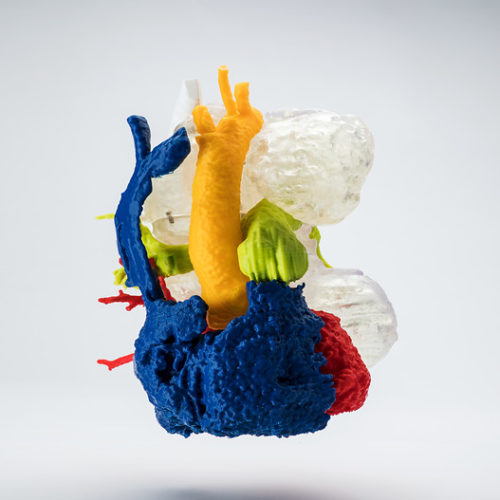
Photo by Tim Fraser
#### CASE: ACHD EP Case
[] Kate - Latest case from Krish Nair
Clinical summery (Azad)
Segmentation screen shot
3D model image
3D print
#### CHD Planning
* Sick Kids group; other CHD centers
* [Eur J Cardiothorac Surg. 2017 Dec 1;52(6):1139-1148. doi: 10.1093/ejcts/ezx208. Three-dimensional printed models for surgical planning of complex congenital heart defects: an international multicentre study](https://pubmed.ncbi.nlm.nih.gov/28977423/)
* See citing and related articles above.
* [Published trials](https://pubmed.ncbi.nlm.nih.gov/?term=3d+printing&filter=pubt.clinicaltrial&filter=pubt.randomizedcontrolledtrial&format=abstract&sort=date)
#### Valve Printing
* Surgical planing and simulation (flow chamber), intra-op decision making re treatment approach.
#### Guidelines
### Surgical Guides and Prosthesis (4)
Dentistry/maxillofacial - a major market; Evidence of benefits? Costs?
(Talk to Matt Ratto)
* doi: 10.1016/j.ijom.2020.09.023. Epub 2020 Oct 31. Comparison of three different types of splints and templates for maxilla repositioning in bimaxillary orthognathic surgery: a randomized controlled trial
* doi: 10.11607/prd.4146. A Randomized Controlled Clinical Trial Comparing Conventional and Computer-Assisted Implant Planning and Placement in Partially Edentulous Patients. Part 3: Time and Cost Analyses - 31% more expensive
Ortho
* [doi: 10.1186/s13018-020-01615-8. Clinical application of individualized 3D-printed navigation template to children with cubitus varus deformity](https://pubmed.ncbi.nlm.nih.gov/32192482/)
Thoracics
* [JAMA Surg. 2019 Apr 1;154(4):295-303. doi: 10.1001/jamasurg.2018.4872. Accuracy of a 3-Dimensionally Printed Navigational Template for Localizing Small Pulmonary Nodules: A Noninferiority Randomized Clinical Trial](https://pubmed.ncbi.nlm.nih.gov/30586136/)
[Burn Face Molds from Gaza](https://www.reuters.com/article/us-palestinians-burns-facemasks-idUSKBN2AB10X)
Nia
Maxillofacial
1. Campioni I, Cacciotti I, Gupta N. Additive manufacturing of reconstruction devices for maxillofacial surgery: design and accuracy assessment of a mandibular plate prototype. Annali dell’Istituto Superiore di Sanità. 2020 Mar 25;56(1):10–8.
Microprosthesis / Nanoprinting
* [Glaucoma valve](https://www.3dprintingmedia.network/nanoscribe-shows-off-3d-printed-microvalve-for-treating-glaucoma/)
#### Bio-printing
* Bio-printing of Prosthetic valves
* other bio-printing
*1. Engler AJ, Cooper-White J. Academic vs industry perspectives in 3D bioprinting. APL Bioengineering. 2020 Mar 1;4(1):010401.*
*2. Birla RK, Williams SK. 3D bioprinting and its potential impact on cardiac failure treatment: An industry perspective. APL Bioengineering. 2020 Mar 1;4(1):010903.*
*3. Placone JK, Mahadik B, Fisher JP. Addressing present pitfalls in 3D printing for tissue engineering to enhance future potential. APL Bioengineering. 2020 Feb 10;4(1).*
### Outlook: Clinical Applications
### Educational Models and Simulators (3)
Image: FOCUS models, PIG, Heart Atlas, TEE Phantom, SCV phantom, CT Abdo Phantom
#### CASE: Toronto Heart Atlas
MeTRA Study
* [Congenit Heart Dis. 2018 Nov;13(6):1045-1049. doi: 10.1111/chd.12673. Epub 2018 Sep 19. Utility of three-dimensional models in resident education on simple and complex intracardiac congenital heart defects](https://pubmed.ncbi.nlm.nih.gov/30230245/)
* [BMC Med Educ. 2018 Aug 2;18(1):178. doi: 10.1186/s12909-018-1293-0. Three-dimensional printing models in congenital heart disease education for medical students: a controlled comparative study](https://pubmed.ncbi.nlm.nih.gov/30068323/)
#### CASE: Neuraxial Injection Phantom
#### CASE: TEE Phantom
#### Outlook: Educational Applications
Patient Education / Consent
* [Semin Thorac Cardiovasc Surg. 2019 Summer;31(2):316-318. doi: 10.1053/j.semtcvs.2018.10.017. Epub 2018 Nov 7. Personalized 3D-Printed Model for Informed Consent for Stage I Lung Cancer: A Randomized Pilot Trial](https://pubmed.ncbi.nlm.nih.gov/30412772/)
Procedural Simulation Refs
* Addressing the Pandemic Training Deficiency: Filling the Void with Simulation in Facial Reconstruction PMID: 33656188 PMCID: PMC8013962 DOI: 10.1002/lary.29490
Anatomy Education Refs
* [doi: 10.1136/bmjopen-2020-036853. Effectiveness of three-dimensional printed and virtual reality models in learning the morphology of craniovertebral junction deformities: a multicentre, randomised controlled study](https://pubmed.ncbi.nlm.nih.gov/32973056/)
Need vs. Market
### Medical Device Development and Production (4)
Image: Stethoscope, PAPR, N95, Faceshield, EVHP enclosure, Tourniquet
#### CASE: Stethoscope
#### CASE: Reusable N95
#### Outlook: Manufacturing
* OSMD & Digital Stockpile
## Looking Ahead
Tools & Technical Context
- Increasing complexity, speed, automation, material range, integrated circuitry, hydraulics
- Power harvesting
- & AI / ML ?
- Standardization
- Regulation
Applications
- Bioprinting
- Local-distributed manufacturing of devices
- Device manufacturing
- AR/AI
Impacts
## References & Resources
## Acknowledgements
---
## Cases
* Cusimano Tumor
* Interventional Cardiology ACHD Cases
* Aortic Valve Study
* Nia prosthetics
* ACHD Atlas
* TEE Phantom; SCV Phantom
* TEE Anatomy Lecture; Echo models
* Cell culture testing panels (Kate)
* Bioprinting
* Heart Enclosure
* Glia Stethoscope
* N95 Mask; OSMD report
## Principles
Avoid a sense of technological determinism. Emphasize our locus of control as users and providers in shaping the technology and its applications.
What is being done with the techniques now
What can be done
What are the drivers - the OS/maker community; the commercial interests; regulators
doi: 10.1016/j.ejrad.2020.109488. Epub 2020 Dec 29.
Application of ultra-low-dose CT in 3D printing of distal radial fractures
### 1.4 - Translation to Practice (3) - Drivers - Reconcile with section 1
The translation of these techniques into applications relies not just on the technical features of the tools but also on a variety of other processes:
TRANSLATION TO PRACTICE
Does it work? Effectiveness, Safety, Usability
* Guidelines, Technical Standards, Regulations
Can we get some? Accessibility
* Technology Development Process and drivers
* Market forces; demand
* Technical innovations
* IP: Thanks to the explosion and rapid evolution of **open-source designs** after the expiry of the first patents for fused deposition modelling (FDM) printers in 1980s, has become **smaller and cheaper and widely available.**; but business viability of IP models. Examples of Prusa, 3DS, Makerbot, Formlabs
* Funding and reimbursement
* Educational Resources
[] Slide with existing guidelines
[] Slide with references on reimbursment and financing
[] Slide with general educational resources on medical 3DP technique, and 1-2 top review articles.
 Sign in with Wallet
Connect another wallet
Sign in with Wallet
Connect another wallet