# <center><i class="fa fa-edit"></i> 5G New Radio </center>
###### tags: `notes`
:::info
**Goal:**
To understand Basic 5G New Radio
**Resources:**
[Wiki 5G](http://www.sharetechnote.com/left_5G.html)
:::
## 5G New Radio
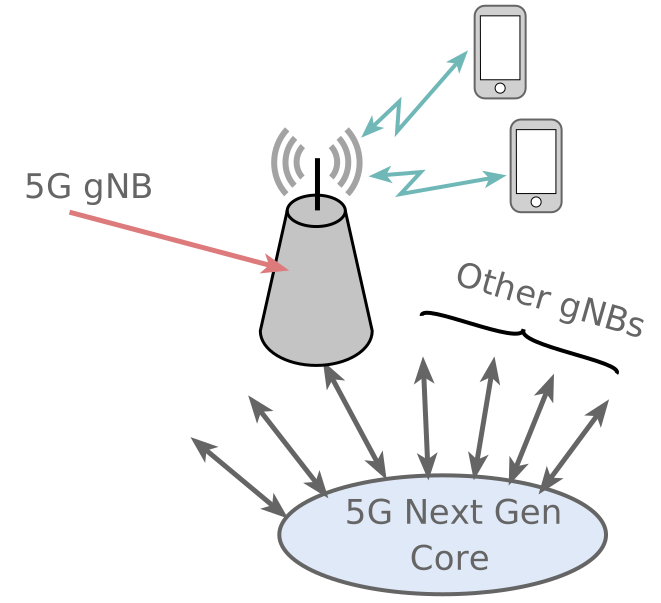
5G New Radio is the new radio air interface that is being developed for 5G mobile communications. This new radio interface provides for the growing needs for mobile connectivity.
5G NR utilises modulation, waveforms, and access technologies that will enable the system to meet the needs of high data rate services, those needing low latency and those needing small data rates and long battery lifetimes amongst others.
## 5G NR Basics

The 5G New Radio has been developed to provide a significant enhancements in areas like flexibility, scalability, and efficiency, both in term of power usage and spectrum.
The 5G New Radio is able to provide communications for very high band with transmissions like streaming video as well as low latency communications for remote control vehicle communications as well as low data rate low bandwidth communications for machine type communications.
There are several cornerstones to the new radio used for 5G:
- <b> New Radio Spectrum</b> : Mobile communications usage is rapidly increasing and the introduction of 5G will accelerate this trend with many more applications being accommodated by the technology. Whilst improvements in spectrum efficiency will be made these will not be able to accommodate the huge increases in usage, so some spectrum is needed. The advantage of the higher frequency bands is that they are much wider and they will be able to allow much higher signal bandwidths and hence support much higher data throughput rates. The disadvantage in some aspects is that they will have a much shorter range, but this is also an advantage because it will also allow much greater frequency re-use.
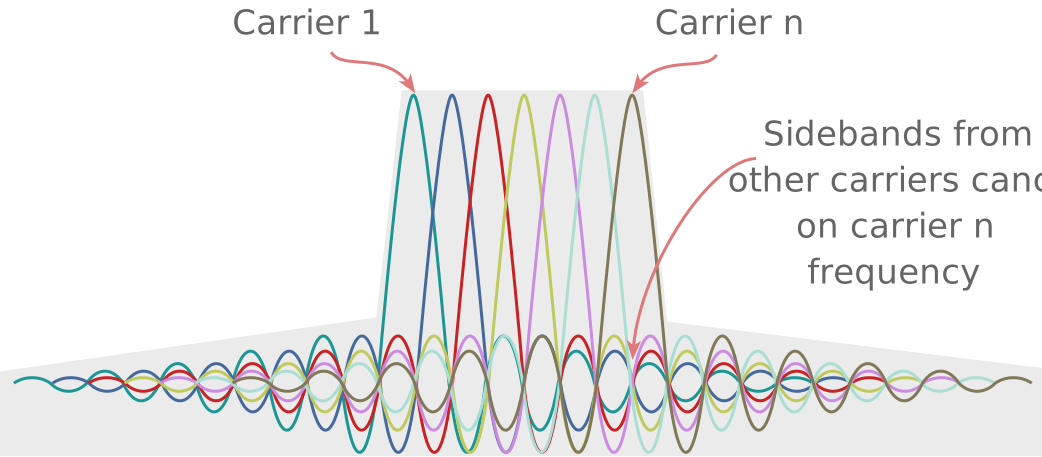
- <b> Optimised OFDM</b> : an early decision was taken to use a form of OFDM as the waveform for phase one of the 5G New Radio. Orthogonal Frequency Division Multiplexing (OFDM) is an efficient modulation format used in modern wireless communication systems including 5G. OFDM combines the benefits of Quadrature Amplitude Modulations (QAM) and Frequency Division Multiplexing to produce a high-data-rate communication system. It has been very successfully used with 4G, the more recent Wi-Fi standards and many other systems and came out as the optimum type of waveform for the variety of different applications for 5G. with the additional processing power available for 5G, various forms of optimisation can be applied.
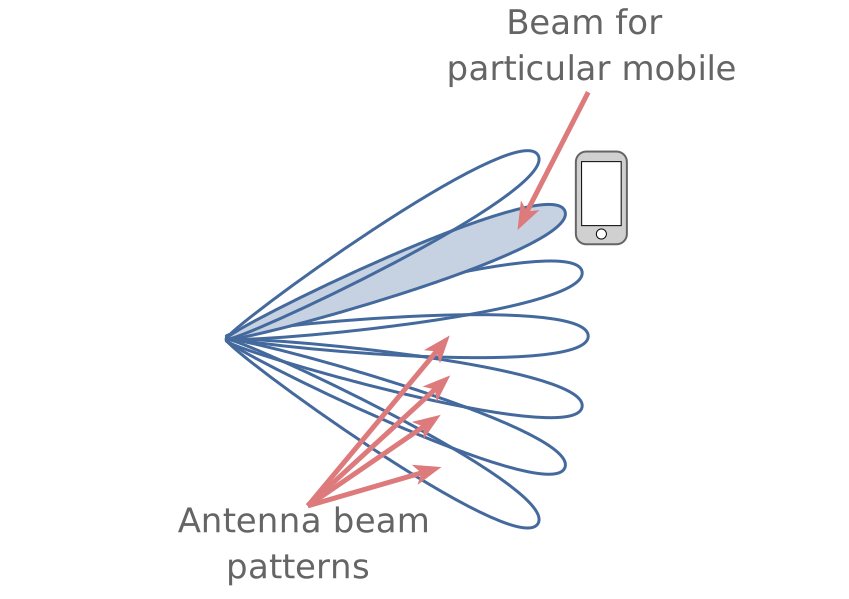
- <b> Beamforming</b> : Beamforming is a technology that has become a reality in recent years and it offers to provide some significant advantages to 5G. To optimize signal strength at the mobile device, NR uses a combination of analog and digital beamforming. Beamforming enables the beam from the base station to be directed towards the mobile. In this way the optimum signal can be transmitted to the mobile and received from it, whilst also cutting interference to other mobiles. The move to higher frequencies allows for much smaller antennas and the possibility of programmable high directivity levels.
- <b> MIMO</b> : Multiple Input Output has been employed I many wireless systems from Wi-Fi to the current 4G cellular system and it provides some significant improvements. Within 5G, MIMO will be one of the mainstay technologies. 5G will take full advantage of Multiuser where it will provide multiple access capabilities to MIMO by utilising the distributed and uncorrelated spatial location of the various users.
- <b> Spectrum Sharing Techniques</b> : much of the radio spectrum, although allocated, is not used in an efficient manner. One of the techniques being proposed is for spectrum sharing.
- <b> Unified Accross Frequencies</b> : With the 5G New Radio utilising a wade variety of frequencies, possibly 3.4 to 3.6 Ghz below 6Ghz and then 24.25 to 27.5 Ghz, as possibilities for the mmWave radio. It is important to have a common interface across these frequencies.
- <b> Small Cells</b> : As network densification is required to provide the required data capability more use of small cells and small cell networks are being proposed. A small cell network is a group of low power transmitting base stations which uses millimetre waves to enhance the overall network capacity. The 5G small cell network operates by coordinating a group of small cells to share the load and reduce the difficulties of physical obstructions which become more important at millimetre waves.
 Sign in via Facebook
 Sign in via X(Twitter)
 Sign in via GitHub
 Sign in via Dropbox
 Sign in with Wallet
Connect another wallet
Sign in with Wallet
Connect another wallet