## Attribution Biases :label:
### ..and intergroup attribution
<!-- Put the link to this slide here so people can follow -->
**Rizqy Amelia Zein**
Department of Personality and Social Psychology
Universitas Airlangga
slides: https://hackmd.io/@ameliazein/kogsos-5
---
To download the slides (.pdf), swipe down and click :printer: icon.
---
---
## Attribution styles :telescope:
<div style="text-align: left">
* Research suggests that **==people have different attributional styles==**.
* This is because they **==differ in the amount of control==** they feel they have over the reinforcements and punishments they receive.
</div>
---
## Attribution styles :telescope:
<div style="text-align: left">
* ==[**Locus of control**](https://psycnet.apa.org/record/1991-97206-008)==
- **==Internals==** believe they have ==significant personal control== over their destiny – things happen because they make them happen.
- **==Externals==** are more fatalistic – they believe that they have ==little control== over what happens to them; things simply occur by chance, luck or the actions of powerful external agents.
</div>
---
## Attribution styles :telescope:
<div style="text-align: left">
* Measuring attributional syles
- [Attributional style questionnaire (ASQ)](https://link.springer.com/content/pdf/10.1007/BF01173577.pdf) measuring :three: dimensions :point_right: internal/external, stable/unstable and global/specific.
- [Attributional complexity scale (ACS)](https://psycnet.apa.org/doiLanding?doi=10.1037/0022-3514.51.4.875) measuring individual differences in the complexity of the attributions that people make for events.
</div>
---
## Attributional biases :speak_no_evil:
<div style="text-align: left">
* The attribution process is clearly **==subject to bias==**.
- e.g it can be biased by personality, biased by interpersonal dynamics or biased to meet communication needs.
* Remember the **==shortcuts and heuristics==**:exclamation:
</div>
---
## Attributional biases :speak_no_evil:
<div style="text-align: left">
* **==Cognitive miser==** :point_right: A model of social cognition that characterises people as using the least complex and demanding cognitions that are able to produce generally adaptive behaviours.
</div>
---
## Attributional biases :speak_no_evil:
<div style="text-align: left">
* **==Motivated tactician==** :point_right: A model of social cognition that characterises people as having **==multiple cognitive strategies available==**, which they choose among on the basis of personal goals, motives and needs.
* The choice of short-cut and choice of attribution can also be influenced by **==personal motives==**.
</div>
---
### Correspondence bias :package:
<div style="text-align: left">
* ...or **==fundamental attribution error==**.
* ..a tendency for people to **over-attribute** behaviour to **==stable underlying personality dispositions==**.
* ..is a tendency for people to make dispositional attributions for others’ behaviour, even when there are clear external/environmental causes.
</div>
---
### Correspondence bias :package:
<div style="text-align: left">
* Correspondence bias is related to two other biases:
- ==[**The outcome bias**](https://www.sciencedirect.com/science/article/pii/S0065260108602361)== :point_right: assume that a person behaving in some particular way intended all the outcomes of that behaviour; and
- ==[**Essentialism**](https://onlinelibrary.wiley.com/doi/abs/10.1348/014466602165072)== :point_right: behaviour is considered to reflect underlying and immutable, often innate, properties of people or the groups they belong to.
</div>
---
### Correspondence bias :package:
<div style="text-align: left">
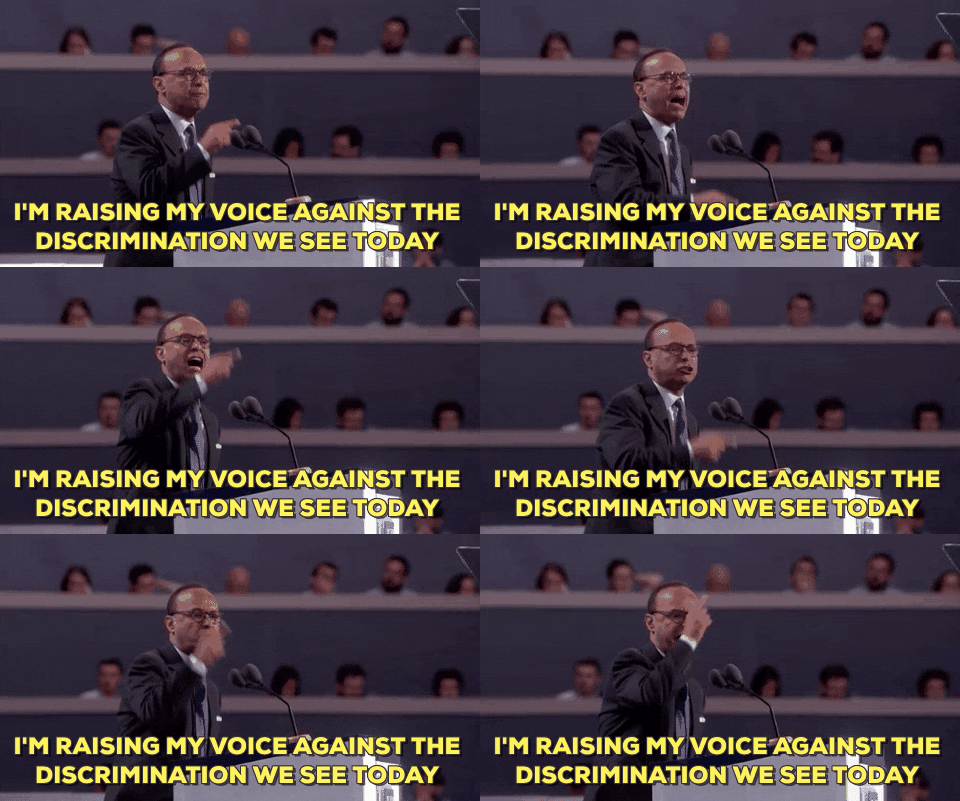
* There is [evidence](https://onlinelibrary.wiley.com/doi/abs/10.1348/014466607X270287) that groups can use essentialism strategically to **==discriminate against outgroups==**.
</div>
---
### Correspondence bias :package:
<div style="text-align: left">
:three: explanations:
:one: **==Focus of attention==** :point_right: The **actor’s behaviour** attracts **==more attention==** than the background; it is disproportionately salient in cognition, and out as the figure against the situational background and is therefore over-represented causally.
</div>
---
### Correspondence bias :package:
<div style="text-align: left">
:two: **==Differential forgetting==** :point_right: There is evidence that people **==tend to forget situational causes==** more readily than dispositional causes, thus producing a dispositional shift over time.
</div>
---
### Correspondence bias :package:
<div style="text-align: left">
:three: **==Linguistic facilitation==** :point_right: the construction of the English language makes it relatively **easy to describe an action and the actor** in the same terms, but **==more difficult to describe the situation==** in the same way.
- e.g. we can talk about a kind or honest person, and a kind or honest action, but not a kind or honest situation.
</div>
---
## The actor-observer effect :cinema:
<div style="text-align: left">
* The actor–observer effect (or the self–other effect) is an extension of the correspondence bias.
* It refers to the **==tendency==** for people to attribute **==others’ behaviour internally==** to dispositional factors and their **==own behaviour externally==** to environmental factors.
</div>
---
## The actor-observer effect :cinema:
<div style="text-align: left">
* It can be **==erased or reversed==** if the actor is encouraged to take the role of the observer regarding the behaviour to be attributed, and the observer the role of the actor.
- Now the actor becomes more dispositional and the observer more situational.
</div>
---
## The actor-observer effect :cinema:
<div style="text-align: left">
:two: explanations
* **==Perceptual focus==** :point_right: it is almost identical to the ‘focus of attention’ explanation for the correspondence bias.
- For the observer, the actor and the actor’s behaviour are figural against the background of the situation.
</div>
---
## The actor-observer effect :cinema:
<div style="text-align: left">
* **==Informational differences==** :point_right: we may actually know that we behave differently in different contexts and thus quite accurately consider our behaviour to be under situational control.
</div>
---
## False-consensus effect :mag_right:
<div style="text-align: left">
* ..seeing our **==own behaviour as being more typical==** than it really is.
* We usually **==seek out similar others==** and so should not be surprised to find that other people are similar to us.
</div>
---
## False-consensus effect :mag_right:
<div style="text-align: left">
* Our own opinions are so salient to us, at the forefront of our consciousness, that they **==eclipse the possibility of alternative opinions==**.
* We are motivated to ground our opinions and actions in perceived consensus in order to **==validate them and build a stable world for ourselves==**.
</div>
---
## Self-serving biases :smirk:
<div style="text-align: left">
* ...attributional distortions that **==protect or enhance self-esteem or the self-concept==**.
* We take credit for our positive behaviours and successes as reflecting who we are and our intention and effort to do positive things (**==the self-enhancing bias==**).
</div>
---
## Self-serving biases :smirk:
<div style="text-align: left">
* At the same time, we explain away our negative behaviours and failures as being due to coercion, normative constraints and other external situational factors that do not reflect who we ‘really’ are (**==the self-protecting bias==**).
* This is [a robust effect](https://psycnet.apa.org/record/1988-98699-017) that **==holds across many cultures==**.
</div>
---
## Self-serving biases :smirk:
<div style="text-align: left">
* Self-serving biases are clearly **==ego-serving==**, but also there is **==a cognitive component==**, particularly for the self-enhancing aspect.
* Self-enhancing biases are **==more common==** than self-protecting biases.
- People with low self-esteem tend not to protect themselves by attributing their failures externally; rather, they attribute them internally.
</div>
---
## Self-serving biases :smirk:
<div style="text-align: left">
* **==Self-handicapping==** :point_right: Publicly making advance external attributions for our anticipated failure or poor performance in a forthcoming event.
* **==Illusion of control==** :point_right: Belief that we have more control over our world than we really do.
* **==Belief in a just world==** :point_right: Belief that the world is a just and predictable place where good things happen to ‘good people’ and bad things to ‘bad people’.
</div>
---
## Intergroup attribution :articulated_lorry:
<div style="text-align: left">
* ...process of **==assigning the cause of one’s own or others’ behaviour to group membership==**.
</div>

---
## Ethnocentrism :electric_plug:
<div style="text-align: left">
* ..or **==ingroup-serving bias==**.
* **Socially desirable** (positive) behaviour by **==ingroup members==** and **socially undesirable** (negative) behaviour by **==outgroup members==** are internally attributed to dispositions.
* **Negative ingroup** and **positive outgroup** behaviour are externally attributed to **==situational factors==**.
</div>
---
## Ultimate attribution error :lightning_cloud:
<div style="text-align: left">
* This is an extension of fundamental attribution error that focuses on attributions for outgroup behaviour.
* **Negative outgroup behaviour is dispositionally attributed**, whereas **positive outgroup behaviour is externally attributed** or explained away so that we preserve our unfavourable outgroup image.
</div>
---

---
### Intergroup attribution :articulated_lorry:
<div style="text-align: left">
At least :two: processes may be responsible for ethnocentric intergroup attributions:
:one: **==Cognitive process==** :point_right: Behaviour that is consistent with our stereotypes or expectancies is attributed to stable internal factors, whereas expectancy-inconsistent behaviour is attributed to unstable or situational factors.
</div>
---
### Intergroup attribution :articulated_lorry:
<div style="text-align: left">
:two: **==Self-esteem process==** :point_right: people’s need for secure self-esteem can be nurtured by making self-favouring comparisons between their ingroup and relevant outgroups.
* This process is a fundamental aspect of [social identity theory](https://en.wikipedia.org/wiki/Social_identity_theory#:~:text=Social%20identity%20theory%20suggests%20that,emotional%20attachment%20to%20the%20group.).
</div>
---
## Societal attribution :shocked_face_with_exploding_head:
<div style="text-align: left">
* We rely on a wealth of acquired and richly textured **==cultural knowledge==** that automatically explains what is going on around us.
* This knowledge resides in **cultural beliefs, social stereotypes, collective ideologies and social representations**.
</div>
---
### Social representation theory :eyeglasses:
<div style="text-align: left">
* ..**==collectively elaborated explanations==** of unfamiliar and complex phenomena that transform them into a familiar and simple form.
* Social representations are **==understandings shared among group members==** and emerge through **informal everyday communication**.
* it provides a common-sense framework for interpreting our experiences.
</div>
---
## Rumour and gossips :ear:
<div style="text-align: left">
* Social representations are constructed in a way that resembles how **==rumours develop and are communicated==**.
</div>

---
## Rumour and gossips :ear:
<div style="text-align: left">
* [Allport and Postman](https://psycnet.apa.org/record/1948-00288-000) identified :three: processes associated with **==rumour transmission==**:
- ==*Levelling*== – the rumour quickly becomes shorter, less detailed and less complex.
- ==*Sharpening*== – certain features of the rumour are selectively emphasised and exaggerated.
- ==*Assimilation*== – the rumour is distorted in line with people’s pre-existing prejudices, interests and agendas.
</div>
---
## Rumour and gossips :ear:
<div style="text-align: left">
* Gossip is **==informal talk==**, usually but not necessarily malicious, behind the back of absent third parties.
* It is **==narrower than rumour==**
- Rumour is about **issues of significance to a group** (a possible round of lay-offs).
- Gossip is about the **personal characteristics** of an absent other (a colleague’s embarrassing sexual escapades).
</div>
---
### Why we gossip? :lips:
<div style="text-align: left">
* Gossip polices normative practices by vilifying those **==who violate norms==**
* **==Increases cohesion==** among those who are included in the circle of gossip.
* Empowers those who spread the gossip by ==**making them appear to be ‘in the loop’**==.
* Privy to **secret information** and **superior to the victims** of the gossip.
</div>
---
## Conspiracy theories :ghost:
<div style="text-align: left">
* ..explanation of **==widespread, complex and worrying events==** in terms of the premeditated actions of small groups of **==highly organised conspirators==**.
* Conspiracy theories are incredibly effective at **==reducing uncertainty==**.
</div>
---
## Conspiracy theories :ghost:
<div style="text-align: left">
* It provides a causal explanation in terms of **==enduring dispositions==** that can **==explain a wide range of events==**, rather than complex situational factors that are less widely applicable.
</div>
---
## Conspiracy theories :ghost:
<div style="text-align: left">
If you are interested, you can [watch my recent talk on vaccination and conspiracy beliefs](https://www.youtube.com/watch?v=In2chqF6dDU&t=487s&ab_channel=RizqyAmeliaZein).
</div>

---
### Thank you! :tada:
Should you have any questions, drop them in:
- [Spreadsheet](https://docs.google.com/spreadsheets/d/1LqcvLnfamGoE3rxKFg9eVtttMbmkPfcF7OxMY1yVGYM/edit?usp=sharing); or
- [Drop-in session (every Friday at 11-12)](https://meet.google.com/iis-oxiz-emc); or
- [Email](mailto:amelia.zein@psikologi.unair.ac.id)
{"metaMigratedAt":"2023-06-15T11:58:53.951Z","metaMigratedFrom":"YAML","title":"bias atribusi & atribusi antarkelompok","breaks":true,"description":"materi minggu ke-5","contributors":"[{\"id\":\"6291606a-b308-4073-872b-e429d6c41f10\",\"add\":17765,\"del\":2838}]"}