## Forming Impression and Social Schema :two:
<!-- Put the link to this slide here so people can follow -->
**Rizqy Amelia Zein**
Department of Personality and Social Psychology
Universitas Airlangga
slides: https://hackmd.io/@ameliazein/kogsos-3
---
To download the slides (.pdf), swipe down and click :printer: icon.
---
<!-- .slide: data-background="#fff" -->
## Social Encoding :computer:
### ([Bargh, 1984](https://psycnet.apa.org/record/2011-28557-001))

---
### Why are some stimuli stand out? :eyes:
<div style="text-align: left">
* **==Salience==** :point_right: A property of a stimulus that makes it stand out ==**relative to other stimuli**==.
* Stimuli can be salient, because:
- Novel (e.g. pregnant women) or figural (wearing hot pink trousers).
- Differing from our prior expectation (e.g. a child who swears bad words).
- Important to our goals, dominating our visual field, or when we are instructed to pay attention.
</div>
---

---
### Why are some stimuli stand out? :eyes:
<div style="text-align: left">
* ==**Vividness**== :point_right: An intrinsic property of a stimulus on its own that attracts our attention.
* Vivid stimuli are:
- emotionally attention-grabbing (e.g. a school shooting).
- concrete and image-provoking (e.g. a gory description of a school shooting).
- close to you in time and place (e.g. a very recent school shooting in your city).
</div>
---
## Accessibility
<div style="text-align: left">
* We tend to **==pay more attention==** to **==an accessible stimulus==**.
* [Priming](https://thedecisionlab.com/biases/priming/) :point_right: occurs when we **==become conscious of features of a stimulus==** domain that are **==highly accessible==** in memory.
- They come easily to mind and are useful in making sense of the ambiguous nature of social information.
</div>
---
## Accessibility
<div style="text-align: left">
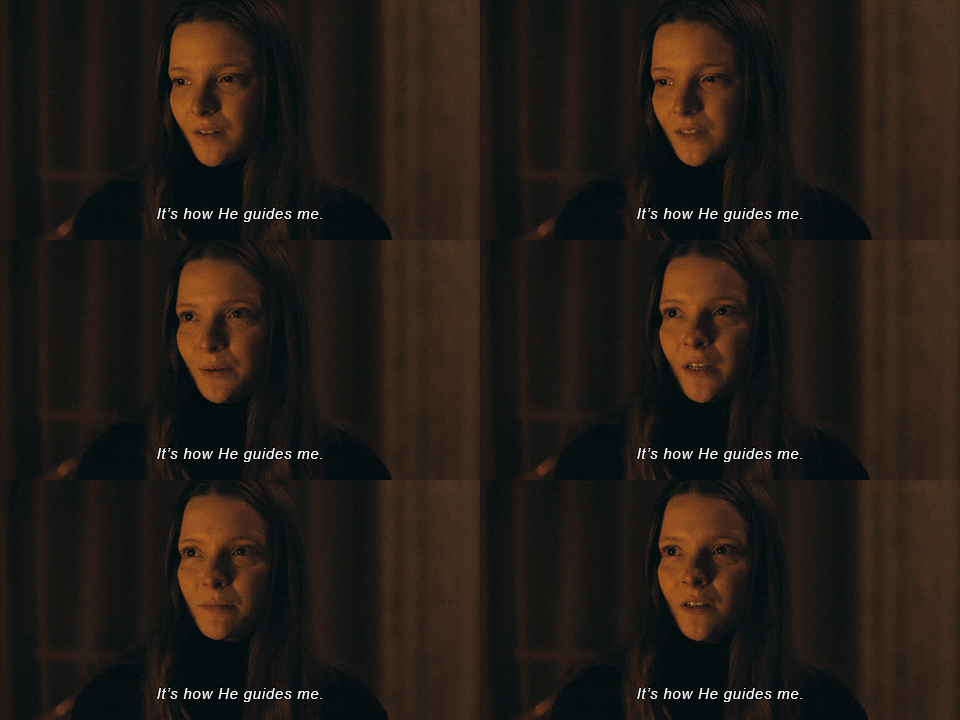
* Despite its [methodological disputes](https://www.frontiersin.org/articles/10.3389/fpsyg.2015.01365/full) and [controversies](https://realkm.com/2016/08/03/the-social-priming-controversy-and-how-it-might-be-resolved/), some research concluded that religious (spiritual) priming [could lead to a higher prosociality](https://www.ncbi.nlm.nih.gov/pmc/articles/PMC5114877/).
</div>
---
### Organisation of person memory :brain:
<div style="text-align: left">
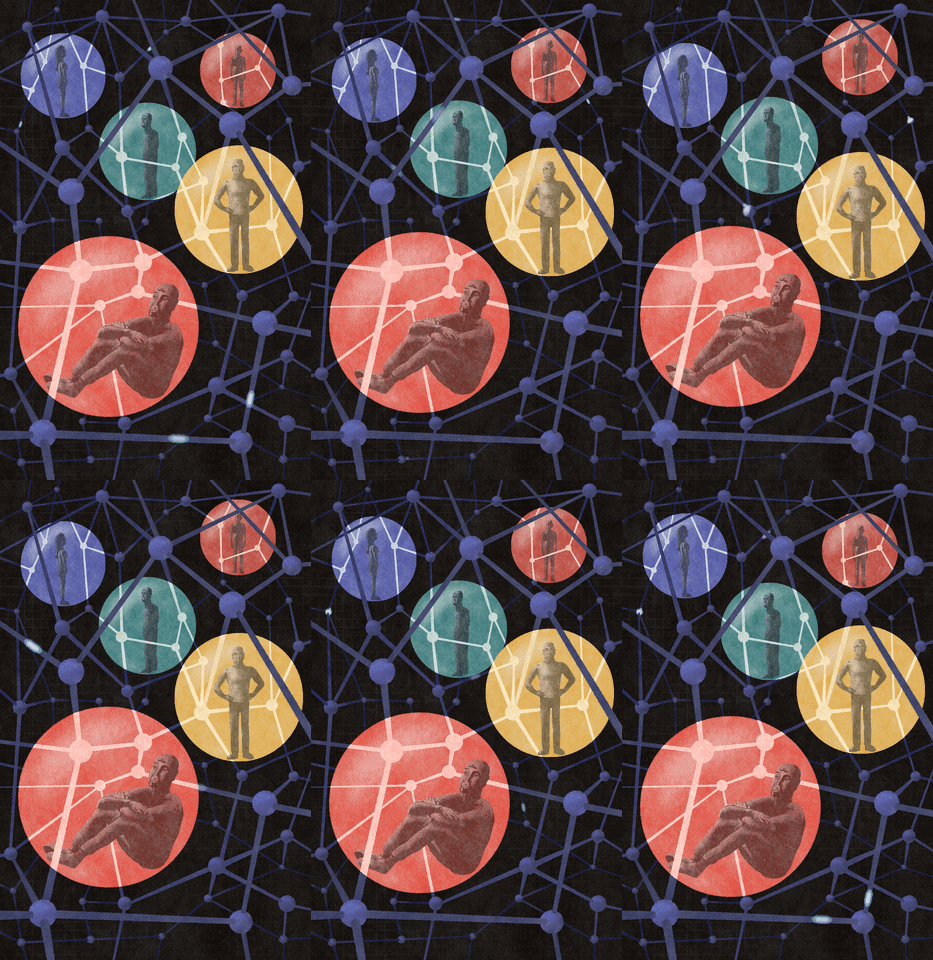
* Social psychological approaches to person memory draw on cognitive psychological theories of memory and mainly adopt **==an associative network or propositional model of memory==**.
</div>
---
### Organisation of person memory :brain:
<div style="text-align: left">
* The general idea is that:
- we store **==propositions==** (e.g. "A woman cooks rendang").
- consisting of ==**nodes or ideas**== (woman, cooking, rendang) that are linked by relationships between ideas.
</div>
---

([Vonahme, 2019](https://oxfordre.com/politics/politics/view/10.1093/acrefore/9780190228637.001.0001/acrefore-9780190228637-e-956))
---
### Organisation of person memory :brain:
<div style="text-align: left">
* Links become stronger, when:
- the more they are **==activated by cognitive rehearsal==** (e.g. recalling or thinking about the propositions), and;
- the **==more different links==** there are to a specific idea (i.e. alternative retrieval routes), the more likely it is to be recalled.
</div>
---
### Organisation of person memory :brain:
<div style="text-align: left">
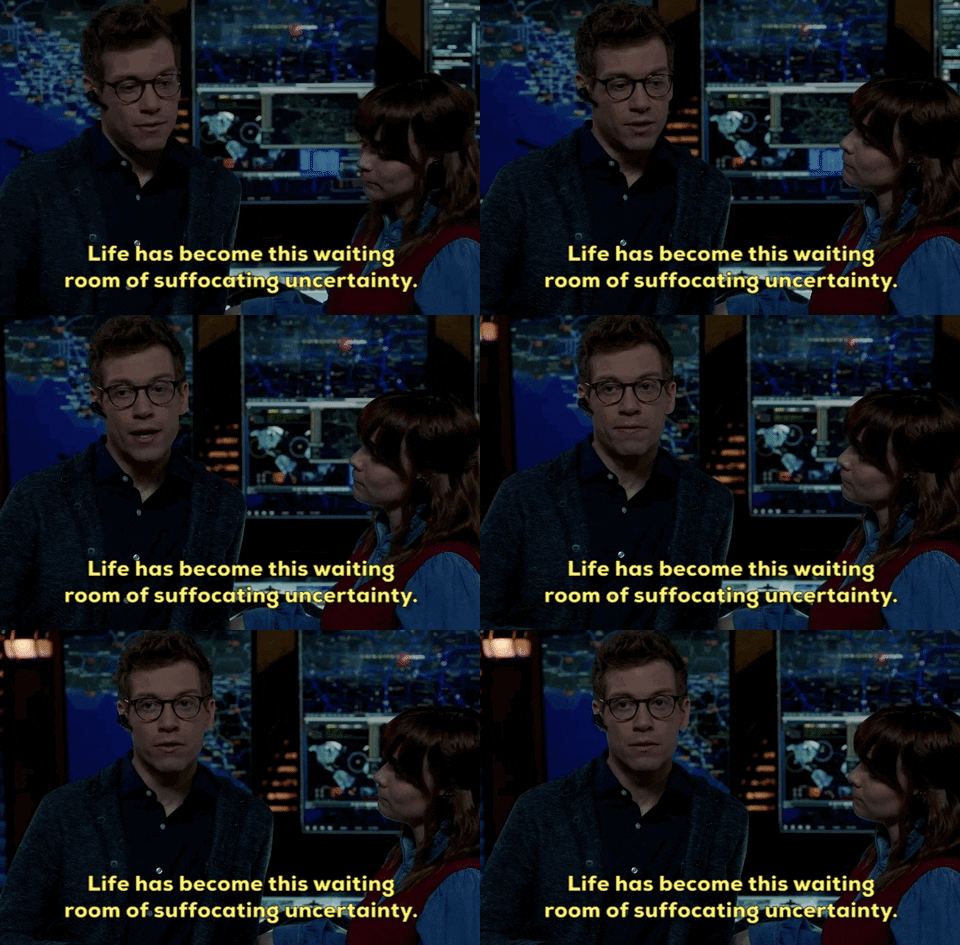
* Our brain **==hates uncertainty==**, so we are more likely to recall information that is **==inconsistent rather than consistent==** with our impression.
</div>
---
### What's inside our person memory :question:
<div style="text-align: left">
* We remember people as a cluster of information about their **==traits, behaviour and appearance==**.
* Most person-memory research concerns **==traits==**.
* Traits are stored in the **==usual propositional form==** (‘Bu Amel galak’) but are based on elaborate inferences from ==**behaviour and situations**==.
</div>
---
### What's inside our person memory :question:
<div style="text-align: left">
* Based on the [stereotype content model (SCM)](https://doi.org/10.1177/0963721417738825) (Week 2), the storage of trait information is organised with respect to two aspects:
- **==Social desirability==** (e.g. warm, pleasant, friendly) and
- **==Competence==** (e.g. intelligent, industrious, efficient)
</div>
---
### What's inside our person memory :question:
<div style="text-align: left">
* Memory for ==**appearance**== is usually based on **==directly observable concrete information==** (‘Bu Amel is short and has full lips’) and is stored as ==**an analogue**==.
* Research shows
- we can often recall faces with [:100:% accuracy over long periods of time](https://psycnet.apa.org/record/1974-29128-001).
- we tend to be **==less accurate==** at recognising the faces of people who are of [a different race from our own](https://psycnet.apa.org/record/1970-03560-001).
</div>
---
### What's inside our person memory :question:
<div style="text-align: left">
* Social memory can be organised [by person or by group](https://psycnet.apa.org/record/1982-09822-001).
* There is an alternative perspective on the relationship between person and group-based person memory:
- They can **==coexist as distinct forms==** of representation.
- This idea is consistent with ==**social identity theory**== (week 8).
</div>
---

---

---
## Social inference :chart_with_upwards_trend:
<div style="text-align: left">
* It addresses the **==inferential processes==** (which can be quite formal and abstract, or intuitive and concrete) that we use to **==identify, sample and combine==** information to **==form impressions and make judgements==**.
* We can rely automatically on general schemas or stereotypes in ==**a top-down deductive**== fashion; or
* We can deliberatively rely on specific instances in a **==bottom-up inductive==** fashion.
</div>
---
### Should we rely on our schemas? :package:
<div style="text-align: left">
* The :one:st stage in making an inference involves **==gathering data and sampling information==** from those data.
- ...and we often **==rely on schemas a little bit too much!==**
* This can cause us to overlook information that is potentially useful, or to exaggerate the importance of information that is misleading :confused:
</div>
---
### Should we rely on our schemas? :package:
<div style="text-align: left">
* ==**Regression**== :point_right: Tendency for initial observations of instances from a category to be **==more extreme than subsequent observations==**.
- e.g. Firstly introduced to Surabayan culture, you might find someone who swears "Jan***" extremely rude, but afterwards, it sounds normal.
</div>
---
### Should we rely on our schemas? :package:
<div style="text-align: left">
* **==Base-rate information==** :point_right: general information, usually factual and statistical, about an entire class of events.
* Research shows that people [chronically underuse this information in making inferences](https://psycnet.apa.org/record/1982-11205-001), particularly when more concrete anecdotal cases exist.
* e.g. people who disregard the danger of COVID-19 might undermine its IFR that reaches >1%.
</div>
---
### Should we rely on our schemas? :package:
<div style="text-align: left">
* **==Covariation and illusory correlation==** :point_right: Cognitive exaggeration of the degree of **==co-occurrence of two stimuli or events==**, or the perception of a co-occurrence where ==**none exists**==.
</div>
---
### Should we rely on our schemas? :package:
<div style="text-align: left">
* **==associative meaning==** :point_right: items are seen as belonging together on the basis of prior expectations.
* **==paired distinctiveness==** :point_right: items are thought to go together because they share some unusual feature.
</div>
---
### Should we rely on our schemas? :package:
<div style="text-align: left">
* E.g. conspiracy theorists who truly believe that COVID-19 and Jewish conspiracy [are strongly related](https://psyarxiv.com/53qsk/).
</div>

---
## Heuristics :warning:
<div style="text-align: left">
* ..[cognitive short-cuts](https://www.sciencedirect.com/science/article/pii/0010028573900339) that ==provide adequately== (not optimal, though) accurate inferences for most of us most of the time.
* People use heuristics to **==reduce complex problem-solving==** to simpler judgemental operations.
* The :three: key heuristics are: (1) representativeness, (2) availability, and (3) anchoring and adjustment.
</div>
---
## Heuristics :warning:
<div style="text-align: left">
* **==Representativeness heuristic==** :point_right: is a relevance judgement that **==disregards==** base-rate information, sample size, quality of information and other normative principles.
* E.g. concluding that Rungkut residents are mostly working-class member would be probably accurate.
</div>
---
## Heuristics :warning:
<div style="text-align: left">
* **==Availability heuristic==** :point_right: is used to **==infer the frequency or likelihood==** of an event on the basis of **==how quickly==** instances or associations come to mind.
* E.g. we are frequently told that Surabayans are loud and brusque, and that information is readily available as the basis of our judgement when seeing a Surabayan.
</div>
---
## Heuristics :warning:
<div style="text-align: left">
* **==Anchoring :anchor: and adjustment==** :point_right: a heuristic that ties inferences to initial standards.
* e.g. inferences about other people are often anchored in beliefs about ourselves.
- We decide how intelligent, artistic or kind someone else is with reference to our own self-schema.
</div>
---
### Improving social inferences :deciduous_tree:
<div style="text-align: left">
* Social inference will improve to the extent that we become ==**less reliant**== on intuitive inferential strategies.
* More critical, less intuitive reasoning.
* [Metacognition](https://en.wikipedia.org/wiki/Metacognition) or *thinking about thinking*
* [Intellectual humility](https://www.vox.com/science-and-health/2019/1/4/17989224/intellectual-humility-explained-psychology-replication)
</div>
---
### The role of affect and emotions :rage:
<div style="text-align: left">
* Affect, emotion and mood infuse and influence thinking, judgement and behaviour.
* **==Affect–infusion model==** :point_right: affect infusion occurs only where people process information in ==**an open and constructive manner**== that involves active elaboration of stimulus details and information from memory ([Forgas, 2002](https://www.tandfonline.com/doi/pdf/10.1207/S15327965PLI1301_01)).
</div>
---
### The role of affect and emotions :rage:
<div style="text-align: left">
* There are :four: distinct ways in which people can process information about one another:
* ==**Direct access**== – they directly access schemas or judgements stored in memory.
* **==Motivated processing==** – they form a judgement on the basis of specific motivations to achieve a goal or to ‘repair’ an existing mood.
</div>
---
### The role of affect and emotions :rage:
<div style="text-align: left">
* **==Heuristic processing==** – they rely on various cognitive short-cuts or heuristics.
* **==Substantive processing==** – they deliberately and carefully construct a judgement from a variety of informational sources.
</div>
---
### The role of affect and emotions :rage:
<div style="text-align: left">
* Current mood states **==do not influence==** judgements involving direct access or motivated processing, but
* They do **==affect judgements==** involving heuristic processing or substantive processing.
</div>
---
---
### Thank you! :tada:
Should you have any questions, drop them in:
- [Spreadsheet](https://docs.google.com/spreadsheets/d/1LqcvLnfamGoE3rxKFg9eVtttMbmkPfcF7OxMY1yVGYM/edit?usp=sharing); or
- [Drop-in session (every Friday at 11-12)](https://meet.google.com/iis-oxiz-emc); or
- [Email](mailto:amelia.zein@psikologi.unair.ac.id)
{"metaMigratedAt":"2023-06-15T11:58:53.621Z","metaMigratedFrom":"YAML","title":"impresi dan skema (2)","breaks":true,"description":"materi minggu ke-3","contributors":"[{\"id\":\"6291606a-b308-4073-872b-e429d6c41f10\",\"add\":13873,\"del\":1016}]"}