# Scrap - on incubating ideas
Since remote associations are the stuff of insights, and the right hemisphere is the home of remote associations, it made sense to go one step further to predict that the right hemisphere is also the origin of insight. Edward Bowden and Mark tested this idea in several visual half-field studies before the neuroimaging work described in the last chapter. They hypothesized that an aha moment occurs when an idea that’s already slightly activated in the right hemisphere—but is still unconscious—suddenly emerges into awareness as an insight. Each participant viewed three-word remote associates problems such as those introduced in the previous chapter (for example, “fish”/“mine”/“rush”; solution: “gold” for “goldfish”/“gold mine”/“gold rush”). After each problem, a fourth word was flashed to the le or right hemispheres of the participants. Their task was simply to say that fourth word out loud as quickly as possible. Sometimes the fourth word was the solution to the problem (“gold”), and sometimes it was unrelated (for example, “rock”).
Ed and Mark reasoned that if a problem unconsciously activates its solution before a participant has consciously realized the solution, then he or she should say the fourth word more quickly when it’s the solution than when it’s unrelated to the problem. This turned out to be true—but only when the word was flashed to the right hemisphere. This result showed that the right hemisphere plays an important role in solving these problems. All well and good. However, by itself, it didn’t prove that the right hemisphere plays a role in solving them by insight. Another finding provided this proof: People said the solution words faster when presented to the right hemisphere—but only when these solution words evoked an aha experience! When the presentation of a problem activates its solution through the remote associations of the right hemisphere, the solution isn’t energized enough to break through to awareness. However, when the solution word or a relevant hint is projected directly to the right hemisphere, this gives the idea just enough of a bounce to enable it to bubble up as an aha (see figure 6.1). This finding, together with all the research on right-hemisphere language processing, laid the foundation for our first neuroimaging study of insight. That’s why we weren’t surprised when we found that insights are accompanied by a burst of neural activity in the right hemisphere.
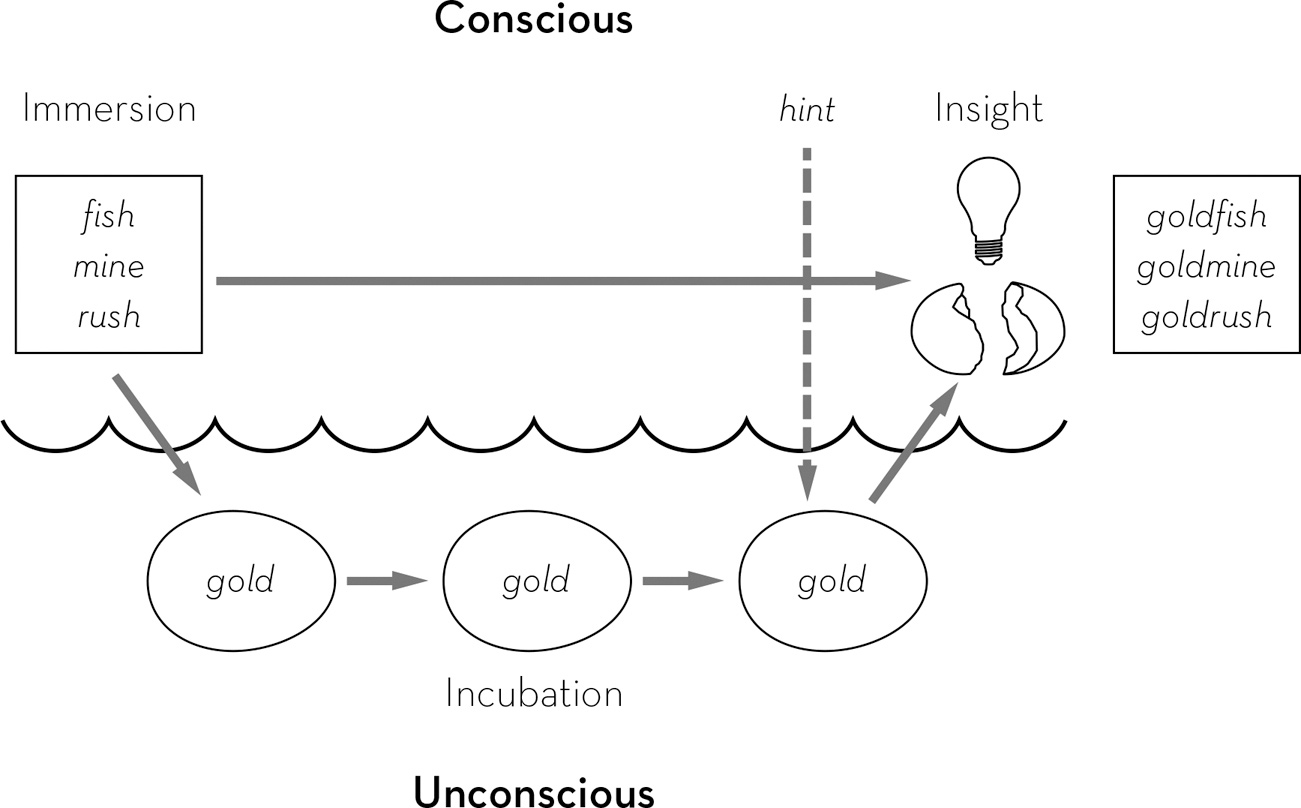
FIGURE 6. 1 : The presentation of a problem can unconsciously activate its solution in the brain’s right hemisphere. But sometimes it takes an external hint to energize this solution to pop into awareness as an insight.
However, before moving on to discuss factors that promote insight, a final thought puts this research into its proper perspective. The right hemisphere’s facility for remote associations and alternate interpretations makes it critical for insight, but real-life accomplishment oen requires both remote and close associations, both insightful and analytic thought. In the world outside of the lab, insights may have to be evaluated, verified, refined, and applied, and this requires contributions from the more analytic le hemisphere. Just as your ability to use language requires two intact hemispheres, so does effective, practical, creative performance. But the right hemisphere provides the spark that ignites the creative fire.
 Sign in with Wallet
Connect another wallet
Sign in with Wallet
Connect another wallet