South Korea's Pre-Primary Education Market at USD 18 Billion: Ken Research Maps the World's Most EdTech-Integrated Preschool Ecosystem to FY2028
================================================================================================================================================
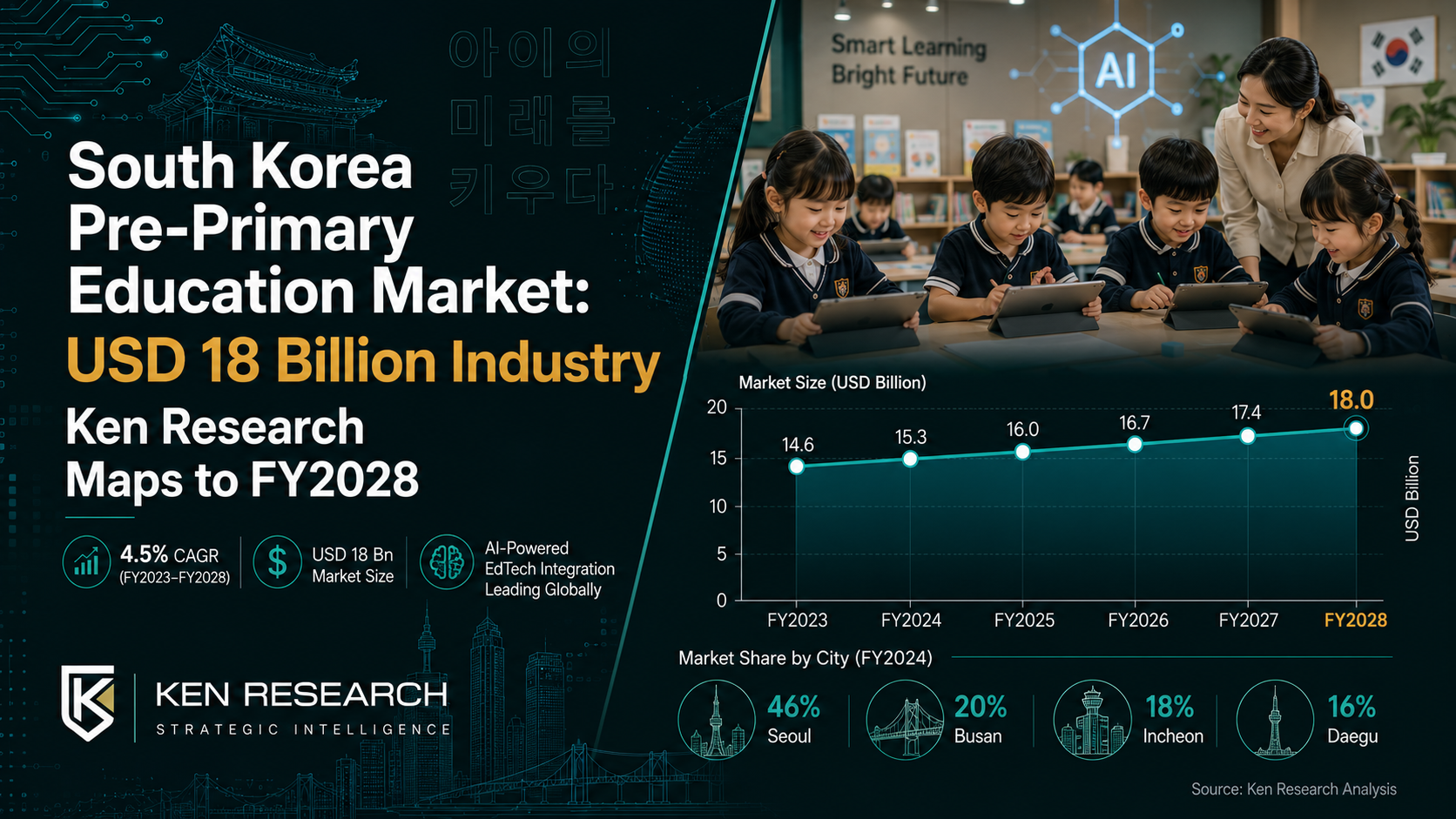
South Korea has built the most technologically sophisticated pre-primary education ecosystem on the planet — and the market data shows that sophistication translating directly into the highest per-student preschool spending globally. [Ken Research](https://www.kenresearch.com/?utm_source=HackMD&utm_medium=Referral&utm_campaign=Automation) has published a comprehensive analysis of the [South Korea Pre-Primary Education Market](https://www.kenresearch.com/industry-reports/south-korea-pre-primary-education-market?utm_source=HackMD&utm_medium=Referral&utm_campaign=Automation), revealing a sector valued at **USD 18 billion in FY2024** growing at a **4.5% CAGR through FY2028**. Government haeyook-won subsidies cover near-universal 3-5 year old enrollment, making Korea's early education system effectively free at the baseline. The competitive differentiation — and the premium market growth — comes from technology integration, English-immersion programs, and the intense investment culture that characterizes Korean educational spending from the earliest ages.
The Haeyook-Won System: Government-Subsidized Universal Preschool
-----------------------------------------------------------------
South Korea's early education system operates through two parallel channels: haeyook-won (kindergartens under Ministry of Education) and eorin-i-jip (childcare centers under Ministry of Health). Government subsidies cover near-universal attendance for ages 3-5, with the National Childcare Voucher system providing monthly subsidies of KRW 220,000-280,000 per child to cover fees at both public and private facilities. The broader [Asia-Pacific Pre-Primary Education Market](https://www.kenresearch.com/industry-reports/asia-pacific-pre-primary-education-childcare-market?utm_source=HackMD&utm_medium=Referral&utm_campaign=Automation) context shows Korea's per-student government subsidy is the highest in the region. This universal baseline subsidy has eliminated price competition at the entry level, driving all competitive differentiation into curriculum quality, English programming, and technology integration.
* **Near-Universal Coverage:** 93%+ of 3-5 year olds enrolled in licensed haeyook-won or eorin-i-jip; among the highest preschool participation rates globally.
* **National Childcare Voucher:** KRW 220,000-280,000/month government subsidy per child at licensed facilities; effectively makes baseline preschool free for most families.
* **Private Sector Dominance:** 75%+ of haeyook-won are private; compete on curriculum quality, EdTech platforms, and English programming above the subsidized baseline.
* **Declining Birth Rate Pressure:** Korea's birth rate of 0.72 (2024) — lowest globally — creates severe enrollment decline; market growth comes entirely from per-student spend increase.
EdTech Leadership: AI-Powered Learning at Age 3
-----------------------------------------------
South Korea's kindergartens are the global benchmark for EdTech integration in early childhood education — a position earned through government mandate, private investment, and the cultural intensity of Korean educational competition. Government guidelines now mandate digital learning tools in all licensed haeyook-won. AI-driven personalized learning platforms like KakaoKids, Naver Kids, and Samsung Kids deliver adaptive curricula customized to individual learning pace. The [Japan Pre-Primary Education Market](https://www.kenresearch.com/industry-reports/japan-pre-primary-education-market?utm_source=HackMD&utm_medium=Referral&utm_campaign=Automation) comparison shows Japan is catching up, but Korea's EdTech ecosystem in early education is 5-7 years ahead. Global EdTech companies use Korean kindergartens as their primary testing ground for AI tutoring systems at preschool ages.
* **KakaoKids:** Kakao's early education platform; AI-adaptive curriculum for ages 2-7; integrated with KakaoTalk parent communication; 3 million+ monthly active child users.
* **Samsung Kids:** Tablet-based learning ecosystem; curated educational content; age-appropriate screen time management; deployed in 10,000+ kindergartens.
* **Naver Kids:** Naver's early learning content platform; integrates search, video, and interactive learning; teacher dashboard for curriculum planning.
* **Government AI Mandate:** Ministry of Education requiring AI-assisted learning assessment tools in all licensed haeyook-won by FY2026; creating a procurement wave across the sector.
Want Ken Research's full breakdown of South Korea's pre-primary education market including EdTech segment analysis, English-immersion market sizing, operator competitive mapping, and enrollment forecasts through FY2028? [Download Sample Report](https://www.kenresearch.com/sample-report/south-korea-pre-primary-education-market?utm_source=HackMD&utm_medium=Referral&utm_campaign=Automation) and access the complete intelligence.
English Hagwon for Preschoolers: Korea's Premium Early Education Battleground
-----------------------------------------------------------------------------
South Korea's hagwon (private cram school) culture, famous for its intensity at the secondary level, has migrated decisively into the preschool years. English-language hagwon for 3-6 year olds — called "English kindergartens" or "Yeong-eo hakwon" — are the premium growth segment of Korea's early education market, charging KRW 800,000-2,000,000 per month (approximately USD 600-1,500) on top of or instead of the government-subsidized haeyook-won. These programs are effectively full-day English immersion programs operating outside the regulatory framework of the standard kindergarten system. The [China Pre-Primary Education Market](https://www.kenresearch.com/industry-reports/china-pre-primary-education-market?utm_source=HackMD&utm_medium=Referral&utm_campaign=Automation) has a comparable premium bilingual segment but at lower relative penetration.
* **English Kindergarten Market:** 3,000+ English-language hagwon for preschool ages in Seoul metropolitan area alone; fees KRW 800,000-2,000,000/month; waitlists common at top programs.
* **Gangnam Concentration:** Seoul's Gangnam district hosts the highest density of premium English kindergartens; benchmark for quality and fees; graduates feed into elite international primary schools.
* **Franchise Models:** Chungdahm Learning, YBM, and Avalon Education operating English kindergarten franchise networks; standardized curriculum with local operator execution.
* **Parent Investment Culture:** Korean parents spending average KRW 500,000-800,000/month on preschool education beyond government subsidy; highest parental co-payment in Asia.
South Korea's preschool EdTech ecosystem and English-immersion premium segment are the most sophisticated in Asia — and understanding their dynamics is essential for any operator or investor targeting the region's early education market. [View the South Korea Pre-Primary Education Market Report](https://www.kenresearch.com/industry-reports/south-korea-pre-primary-education-market?utm_source=HackMD&utm_medium=Referral&utm_campaign=Automation) to access Ken Research's full analysis through FY2028.
Conclusion
----------
South Korea's pre-primary education market at **USD 18 billion in FY2024** is the most intensively invested early education ecosystem in the world on a per-student basis. The **4.5% CAGR** is driven entirely by per-student spend increase against a declining enrollment backdrop — Korea's 0.72 birth rate means the volume headwind is severe. Ken Research's analysis makes clear that **KakaoKids, Samsung Kids, English hagwon operators, and government-mandated EdTech platform vendors** are the structural growth beneficiaries as the market premiumizes aggressively. Access the complete [South Korea Pre-Primary Education Market](https://www.kenresearch.com/industry-reports/south-korea-pre-primary-education-market?utm_source=HackMD&utm_medium=Referral&utm_campaign=Automation) report for Ken Research's full competitive intelligence and FY2028 investment framework.
Frequently Asked Questions
--------------------------
### What is the size of South Korea's pre-primary education market?
South Korea's pre-primary education market is valued at USD 18 billion in FY2024, growing at a 4.5% CAGR through FY2028. Despite having the world's lowest birth rate (0.72), the market grows through per-student spending intensification. For regional context, see the [Asia-Pacific Pre-Primary Education Market](https://www.kenresearch.com/industry-reports/asia-pacific-pre-primary-education-childcare-market?utm_source=HackMD&utm_medium=Referral&utm_campaign=Automation) from Ken Research.
### How does South Korea's government subsidy system work for preschool?
South Korea's National Childcare Voucher provides KRW 220,000-280,000/month per child at licensed haeyook-won (kindergartens) and eorin-i-jip (childcare centers). This subsidy covers near-universal attendance for ages 3-5, making baseline preschool effectively free. Private operators compete for additional parent spending through premium curriculum and English programming.
### What is an English kindergarten in South Korea?
English kindergartens (Yeong-eo hakwon) are private English-immersion programs for ages 3-6, operating outside the standard haeyook-won framework. They charge KRW 800,000-2,000,000/month and function as full-day English immersion environments. Seoul's Gangnam district hosts the highest concentration of premium English kindergartens in Asia.
### Which companies lead South Korea's preschool EdTech market?
KakaoKids (3 million+ monthly active child users), Samsung Kids (deployed in 10,000+ kindergartens), and Naver Kids lead the digital learning platform segment. Government AI mandate requiring AI-assisted assessment tools by FY2026 is creating a procurement wave for EdTech vendors across the sector.
### How does South Korea's preschool market compare to Japan's?
Both have near-universal government subsidy systems and declining birth rates, but Korea leads significantly on EdTech integration (5-7 years ahead), per-student parental co-payment intensity, and English-immersion premium segment scale. Japan's kodomo-en reform created a more integrated delivery system. See the [Japan Pre-Primary Education Market](https://www.kenresearch.com/industry-reports/japan-pre-primary-education-market?utm_source=HackMD&utm_medium=Referral&utm_campaign=Automation) for direct comparison.
 Sign in via Google
 Sign in via Facebook
 Sign in via X(Twitter)
 Sign in via GitHub
 Sign in via Dropbox
 Sign in with Wallet
Connect another wallet
Sign in with Wallet
Connect another wallet