# 群聯 SSD Controller for NMC
## Target Hardware
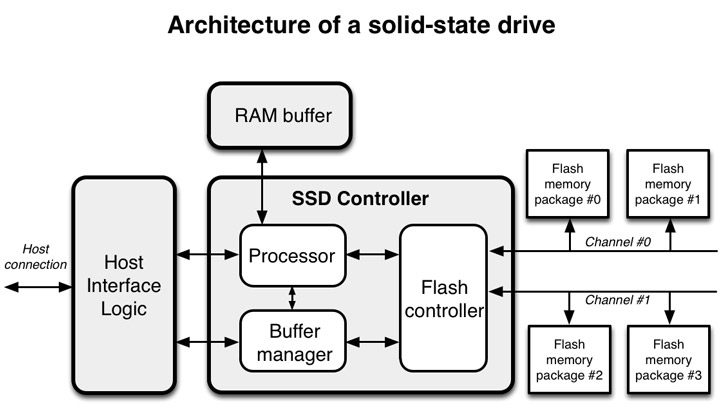
### SSD
[解構SSD--看完變成專家](https://www.bingle.com.tw/%E8%A7%A3%E6%A7%8Bssd-%E7%9C%8B%E5%AE%8C%E8%AE%8A%E6%88%90%E5%B0%88%E5%AE%B6)
### Controller
The controller for non-volatile drive, such as
* **SSD controller**
* **Flash controller**
The controller might be embedded with ARM based micro-controller, which is capable of doing AI inference/(learning).
Besides, there might be AI acceleration hardware alongside the controller to assist the computation of AI model.
## Near Memory/SSD Computing (NMC)
### Why NMC?
[Reference](https://semiengineering.com/in-memory-vs-near-memory-computing/)
* Bring the memory closer to the processing tasks to speed up the system
* Boosting the data processing functions in the systems
* Increase performance/watt
* Drive new architectures such as neural networks
### Applications of NMC
[Near-Memory Computing: Past, Present, and Future](https://arxiv.org/pdf/1908.02640.pdf)
By bringing compute into the memory, higher throughput can be achieved by tapping into the memory sub-arrays.
This technique also has the potential to increase the energy efficiency.
With built-in scalability and modularity, it can address a range of needs from low-power Internet of Things (IoT) and edge devices all the way to data centers and servers.
* **Cybersecurity**
[SSD-Insider: Internal Defense of Solid-State Drive against Ransomware with Perfect Data Recovery](https://par.nsf.gov/servlets/purl/10084234)
* Malware detection algorithm observes I/O patterns of a host system and decides whether or not the host is being attacked by ransomwares in an early stage
* Detection latency is inevitable by any means, so some portion of disk blocks will have been already encrypted
* The speed of detection thus becomes a great of significance
[Advanced Countermeasures: Integrating SSDs Into Cyber-Security Defense](https://www.flashmemorysummit.com/Proceedings2019/08-06-Tuesday/20190806_SSDS-102-1_Jean.pdf)
[網路安全新標準 群聯攜手Cigent共同推出自我防衛SSD方案
](https://www.phison.com/zh-tw/company/newsroom/press-releases/general/2100-%E7%B6%B2%E8%B7%AF%E5%AE%89%E5%85%A8%E6%96%B0%E6%A8%99%E6%BA%96-%E7%BE%A4%E8%81%AF%E6%94%9C%E6%89%8Bcigent%E5%85%B1%E5%90%8C%E6%8E%A8%E5%87%BA%E8%87%AA%E6%88%91%E9%98%B2%E8%A1%9Bssd%E6%96%B9%E6%A1%88)
* AI/ML cyber-security suite that is tightly integrated with the storage align the protection system with the threat landscape
* The SSD can become another sensor input into the AI/ML engine
* Pushing the detection and response further down the data stack (all the way to the storage device) is a force multiplier for AI/ML defense
* AI/ML cyber-security + tightly integrated storage = solid protection
* **(Edge) AI computing**
[Intel Labs inserts distributed computational units into the memory array](https://www.intel.com/content/www/us/en/research/blogs/compute-near-memory-increases-ai-throughput.html)
* Computing near-memory can reduce data transfer energy and increase throughput in neural networks
* Deploy trained NN model on micro controller or AI accelerator alongside memory
* Convolution neural networks (CNNs) require high data reuse
* Recursive neural networks (RNNs) have low data reuse, but require high memory bandwidth
* With matrix multiplication units embedded inside the memory, compute can performed very close to the memory itself
* This relieves the energy bottleneck of moving the data into the processing unit by augmenting static random-access memory (SRAM) banks with compute logic for dot-product operations
 Sign in via Google
 Sign in via Facebook
 Sign in via X(Twitter)
 Sign in via GitHub
 Sign in via Dropbox
 Sign in with Wallet
Connect another wallet
Sign in with Wallet
Connect another wallet