---
title: Python OOP
tags: python, class, object
---
[TOC]
---
## Class and Object
### Basic Class Prototype
```python=
class ClassName(object):
def __init__(self, args):
# Initialize data members
self.public_data # No underline
self._protected_data # Single underline
self.__private_data # Double underline
def __del__(self):
# Destructor
pass
def func(self):
# Define member function
pass
def __private_func(self):
pass
```
1. Class 一般名稱開頭會大寫
2. Class 的每個member function第一個參數一定要是self
- self 指的就是該類別本身
- 在class內部存取自己的data member都要透過self
3. `__init__` 相當於建構元,用於初始化data member
- 在Python建立物件的流程,事實上是,`__new__ -> __init__`
4. `__del__` 相當於解構元(我還沒用過)
5. 關於`public、protected、private`
- Python 並沒有實作太多這樣的存取機制(protected 不常見到,一般最多就publice、private)
- Default 都是public
- 若要private,前面加雙底線
6. `class ClassName(object):` 可以寫成 `class ClassName:`
- 後面繼承會談到
```python=
def getGender(self):
return self.gender
class Person:
""" This is Person class description """
def __init__(self, name, gender, age=18):
self.name = name
self.gender = gender
self.__age = age
# 提供我知道的一些方法
def showName(self):
print(self.name)
getAge = lambda self : self.__age
getGender = getGender
Mary = Person('Mary', 'woman', 20)
# Class 往下如果是一個多行註解,它會變成該class的說明文字
# 也可以在help(Person)、help(Mary)查看該說明內容
print(Person.__doc__, Mary.__doc__)
# 示範使用member function
Mary.showName()
print(Mary.getGender(), Mary.getAge())
# Raise AttributeError
print(Mary.__age)
```
### Inheritance
#### Concept
在Python中,每個東西都是物件,在這樣的前提下,它們都有同一個根源,叫做「Object」,每一個物件都是繼承該類別而來,包括我們自定義的類別。
#### Simple Syntax Intro
```python=
# Single Inheritance
class SuperClass:
pass
class SubClass(SuperClass):
def __init__(self, args)
# 兩種方式呼叫父類別建構元
super().__init__(args)
SuperClass.__init__(self, args)
# Multiple Inheritance
class SubClass(Class1, Class2, ...):
pass
```
### Polymorphism
### Opeartor Overloading
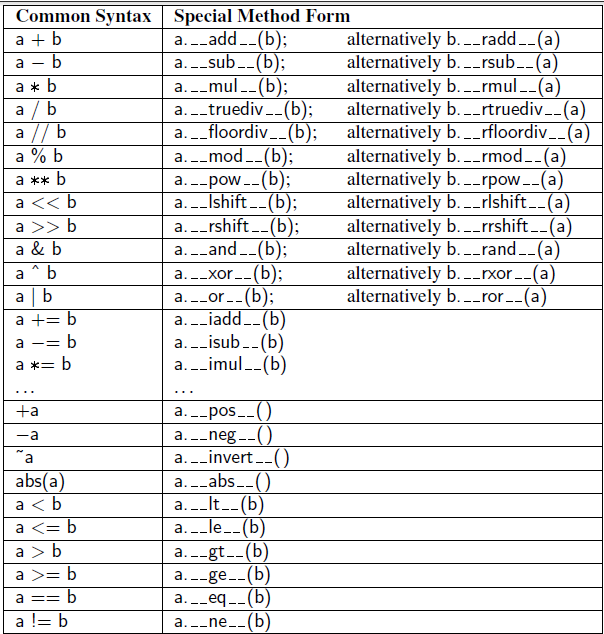
- `int() <=> __int__(self)`
- `float() <=> __float__(self)`
- `str() <=> __str__(self)`
- `[index] <=> __getitem__(self, index)`
- `in <=> __contains__(self, other)`
- `len <=> __len__(self)`
```python=
# Inheritance、Operator Overloading、Override
# 題目為用現成的PriorityQueue實作Reverse
import queue
# 該Class用來封裝資料,目的是要使用自定義的比大小方式
# 藉此達到Reverse
class Wrapper():
def __init__(self, data):
self.data = data
getValue = lambda self : self.data
# >=
def __ge__(self, other):
if isinstance(other, Wrapper):
return not self.data >= other.data
else:
raise TypeError
# >
def __gt__(self, other):
if isinstance(other, Wrapper):
return not self.data > other.data
else:
raise TypeError
# <=
def __le__(self, other):
if isinstance(other, Wrapper):
return not self.data <= other.data
else:
raise TypeError
# <
def __lt__(self, other):
if isinstance(other, Wrapper):
return not self.data < other.data
else:
raise TypeError
# ==
def __eq__(self, other):
if isinstance(other, Wrapper):
return self.data == other.data
else:
raise TypeError
# 該class繼承了現有PriorityQueue
# 並對put、get兩個function做改寫
# 將送進去儲存的資料用上面的class包裝起來
class MyPriorityQueue(queue.PriorityQueue):
def put(self, data):
super().put(Wrapper(data))
def get(self):
return super().get().getValue()
# 測試函式
if __name__ == '__main__':
pq = MyPriorityQueue()
aList = [5,6,73,1,42,3,9,75]
for e in aList:
pq.put(e)
while True:
if not pq.empty():
print(pq.get(), end=' ')
else:
break
```
有空用Assert改寫程式
### Callable Object
- 改寫 `__call__`
---
## Note
- `self`
- Python's self is the same as the this pointer in C++ or Java, but self is always explicit in both headers and bodies of Python methods to make attribute accesses more obvious.
 Sign in with Wallet
Connect another wallet
Sign in with Wallet
Connect another wallet