# An FPGA processor for modelling wildfire spreading
---
---
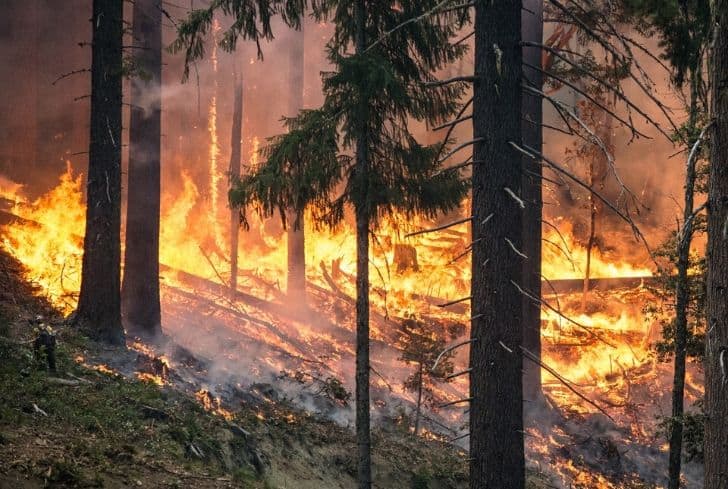
## Wildfires are important disasters
- Country people lose their homes
- Rare animal species are threatened
- The number of sources of oxygen is decreased → the greenhouse effect
---
## Computational fire spread models is important.
wind and ground slope
affect how a fire will develop through time.
differences in fuel beds between parts of the landscape also affect the way fires spread.
To predict the spreading of a fire is very difficult.
A fire front.
**help optimize the response of the fire fighters**
---
## Related research
partial differential equations(PDE)
- Rothermel's equations
- The BEHAVE system
- The FARSITE model
---
## PDEs problems
- 扱いがむずかしい
- 計算速度の問題
---
## CA approach

---
## CA approach
CA with square cells, that uses weight factors to describe the effect of different kinds of
fuel, wind and slope.
the accuracy decreases somehow in more complex cases
要素が足りない、精度が低い
The model proposed in this paper, can be considered inspired by the ones already
described above, but features a number of changes and additions compared to them, aimed to make the model faster and
less resource-demanding, while remaining reasonably accurate in the representation of reality
---
## CA problems
the time a wildfire needs to spread < the time needed for execution over a wide area
---
## Real-time fire spread model
The aim of this work is to formulate a CA-based fire spread model
focusing on implementing an accurate, real-time yet light on resources approach to wildfires.
The result is an algorithm directly implemented in hardware, able to yield useful results in a short time.
---
## Using FPGA
Furthermore, because of the inherent parallelism of CAs, the proposed model is hardware implemented with the help
of the Very High Speed Integrated Circuit (VHSIC) Hardware Description Language (VHDL) synthesizable code in order to
speed up the application of CAs to the study of wildfire spreading. More specifically, a translation algorithm is used, that
checks the CA parameters values previously determined by the user and automatically produces the synthesizable VHDL
code that describes the aforementioned CA. It should be mentioned that CAs are one of the computational structures best
suited for hardware realization.
he CA architecture offers a number of advantages and beneficial features such as simplicity,
regularity, ease of mask generation, silicon-area utilization, and locality of interconnections
---
## Cellular automata
- space and time are discrete
- interactions are local
---
## A CA is characterized by
1. the number of spatial dimensions (n);
2. the width of each side of the array (w). wj is the width of the jth side of the array, where j = 1, 2, 3, . . . , n;
3. the width of the neighbourhood of the cell (d). dj is the width of the neighbourhood along the jth side of the array;
4. the states of the CA cells;
5. the CA rule, which is an arbitrary function F .
---
### CA vs PDE
complicated boundary and initial conditions
CAs run quickly on digital computers
serial computers because they exploit the inherent parallelism of the CA structure
---
## Fire spread model
is to synthesize a model maintaining as much of the functionality of the aforementioned model as possible,
while concentrating on lowering computation time and resource needs,
making it quick to run as real-time model and power-efficient.
The goal of this effort was to design a model able to be the core around which a mobile device can be designed, where computational resources are limited and power consumption is critical
---
## Model overview
hexagonal lattice.
approaching the shape of a circle much better than square cells
cell value: spread rate
- the fuel in the cell
- the wind in the cell
- the slope of the ground
uphill
wind
---
## The wind and the slope
$$
\phi_{s} = 5.257 \times \tan a^2
$$
$$
\phi_{w} = 0.276 \times p_{wr}
$$
$$
R_{max} = R_0(1+\phi)
$$
$$
\vec{\phi} = \vec{\phi_w} + \vec{\phi_s}
$$
楕円の画像
---
## The corresponding cellular automaton model
fire そのセルの火の強さ
A is deducted from B
fuel
60度の平均がR
---
## Calculation of the next state of the CA
wind
state of the cell
$$
fire \times R(\theta)
$$
ランダムに2つ以上離れた場所も燃える
enable フラグは、1つ飛びで火がくるイベント
---
## FPGA realization
CA consist of a uniform structure composed of many finite state machines
matching the inherent design layout of FPGA hardware
計算速度
電力消費などで優位に4
ユーザーはMatlabインターフェースにパラメーターを入力する
---
## Simulation results
---
## Comparison between hardware and software
小数点以下の計算精度の違いにより、software と hardware に差がでた
---

---

---
### Fire starting on a hillside

---
### Fire starting on a hillside

---
### Fire starting inside a pit

---
### Fire spreading over an area with obstacles

---
### Simulation conclusions
software: 2.5s
hardware: 1μs
as the fire front progresses the calculations needed to be carried out increase exponentially, and
therefore the serial calculation of the proposed algorithm will eventually take too long to perform.
On the other hand, the hardware implementation will take one clock cycle
regardless of the size of the matrix and the spread of the fire, and the complexity of the under study conditions, fully
exploiting its inherent parallelism.
---
### Conclusions
portable system with GPS
Note:
hello
{"metaMigratedAt":"2023-06-17T02:29:54.349Z","metaMigratedFrom":"Content","title":"An FPGA processor for modelling wildfire spreading","breaks":true,"contributors":"[{\"id\":\"5d4a9bcc-32de-437a-a96c-5cb81b5833a7\",\"add\":16096,\"del\":10330}]"}