# The Naive Bayes Algorithm for Classification
---
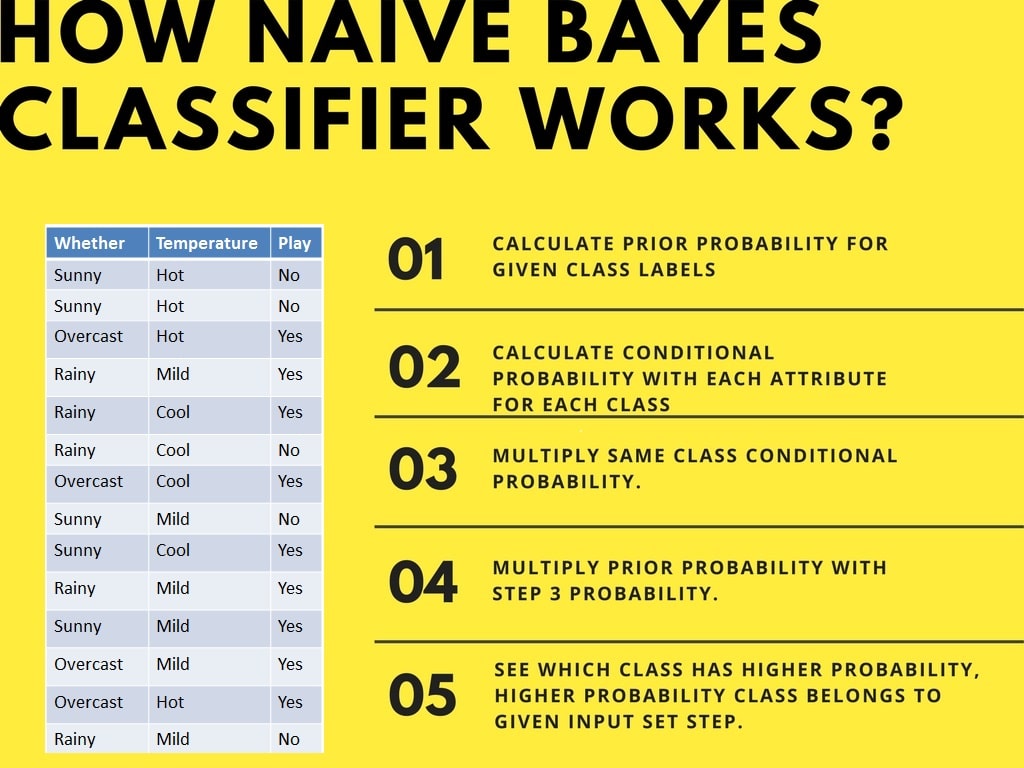
## Introduction
In the fields of data science and machine learning, we often need algorithms that can classify data into predefined categories. Imagine trying to automatically sort emails into "Spam" and "Not Spam," or diagnosing a condition based on symptoms. The Naive Bayes algorithm is a popular and surprisingly effective method for tackling such **classification** tasks. It belongs to the family of **supervised learning** algorithms, meaning it learns from labeled data (data where the correct category is already known).
This article provides a detailed explanation of the Naive Bayes algorithm, outlining its mathematical basis, the steps involved in training and using the model, its practical applications, and its inherent limitations.
### What is Naive Bayes?
Naive Bayes is a probabilistic classifier based on **Bayes' Theorem**, a fundamental concept in probability theory. The "naive" part of its name comes from a key assumption it makes: **all features (or predictors) used for classification are independent of each other, given the class.** While this assumption rarely holds perfectly true in the real world, the algorithm often performs remarkably well despite it.
**Data Types:** Naive Bayes is particularly well-suited for datasets with **categorical features** (features that fall into distinct categories, like 'color' being 'red', 'blue', or 'green'). However, variations exist, like Gaussian Naive Bayes, which can handle **continuous features** (features that can take any numerical value within a range, like 'height' or 'temperature').
**Strengths:**
* **Simplicity and Speed:** It's relatively easy to understand, implement, and computationally fast to train and make predictions.
* **Efficiency with High Dimensions:** It performs well even when dealing with a large number of features (high-dimensional data), such as in text classification where every word can be a feature.
* **Requires Less Training Data:** Compared to more complex models, it often achieves decent results with smaller datasets.
**Weaknesses:**
* **The "Naive" Assumption:** Its core weakness is the strong feature independence assumption. If features are actually correlated (e.g., the words "cheap" and "offer" appearing together in an email strongly suggests spam), the algorithm might not capture this relationship optimally, potentially affecting accuracy.
* **Sensitivity to Feature Distribution:** The performance can depend on how well the data's distribution matches the assumptions made by the specific Naive Bayes variant (e.g., Gaussian Naive Bayes assumes normally distributed continuous features).
---
## The Mathematical Foundation: Bayes' Theorem
At its heart, Naive Bayes uses Bayes' Theorem to calculate the probability of a certain class occurring, given a set of observed features. Bayes' Theorem is stated as:
$$P(C | X) = \frac{P(X | C) . P(C)}{P(X)}$$
Let's break down these terms:
* $P(C | X)$: This is the **Posterior Probability**. It represents the probability of a data point belonging to class $C$, given that we have observed the features $X$. This is what we want to calculate.
* $P(X | C)$: This is the **Likelihood**. It's the probability of observing the features $X$, given that the data point belongs to class $C$.
* $P(C)$: This is the **Prior Probability**. It's the initial probability of a data point belonging to class $C$, before observing any features. Essentially, it's how common class $C$ is in the training data.
* $P(X)$: This is the **Evidence**. It's the probability of observing the features $X$, regardless of the class. It acts as a normalizing constant.
In a classification problem with multiple classes $C_1, C_2, ..., C_k$, we want to find the class $C_k$ that has the highest posterior probability for a given feature set $\mathbf{x} = (x_1, x_2, ..., x_n)$. So, we calculate $P(C_k | \mathbf{x})$ for each class $k$ and choose the class that yields the maximum probability.
The formula using a feature vector $\mathbf{x}$ becomes:
$$P(C_k | \mathbf{x}) = \frac{P(\mathbf{x} | C_k) P(C_k)}{P(\mathbf{x})}$$
### The "Naive" Independence Assumption
Calculating the likelihood $P(\mathbf{x} | C_k) = P(x_1, x_2, ..., x_n | C_k)$ directly can be computationally expensive and require vast amounts of data, as it involves the joint probability of all features.
This is where the "naive" assumption comes in. We assume that each feature $x_i$ is conditionally independent of every other feature $x_j$ (for $i \neq j$), given the class $C_k$. Mathematically, this means:
$$P(\mathbf{x} | C_k) = P(x_1, x_2, ..., x_n | C_k) = \prod_{i=1}^{n} P(x_i | C_k)$$
where $\prod$ is the product operator.
This simplifies the calculation dramatically! Instead of needing to compute a complex joint probability, we only need to compute the individual probabilities of each feature occurring given the class, $P(x_i | C_k)$, and multiply them together.
### Handling Violation of the Independence Assumption
In Naive Bayes, we assume that all features are **conditionally independent** given the class. However, in real-world data, this assumption often **fails** — features can be correlated.
#### What Happens When Independence Fails?
- The calculated probabilities may no longer accurately represent the true likelihood.
- Correlated features might be **double-counted**, leading to **overconfident** or **biased predictions**.
- Overall classification accuracy can **decrease**, especially in domains where feature interactions are important.
#### How Can It Be Handled?
Several strategies are used to mitigate this problem:
- **Feature Selection**: Remove redundant or highly correlated features during preprocessing to reduce dependence.
- **Feature Extraction**: Use techniques like **Principal Component Analysis (PCA)** to create new independent features.
- **Augmented Models**: Use models that relax independence, such as:
- **Tree-Augmented Naive Bayes (TAN)**: Allows limited dependencies between features.
- **Hidden Naive Bayes (HNB)**: Weights features based on their dependency.
- **Ensemble Methods**: Combine multiple models to balance out errors due to dependency violations.
Even when independence is not perfect, Naive Bayes often still performs well — but awareness of its limitations is crucial for building robust models.
### The Naive Bayes Classifier Formula
Substituting the independence assumption back into Bayes' Theorem, we get the core formula for the Naive Bayes classifier:
$$P(C_k | \mathbf{x}) = \frac{P(C_k) \prod_{i=1}^{n} P(x_i | C_k)}{P(\mathbf{x})}$$
When we are comparing the posterior probabilities for different classes $C_k$ for the *same* input $\mathbf{x}$, the denominator $P(\mathbf{x})$ remains constant. Since it doesn't affect which class has the *highest* probability, we can ignore it for the purpose of classification.
Therefore, the classification rule simplifies to finding the class $C_k$ that maximizes the numerator:
$$\hat{y} = \arg\max_{k \in \{1, ..., K\}} P(C_k) \prod_{i=1}^{n} P(x_i | C_k)$$
Where $\hat{y}$ is the predicted class.
---
## How it Works: Training ("Fitting") the Model
Training a Naive Bayes model involves learning the prior probabilities $P(C_k)$ and the likelihoods $P(x_i | C_k)$ from the labeled training dataset.
**Step 1: Calculate Prior Probabilities $P(C_k)$**
This is simply the frequency of each class in the training data.
* Formula: $P(C_k) = \frac{\text{Number of training samples in class } C_k}{\text{Total number of training samples}}$
* Pseudocode:
```
FUNCTION calculate_priors(training_data):
total_samples = COUNT(training_data)
class_counts = INITIALIZE_MAP() // {class_label: count}
FOR each sample in training_data:
class_label = GET_CLASS(sample)
INCREMENT class_counts[class_label] by 1 (initialize if not present)
priors = INITIALIZE_MAP() // {class_label: probability}
FOR each class_label, count in class_counts:
priors[class_label] = count / total_samples
RETURN priors
```
**Step 2: Calculate Likelihoods $P(x_i | C_k)$**
The calculation method depends on the type of feature $x_i$.
* **For Categorical Features:**
We calculate the probability of a specific feature value $v$ occurring within samples belonging to class $C_k$.
* Basic Formula: $P(x_i = v | C_k) = \frac{\text{Count}(x_i=v \land C=C_k)}{\text{Count}(C=C_k)}$
* **Handling the Zero Frequency Problem:** What if a particular feature value $v$ never appears with class $C_k$ in the training data? The probability would be 0, potentially zeroing out the entire posterior probability calculation. To avoid this, we use **Laplace (Additive) Smoothing**. We add a small number $\alpha$ (often 1) to each count in the numerator and $\alpha \times V$ to the denominator, where $V$ is the number of unique possible values for feature $x_i$.
* Formula with Laplace Smoothing ($\alpha=1$):
$$P(x_i = v | C_k) = \frac{\text{Count}(x_i=v, C=C_k) + \alpha}{\text{Count}(C=C_k) + \alpha \times V_i}$$
where $V_i$ is the number of unique values for feature $i$.
* Pseudocode (for one feature, with Laplace Smoothing):
```
FUNCTION calculate_categorical_likelihoods(training_data, feature_index, alpha=1):
likelihoods = INITIALIZE_MAP() // {class: {feature_value: probability}}
class_feature_counts = INITIALIZE_MAP() // {class: {feature_value: count}}
class_counts = INITIALIZE_MAP() // {class: count}
feature_values = GET_UNIQUE_VALUES(training_data, feature_index)
num_unique_feature_values = COUNT(feature_values)
// Initialize counts to zero for all class/value combinations
all_classes = GET_UNIQUE_CLASSES(training_data)
FOR each class_label in all_classes:
class_counts[class_label] = 0
class_feature_counts[class_label] = INITIALIZE_MAP()
FOR each value in feature_values:
class_feature_counts[class_label][value] = 0
// Count occurrences
FOR each sample in training_data:
class_label = GET_CLASS(sample)
feature_value = GET_FEATURE(sample, feature_index)
INCREMENT class_counts[class_label] by 1
// Ensure value exists in map before incrementing (might be new if not seen during init)
IF feature_value in class_feature_counts[class_label]:
INCREMENT class_feature_counts[class_label][feature_value] by 1
// ELSE: Handle potential new feature value if needed, though smoothing helps
// Calculate smoothed probabilities
FOR each class_label, counts_map in class_feature_counts:
total_class_samples = class_counts[class_label]
likelihoods[class_label] = INITIALIZE_MAP()
FOR each feature_value, count in counts_map:
numerator = count + alpha
denominator = total_class_samples + (alpha * num_unique_feature_values)
likelihoods[class_label][feature_value] = numerator / denominator
// Add smoothed probability for values potentially unseen with this class
FOR each value in feature_values:
IF value NOT IN likelihoods[class_label]:
numerator = alpha
denominator = total_class_samples + (alpha * num_unique_feature_values)
likelihoods[class_label][value] = numerator / denominator
RETURN likelihoods
```

---
## How it Works: Making Predictions
Once the model is trained (i.e., priors and likelihoods/parameters are calculated), we can predict the class for a new, unseen data point $\mathbf{x}_{new} = (x_1, x_2, ..., x_n)$.
**Step 1: Calculate Score for Each Class $C_k$**
For each possible class $C_k$, calculate a score based on the learned parameters and the features of the new data point. We use the formula derived earlier (ignoring the constant denominator $P(\mathbf{x})$):
$$Score(C_k) = P(C_k) \times \prod_{i=1}^{n} P(x_i | C_k)$$
* **Practical Consideration (Log Probabilities):** Multiplying many small probabilities (likelihoods) can lead to numerical underflow (results becoming too small for the computer to handle accurately). To avoid this, it's standard practice to work with the logarithm of the probabilities. The product becomes a sum:
$$LogScore(C_k) = \log(P(C_k)) + \sum_{i=1}^{n} \log(P(x_i | C_k))$$
- Where $\sum$ is the summation operator.
- Since the logarithm function is monotonic (it preserves order), the class that maximizes the log-score will also maximize the original score.
**Step 2: Choose the Class with the Highest Score**
The predicted class $\hat{y}$ is the one with the highest calculated score (or log-score).
$\hat{y} = \arg\max_{k} Score(C_k)$ or $\hat{y} = \arg\max_{k} LogScore(C_k)$
* Pseudocode (using log-probabilities):
```
FUNCTION predict(new_sample_features, priors, learned_likelihoods_or_params):
scores = INITIALIZE_MAP() // {class_label: score}
FOR each class_label, prior in priors:
log_score = LOG(prior) // Use log of prior probability
FOR i from 0 to N_FEATURES-1:
feature_value = new_sample_features[i]
feature_type = GET_FEATURE_TYPE(i) // Determine if categorical or continuous
IF feature_type is CATEGORICAL:
// Get P(feature_value | class_label) from learned likelihoods table
// Ensure smoothing was applied during training or handle unseen values here
prob = GET_LIKELIHOOD(learned_likelihoods_or_params[class_label], feature_index=i, feature_value)
ELSE IF feature_type is CONTINUOUS (Gaussian):
// Get learned mean and std_dev for feature i, class_label
params = learned_likelihoods_or_params[class_label][i]
mean = params.mean
std_dev = params.std_dev
// Calculate probability using Gaussian PDF
prob = gaussian_pdf(feature_value, mean, std_dev)
// ELSE: Handle other feature types if necessary
// Add log probability. Handle cases where prob might be 0 or very small.
IF prob > VERY_SMALL_NUMBER:
log_score += LOG(prob)
ELSE:
// Add a very small log value to avoid -infinity and maintain calculation flow
log_score += LOG(VERY_SMALL_PROBABILITY) // e.g., log(1e-9)
scores[class_label] = log_score
// Find the class label associated with the maximum log score
predicted_class = FIND_KEY_WITH_MAX_VALUE(scores)
RETURN predicted_class
```
---
## Example: Should We Play Tennis?
**Goal**: Predict whether someone will **PlayTennis** based on weather features using **Naive Bayes Classifier**
### Dataset
We have the following **training data**:
| Outlook | Wind | PlayTennis |
|-----------|--------|------------|
| Sunny | Weak | No |
| Sunny | Strong | No |
| Overcast | Weak | Yes |
| Rain | Weak | Yes |
| Rain | Strong | No |
| Overcast | Strong | Yes |
| Sunny | Weak | Yes |
| Rain | Weak | Yes |
### Task
Predict `PlayTennis` for:
- **Outlook = Sunny**
- **Wind = Strong**
### Step 1: Calculate Prior Probabilities
We count how often each class occurs:
- Total examples: 8
- Number of `Yes`: 5
- Number of `No`: 3
$$
P(\text{Yes}) = \frac{5}{8}, \quad P(\text{No}) = \frac{3}{8}
$$
### Step 2: Calculate Likelihoods
- For class = **Yes** (5 examples):
- `Outlook = Sunny` appears **1** time
- `Wind = Strong` appears **1** time
$$
P(\text{Sunny} \mid \text{Yes}) = \frac{1}{5}, \quad P(\text{Strong} \mid \text{Yes}) = \frac{1}{5}
$$
- For class = **No** (3 examples):
- `Outlook = Sunny` appears **2** times
- `Wind = Strong` appears **1** time
$$
P(\text{Sunny} \mid \text{No}) = \frac{2}{3}, \quad P(\text{Strong} \mid \text{No}) = \frac{1}{3}
$$
### Step 3: Compute Posterior Probabilities
Using the Naive Bayes formula:
$$
P(C_k \mid x) \propto P(C_k) \cdot \prod_{i=1}^{n} P(x_i \mid C_k)
$$
- For **Yes**:
$$
P(\text{Yes} \mid x) \propto \frac{5}{8} \cdot \frac{1}{5} \cdot \frac{1}{5} = \frac{5}{8} \cdot \frac{1}{25} = \frac{5}{200} = 0.025
$$
- For **No**:
$$
P(\text{No} \mid x) \propto \frac{3}{8} \cdot \frac{2}{3} \cdot \frac{1}{3} = \frac{3}{8} \cdot \frac{2}{9} = \frac{6}{72} = 0.083
$$
### Final Prediction
- $P(\text{Yes} \mid x) = 0.025$
- $P(\text{No} \mid x) = 0.083$
Since $0.083 > 0.025$, we predict:
> **PlayTennis = No**
---
## Practical Use Cases
Naive Bayes classifiers are used in various real-world applications:
1. **Text Classification:** This is a classic application.
* **Spam Filtering:** Classifying emails as "spam" or "not spam" based on the words they contain.
* **Sentiment Analysis:** Determining if a piece of text (like a review) expresses positive, negative, or neutral sentiment.
* **Topic Categorization:** Assigning news articles or documents to predefined topics (e.g., "sports," "technology," "politics").
2. **Medical Diagnosis:** Assisting in diagnosing diseases based on a patient's symptoms (features), although often used as a baseline or part of a larger system due to the critical nature of medical decisions.
3. **Recommendation Systems:** Suggesting products or content based on user characteristics or past behavior (though often less sophisticated than collaborative filtering or deep learning methods).
### Real-world use cases - example:
**Predicting Type 2 Diabetes Risk Using EHR-Derived Features with Naive Bayes Classifier**
- Researchers and hospitals are increasingly using Naive Bayes classifiers to predict chronic disease onset using structured data from EHRs (like lab test results, vitals, medication history, etc.).
- A Naive Bayes model was trained on anonymized EHR data from patients to predict the risk of developing Type 2 Diabetes based on early clinical indicators.
- The Naive Bayes model achieved AUC scores of ~0.75, showing reasonable predictive power for a simple model.
- It helped clinicians flag high-risk patients who could benefit from lifestyle interventions or early screening.
---
## Limitations
1. **Feature Independence Assumption:** As mentioned, this is the most significant limitation. When features are strongly dependent, the model's performance can degrade because the assumption doesn't reflect reality.
2. **Zero Frequency Problem:** Without smoothing, encountering a feature value in the test data that wasn't seen for a specific class during training leads to a zero probability, invalidating the prediction for that class. Laplace smoothing is essential.
---
## Conclusion
The Naive Bayes algorithm provides a simple, efficient, and often surprisingly effective approach to classification problems. Its foundation lies in Bayes' Theorem, simplified by the "naive" assumption of feature independence. Despite this strong assumption, it excels in many tasks, particularly text classification, due to its speed and ability to handle high-dimensional data. Understanding its mechanics, including how priors and likelihoods are calculated (and smoothed) and how predictions are made, along with being aware of its limitations, is key to applying it appropriately in data science projects.
---
## References
1. DataCamp. (n.d.). *Naive Bayes Tutorial: Naive Bayes Classifier in Python (Sklearn)*.
🔗 [Link](https://www.datacamp.com/tutorial/naive-bayes-scikit-learn)
2. Rish, I. (2001). *An empirical study of the naive Bayes classifier*. In IJCAI 2001 Workshop on Empirical Methods in Artificial Intelligence.
🔗 [Link](https://www.cs.cmu.edu/~tom/mlbook/NBayesLogReg.pdf)
3. McCallum, A., & Nigam, K. (1998). *A comparison of event models for naive Bayes text classification*. In AAAI/ICML Workshop on Learning for Text Categorization.
🔗 [Link](https://www.cs.cmu.edu/~knigam/papers/multinomial-aaaiws98.pdf)
4. Jurafsky, D., & Martin, J. H. (2023). *Speech and Language Processing* (3rd ed., draft chapters).
🔗 [Link](https://web.stanford.edu/~jurafsky/slp3/)
5. Pedregosa, F., Varoquaux, G., Gramfort, A., Michel, V., Thirion, B., Grisel, O., ... & Duchesnay, E. (2011). *Scikit-learn: Machine learning in Python*. Journal of Machine Learning Research, 12, 2825–2830.
🔗 [Link](https://jmlr.csail.mit.edu/papers/v12/pedregosa11a.html)
6. Wang, F., Preininger, A., & Glassman, P. A. (2019). *Predictive modeling of hospital readmission using EHR data: A review of data mining techniques*. International Journal of Medical Informatics, 134, 104132.
🔗 [Link](https://doi.org/10.1016/j.ijmedinf.2018.11.001)
7. Fernández, A., Garcia, S., Galar, M., Prati, R. C., Krawczyk, B., & Herrera, F. (2014). *Learning classifiers with imbalanced data: A review*. Information Sciences, 270, 1–35.
🔗 [Link](https://doi.org/10.1016/j.ins.2013.10.038)
8. Kavakiotis, I., Tsave, O., Salifoglou, A., Maglaveras, N., Vlahavas, I., & Chouvarda, I. (2017). *Machine learning and data mining methods in diabetes research*. Computational and Structural Biotechnology Journal, 15, 104–116.
🔗 [Link](https://doi.org/10.1016/j.csbj.2016.12.005)
9. Zhou, X., Ball, T., & Wang, Y. (2020). *Machine learning for detection of COVID-19 using wearable health data*. Scientific Reports, 10, 12183.
🔗 [Link](https://www.nature.com/articles/s41598-020-78130-9)
10. Lantz, B. (2019). *Machine learning with R* (3rd ed.). Packt Publishing.
🔗 [Link to book](https://www.packtpub.com/product/machine-learning-with-r-third-edition/9781788295864)
---
 Sign in via Google
 Sign in via Facebook
 Sign in via X(Twitter)
 Sign in via GitHub
 Sign in via Dropbox
 Sign in with Wallet
Connect another wallet
Sign in with Wallet
Connect another wallet