# Introduction to Problem Solving
---
Notes Description
---
* Introduction to Problem Solving
* Time Complexity
* Introduction to Arrays
* Prefix Sum
* Carry Forward
* Subarrays
* 2D Matrices
* Sorting Basics
* Hashing Basics
* Strings Basics
* Bit Manipulation Basics
* Interview Problems
**Following will be covered in the notes!**
1. Count the Factors
2. Optimisation for counting the Factors
3. Check if a number is Prime
4. Sum of N Natural Numbers
5. Definition of AP & GP
6. How to find the number of a times a piece of code runs, i.e, number of Iterations.
7. How to compare two Algorithms.
## Count of factors of a number N
Q. What is a factor?
A. We say i is a factor of N if i divides N completely, i.e the remainder is 0.
How to programmatically check if i is a factor of N ?
We can use % operator which gives us the remainder.
=> **N % i == 0**
**Question 1:**
Given N, we have to count the factors of N.
**Note:** N > 0
**Question 2:**
Number of factors of the number 24.
**Choices**
- [ ] 4
- [ ] 6
- [x] 8
- [ ] 10
**Explanation:**
1, 2, 3, 4, 6, 8, 12, and 24 are the factors.
**Question 3:**
Number of factors of the number 10.
**Choices**
- [ ] 1
- [ ] 2
- [ ] 3
- [x] 4
**Explanation:**
1, 2, 5, and 10 are the factors.
:::warning
Please take some time to think about the solution approach on your own before reading further.....
:::
### Counting Factors Brute force solution
What is the minimum factor of a number ?
=> 1
What is the maximum factor of a number ?
=> The number itself
So, we can find all factors of N from 1 to N.
### Pseudocode
```cpp
function countfactors (N):
fac_count = 0
for i = 1 till N:
if N % i == 0:
fac = fac + 1
return fac
```
### Observations for Optimised Solution
* Now, your code runs on servers.
* When you submit your code, do you expect some time within which it should return the Output ?
* You wouldn't want to wait when you even don't know how long to wait for ?
* Just like that one friend who says, 'Just a little more time, almost there.' And you feel annoyed, not knowing how much longer you'll have to wait.
Servers have the capability of running ~10^8 Iterations in 1 sec.
|N| Iterations| Execution Time|
|-|----------|---------- |
|10^8| 10^8 iterations| 1 sec |
|10^9| 10^9 iterations| 10 sec |
|10^18| 10^18 iterations| 317 years |
### Optimisation for Counting Factors
**Optimization:**
i * j = N -> {i and j are factors of N}
=> j = N / i -> {i and N / i are factors of N}
For example, N = 24
|i| N / i|
|-|----------|
|1| 24|
|2| 12|
|3| 8|
|4| 6|
|6| 4|
|8| 3|
|12| 2|
|24| 1|
Q. Can we relate these values?
A. We are repeating numbers after a particular point. Here, that point is from 5th row.
Now, repeat the above process again for N = 100.
|i| N / i|
|-|----------|
|1| 100|
|2| 50|
|4| 25|
|5| 20|
|10| 10|
|20| 5|
|25| 4|
|50| 2|
|100| 1|
:::warning
Please take some time to think about the solution approach on your own before reading further.....
:::
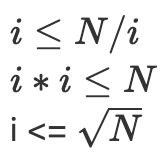
The factors are repeating from 6th row. After a certain point factors start repeating, so we need to find a point till we have to iterate.
We need to only iterate till -
### Pseudocode
```cpp
function countfactors (N):
fac_count = 0
for i = 1 till sqrt(N):
if N % i == 0:
fac = fac + 2
return fac
```
Q. Will the above work in all the cases?
A. No, not for perfect squares. Explain this for N = 100, what mistake we are doing. We will count 10 twice.
**Observation:** Using the above example, we need to modify the code for perfect squares.
### Pseudocode with Edge Case Covered
```cpp
function countfactors (N):
fac_count = 0
for i = 1 till sqrt(N):
if N % i == 0:
if i == N / i:
fac = fac + 1
else:
fac = fac + 2
return fac
```
Dry run the above code for below examples,
N = 24, 100, 1.
|N| Iterations| Execution Time|
|-|----------|---------- |
|10^18| 10^9 iterations| 10 secs |
To implement sqrt(n) , replace the condition i <= sqrt(N) by i * i <= N.
### Follow Up Question
Given N, You need to check if it is prime or not.
**Question**
How many prime numbers are there?
10, 11, 23, 2, 25, 27, 31
**Choices**
- [ ] 1
- [ ] 2
- [ ] 3
- [x] 4
**Explanation:**
Q. What is a prime Number?
A. Number which has only 2 factors, 1 and N itself.
So, 11, 23, 2, and 31 are the only prime numbers since they all have exactly 2 factors.
## Prime Check
Our original question was to check if a number is prime or not. For that, we can just count the number of factors to be 2.
```cpp
function checkPrime(N):
if countfactors(N) == 2:
return true
else:
return false
```
For N = 1, it will return false, which is correct. Since, 1 is neither prime nor composite.
---
**Question**
1 + 2 + 3 + 4 + 5 + 6 + .. 100 = ?
**Choices**
- [ ] 1010
- [x] 5050
- [ ] 5100
- [ ] 1009
**Explanation:**

Generalize this for the first N natural numbers.

## Some basic math properties:
1. `[a,b]` - This type of range means that a and b are both inclusive.
2. `(a,b)` - This type of range means that a and b are both excluded.
**Question**
How many numbers are there in the range [3,10]?
**Choices**
- [ ] 7
- [ ] 6
- [x] 8
- [ ] 10
**Explanation:**
The range [3,10] includes all numbers from 3 to 10, inclusive. Inclusive means that both the lower bound (3) and the upper bound (10) are included in the range. Thus the numbers that are included are 3 4 5 6 7 8 9 10.
**Question**
How many numbers are there in the range [a,b]?
**Choices**
- [ ] b-a
- [x] b-a+1
- [ ] b-a-1
**Explanation:**
To find the number of numbers in a given range, we can subtract the lower bound from the upper bound and then add 1. Mathematically, this can be expressed as:
```
Number of numbers in the range
= Upper bound - Lower bound + 1
```
### What do we mean by Iteration?
The number of times a loop runs, is known as Iteration.
**Question**
How many times will the below loop run ?
```cpp
for(i=1; i<=N; i++)
{
if(i == N) break;
}
```
**Choices**
- [ ] N - 1
- [x] N
- [ ] N + 1
- [ ] log(N)
**Question**
How many iterations will be there in this loop ?
```cpp
for(int i = 0; i <= 100; i++){
s = s + i + i^2;
}
```
**Choices**
- [ ] 100 - 1
- [ ] 100
- [x] 101
- [ ] 0
**Question**
How many iterations will be there in this loop?
```cpp
func(){
for(int i = 1; i <= N; i++){
if(i % 2 == 0){
print(i);
}
}
for(int j = 1; j <= M; j++){
if(j % 2 == 0){
print(j);
}
}
}
```
**Choices**
- [ ] N
- [ ] M
- [ ] N * M
- [x] N + M
**Explanation:**
We are executing loops one after the other. Let's say we buy first 5 apples and then we buy 7 apples, the total apples will be 12, so correct ans is N + M
## Geometric Progression (G.P.)
> **Example for intution:**
```
5 10 20 40 80 ..
```
In these type of series, the common ratio is same. In the given example the common ratio r is
= 10/5
= 20/10
= 40/20
= 80/40
= 2
**Generic Notation:**
a, a * r, a * r^2, ...
### Sum of first N terms of a GP
**Sum of first N terms of GP:**
=
r cannot be equal to 1 because the denominator cannot be zero.
**Note:**
When r is equal to 1, the sum is given by a * n.
## How to compare two algorithms?
**Story**
There was a contest going on to SORT the array and 2 people took part in it (say Gaurav and Shila).
They had to sort the array in ascending order.
arr[5] = {3, 2, 6, 8, 1} -> {1, 2, 3, 6, 8}
Both of them submitted their algorithms and they are being run on the same input.
### Discussion
**Can we use execution time to compare two algorithms?**
Say initially **Algo1** took **15 sec** and **Algo2** took **10sec**.
This implies that **Shila's Algo 1** performed better, but then Gaurav pointed out that he was using **Windows XP** whereas Shila was using **MAC**, hence both were given the same laptops.........

### Conclusion
We can't evaluate algorithm's performance using **execution time** as it depends on a lot of factors like operating system, place of execution, language, etc.
**Question**
How can we compare two algorithms?
Which measure doesn't depend on any factor?
**Answer:** Number of Iterations
**Why?**
* The number of iterations of an algorithm remains the same irrespective of Operating System, place of execution, language, etc.
 Sign in with Wallet
Connect another wallet
Sign in with Wallet
Connect another wallet