# Interview Problems
## Analyzing constraints
### Tips on Problem Constraints
* Analyzing the constraints can help you determine which time complexity and data structure or algorithm to use for a given problem.
* It is important to look at the constraints whenever we are solving a problem.
Note: In Interviews, don't ask the constraints directly. Rather, tell your approach and ask the interviewer if you need to optimize further.
If,
| Constraint | Possible Time Complexities |
| ----------------------- | ------------------------------ |
| n <= 10^6 | O(n), O(nlogn) |
| n <= 20 | O(n!), O(2^n) |
| n <= 10^10 | O(logn), O(sqrt(n)) |
Note: These are just general guidelines. The actual time complexity can vary based on the specific problem and implementation.
It's always important to analyze the problem and determine the best approach for your specific solution.
---
### Problem 1 Find the maximum number of consecutive 1's after replacement
#### Problem Statement
Given an array of 1's and 0's, you are allowed to replace only one 0 with 1. Find the maximum number of consecutive 1's that can be obtained after making the replacement.
**Example 1**
```cpp
Input = [1, 1, 0, 1, 1, 0, 1, 1]
Output = 5
```
**Explanation:**
If we replace 0 at 2nd index or 0 at 5th index with 1, in both cases we get 5 consecutes 1's.
### Question
Find the maximum number of consecutive 1's that can be obtained after replacing only one 0 with 1.
A[] = [ 1, 1, 0, 1, 1, 0, 1, 1, 1 ]
**Choices**
- [ ] 4
- [ ] 5
- [x] 6
- [ ] 7
* If we replace 0 at 2nd index with 1 we get 5 consecutes 1's.
* If we replace 0 at 5th index with 1 we get 6 consecutes 1's.
Hence, the maximum is 6 consecutive 1's.
---
### Question
Find the maximum number of consecutive 1's that can be obtained after replacing only one 0 with 1.
A[] = [0, 1, 1, 1, 0, 1, 1, 0, 1, 1, 0]
**Choices**
- [ ] 4
- [ ] 5
- [x] 6
- [ ] 7
* If we replace 0 at 0th index with 1 we get 4 consecutes 1's.
* If we replace 0 at 4th index with 1 we get 6 consecutes 1's.
* If we replace 0 at 7th index with 1 we get 5 consecutes 1's.
* If we replace 0 at last index with 1 we get 3 consecutes 1's.
Hence, the maximum is 6 consecutive 1's.
---
:::warning
Please take some time to think about the solution approach on your own before reading further.....
:::
### Solution Approach
* Maintain a variable say "ans", which keeps track of the maximum consecutive 1's encountered.
* Initialize it with 0.
* Iterate through the input array. When we encounter a zero at an index, we do the following:
* Count no. of consecutive 1's on left: **l**
* Count no. of consecutive 1's on right: **r**
* If (**l+r+1** > ans), replace ans with (**l+r+1**).
**Edge case**: When all the array elements are `1's`, then return the length of the whole array.
#### Pseudocode
```cpp
int findMaxConsecutiveOnes(int nums[]) {
int n = nums.size();
int maxCount = 0;
int totalOnes = 0;
for (int i = 0; i < n; i++) {
if (nums[i] == 1)
totalOnes++;
}
if (totalOnes == n)
return n;
for (int i = 0; i < n; i++) {
if (nums[i] == 0) {
int l = 0, r = 0, j = i + 1;
// calculate the maximum consecutive ones after replacing this zero
while (j < n && nums[j] == 1) {
r++;
j++;
}
j = i - 1;
while (j >= 0 && nums[j] == 1) {
l++;
j--;
}
maxCount = max(l + r + 1, count);
}
}
return maxCount;
}
```
---
### Question
What will be the TC of this approach ?
**Choices**
- [x] O(n)
- [ ] O(n^2)
- [ ] O(n^3)
- [ ] O(n^4)
**Explanation:**
The time complexity of the above solution is O(n) because it performs a single pass over the input array and every element will get accessed at maximum of 3 times.
> 
---
## Variation of Problem 1
### Coding Question 2
#### Problem Statement
Given an array of 1's and 0's, find the maximum number of consecutive 1's that can be obtained by SWAPPING at most one 0 with 1(already present in the string).
**Example 1**
```cpp
Input: [1, 0, 1, 1, 0, 1]
Output: 5
```
#### Explanation:
We can swap zero at index 4 with 1 to get the array [1, 0, 1, 1, 1, 1], which has 5 consecutive 1s.
---
### Question
find the maximum number of consecutive 1’s that can be obtained by swapping at most one 0 with 1.
A[] = [1, 1, 0, 1, 1, 1]
**Choices**
- [ ] 2
- [ ] 4
- [x] 5
- [ ] 6
**Explanation:**
We can swap the zero at index 2 with 1 at either index 0 or index 5 to get the array which has 5 consecutive 1s.
---
### Problem 1 variation continues
#### Solution
* The solution is very similar to solution to previous problem except for some modifications.
* We iterate through the input array. When we encounter a zero at an index, we do the following:
* Count no. of consecutive 1's on left -> l.
* Count no. of consecutive 1's on right -> r.
* If (l+r) is equal to total no. of 1's in the array, then currMax = (l+r), else currMax = (l+r+1).
* If (currMax > ans), replace ans with (currMax)
**Edge case**: When all the array elements are `1's`, then return the length of the whole array.
#### Pseudocode
```cpp
int findMaxConsecutiveOnes(int nums[]) {
int n = nums.size();
int maxCount = 0;
int totalOnes = 0;
for (int i = 0; i < n; i++) {
if (nums[i] == 1)
totalOnes++;
}
if (totalOnes == n)
return n;
for (int i = 0; i < n; i++) {
if (nums[i] == 0) {
int l = 0, r = 0, j = i + 1, currMax;
// calculate the maximum consecutive ones after swapping this zero
while (j < n && nums[j] == 1) {
r++;
j++;
}
j = i - 1;
while (j >= 0 && nums[j] == 1) {
l++;
j--;
}
if (l + r == totalOnes)
currMax = l + r;
else
currMax = l + r + 1
maxCount = max(currMax, count);
}
}
return maxCount;
}
```
#### Time and Space Complexity
* TC - O(n)
* SC - O(1)
---
### Problem 2 Majority Element
Given an array of N integers, find the **majority element.**
The **majority element** is the element that occurs more than n/2 times where n is size of the array.
**Example 1**
```plaintext
A[ ] = { 2, 1, 4 }
Ans = No Majority element
```
### Explanation
Here, none of the elements have frequency more than n/2 where n is 3.
**Example 2**
```plaintext
A[ ] = { 3, 4, 3, 2, 4, 4, 4, 4}
Ans = 4
```
#### Explanation
Here, frequency of 4 is more than n/2 that is 5 where n is 8. So 4 will be the majority element.
**Example 3**
```plaintext
A[ ] = { 3, 3, 4, 2, 4, 4, 2, 4}
Ans = No Majority element
```
#### Explanation:
Here, none of the elements have frequency more than n/2 where n is 8.
---
### Question
What is the majority element in this array?
3, 4, 3, 6, 1, 3, 2, 5, 3, 3, 3
**Choices**
- [ ] 1
- [x] 3
- [ ] 2
- [ ] 6
Here, 3 has frequency > n/2 where n is 11.
### Question
What is the majority element in the following array?
4, 6, 5, 3, 4, 5, 6, 4, 4, 4
**Choices**
- [ ] 3
- [ ] 4
- [ ] 6
- [x] No Majority Element
**Explanation:**
Here, none of the elements have frequency more than n/2 where n is 10.
---
### Question
At max how many majority elements can be there in an array?
**Choices**
- [x] 1
- [ ] 2
- [ ] n-1
- [ ] n
Suppose there is an array of size n. If frequency of an element is greater than n/2, then there cannot exist an element in remaining elements whose frequency is greater than n/2 .
Hence, there can be only one majority element.
---
### Problem 2 Brute Force
Iterate through every element in the array, count the number of times each element appears, and return the element that appears more than n/2 times.
#### Pseudocode
```cpp
void findMajority(int arr[], int n) {
int maxCount = 0;
int index = -1;
for (int i = 0; i < n; i++) {
int count = 0;
for (int j = 0; j < n; j++) {
if (arr[i] == arr[j])
count++;
}
if (count > maxCount) {
maxCount = count;
index = i;
}
}
if (maxCount > n / 2)
print(arr[index])
else
print("No Majority Element")
}
```
#### Complexity
-- TC - $O(n^2)$
-- SC - $O(1)$
:::warning
Please take some time to think about the Optimised approach on your own before reading further.....
:::
---
### Problem 2 Optimised Approach using Moore’s Voting Algorithm
#### Observation 1:
There can only be **one majority element** in the array.
#### Proof:
We will prove it by contradiction.
* Let's say there are two majority elements, say m1 and m2.
* frequency(m1) > n/2 and frequency(m2) > n/2
* Adding both sides,
* frequency(m1) + frequency(m2) > n **[it not possible]**
* Hence, Prooved.
#### Observation 2:
If we **remove any two distinct elements, the majority element remains the same.**
**Explanation 1:**
> Consider array of 13 blocks.
First **7 blocks** are filled with **GREEN colour**.
Next **6 blocks** are filled with **RED colour**.
**Majority** is **GREEN**.
If we remove 2 distinct blocks, 1 from GREEN and 1 from RED, we will be left with 11 elements.
**Majority** is still **GREEN**.
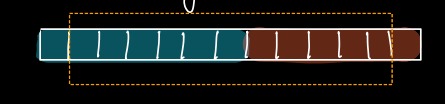
> Again, If we remove 2 distinct elements, 1 from GREEN and 1 from RED, we will be left with 9 elements.
**Majority** is still **GREEN**.
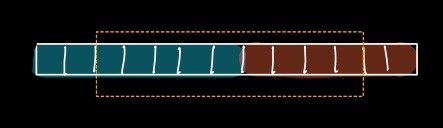
> If we continue this process we will get GREEN as MAJORITY element.
**Explanation 2:**
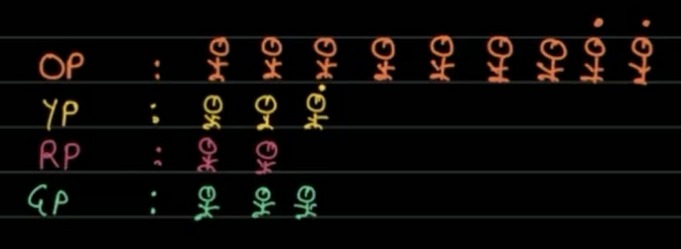
Suppose there are **4 parties** participating in an **election**.
* First: ORANGE party(OP) with **9** candidates.
* Second: YELLOW party(YP) with **3** candidates.
* Third: RED party(RP) with **2** candidates.
* Fourth: GREEN party(GP) with **3** candidates.
Currently, the **WINNER is ORANGE**
| Remove | Orange | Yellow | Red | Green | Winner|
| --- |--- | ---| ----- | ------| ---|
|1 OP and 1 YP | 8 | 2 | 2 | 3 |Orange
|1 OP and 1 GP | 7 | 2 | 2 | 2 |Orange
|1 OP and 1 RP | 6 | 2 | 1 | 2 |Orange
|1 YP and 1 RP | 6 | 1 | 0 | 2 |Orange
|1 YP and 1 GP | 6 | 0 | 0 | 1 |Orange
|1 OP and 1 GP | 5 | 0 | 0 | 0 |Orange
We can observe that after removing 2 distinct party votes every time, majority is maintained at every point.
**Note:** We cannot remove same party votes twice.
---
### Problem 2 Moore’s Voting Algorithm Approach and Dry Run
#### Approach
* Iterate through each element of the array, keeping track of the majority element's count and index.
* If the next element is the same as the current majority element, increase the count; otherwise, decrease the count.
* If the count becomes zero, update the majority index to the current element and reset the count to 1.
* After the iteration, go through the array once again and determine the count of the majority element found.
* If count > N/2, return majority elsement; else majority element doesn't exist.
#### Dry Run
Please **dry run** for the following example:
```plaintext
A[ ] = { 3, 4, 3, 6, 1, 3, 2, 5, 3, 3, 3 }
```
#### Pseudocode
```cpp
int findCandidate(int a[], int size) {
int maj_index = 0, count = 1;
for (int i = 1; i < size; i++) {
if (count == 0) {
maj_index = i;
count = 1;
} else {
if (a[maj_index] == a[i])
count++;
else
count--;
}
}
//check if the candidate
//occurs more than n/2 times
int count = 0;
for (int i = 0; i < size; i++) {
if (a[i] == a[maj_index])
count++;
}
if (count > size / 2)
return a[maj_index];
else
return -1;
}
```
#### Time and Space Complexity
What will be T.C and S.C for this approach?
-- TC - $O(n)$
-- SC - $O(1)$
---
### Problem 3 Row to Column Zero
You are given a 2D integer matrix A, make all the elements in a row or column zero if the A[i][j] = 0. Specifically, make entire ith row and jth column zero.
**Example**
**Input:**
[1,2,3,4]
[5,6,7,0]
[9,2,0,4]
**Output:**
[1,2,0,0]
[0,0,0,0]
[0,0,0,0]
**Explanation:**
A[2][4] = A[3][3] = 0, so make 2nd row, 3rd row, 3rd column and 4th column zero
#### Observation
If you start row wise and make one row completely zero if it has 0 then you will loose information for making columns zero.
**Note:** None element is negative so see if you may use this for not loosing info.
#### Approach
* Let's start row wise first.
* Select rows one by one and make all the elements of that row -1(except which are 0), if any element in that row is 0.
* Similariy you have to do the same thing for columns.
* Now, before returning traverse the matrix and make all the -1 elements 0.
#### Pseudocode
```cpp
int n = A.size(), m = A[0].size();
for (int i = 0; i < n; i++) {
int flag = 0;
for (int j = 0; j < m; j++) {
if (A[i][j] == 0) flag = 1;
}
if (flag == 1) {
for (int j = 0; j < m; j++) {
if (A[i][j] != 0) A[i][j] = -1;
}
}
}
for (int j = 0; j < m; j++) {
int flag = 0;
for (int i = 0; i < n; i++) {
if (A[i][j] == 0) flag = 1;
}
if (flag == 1) {
for (int i = 0; i < n; i++) {
if (A[i][j] != 0) A[i][j] = -1;
}
}
}
for (int i = 0; i < n; i++) {
for (int j = 0; j < m; j++) {
if (A[i][j] == -1) A[i][j] = 0;
}
}
return A;
```
 Sign in with Wallet
Connect another wallet
Sign in with Wallet
Connect another wallet