Nigeria Dairy Market Hits USD 2.8B on USD 1.5B Import Reset | Ken Research
==========================================================================
The sharpest shift in Nigeria's dairy economy is not on the supermarket shelf. It is the policy reset triggered by an annual **USD 1.5 billion import bill** that the federal government has now committed to closing. As per [**Ken Research**](https://www.kenresearch.com/?utm_source=HackMD&utm_medium=Referral&utm_campaign=Automation) market modelling, the Nigeria Dairy Market is valued at **USD 2.8 billion** with a forecast horizon through **2030**. The full segment forecasts and producer share data are in the [**Nigeria Dairy Market Report**](https://www.kenresearch.com/industry-reports/nigeria-dairy-market-report?utm_source=HackMD&utm_medium=Referral&utm_campaign=Automation).
_This analysis draws on data from Ken Research market modelling, Federal Ministry of Agriculture disclosures, the National Dairy Policy 2023-2028 framework, and independent African dairy-sector benchmarking._
National Dairy Policy 2023-2028 Targets the USD 1.5 Billion Import Bill
-----------------------------------------------------------------------
Nigeria consumes roughly **1.6 million metric tonnes of milk annually**, yet domestic production covers only **700,000 metric tonnes**, leaving a structural import gap valued at **USD 1.5 billion per year**. The federal government's **National Dairy Policy 2023-2028**, launched on World Milk Day, sets self-sufficiency as the explicit target ([Federal Ministry of Information dairy policy launch](https://fmino.gov.ng/fg-launches-the-national-dairy-policy-to-attain-self-sufficiency-others/?utm_source=HackMD&utm_medium=Referral&utm_campaign=Automation)). Capex support from the federal government includes allocations above **NGN 10 billion** earmarked for smallholder dairy farmers. Operators benchmarking cold-chain bottlenecks will find a direct parallel in the [**Nigeria Cold Chain Market**](https://www.kenresearch.com/industry-reports/nigeria-cold-chain-market?utm_source=HackMD&utm_medium=Referral&utm_campaign=Automation), where post-harvest infrastructure gaps shape both sectors.
* **Supply gap:** **900,000 metric tonnes** consumption-production deficit forces ongoing imports.
* **Policy lever:** **National Dairy Policy 2023-2028** and **NGN 10 billion** farmer support package now active.
* **Consumption gap:** Per capita milk consumption sits at **8.7 litres per year**, versus the WHO target of **210 litres**.
FrieslandCampina WAMCO and Promasidor Anchor Multi-Brand Dairy Leadership
-------------------------------------------------------------------------
The Nigeria dairy market is dominated by multinational processors operating across powdered milk, fresh milk, yoghurt, and ice cream segments. **FrieslandCampina WAMCO** (Peak Milk), **Promasidor Nigeria** (Dano, Cowbell), **Nestlé Nigeria**, **Arla Foods**, and **Fan Milk Nigeria** (a Danone company) anchor consumer awareness. Per Ken Research analysis, this multinational tier captures the urban premium segment while indigenous processors and CHI Limited drive volume in regional markets. Procurement teams comparing emerging-market dairy structures will find a contrasting structure in the [**India Dairy Market**](https://www.kenresearch.com/industry-reports/india-dairy-market?utm_source=HackMD&utm_medium=Referral&utm_campaign=Automation), where cooperative models dominate over multinational brands.
* **Multinational anchor:** **FrieslandCampina WAMCO**, **Promasidor**, **Nestlé**, **Arla**, and **Fan Milk Nigeria** shape brand share.
* **Brand portfolio:** Peak Milk, Dano, Cowbell, and Three Crowns dominate powdered milk shelf space.
* **Volume tail:** **CHI Limited** and indigenous processors capture the regional fresh-milk and yoghurt volume layer.
* * *
> Curious how the National Dairy Policy will reshape import share, processor capex, and rural collection networks by 2030? [**Download Sample Report**](https://www.kenresearch.com/sample-report/nigeria-dairy-market-report?utm_source=HackMD&utm_medium=Referral&utm_campaign=Automation) for processor share, segment forecasts, and cold-chain capex outlook.
* * *
Why Are Powdered Milk and Yoghurt Driving Most New Dairy Spend in 2026?
-----------------------------------------------------------------------
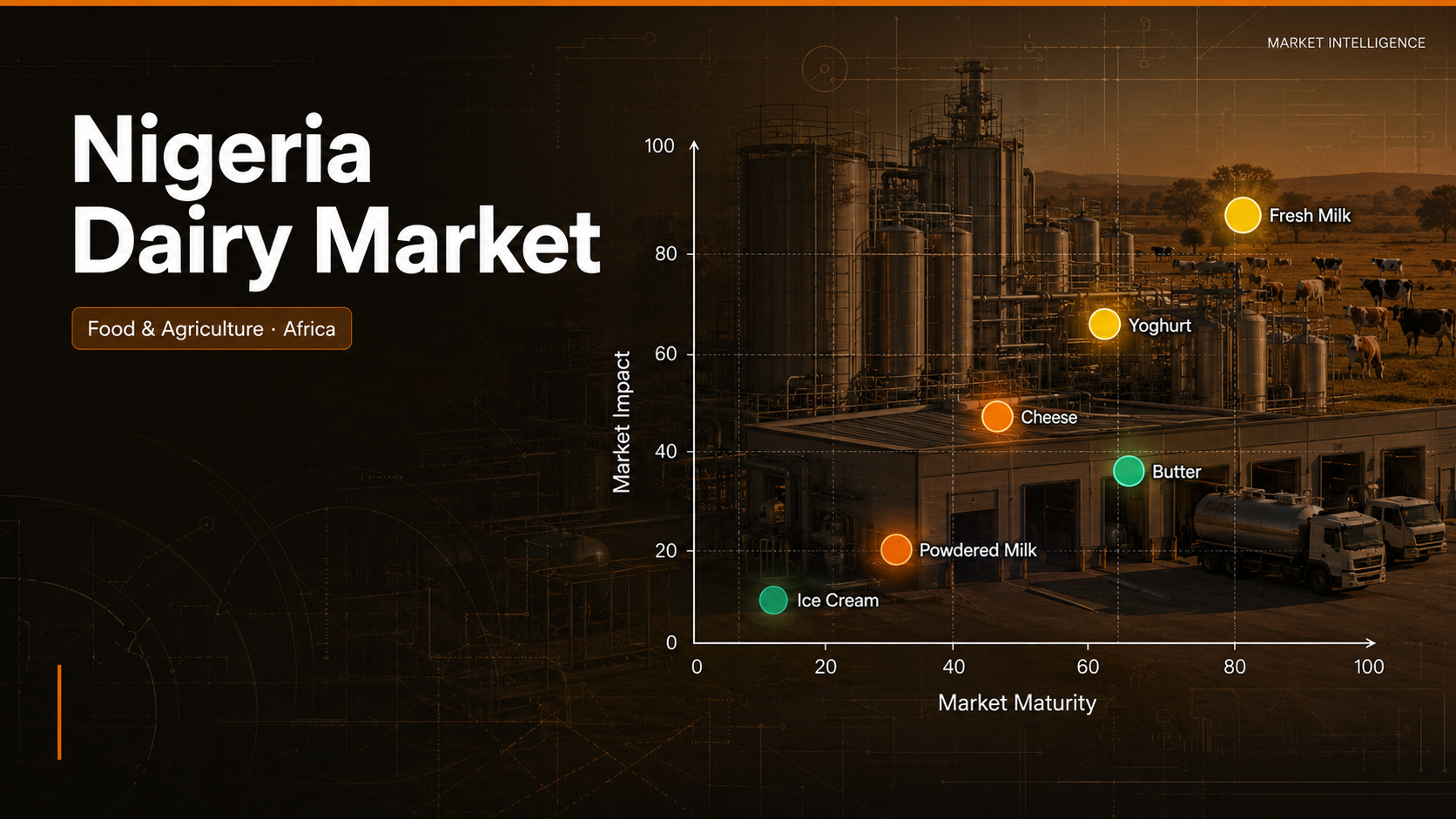
Powdered milk continues to lead by volume because of shelf stability in markets where only **30% of rural roads** are in good condition. Yoghurt is the fastest-growing fresh-format segment as urbanisation reaches a projected **220 million urban population** and health-related spending rises by an estimated **30%**. Per Ken Research estimates, supermarkets and convenience stores capture rising urban consumption while traditional stores still anchor rural distribution. Post-harvest losses across the dairy chain run at roughly **40%**, capping the upside until cold-chain capex catches up.
Nigeria Dairy Outlook to 2030: USD 2.8B Base and the Import-Substitution Trajectory
-----------------------------------------------------------------------------------
Cross-firm benchmarking points to a near-term trajectory taking the broader Nigeria dairy market from **USD 1.06 billion (2024)** toward **USD 2.29 billion by 2033 at 8.86% CAGR**, aligning with Ken Research's **USD 2.8 billion base modelling** through 2030. The import-substitution narrative will only convert if farm-gate financing improves, given interest rates averaging **20%** and feed prices that have already risen by **25%**. As estimated by Ken Research, processor consolidation will accelerate as multinationals build out local collection networks. The structural parallel for FMCG distribution is visible in the [**Nigeria FMCG Retail Modern Trade Market**](https://www.kenresearch.com/nigeria-fmcg-retail-modern-trade-market?utm_source=HackMD&utm_medium=Referral&utm_campaign=Automation).
* **Financing drag:** **20% interest rates** and **25% feed-price increase** compress farmer economics.
* **Distribution gap:** Only **30% of rural roads** in good condition limits fresh-milk reach.
What Processors, Distributors, and Investors Must Do Before 2028 Policy Targets Reset
-------------------------------------------------------------------------------------
The runway between today and the **2028 National Dairy Policy milestone** is roughly **30 months**, shorter than a typical dairy capex cycle. With the **USD 1.5 billion import gap** as the explicit policy target and **NGN 10 billion** in farmer support already committed, three stakeholder groups face concentrated decisions.
* **Processors:** Lock collection-network expansion before **40% post-harvest losses** become a tendering constraint.
* **Distributors:** Reposition supermarket and convenience-store mix to capture the **30% health spending lift**.
* **Investors:** Position around multinationals scaling local farm-gate collection where **USD 1.5 billion** in import substitution rewards capacity owners.
* * *
> Need processor share, segment forecasts, and cold-chain capex modelling for Nigeria dairy through 2030? [**Nigeria Dairy Market Report**](https://www.kenresearch.com/industry-reports/nigeria-dairy-market-report?utm_source=HackMD&utm_medium=Referral&utm_campaign=Automation) covers the full competitive landscape with year-on-year forecasts.
* * *
Conclusion
----------
Nigeria's dairy sector has entered a policy-driven import-substitution phase that rewards a different playbook than the one that scaled the multinational brand layer. With **USD 2.8 billion** already at stake and a **USD 1.5 billion** import bill in the federal government's sights, the strategic question is no longer how to grow consumer awareness, it is who builds rural collection capacity before the 2028 policy milestone reshapes processor economics.
Frequently Asked Questions
--------------------------
### Q1: What is the size of the Nigeria Dairy Market?
Per Ken Research market modelling, the Nigeria Dairy Market is valued at **USD 2.8 billion** with a forecast horizon through **2030**. Cross-firm benchmarking puts the broader market on an **8.86% CAGR trajectory through 2033**.
### Q2: Who are the key players in Nigeria's dairy market?
The leaders are **FrieslandCampina WAMCO** (Peak Milk), **Promasidor** (Dano, Cowbell), **Nestlé Nigeria**, **Arla Foods**, and **Fan Milk Nigeria**. The contrasting cooperative-led model is visible in the [**Indonesia Dairy Food Industry**](https://www.kenresearch.com/industry-reports/indonesia-dairy-food-industry?utm_source=HackMD&utm_medium=Referral&utm_campaign=Automation).
### Q3: Which dairy segment leads the Nigeria market?
Powdered milk leads by volume because of shelf stability across distribution networks where only **30% of rural roads** are in good condition. Yoghurt is the fastest growing fresh-format segment lifted by urbanisation and the projected **220 million urban population**.
### Q4: What is driving growth in Nigeria's dairy market?
Three drivers stack: the **National Dairy Policy 2023-2028**, an import-substitution target worth **USD 1.5 billion**, and an estimated **30% lift in health-related spending** across urban households per Ken Research analysis.
### Q5: How does the National Dairy Policy affect dairy processor strategy?
The policy targets self-sufficiency by **2028**, supported by allocations above **NGN 10 billion** for smallholder dairy farmers. Processors must build local collection networks before federal incentives shift toward integrated milk-shed operators.
For the full competitive benchmarking, segment forecasts, and regional breakdown, access the [**Nigeria Dairy Market Report**](https://www.kenresearch.com/industry-reports/nigeria-dairy-market-report?utm_source=HackMD&utm_medium=Referral&utm_campaign=Automation) from Ken Research, a leading market intelligence firm covering African food and agriculture markets.
 Sign in via Google
 Sign in via Facebook
 Sign in via X(Twitter)
 Sign in via GitHub
 Sign in via Dropbox
 Sign in with Wallet
Connect another wallet
Sign in with Wallet
Connect another wallet