Indonesia Logistics Market Hits USD 131B at 6.29% CAGR on E-Commerce Boom | Ken Research
========================================================================================
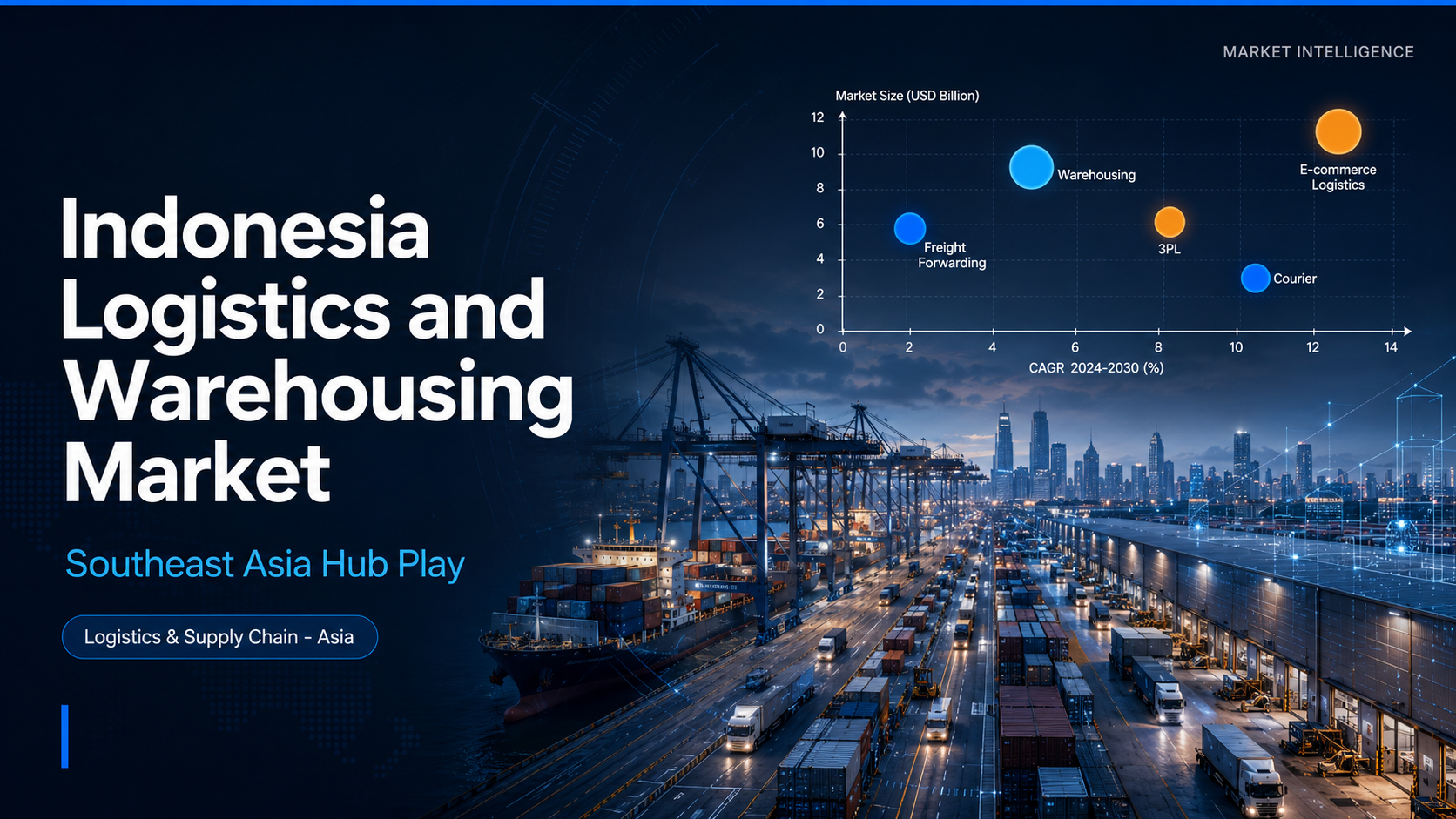
The biggest shift in Indonesian supply chain is not coming from new port builds or expanded sea-freight routes. It is coming from courier players processing **1 million parcels a day** inside automated mega-hubs around Greater Jakarta. As per [**Ken Research**](https://www.kenresearch.com/?utm_source=HackMD&utm_medium=Referral&utm_campaign=Automation) market modelling, the Indonesia Logistics and Warehousing Market is valued at **USD 131.2 billion in 2025**, projected at **USD 178.1 billion by 2030** at a **6.29% CAGR**. The full competitive landscape is in the [**Indonesia Logistics and Warehousing Market Report**](https://www.kenresearch.com/industry-reports/indonesia-logistics-warehousing-market?utm_source=HackMD&utm_medium=Referral&utm_campaign=Automation).
_This analysis draws on Ken Research market modelling, Indonesia Ministry of Transport infrastructure disclosures, Pos Indonesia automation data, and independent ASEAN freight benchmarking._
USD 131 Billion Indonesia Base: How E-Commerce Forced Faster Hub Automation
---------------------------------------------------------------------------
The fastest pivot in Indonesian logistics is not toward asset-light forwarding. It is toward automated mega-hubs that absorb e-commerce parcel surge. Per Ken Research, the Indonesia Logistics Market sits at **USD 131.2 billion in 2025**, on a **6.29% CAGR** path to **USD 178.1 billion by 2030**. Indonesia rose from **71st to 60th** in the World Bank Logistics Performance Index between **2016 and 2018**, supported by over **15 regulatory reforms**. Non-temperature controlled warehousing holds **90.9%** of revenue share in 2025, while cold chain expands at a **5.95% CAGR** through 2031. Vendors benchmarking adjacent demand will find a direct parallel in the [**UAE 3PL Warehousing Market**](https://www.kenresearch.com/uae-3pl-warehousing-and-contract-logistics-market?utm_source=HackMD&utm_medium=Referral&utm_campaign=Automation), where similar e-commerce-led growth drives vendor unit economics.
* **Trajectory:** Market grows from **USD 131.2 billion in 2025** to **USD 178.1 billion by 2030** at **6.29% CAGR**.
* **Warehouse split:** Non-temperature controlled holds **90.9%** share in 2025, cold chain grows **5.95% CAGR**.
* **LPI lift:** Indonesia rose from **71st to 60th** in the World Bank LPI through structural reform.
JNE, J&T Express, and SiCepat Anchor 1 Million Daily Parcels Each
-----------------------------------------------------------------
The competitive map is consolidating around three domestic CEP champions. JNE, J&T Express, and SiCepat each process over **1 million daily parcels**, with JNE's mega-hub approach able to handle over **2 million parcels per day** at peak using AI sorting. Pos Indonesia deployed **150 sorting robots** and lifted throughput to **18,000 parcels per hour**, with automation lifting efficiency by up to **42%**. SiCepat closed a large **Series B** in March 2025 and signed an integrated logistics service partnership with Pos Indonesia in November 2025. In August 2025, Lion Group inaugurated the **6,000 sqm** Lion Hub Halim facility. Investors tracking adjacent freight demand will find a direct parallel in the [**Indonesia Freight Logistics Market**](https://www.kenresearch.com/indonesia-freight-logistics-market?utm_source=HackMD&utm_medium=Referral&utm_campaign=Automation).
* **JNE scale:** Peak processing over **2 million parcels per day** using AI sorting and automated monitoring.
* **Pos Indonesia automation:** **150 sorting robots** deployed, throughput at **18,000 parcels per hour**, efficiency up **42%**.
* **Consolidation move:** SiCepat Series B in **March 2025** and Pos Indonesia partnership in **November 2025**.
* * *
> Want to map vendor share, segment-level CAGR, and warehouse pricing across the Indonesian logistics stack? [**Download Sample Report**](https://www.kenresearch.com/sample-report/industry-reports/indonesia-logistics-warehousing-market?utm_source=HackMD&utm_medium=Referral&utm_campaign=Automation) for a structured preview of competitive shares, segment forecasts, and procurement signals.
* * *
Why Is Greater Jakarta Outpacing Other Indonesian Regions in Parcel Hub Investment by 2027?
-------------------------------------------------------------------------------------------
The geographic gap inside Indonesia is widening as Greater Jakarta concentrates e-commerce parcel volume and automated hub investment ([Indonesia Ministry of Transport portal](https://dephub.go.id/en?utm_source=HackMD&utm_medium=Referral&utm_campaign=Automation)). Lion Group's **6,000 sqm** Halim hub, JNE's mega-hub network, and SiCepat's regional expansion concentrate demand. Surabaya, Medan, and Makassar anchor secondary hubs, while Kalimantan grew via JNE's Cahaya Logistics acquisition. The **15+ regulatory reforms** Indonesia committed to under World Bank Logistics Reform Loan are reshaping cross-island freight efficiency through **2027**.
Indonesia Logistics Outlook to 2030: USD 178B Trajectory and Three Platform Plays
---------------------------------------------------------------------------------
Forward-looking demand is concentrating around three plays: e-commerce courier hubs, cold chain warehousing, and integrated 3PL. Indonesia's logistics market grows from **USD 131.2 billion in 2025** to **USD 178.1 billion by 2030** at **6.29% CAGR**, with the broader market reaching **USD 226.4 billion by 2034** at **7% CAGR** per alternative estimates. Cold chain expands at **5.95% CAGR** through 2031. Vendors benchmarking adjacent ASEAN demand will find a direct parallel in the [**Turkey Logistics and Warehousing Market**](https://www.kenresearch.com/industry-reports/turkey-logistics-and-warehousing-market?utm_source=HackMD&utm_medium=Referral&utm_campaign=Automation), where similar trans-continental hub plays drive vendor unit economics.
* **CEP lead:** Courier and parcel champions process over **3 million combined daily parcels**, anchoring automation capex.
* **Cold chain growth:** Cold chain expands at a **5.95% CAGR** through 2031.
* **Trajectory:** Logistics market reaches **USD 178.1 billion by 2030** at **6.29% CAGR**.
What 3PL Operators, Retailers, and Logistics Investors Must Do Before 2027 Closes
---------------------------------------------------------------------------------
The capacity window is short: 3PL operators must lock long-term automation contracts before the next **SiCepat Series B** capital cycle allocates to incumbents, and retailers must align with mega-hub operators ahead of **2027** Jakarta-centric procurement milestones.
* **3PL operators:** Standardize on AI sorting, benchmarking against Pos Indonesia's **18,000 parcels per hour** throughput.
* **Retailers:** Lock multi-year parcel capacity targeting the **1 million** daily-volume threshold each CEP champion now clears.
* **Logistics investors:** Concentrate capital on cold chain plays expanding at **5.95% CAGR** through 2031.
* * *
> Ready to align supply chain strategy with Indonesia's USD 131 billion logistics base and the 6.29% CAGR e-commerce trajectory? Access the [**Indonesia Logistics and Warehousing Market Report**](https://www.kenresearch.com/industry-reports/indonesia-logistics-warehousing-market?utm_source=HackMD&utm_medium=Referral&utm_campaign=Automation) for granular vendor share, segment forecasts, and procurement intelligence.
* * *
Conclusion
----------
Indonesian logistics has entered an e-commerce-led consolidation that rewards a different playbook than the asset-heavy era built. Operators that win from here will convert mega-hub automation into durable retail and pharma contracts before the **2027** Jakarta procurement window narrows. For 3PL operators and investors, the strategic question is no longer how fast to add square meters, it is which players can prove AI-sorted throughput at the **USD 131 billion** scale Indonesia's e-commerce engine now requires.
Frequently Asked Questions
--------------------------
### Q1: What is the size of the Indonesia Logistics and Warehousing Market?
The market is valued at **USD 131.2 billion in 2025** per Ken Research, projected to reach **USD 178.1 billion by 2030** at a **6.29% CAGR**. Broader estimates place the wider logistics market at **USD 226.4 billion by 2034**.
### Q2: Who are the key players in the Indonesia logistics market?
Leading vendors include JNE (over **2 million parcels per day** peak), J&T Express (**1 million** daily), SiCepat (Series B in **March 2025**), Pos Indonesia (**150 robots**), DHL, Kuehne+Nagel, CEVA Logistics, DB Schenker, Lion Group, and Kerry Logistics.
### Q3: Which segment leads the Indonesia logistics market?
Non-temperature controlled warehousing leads at **90.9%** share in 2025. Courier and e-commerce parcel grows fastest, with the three domestic champions each processing over **1 million daily parcels**.
### Q4: How does e-commerce affect Indonesia logistics procurement?
E-commerce parcel surge has institutionalized AI-driven sorting and automated mega-hubs. Pos Indonesia lifted efficiency by up to **42%** with **150 robots**, while JNE's hub processes over **2 million daily parcels** at peak, locking in long-term procurement demand.
### Q5: What is driving growth in the Indonesia logistics market?
Three forces converge: e-commerce-led parcel surge, automation capex from JNE, J&T Express and SiCepat, and the **15+ regulatory reforms** committed under World Bank Logistics Reform Loan. Adjacent CEP dynamics are visible in the [**Indonesia Online Education Market**](https://www.kenresearch.com/industry-reports/indonesia-online-education-market?utm_source=HackMD&utm_medium=Referral&utm_campaign=Automation), where similar e-commerce-led adoption drives platform unit economics.
 Sign in via Google
 Sign in via Facebook
 Sign in via X(Twitter)
 Sign in via GitHub
 Sign in via Dropbox
 Sign in with Wallet
Connect another wallet
Sign in with Wallet
Connect another wallet