# Anglicisms in Spanish Language and Culture (Part II)
*In the [previous post](https://steemit.com/education/@adsactly/adsactly-education-anglicisms-in-spanish-language-and-culture-part-i) we were saying that languages tend to adopt selective patterns that already exist in their systems and that these isolated borrowings rarely altered them considerably.*
<div class = "text-justify">That kind of linguistic selectivity can be appreciated in the Anglicisms used in Venezuela. Some of them could be easily adapted to previous forms or patterns and were eventually completely assimilated (fax ><em>faxear</em>, flirt ><em>flirtear</em>). Some others are used in their original form, but cannot be inflected or modified (stop can be used as a noun [<em>se comió el stop</em> = He ran the stop sign], but it cannot be transformed into the verb <em>estopear</em>). Yet others, even if assimilated and modified become nothing but fashionable traits and, in time, will no longer be used (<em>claxon</em> < Klaxon, <em>broder</em> < brother, <em>guatecloc</em> < water closet).</div>
https://bellezanaturaleve.com/wp-content/uploads/2018/03/Copia-de-Lenguaje-cosm%C3%A9ticos-800x675.jpg [Source](https://bellezanaturaleve.com/anti-aging-wellness-anglicismos-de-belleza-moda/)
<div class = "text-justify">From Rómulo Gallegos in the 1940s to Otero Silva in the 1970s, Venezuelan authors have included in their works some samples of the fashionable Anglicisms of their time. However, they always handled them with care, used them sparingly, and, to some extent avoided them in formal written language. In the last decades, the number of Anglicisms has increased exponentially. The new Venezuelan literature seems to be more willing to experiment with the new forms of the language. Authors are less apprehensive regarding purity and correctness.
One supporter of this new wave is Eloi Yagüe. Even though his detective novella, <em>Las Alfombras Gastadas del Gran Hotel Venezuela</em> (1999) might not have an extraordinary literary value (it has flaws in terms of form and execution), its merit resides in the accurate exposition of a contradictory socio-historic reality and uninhibited use of the language. Yagüe attempts to reconcile the contrived lyricism of the author with the grotesqueness of the narrator and the rest of the characters. The result is a sub-real detective-like narration in which the nuances of the language and the plot reveal the ambiguities of a culture that struggles to find its own identity in the middle of a labyrinth of foreign influences and models.</div>
---
<center></center>
<div class = "text-justify">The novel portrays a reporter who is trying to become a writer and chooses to write a detective novel. To find his muse, he goes to the province. He decides to stay in a formerly renowned hotel in a remote area of the north coast. What he finds is an abandoned hotel with ragged carpets, trapped in a town ruled by reckless and ignorant people who live on the glories of the past and hide from the uncertainty of the future.</div>
---
<div class = "text-justify">The fascination for all that was foreign is one of the features of this glorious past. Yagüe uses the language to reconstruct the social tensions of an epoch while revealing a linguistic reality that is perhaps the most authentic and characteristic Venezuelan feature. Detached from purist pretensions, Yagüe utilizes in his novel linguistic elements from the opposite sides of the academically acceptable spectrum: Venezolanisms and Anglicisms. Thus, his novel becomes a particularly fascinating linguistic corpus.</div>
---
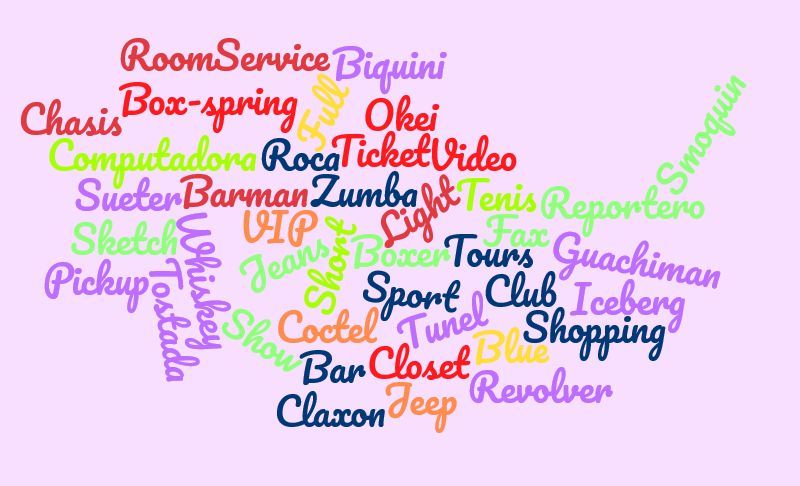
I put together a word cloud with about fifty of the most easily identifiable Anglicisms used by Yagüe in <em>Las Alfombras Gastadas del Gran Hotel Venezuela.</em>
## Linguistic Analysis.
<div class = "text-justify">The analysis of the Anglicisms found in Yagüe’s novel show that <B>the borrowing in Venezuelan Spanish is mainly lexical</B>. Almost all the words used in the novel are nouns. These nouns are predominantly used in its original form (light, ticket, club), although they are pronounced with Spanish variations. In fact, most of the words are used in italics probably to denote their foreignness. Some of the neologisms that are spelled differently from the English form (<EM>tenis, tunel, coctel</EM>) have been already officially included in Spanish dictionaries, as well as the words derived from them (<em>tenista, coctelera</em>).</div>
---
<div class = "text-justify">The only syntactic feature in Yague’s novel that can be considered anglicized is the inversion of noun-adjective form. Yagüe tends to place the adjectives before the nouns, as in famosa novela, vieja máquina, cercano terminal (5). This form is not entirely alien to Spanish, though, and Yague mostly keeps the Spanish Noun-Adjective form. Spanish, like all synthetic languages, is syntactically flexible, and there are instances where placing the adjective before the nouns sounds even better than otherwise. As Pountain says, this kind of combination only fulfills semantic needs and fills morphological gaps (120).</div>
https://cdn.pixabay.com/photo/2013/05/12/09/37/translate-110777_960_720.jpg [Source](https://pixabay.com/es/illustrations/traducir-teclado-internet-bot%C3%B3n-110777/)
<div class = "text-justify">In Spanish it is common to use adjectives as nouns, for instance, <em>bueno</em> becomes <em>los buenos</em> (‘good, the good ones’), <em>loco</em> becomes <em>el loco</em> (‘crazy, the crazy one’). The opposite, to use a noun as an adjective, in less frequent, but it was an established form used in the past (118). An interesting example of the noun + noun combination in Yagüe’s novel is the use of the acronym VIP as an adjective in <em>zona VIP</em>, ‘VIP area’ (107) and <em>camisas sport</em>, ‘sport shirts’ (80). Even when the Anglicism is used, concurring with Pountain’s conclusions, there is “no possibility of changing the order of the two nouns” (119).</div>
---
## Morphological and phonetic changes.
https://cdn.pixabay.com/photo/2019/09/01/06/19/questions-4444446_960_720.jpg [Source](https://pixabay.com/es/illustrations/preguntas-sherlock-holmes-quien-qu%C3%A9-4444446/)
<div class = "text-justify">The different academies that rule the Spanish language tend to prescribe the way people should pronounce, write, and use words, especially foreign words when their adoption becomes inevitable. However, arbitrariness prevails in many cases, and regional variation can considerably alter the way an Anglicism is assimilated. In terms of word formation, Spanish speakers can add a vowel to English words ending in a consonant, especially t, d, v, k, and r. For instance, reporter becomes <em>reportero</em>, bat becomes <em>bate.</em> They could also either pronounce the final vowel that in English is silent, as in chance, or drop it as in <em>misil</em>.</div>
---
<div class = "text-justify">Some borrowings might never be officially accepted in the way they are pronounced (<em>flas</em> from flash), but this initial phonetic alteration can be the prelude of a future coinage (stress becomes <em>estrés</em> and from there the adjective <em>estresado</em>, stressed). Other predictable phonetic alterations made by Spanish speakers are: dropping the final consonant, as in <em>estó</em> from stop; adding an e before words starting with s, for example, <em>espor</em> from sport, <em>esmoquin</em> from smoking; replacement (almost always) of initial w sound by a g sound, for instance, <em>guachiman</em> from watchman, <em>gualla</em> from wire; and changing the point of articulation of some consonants. For instance, V (labio-dental) will generally be pronounced B (bilabial), as in /bideo/ < video.</div>
---
<div class = "text-justify">In terms of spelling, double consonants tend to be reduced (<em>tenis</em> < tennis, <em>túnel</em> < tunnel, <em>misil</em> < missile), w changes for u (<em>suiche</em> <switch), vowels are reduced to the minimum required in Spanish to produce the sound, as in <em>suéter</em> < sweater, <em>turista</em> <tourist, <em>friser</em> < freezer, and Sh is replaced by ch, (<em>chutar</em> <shoot).</div>
---
https://upload.wikimedia.org/wikipedia/commons/thumb/e/e8/Savile_Club_Bar%2C_Maja_Photo%2C_Mar_2016.JPEG/800px-Savile_Club_Bar%2C_Maja_Photo%2C_Mar_2016.JPEG [Source](https://commons.wikimedia.org/wiki/File:Savile_Club_Bar,_Maja_Photo,_Mar_2016.JPEG)
<div class = "text-justify">Most of the linguistic loans present in Yagüe’s novel are words derived from fashion (sweater, smoking, blazer, boxer), technology (fax, jeep, cellular), or terms associated with social status (whiskey, poker, club, tourism). This sample represents an interesting historical and socio-linguistic corpus in terms of the kind of contact Venezuela has had with the US and the kind of borrowing the speaker are willing to adopt.</div>
---
No significant syntactic change attributable to English influence was observed in the language sample (limited as it can be); instead, it can be perceived in Yague a certain authorial satisfaction and easiness for being able to use Anglicisms without much apprehension.
<div class = "text-justify"><B>Languages are living creatures unwilling to contain their impulses and needs. Purists throughout history have not been successful in preventing linguistic contact and its subsequent borrowings</B>. They have also failed in prescribing language use. English did not lose agency or prestige because of the influence of Latin, Danish, Norse, or French, for instance. On the contrary, English benefited enormously from those contacts because they allowed English people to interact with, blend with, and profit from other cultures while the language grew and became more functional. In the same way, Spanish has benefited from having to import what it lacks economically, technologically, and culturally. Linguists should trust the selective system of the language and allow its speakers to participate and benefit from the richness of other languages. <B>The malleability of the Spanish language makes possible the immediate incorporation of new concepts and their expansion inside and beyond the limits of its linguistic system</B>.</div>
---
https://cdn.pixabay.com/photo/2013/05/12/09/36/globe-110775_960_720.jpg [Source](https://pixabay.com/es/illustrations/globo-mundo-idiomas-traducir-110775/)
https://steemitimages.com/DQmdu12BTMUSSk4hoHJzYS1jULPQLyE7HgRhhPRteYaUaDZ/separador%20steemitvzla.jpg
### <center>Works Cited</center>
**Kishida**, Maria José. “Los Angliscismos en Espanol. Puntos Para el Debate.” <http://usuarios.iponet.es/ddt/anglicismos.htm>
**Pountain**, Christopher J. “Syntactic Anglicisms in Spanish: Exploitation or Innovation?” The Changing Voices of Europe. Social and Political Changes and Their Linguistic Repercussions, Past, Present and Future. Eds. M. M. Parry, W.V. Davies and R.A.M. Temple. Cardiff: U of Wales P, 1994. 109-24.
**Pratt**, Chris. El Anglicismo en el Español Peninsular Contemporameo. Madrid: Gredos, 1980.
**Teschner**, Richard V. “Exploring the Role of Hispano in the Dissemination of Anglicisms in Spanish.” Foreign Language Annals 7 (1974): 681-93.
**Tió**, Salvador. Lengua Mayor. Ensayos Sobre el Español de Aquí y de Allá. Rio Piedras: Plaza Mayor, 1991.
**Vega**, Ana Lydia. “Pollito Chicken.” Vírgenes y Mártires: (Cuentos). Rio Piedras: Antillana, 1983.
**Yague**, Eloi. Las Alfombras Gastadas del Gran Hotel Venezuela. Caracas: Planeta, 1999.
 Sign in with Wallet
Connect another wallet
Sign in with Wallet
Connect another wallet