<style>
h2.part{color:#0099B0;}
h3.part{color:#D92424;}
h4.part{color:#005BB0;}
h5.part{color:#FD6F0A;}
h6.part{color:#4400B0;}
</style>
# 2016q3 Homework2 (phonebook-concurrent)
contributed by <`f5120125`>
###### tags: `sysprog`
## 開發環境
#### Ubuntu 14.04 LTS
- CPU: Intel® Core™ i5 CPU 650 @ 3.20GHz × 4
- Mem: 8 GiB
- Cache:
L1d cache: 32 KB
L1i cache: 32 KB
L2 cache: 256 KB
L3 cache: 4096 KB
## Concurrency
- ### Concurrency(並行性) 不為 Parallelism (平行性) [[1]](http://learn-gevent-socketio.readthedocs.io/en/latest/general_concepts.html)[[2]](https://hackmd.io/s/H10MXXoT)[[3]](http://stackoverflow.com/questions/1050222/concurrency-vs-parallelism-what-is-the-difference)
- #### 實作threads主要是為了達到Concurrency:
再一條時間軸上, threads間有所重疊, 因此藉由共享==code section==, ==data section==, ==task上能夠運用的資源==達到有效利用CPU, 達到==vitual paralellism==
- #### 實作processes主要是為了達到Parallelism:
再同一時間, 有多個tasks需處理,利用多個CPU去處理達到平行化
- ### [Sequenced Before](http://enginechang.logdown.com/posts/788206-concurrency-series-2-starting-from-sequenced-before)
- threads間執行順序的不確定性, 得需知道求值順序
- ### [Happens-Before](http://enginechang.logdown.com/posts/797113-concurrency-series-3-happens-before)
- 前一個操作的效果在後一個操作執行之前必須要visible
- 只關注是否看起來有這樣的效果,從外界看起來,就像是先執行某一行A,再執行其接著的下一行B
- 關鍵在於只要A的效果在B執行之前,對於B可見就可以了,實際上怎麼執行的並不需要深究
## 案例分析 Phonebook-concurrent
- 此程式延續之前作業, 修改為thread版本來提升效能
### Preliminaries
- ==**Macro**== 的使用
- **```#if...#else...#endif```**
- **```#ifdef MACRO_NAME...#endif```, ```#ifndef MACRO_NAME...#endif```**
- **```#if defined( MACRO_NAME )...#endif```**
- **```#include IMPL```**
- ==**Thread management**==
- **```pthread_create()```**
- **```pthread_join()```**
- **```pthread_exit()```**
- ==**Map file into memory**==
- **```mmap()```**
- **```munmap()```**
- ==**File alignment**==
### 1. Macro 的使用
- 在```phonebook_opt.h```中定義了一個macro: ```OPT``` , 主要功能是拿來判斷```main.c``` 中哪裡是原來版本或是執行緒版本該執行的
#### example
```clike=
#if OPT
/*do sommthing*/
#endif
```
```clike=
#ifdef OPT
/*do something*/
#endif
```
```clike=
#if defined(OPT) && OPT
/*do something*/
#endif
```
### 2. Thread management
#### pthread_create()
```clike=
int pthread_create(pthread_t *thread, const pthread_attr_t *attr,
void *(*start_routine)(void *), void *arg);
```
###### ◆第一個參數
- ==**unique Thread ID**==
###### ◆第二個參數
- 用於指定不同 ==**thread的attributes**==, 通常為傳入NULL, 代表是default attribute
###### ◆第三個參數
- **```void *```** 為 ==**generic pointer**==, 主要功用
- ==**儲存任何型態的address**==
- ==**typecast成任何型態**==
```clike=
void *somePtr;
int *integerPtr = 10;
int *anotherIntPtr;
somePtr = &integerPtr;/*儲存int型態的address*/
//error occur !!
printf("%d\n", (int)(*somPtr));/*不能使用`*`去存取值*/
anotherIntPtr = (int*)somePtr;/*typecast成(int*)型態*/
printf("%d\n", *anotherIntPtr);
```
- **```(*start_routine)```** 為 ==**function pointer**==, 其所能傳入的參數型態為 **```void *```**
###### ◆第四個參數
- start_routine要用到的參數, 若是start_routine有許多參數, 可以傳入一個structure
#### pthread_join()
```clike=
int pthread_join(pthread_t thread, void **retval);
```
###### ◆第一個參數
- ==**unique Thread ID**==
###### ◆第二個參數
- 用於
##### pthread_exit()
### 3. Map file into memory
#### MMAP
[SYNOPSIS]((http://man7.org/linux/man-pages/man2/mmap.2.html))
```clike=
#include <sys/mman.h>
void *mmap(void *addr, size_t length, int prot, int flags, int fd, off_t offset);
```
mmap() 將檔案映射到一個 virtual memory address 上面,藉由直接對 memory address 修改的方式不用經過buffer,減少資料load到緩衝區的overhead,快速的記憶體存取可以提高對檔案 IO 的效率
:::info
**Blocking** VS **Non-blocking I/O**
* Blocking I/O
允許 sleep/awaken 動作的 process,基本動作:
* 當 process 進行 read 動作但是資料尚未就緒時,process 必須被 block 住 (sleep),而當有資料進來時就需要立即被喚醒 (awaken),就算資料仍不完整也是
* 當 process 進行 write 動作但是 buffer 沒有空間時,process 也必須被 block 住,而且必須被放到跟 read 動作不同的 wait queue 中去等待 wake-up (buffer 騰出空間寫入)
* Non-blocking I/O
* 讀不到資料或寫不進 buffer 時,他會送出 retry 的動作,再試一次
>>[參考觀念](https://hackmd.io/AwJgzA7ARgHMCsBaEJjEQFgMYE4uJgFMcA2RXYEiYYmAMxgiA===?both)
:::
>[記憶體映射函數 mmap 的使用方法](http://welkinchen.pixnet.net/blog/post/41312211)
* `addr` : 要 map 到的記憶體位置
* 如果 addr 為 NULL,kernel 將在建立的 mapping 地址中自行選擇,這是建立新的 mapping 最簡單的方法。
* 如果 addr 不是NULL,mapping 會在附近的 page boundary 建立,並將新 mapping 地址傳回。
* `length`: 要 mapping 的長度,它會從 fd + offset 的位置開始 mapping 檔案。
* `prot`: 要保護的記憶體保護 mapping
**不能跟 open mode 衝突**
* PROT_EXEC 可能執行
* PROT_READ 可能讀取
* PROT_WRITE 可能寫入
* PROT_NONE 可能不能存取
* `flags`: 選擇 map file 能不能被其他程式看到
* MAP_SHARED 分享此 mapping
* MAP_PRIVATE 建立一個私有 copy-on-write mapping
* `fd`: 用系統函式 open 打開的檔案位置,open mode 可以選擇檔案的讀寫屬性,不能跟 prot 有衝突。
* `offset`: 從檔案的哪裡開始 mapping,offset 必須是 page size 的倍數,可以用 sysconf(_SC_PAGE_SIZE) 取得。
#### munmap
munmap() 用來取消參數 start 所指的映射記憶體起始地址,參數 length 則是欲取消的記憶體大小。當行程結束或利用 exec 相關函數來執行其他程式時,映射記憶體會自動解除,但關閉對應的文件描述詞時不會解除映射。
>[C語言munmap()函數:解除内存映射](http://c.biancheng.net/cpp/html/139.html)
### 4. File alignment
### 5. 檢查aligned file是否和原輸入一樣
#### check.c
```clike=
#include <stdio.h>
#include <sys/stat.h>//stat, stat(paath, struct stat)
#include <sys/mman.h>//mmap()
#include <fcntl.h>//open(file_name, )
#include <stdbool.h>
#define MAX 16
#define ORIG_FILE_PATH "./dictionary/words.txt"
#define ALIGNMENT_FILE "align.txt"
off_t getFileSize( char *path);
int main(){
bool consistency=true;
char orig_buff[MAX];
char align_buff[MAX];
FILE *orig_fp = fopen(ORIG_FILE_PATH, "r");
FILE *align_fp = fopen(ALIGNMENT_FILE, "r");
int fd = open(ALIGNMENT_FILE, O_RDONLY | O_NONBLOCK);
off_t new_file_size = getFileSize(ALIGNMENT_FILE);
char *map = mmap(NULL, new_file_size, PROT_READ, MAP_SHARED, fd, 0);
char *tmp=map;
while( fgets(orig_buff, sizeof(orig_buff), orig_fp) ){
if( strncmp(orig_buff, tmp, sizeof(orig_buff)) != 0){
consistency=false;
break;
}
tmp+=MAX;
}
if(consistency)
printf("Files are consistent\n");
else
printf("Files are not the same\n");
return 0;
}
off_t getFileSize( char *path){
struct stat file_stat;
stat(path, &file_stat);
return file_stat.st_size;
}
```
##### 執行結果
- 檢查完aligned file和原本words.txt檔後, 確認檔案一樣
```
Performance counter stats for './phonebook_opt' (100 runs):
841,854 cache-misses # 66.507 % of all cache refs ( +- 1.05% )
1,265,807 cache-references ( +- 0.65% )
172,850,372 instructions # 0.76 insns per cycle ( +- 0.07% )
226,345,721 cycles ( +- 0.88% )
0.090487839 seconds time elapsed ( +- 2.76% )
cc -Wall -std=gnu99 calculate.c -o calculate
./calculate
hua@hua-ubuntu:~/Desktop/sysprog-class/homework2/phonebook-concurrent$ ./check
Files are consistent
```
### Code Refactoring
- [x] 整理程式碼
- 變重新命名
- 整理Macro
- [x] 程式的改進
- findName()的改進
#### original
- 下列程式碼為append完後, 將threads間的linked-list合併在一起
- 改進方向可以考慮對每個thread做findName()
```clike=
entry *etmp;
pHead = pHead->pNext;
for (int i = 0; i < THREAD_NUM; i++) {
if (i == 0) {
pHead = argsPtr[i]->entryHead->pNext;
} else {
etmp->pNext = argsPtr[i]->entryHead->pNext;
}
etmp = argsPtr[i]->entryTail;
}
```
##### 原本程式執行結果

#### 合併pthread_create()和pthread_join()的分析
##### 執行結果
- create 和 join合併到同一個for loop

#### threaded_findName()
##### 執行結果

### Thread Pool
>>[參考觀念](https://hackmd.io/GYVgLATAbGAmYFpYHYBGsFgMYEZgNRFgA4CBmVMYATmIENYAGLCIA===?both)
- Thread 缺陷
- 建立太多執行緒,會浪費一定資源,並且有些執行緒未被充份使用
- 銷毀太多執行緒,會導致之後浪費時間再次創建它們
- 建立執行緒太慢,導致效能變差
- 銷毀執行緒太慢,導致其它執行緒沒有資源
- Thread Pool 功能
- 管控 Thread 的產生與回收
- 分發 Thread 處理 request
- 處理 request 的 queue
>[C 的 Thread Pool 筆記](http://swind.code-life.info/posts/c-thread-pool.html)
>[github source code](https://github.com/mbrossard/threadpool)
```clike=
typedef struct {
void (*function)(void *);
void *argument;
} threadpool_task_t;
//Thread Pool 需要 job/task 讓 Thread 知道他們要做什麼事情
threadpool_t *threadpool_create(int thread_count, int queue_size, int flags);
//傳入 thread 的數量,queue 的大小,回傳 threadpool 型態是 threadpool_t
int threadpool_add(threadpool_t *pool, void (*routine)(void *), void *arg, int flags);
//傳入 threadpool,要執行的 function 位置,要傳入的參數
int threadpool_destroy(threadpool_t *pool, int flags);
//傳入 threadpool,會把 threadpool 的空間 free 掉
```
### Lock-free Thread Pool
#### Thread Pool VS Lock-Free Thread Pool
* Thread Pool
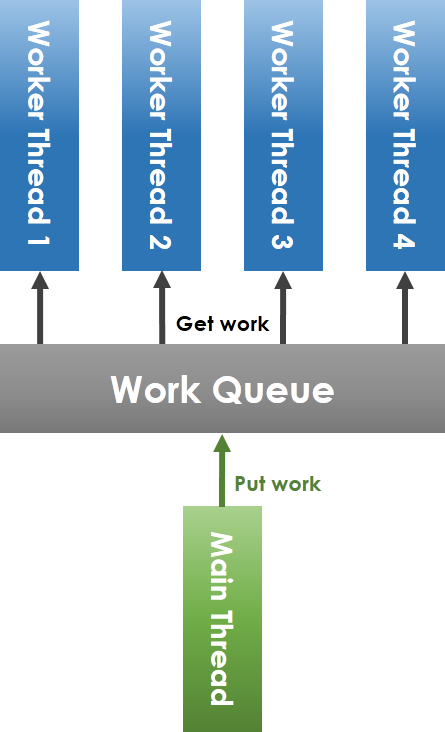
共享 workqueue 的操作必須在 mutex 的保護下安全進行。
* Lock-Free Thread
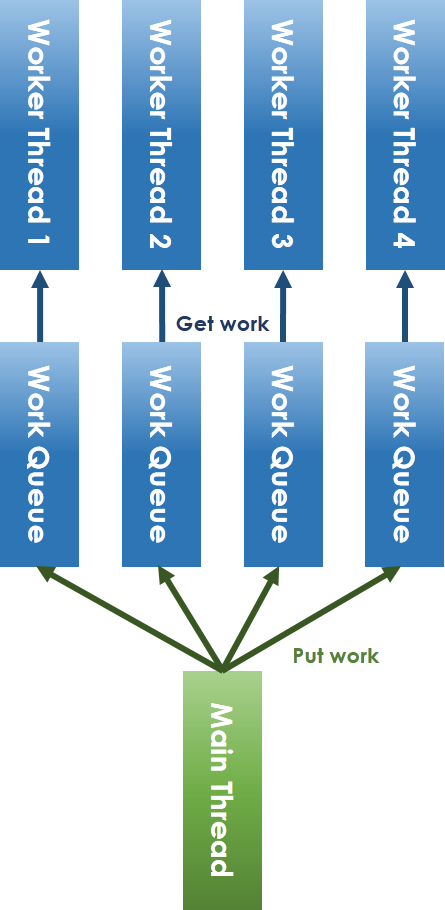
* 解決 lock 機制:
解決 lock-free 必須避免共享資源的競爭,因此將共享 workqueue 拆分成每個 worker thread 一個 workqueue。
對於 main thread 放入工作和 worker thread 取出任務的競爭問題,可以採取 ring-buffer 的方式避免。
* condition variable 問題:
condition variable 解決執行緒之間的通訊。
semaphore 作為一種通信方式,可以代替之。
>[高效線程池之無鎖化實現](http://blog.csdn.net/xhjcehust/article/details/45844901)
```clike=
void *tpool_init(int num_threads)
//初始化時決定要用哪種方式進行 put work,選用 `ring-buffer` 的方式將 worker 加入queue
static int wait_for_thread_registration(int num_expected)
//確保所有執行緒都在準備中
int tpool_add_work(void *pool, void(*routine)(void *), void *arg)
//配合 `dispatch` 加入 task 到 work queue 中
static void *tpool_thread(void *arg)
//給 worker task,沒有用到 mutex_lock
static tpool_work_t *get_work_concurrently(thread_t *thread)
//利用 CAS 讓每個執行緒拿到自己的 task,確保從 work queue 出來時,遞減 `out` 的變數同步
void tpool_destroy(void *pool, int finish);
//判斷所有的 queue 是不是空的,確保所有 worker 完成工作
```
:::info
**CAS**
以具有 atomic 特性的計算操作來達成。
```clike=
bool CAS(T* addr, T exp, T val)
{
if (*addr == exp) {
*addr = val;
return true;
}
return false;
}
```
:::
>[github source code](https://github.com/xhjcehust/LFTPool)
#### 實做測試
```shell
$ git clone https://github.com/xhjcehust/LFTPool
$ cd LFTPool/
$ make
$ ./testtpool
```
 Sign in with Wallet
Connect another wallet
Sign in with Wallet
Connect another wallet