# Lab Exercise 16 (Formatted Sentence)
## Task
A sentence can be defined as a list of words (words are strings). The string representation of a sentence is the concatenation of all of the words in the list, separated by a space.
```python
from abc import ABC,abstractmethod
class Sentence:
def __init__(self,words:[str]):
self.__words = words
def __str__(self) -> str:
sentenceString = ""
for word in self.__words:
sentenceString += word + " "
return sentenceString[:-1]
```
Instances of sentences can be printed with formatting:
- **bordered** - Given the sentence, `["hey","there"]` it prints:
```
-----------
|hey there|
-----------
```
- **fancy** - Given the sentence, `["hey","there"]` it prints:
```
-+hey there+-
```
- **uppercase** - Given the sentence, `["hey","there"]` it prints:
```
HEY THERE
```
The formatting of a sentence is decided during runtime. These formats should also allow for combinations with other formats:
- **bordered fancy** - Given the sentence, `["hey","there"]` it prints:
```
---------------
|-+hey there+-|
---------------
```
- **fancy uppercase** - Given the sentence, `["hey","there"]` it prints:
```
-+HEY THERE+-
```
To accomplish these features, you need to implement the decorator pattern. Each formatting will be a decorator for `Sentence` objects. These formats need to inherit from some abstract `FormattedSentence` class. This abstract class is specified to compose and inherit from sentence. The behavior that needs to be decorated is the `__str__()` function since you need to change how sentence is printed for every format.
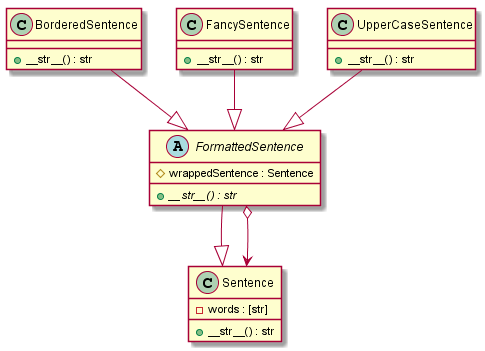
**Complete the system using the decorator pattern**
## Assessment Criteria
- Completeness of the pattern - 40
- Elegance of method and attribute naming - 10
 Sign in with Wallet
Connect another wallet
Sign in with Wallet
Connect another wallet