# Spring核心理論基礎
- 控制權轉置 IoC (Inversion of Control)
- 依賴注入 DI (Dependency Injection)
- 剖面導向程式設計AOP (Aspect Oriented Programming)
## Framework Reuse
### Template Method (Design Pattern)
核心概念:
- 共用的主流程寫在父類別 (template method)
- 可變動(客製化)部分挖空變成抽象方式(hook method)
Framework reuse 便是套用這個概念
### Framework Reuse vs Library Reuse
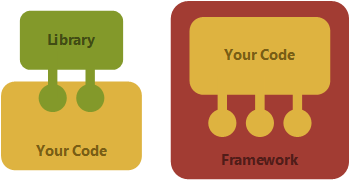
- Library Reuse: 開發者控制主流程依需求使用library提供的function
- Framework Reuse: 框架決定主流程,開發者依需求實作callback function

- 主流程控制權由開發者移轉到框架=>所以是主流程控制權倒置(IoC)
### Application Framework
- 定義:可重用的半製品,客製化後成為一個可用的系統
- High level (完成度高 彈性低 特定使用): ERP framework, Insurance framework
- Low level (完成度低,彈性高 可開發任意應用): Spring framework, Hibernate
- 好處:
- 共同領域抽象化機制
- 節省開發時間 (不用從底層實作)
- **應用程式整體有一致性** (每個人風格寫法不同,日後解讀維護困難)
- Template Method:
- 內含主流程的父類別=>framework
- 實作hook method子類別=>element,可抽換不同element
## Dependency Injection
將物件控制權從主程式反轉給Spring Container,由它負責物件的建立,銷毀並管理物件間的關聯性
### Dependency
- 狹隘的dependency
```mermaid
classDiagram
classK ..> classL : Dependency
```
- 廣義的dependency
```mermaid
classDiagram
classA --|> classB : Inheritance
classM ..|> classN : Realization
classG --> classH : Association
classE --o classF : Aggregation
classC --* classD : Composition
classK ..> classL : Dependency
```
- 依賴方式:
- parameter
- local variable
- global variable
參考:[快速搞懂 UML 類別圖 6 種關係線( Dependency、Association、Aggregation、Composition、Generalization、Realization )](https://dongstudio.medium.com/%E5%BF%AB%E9%80%9F%E6%90%9E%E6%87%82-uml-%E9%A1%9E%E5%88%A5%E5%9C%96-6-%E7%A8%AE%E9%97%9C%E4%BF%82%E7%B7%9A-dependency-association-aggregation-composition-generalization-realization-bf0670370c3d)
### Dependency 對程式碼可重用性的影響
- Dependency和程式碼可重用性是反比關係
- Liskov代換法則:降低Dependency的手法
- 將Client與實作類別中間用Interface隔開,去除Client與實作類別的依賴性
- **Interface保持簡單及穩定**
### Spring 如何降低依賴性
- 提倡以POJO為基礎程式設計
>POJO (Plain Old Java Object): 普通的Java物件,不受任何特殊條件限制
- Spring在執行時期會作為元件的中間人將元件間依賴關係注入
- Spring透過AOP將特定的技術邏輯(非功能面需求 ex: log, transaction)注入元件中,而不是透過傳統的繼承方式(EJB)
### 物件生成與相依關係建立
- 生成:使用new建立物件
- 建立關係:透過setter或是construct建立關係
```java=
Message msg = new MimeMessage(session);
msg.setFrom(new InternetAdress(from));
msg.setSubset(subset);
msg.setText("My Message");
msg.setHeader("X-Mailer", "abc");
msg.sendDate(new Date());
transport.send(msg);
```
- 可以透過Factory將物件生成過程抽象化並封裝,將生成的責任委派給Factory
```java=
Message msg = myMessageFactory.create(session);
transport.send(msg);
```
將這種模式推展到極致,可以設計一種泛用的Factory專門用來生成並組合物件,也就是**輕量級容器**
### 輕量級容器與IoC
在使用輕量級容器,實質上就是物件生成主控權從程式倒置給容器。所以有人會稱之為IoC Container。
- frame reuse IoC: 主流程主控權倒置
- IoC container:物件生成主控權倒置
[為了避免混淆主流程主控權與物件生成主控權倒置,建議使用DI(Dependency Injection)指稱IoC container](https://martinfowler.com/articles/injection.html)
### DI 類型
1. setter
2. constructor
3. interface
Spring只有支援 **setter** 和 **constructor injection**
因為interface injection有較強的侵入性,後續要移植到其他framework會付出更多成本修改。
參考:[interface-injection-example](https://stackoverflow.com/questions/10248000/spring-interface-injection-example)
## Spring 如何實現 DI
### Bean, Bean 容器 與Bean設定檔
1. Bean: Spring frameworkm元件(廣義一般class)
2. Bean設定檔:對Bean屬性或行為做設定(現在都用annotation)
3. Bean 容器:管理Bean生命週期及建立關聯
### Bean vs JavaBean
#### JavaBean:
- 規定:
1. 具有一個無參數建構子
2. 使用getter,setter存取private variable且命名須為Camel命名慣例
3. 若要支援遠端傳送或永續性(DB)必須為可序列化(Serializable)
```java=
//Serializable => marker interface:沒有定義任何虛實作方法
public class Product implements Serializable{
private int productId;
public void setProductId(int id){
productId = id;
}
public int getProductId(){
return productId;
}
}
```
- 缺點
- 無法一次設多個屬性
- 在JDK1.4前無法存取巢狀屬性
- **要取得Bean事件的類別必須實作java.beans.PropertyChangeSupport(產生Dependency)**
#### Bean
- 承襲JavaBean優點可以從外部改變屬性及行為 (ex: 從Bean設定檔set屬性)
- 沒有任何規範,任何POJO都可以設為Bean
### 開發Spring應用程式標準步驟
1. 規劃與設計Bean(使用OOAD物件導向分析設計)
2. 寫出Bean設定檔
3. 寫出使用Bean的Client端程式
### Bean容器
- 負責管理1~多個Bean
- init時會讀入Bean設定檔
- 維護Bean的註冊表格(Map),一筆Bean紀錄=>BeanDefinition
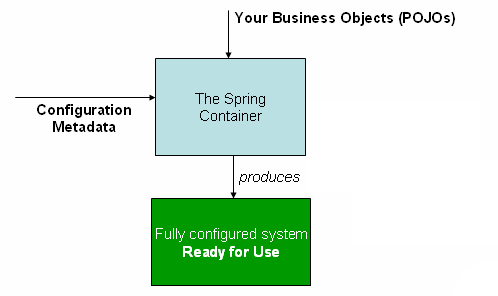
當Client需要時可用id,Class向容器取得Bean實例來使用
### Bean 設定檔
- 由3個部分組成:
1. XML宣告區段
2. 標頭宣告區段
3. Bean宣告區段
- xml結構與型別:
- DTD (比較舊,沒有data type)
- XML Schema (有data type) <- 盡可能採用
### Bean 設定檔放置路徑
```mermaid
flowchart LR
src---spring---unit2---Product.java
unit2---beans-config.xml
```
編譯後,beans-config.xml會被複製到預設Class Path: bin/spring/unit2/跟Product.class放在一起
:::info
通常團隊合作開發會拆功能套件,每一個功能套件會維護一個bean config file並放在同一個套件資料夾方便管理
:::
### 取得Bean元件
- BeanFactory(已被標注要淘汰)
```java=
Resource resource = new ClassPathResource("beans-config.xml");
BeanFactor bf = new XmlBeanFactory(resource);
Product product = (Product)bf.getBean("product");
```
- ApplicationContext (推薦使用)
```java=
ApplicationContext context= new ClassPathXmlApplicationContext("beans-config.xml");
Product product = (Product)context.getBean("product");
```
如果有多個bean config檔要載入
```java=
String[] configs = {"beans-config.xml","beans-config2.xml"};
ApplicationContext context= new ClassPathXmlApplicationContext(configs);
```
:::warning
:warning: 設定檔裡面Bean的id不可以重複,否則容器無法知道要生成哪一個。
- IDE可以檢查同一個設定檔內是否有重複id
- 但IDE無法檢查多個設定檔內是否有重複id,必須依靠專案會議大家先對齊
:::
### 黏合用程式碼(Glue Code)
- 開發者自行建構BeanFactory或ApplicationContext並取得Bean的程式稱為**黏合用程式碼(Glue Code)**
- Spring 應用程式只有在黏合用程式碼(Glue Code)所在的類別才會相依於Spring Framework
```java=
/* Product.java */
public class Product{
private String productId;
private String name;
...
}
/* Client.java */
public class Client{
public static void main(String[] args){
//glue code
ApplicationContext context= new ClassPathXmlApplicationContext("beans-config.xml");
Product product = (Product)context.getBean("product");
...
}
}
```
### ApplicationContext vs BeanFactory
一般情況下建議使用ApplicationContext作為Bean容器
- ApplicationContext包含BeanFactory功能
- 具有去除Glue Code功能
:::info
Web Application 用 ContextLoaderListener或ContextLoaderServlet在初始化載入ApplicationContext,開發者不用寫glue code
```xml
<context-param>
<param-name>contextConfigLocation</param-name>
<param-value>/WEB-INF/daoContext.xml /WEB-INF/applicationContext.xml</param-value>
</context-param>
<listener>
<listener-class>org.springframework.web.context.ContextLoaderListener</listener-class>
</listener>
<!-- or use the ContextLoaderServlet instead of the above listener
<servlet>
<servlet-name>context</servlet-name>
<servlet-class>org.springframework.web.context.ContextLoaderServlet</servlet-class>
<load-on-startup>1</load-on-startup>
</servlet>
-->
```
:::
### Bean實體化
```xml
<bean id="myProduct" class="myPackage.Product"/>
```
- id: Bean元件的唯一識別名稱,在同一個Bean Container不同Bean,**id不可重複**
- class: 指定元件類別,必須包含完整套件名稱的類別全稱(fully qualified name)
### 設定Bean屬性
透過 property標籤要求容器經由對應的setter方式設值
- 基本型別直接設值(int, double, boolean, String)
Product.java:
```java=
class Product {
private String productId;
public void setProductId(String productId){
this.productId = productId;
}
}
```
beans_config.xml:
```xml=
<bean id = "myProduct" class="Product">
<property name="productId" value="10001" />
</bean>
```
- 如果是設定參考型別物件必須透過依賴注入的技術達成
- setter
- constructor
### Setter Injection
```mermaid
classDiagram
ProductViewer --> Product : Association
```
ProductViewer.java
```java=
class ProductViewer{
private Product product;
public void setProduct(Product product){
this.product = product;
}
}
```
beans_config.xml:
```xml=
<bean id = "myProduct" class="Product">
<property name="productId" value="10001" />
</bean>
<bean id = "myProductViewer" class="ProductViewer">
<property name="product" ref="myProduct" />
</bean>
```
:::info
p-namespace:在標題加上xmlns:p="http://www.springframework.org/schema/p" 就可以使用p-namespace簡便語法。(可以在IDE透過設定方式加入,不要自己key)
```xml!
<bean id="coderTanu" class="com.gfg.scripter.Coder">
<property name="id" value=100/>
<property name="name" value="Tanu Jain"/>
<property name="qualification" value="B.Tech - CSE"/>
<property name="dob" value="27-07-1996"/>
</bean>
<bean id="coderTanu" class="com.gfg.scripter.Coder" p:id=100 p:name="Tanu Jain" p:qualification="B.Tech - CSE" p:dob="27-07-1996"/>
```
:::
### Constructor Injection
相較於association,aggreation的關係更緊密,需要在建構子就建立關聯。
```mermaid
classDiagram
ProductViewer --> Product : Aggreation
```
ProductViewer.java
```java=
class ProductViewer{
private Product product;
public ProductViewer(Product product){
this.product = product;
}
}
```
beans_config.xml:
```xml=
<bean id = "myProduct" class="Product">
<property name="productId" value="10001" />
</bean>
<bean id = "myProductViewer" class="ProductViewer">
<constructor-arg ref="myProduct" />
</bean>
```
:::info
- 多個參數
```xml
<bean id = "myProductViewer" class="ProductViewer">
<constructor-arg ref="product1" />
<constructor-arg ref="product2" />
</bean>
```
- 多個**有序**參數
```xml
<bean id = "myProductViewer" class="ProductViewer">
<constructor-arg index="1" ref="product1" />
<constructor-arg index="2" ref="product2" />
</bean>
```
:::
### Bean Scope
- Singleton
- 確保在整個容器中只有一個實體,適合放共用資料
```mermaid
flowchart LR;
singleton[singleton bean]
b1[bean1]
b2[bean2]
b3[bean3]
subgraph Bean容器
singleton
end
b1 & b2 & b3 -->|ref| singleton
```
- xml:
```xml
<bean id = "myProductViewer" scope="singleton" class="ProductViewer">
...
</bean>
```
- **預設scope**
- Prototype
- 每一個getBean() 要求都會送一個Bean元件的copy給Client端
```mermaid
flowchart LR;
b1[bean1]
b2[bean2]
b3[bean3]
subgraph Bean容器
bean
copy1
copy2
copy3
end
b1 -->|ref| copy1
b2 -->|ref| copy2
b3 -->|ref| copy3
```
- xml:
```xml
<bean id = "myProductViewer" scope="prototype" class="ProductViewer">
...
</bean>
```
由於prototype會建立新的instance如果是跟DB連線等資源相關,需要注意效能是否會被影響。
:::info
不同singelton定義:
1. GoF Singleton(C++):在整個作業系統只有一個實例
```mermaid
flowchart TB;
subgraph OS
singelton
end
```
2. Java Singleton:在整個JVM上只有一個實例
```mermaid
flowchart TB;
subgraph OS
subgraph JVM1
singleton1
end
subgraph JVM2
singleton2
end
end
```
5. Spring Singleton:在一個IoC容器只有一個實例
```mermaid
flowchart LR;
subgraph OS
subgraph JVM1
subgraph IoC container1
singleton1
end
subgraph IoC container2
singleton2
end
end
end
```
:::
:::info
除了預設的singleton和prototype之外,針對web service有其他的scope。
詳見:[Bean Scopes](https://docs.spring.io/spring-framework/reference/core/beans/factory-scopes.html)
[scope相關開發問題](https://medium.com/@HsuanChenLin/spring-annotation-scope-362b43705595)
:::
### 注入Array
```java
public class Order{
private Product[] lineItems;
public void setLineItems(Product[] products){
this.lineItems = products;
}
}
```
```xml
<bean id="order" class="Order">
<property name="lineItems">
<list>
<ref bean="product1"/>
<ref bean="product2"/>
</list>
</property>
</bean>
```
### 注入List
```java
public class Order{
private List<Product> lineItems;
public void setLineItems(List<Product> products){
this.lineItems = products;
}
}
```
```xml
<bean id="order" class="Order">
<property name="lineItems">
<list>
<ref bean="product1"/>
<ref bean="product2"/>
</list>
</property>
</bean>
```
### 注入Set
```java
public class Order{
private Set<Product> lineItems;
public void setLineItems(Set<Product> products){
this.lineItems = products;
}
}
```
```xml
<bean id = "product1" class="Product">
...
</bean>
<bean id = "product2" class="Product">
...
</bean>
<bean id="order" class="Order">
<property name="lineItems">
<set>
<ref bean="product1"/>
<ref bean="product2"/>
</set>
</property>
</bean>
```
:::info
Product需要實作hashcode跟equal才能在新增到set時判斷是否重複
參考:[equals() & hashCode() in Java](https://medium.com/joe-tsai/equals-hashcode-4480f4580be4)
:::
### 注入Properties
```xml
<props>
<prop key="id" value="john" />
</props>
```
### 注入Map
| key | value|
| -------- | -------- |
| name | "John" |
| product | product1 |
```xml
<bean id = "product1" class="Product">
...
</bean>
<bean id="order" class="Order">
<property name="lineItems">
<map>
<entry>
<key>
<value>name</value>
</key>
<value>John</value>
</entry>
<entry>
<key>
<value>product</value>
</key>
<ref bean="product1"/>
</entry>
</map>
</property>
</bean>
```
簡寫:
```xml
<bean id = "product1" class="Product">
...
</bean>
<bean id="order" class="Order">
<property name="lineItems">
<map>
<entry key="name" value="John" />
<entry key="product" value-ref="product1"/>
</map>
</property>
</bean>
```
### Factory Method
- 適用:無法透過xml設定bean(ex: 需要讀取DB或API)可以用程式解決。
```java=
public class Product{
public static Product getInstance(){
//特有的Product實體建構邏輯
}
}
```
```xml!
<bean id="product" class="Product" factory-method="getInstance"/>
```
### Factory Bean
使用工廠模式產生Object
```java=
public class ProductFactory{
public static Product getInstance(){
//特有的Product實體建構邏輯
}
}
```
```xml!
<bean id="productFactory" class="ProductFactory" />
<bean id="product" class="Product"
factory-bean="productFactory"
factory-method="getInstance"/>
```
---
## AOP
### 開發應用程式流程
```mermaid
flowchart LR;
U[Mental model]
R[Requirement model]
A[Architecture model & AOP]
D[Design model]
S[Solution model]
I[Implementation]
T[Testing]
Dev[Deployment]
M[Maintain]
U-->R
R-->|NFR|A
R-->|FR|D
A-->S
D-->S
S-->I-->T-->Dev-->M
```
FR: functional requirement
NFR: non functional requirement
從require model到solution model可以用OOAD方式設計系統
### 使用AOP動機
AOP要解決的是**商務邏輯跟非商務邏輯程式混雜的問題**
系統開發過程中往往要考量許多跟主要業務流程無關的橫切面考量(Cross-Cutting Concerns)
- 交易(transaction)
- 安全性
- 例外處理
- 記錄檔(log)
但若沒有仔細切分,容易讓程式碼中的商務流程跟系統考量交雜在一起,後續**維護困難**
### 將剖面(Aspect)單獨考量
基於重用的原則,將這些橫切面的處理邏輯抽出成一個Aspect單獨開發。
開發完再一次套用到有此需求的商務流程。

### Aspect-Oriented Programming (AOP)
- 分別專注在商務領域問題跟橫切面問題開發,個別完成後再進行縫合(Weaving)
- 透過AOP的思維,Aspect可以獨立於應用程式之外
- 必要時透過設定,可介入應用程式提供服務
- 不需要時,也可以將Aspect直接抽離,應用程式本身不需要修改程式碼。
- 因為命名關係,有些人會將AOP與OOP(Object-Oriented Programming)拿來比較。但它們並不互相抵觸是相輔相成的兩個設計模型。
### AOP 觀念術語
- Aspect
- 代表一個Cross-Cutting Concerns
- 由Pointcut與Advice二類的元件組成
- Advise
- Aspect的具體實作
- Join Points
- Advise在切入商務流程的點稱之為Joint Point
- 實作上來說就是Advice在應用程式裡**被執行的時機點**
- Spring只支援**類別方法**的Join Points
- Spring**不支援Field**的Join Points,因為Sping開發人員認為這樣會破壞物件的封裝性。
- Pointcut
- 用來定義一群Joint Points
- 當呼叫的方法符合Pointcut的表示式時,系統會自動將Advice與方法縫合
- Target
- 一個Advice被應用的對象或目標物件
- Weave
- Advice被應用到物件上的過程稱之為縫合(Weave)
- 在AOP中縫合的時間點:
1. 編譯時期
2. 類別載入時期
3. 執行時期(大部分應用屬於此類)
### Pointcut宣告語法範例
```
execution(
modifiers-pattern? //修飾子:(public, protected, default)
return-type-pattern? //回傳型別
declaring-type-pattern?//指定套件,類別
name-pattern(parameter-pattern)?//方法
throws-pattern?//例外
)
```
- execution(public * *(\.\.))
- 符合任何的公開方法
- execution(\* hello\*(\.\.))
- 符合任何名稱是hello開頭的方法
- execution(\* somepackage.service.MyService\.\*(\.\.))
- 符合MyService任何方法
- execution(\* somepackage.service\.\*\.\*(\.\.))
- 符合somapackage.service套件中任何方法
- execution(\* somepackage\.\.\*.\*(\.\.))
- 符合somepackage套件或子套件中任何方法
### Advice介入Joint Point時機
- Before advice
- Advice會在joint point執行之前被觸發
```java
public void before(JointPoint jointpoint){
...
}
```
- After returning advice
- 如果joint point所在方被成功執行並return,advice會緊接著執行
```java
public void afterReturning(JointPoint jointpoint){
...
}
```
- After advice
- 無論是否成功return,advice都會緊接著執行
```java
public void after(JointPoint jointpoint){
...
}
```
- After throwing
- 方法拋出例外時執行
```java
public void afterThrowing(JointPoint jointpoint){
...
}
```
- **Around**
- 從joint point觸發前到return後的過程完全掌握
- 適合用在交易,觀測
- 跟其他advice參數和回傳型別不同
```Java
public Object around(ProceedingJoinPoint proceedingJoinPoint) throws Throwable {
//方法執行前
Object result = proceedingJoinPoint.proceed();
//方法執行後
return result;
}
```
因為要掌握完整流程需要暫時取得物件控制權,執行後要把物件(Object)回傳IoC Container,讓容器繼續管理物件。所以如果回傳null,Spring會無法正常執行發出error
### 使用XML設定Spring AOP
- 寫作Advice類別
- 在bean設定檔加入AOP命名空間
- 在bean設定檔宣告AOP相關設定
### 寫作Advice類別
```java=
public class LogAdvice{
...
public void before(JointPoint jointPoint){
...(要插入的邏輯)
}
}
```
### 在bean設定檔加入AOP命名空間
可以使用IDE自動產生
```xml!
<?xml version="1.0" encoding="UTF-8"?>
<beans xmlns="http://www.springframework.org/schema/beans" xmlns:xsi="http://www.w3.org/2001/XMLSchema-instance" xmlns:aop="http://www.springframework.org/schema/aop"
xsi:schemaLocation="
http://www.springframework.org/schema/beans http://www.springframework.org/schema/beans/spring-beans-3.0.xsd http://www.springframework.org/schema/aop http://www.springframework.org/schema/aop/spring-aop-3.0.xsd">
</beans>
</xml>
```
### 在bean設定檔宣告AOP相關設定
```xml!
<bean id="logAdvice" class="mypackage.LogAdvice" />
<bean id="product" class="mypackage.Product" />
<aop:config>
<aop:aspect id="logging" ref="logAdvice">
<aop:before pointcut="execution(*mypackage.Product.*(..))" method="before"
</aop:aspect>
</aop:config>
```
在Product任何類別方法執行前插入LogAdvice.before的方法
### 改成Annotation
1. 在Bean設定檔中加入AOP命名空間
2. 在Bean設定檔中加入\<aop:aspectj-autoproxy>
3. 寫作Target類別並加入Annotations
### 在Bean設定檔中加入\<aop:aspectj-autoproxy>
修改前:
```xml!
<bean id="logAdvice" class="mypackage.LogAdvice" />
<bean id="product" class="mypackage.Product" />
<aop:config>
<aop:aspect id="logging" ref="logAdvice">
<aop:before pointcut="execution(*mypackage.Product.*(..))" method="before"
</aop:aspect>
</aop:config>
```
修改後,透過Annotion讓系統自行加入Advice:
```xml!
<bean id="logAdvice" class="mypackage.LogAdvice" />
<bean id="product" class="mypackage.Product" />
<aop:aspectj-autoproxy>
```
### 寫作Target類別並加入Annotations
```java=
@Aspect
public class LogAdvice{
...
@Before("excution(* mypackage.Product.*(..))")
public void before(JointPoint jointPoint){
...(要插入的邏輯)
}
}
```
:::info
小秘訣:
pointcut語法容易key錯,可以考慮將常用的pointcut語法放到一個類別去管理。
```java
//管理pointcut類別
@Aspect
public class SystemArchitecture {
/**
* A join point is in the web layer if the method is defined
* in a type in the com.xyz.someapp.web package or any sub-package
* under that.
*/
@Pointcut("within(com.xyz.someapp.web..*)")
public void inWebLayer() {}
}
//定義Targer類別
@Aspect
public class LogAdvice{
...
@Before(pointcut = "inWebLayer()")
public void before(JointPoint jointPoint){
...(要插入的邏輯)
}
}
```
:::
### Aspect vs Filter
Aspect跟Web Application的Filter相似
- Filter
web.xml用URL pattern指定哪些URL的request 會套上Filter
- Aspect
beans-config.xml指定哪些方法會觸發Advice
### AOP & Proxy Design Pattern
有注意到 \<aop:aspectj-autoproxy\>裡出現的aspectj和proxy嗎?
- Spring 從Spring 2.0開始支援IBM的AspectJ並受到啟發,在語法操作上盡量和AspectJ一致。
- 而proxy則是暗示AOP是實作Proxy Design Pattern
### 什麼是Proxy Design Pattern

一種結構設計模式,創造一個代理者(proxy)和其他物件互動。由於代理者會掌握被代理者流程,可以在被代理者流程執行前後插入其他流程,適合用來身份驗證或是埋入log等操作。
1. 靜態代理(較簡單):
被代理者切出一個共用介面,讓代理者(proxy)跟被代理者實作同一個介面,並讓代理者擁有被代理者控制權。
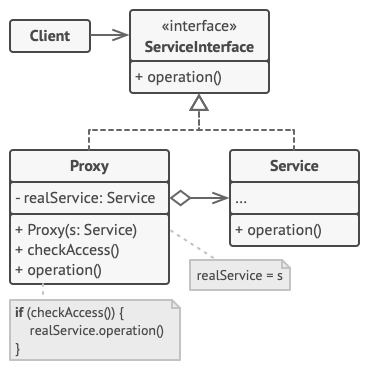
2. 動態代理:
代理者不限定只代理特定類別,通常由底層系統自動產生代理物件。
Spring AOP支援3種代理方式:
1. 執行時期產生代理物件
- Java Dynamic Proxy
- cglib(Code Generation Library)
2. 編譯或類別載入時期產生代理物件
- AspectJ
## 參考連結
[SPF doc 核心概念](https://docs.spring.io/spring-framework/reference/core.html)
[AOP參考](https://openhome.cc/Gossip/SpringGossip)
[關於AspectJ](https://openhome.cc/Gossip/Spring/AspectJ.html)
[從動態代理到Sping AOP](https://www.ithome.com.tw/voice/127388)
[Spring AOP - Java Dynamic Proxy and CGLib](https://www.tpisoftware.com/tpu/articleDetails/457)
 Sign in via Google
 Sign in via Facebook
 Sign in via X(Twitter)
 Sign in via GitHub
 Sign in via Dropbox
 Sign in with Wallet
Connect another wallet
Sign in with Wallet
Connect another wallet