# Post-Modernism
###### tags: `Higher Ironies Project`
[TOC]
## Post-Modernism Defined
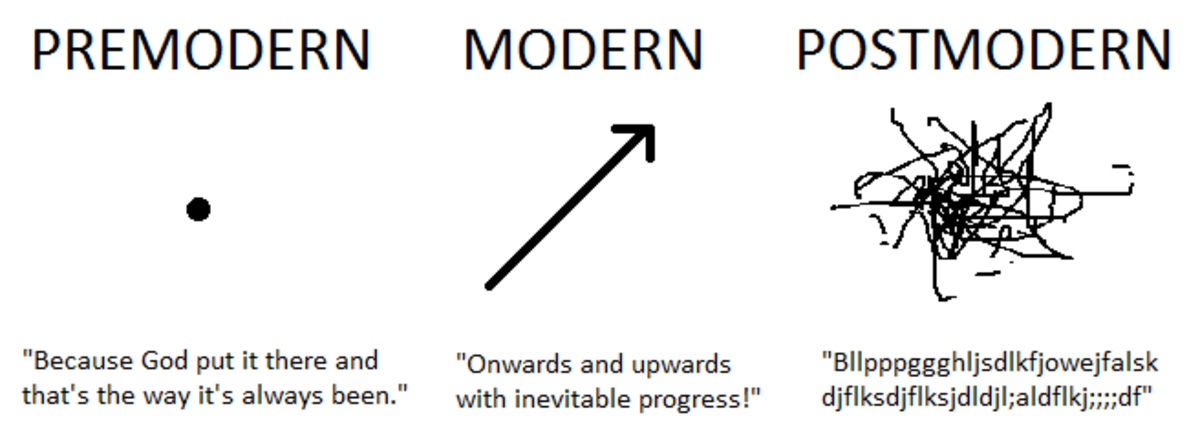
**Post-Modernism** is the dominant philosophical framework in the Western world today. While many have proposed different definitions for it, for our purposes we can consider it ***the rejection of any objective standards of truth or beauty.*** **Postmodernism** posits that, because we human beings are only able to percieve the world subjectively--that is, from our own perspective--we can never definitively prove that anything is *objectively*--that is, for all people at all times--true.
This stands in contrast to **Pre-Modernism**, which *did* believe in objective truth founded on faith in God, or at least in some transcendent eternal principles (natural law theory, for example). It also stands in contrast to **Modernism**, which believed in objective truth founded on verifiable scientific observations.
``` mermaid
graph TD
A(PRE-MODERNISM <br/> Objective truth based on God <br/> Concerned with obedience to God) -- The Enlightenment <br/> The Scientific Revolution <br/> The Industrial Revolution--> B(MODERNISM <br/> Objective truth based on science <br/> Concerned with societal progress) -- The World Wars <br/> Chemical Warfare <br/> The Atom Bomb --> C(POST-MODERNISM <br/> All truth is subjective <br/> Concerned with deconstruction )
```
The story of how these philosophical frameworks rose and fell is a long and complex one, but I will attempt to provide a brief history below.
## The Development of Post-Modernism Through History
**Pre-Modernism** was the dominant philosophical framework for most of human history--or at least since the dedicated studies of theology and philosophy began among the Hebrews and Greeks, respectively. People whose worldviews had been shaped by these traditions (which, by the 5th century A.D., included almost everyone in the Western world thanks to the spread of Christianity, a religion rooted in Judaism that incorporated elements of Greek philosophy) believed in objective truth, and their faith in this truth was a component of their faith in God. Later **Pre-Modern** thinkers, such as the deists of the early Enlightenment, would sometimes attempt to remove God from the picture or reduce his role, but they still held faith in transcendent, objective principles.
The Enlightenment did, on the whole, reduce the emphasis on God and on faith as sources of objective truth. Instead, many of the later Enlightenment thinkers believed that "rationality" would serve as a guide to discovering objective truth. This trend towards seeing faith in God as unnecessary to the pursuit of truth would accelerate with the advent of the Scientific Revolution in the 16th century; instead, science would be the means by which humanity could truly discover truth and cleanse itself of its old superstitions. **Modernism** was a philosophical outlook that believed that, through the mechanism of science and the application of the scientific method to all human endeavors, humanity would ultimately better itself and enter an age of utopia.
But everything changed when the [Little Boy](https://en.wikipedia.org/wiki/Little_Boy) and the [Fat Man](https://en.wikipedia.org/wiki/Fat_Man) attacked.
<p align="center"> <img width="450" height="550" src="https://upload.wikimedia.org/wikipedia/commons/thumb/e/e0/Nagasakibomb.jpg/220px-Nagasakibomb.jpg"> </p>
During the World Wars, we humans used all of the science in which the **Modernists** had put their faith to kill each other in new and horrific ways. The atomic bomb was the most obvious and vivid example of this, but [not the only one](https://www.youtube.com/watch?v=DxkeOkaVRLo). Machine guns, chemical weapons, the gas chambers and furnaces of the Holocaust--suddenly, science seemed very much like a false god.
As a result, **Modernism** gave way to **Post-Modernism.** Whereas **Pre-Modernism** had faith in God and **Modernism** had faith in science and "progress," **Post-Modernism** had faith in nothing. It denied the existence of objective truth, instead arguing that the only real truth is subjective to each individual and each individual's emotions.
## Post-Modernism and Deconstruction
But **Post-Modernism**'s lack of faith did not mean that it had no mission. For it did: to **deconstruct** the false truths that had come before it. After all, if we can't ever prove something to be objective from our subjective perspectives of the world, then anyone who *claims* that something is objectively true must be either:
* Under a delusion that he can prove what is by definition unprovable, or...
* Actively attempting to decieve others into believing in an unprovable "objective" truth for his own benefit.
In the first case, the **Post-Modernist** seeks to disabuse the deluded person of his delusion. In the second, the **Post-Modernist** seeks to prevent the deciever from bringing any others under his spell.
It is for these reasons that **Post-Modernism** regularly makes such use of **Deconstruction.** As a reminder, **Deconstruction** can be defined as follows:
* **Deconstruction:** Breaking down some point of view, work of art, or experience into its component parts and then analyzing those parts in isolation as a means of exposing falsehood.
**Post-Modernism**, as a reaction to what it regards as superstition in **Pre-Modernism** and as false hope in **Modernism**, makes its goal to **deconstruct** the beliefs of those earlier frameworks. It is not concerned with positing any **sincere** beliefs of its own, but rather with tearing down those of the philosophical frameworks that preceded it.
## Post-Modernism and Irony
You can probably see where I am going with this. As **Post-Modernism** gradually became the dominant philosophical framework in the West, **traditional irony** began to be used more and more to mock and **deconstruct** traditionally held **sincere** beliefs. The advent of the internet, a uniquely impersonal medium of communication, only accelerated this trend.
As previously discussed, this has led to **traditional irony** becoming in many ways the default form of communication on the internet today. However, this has led to some problems--both practically, for those who wish to employ **irony** as a literary device, and philosophically, for those who hold to **Post-Modern** philosophy. I will discuss these problems presently.
Next Chapter: **[Irony Evolves](/7PLp1rfdQCSzrEbZN1KSkQ)**
 Sign in with Wallet
Connect another wallet
Sign in with Wallet
Connect another wallet