---
tags: Communication System Design, ss, ncu
author: N0-Ball
title: Link Equation and Link Budget
GA: UA-208228992-1
---
[ToC]
# Link Equation
:::info
Used to calculate received power in a radio link
:::

Parameters list:
- P~t~ (Transmitted power)
- G (Antenna gains)
- R (Distance between Tx and Rx)
- $f = \frac{c}{\lambda}$ (Radio frequency)
$$
P_r = \frac{\text{EIRP} \times \text{Receiver Antenna Gain}}{\text{Path Loss}}
$$
evaluated in decibels:
$$
P_r = P_t + G_t + G_r - L_p \text{ (dBW)}
$$
Where
P~r~
: Received power in watts
P~t~
: Transmitted power in watts
G~t~
: Transmitting antenna gain (ratio)
G~r~
: Receiving antenna gain (ratio)
L~p~
: Path loss
:::warning
Additional losses must be included in the Link Equation
:::

$$
P_r = P_t + G_t + G_r - L_p - L_a - L_{ta} - L_{ra} \text{ (dBW)}
$$
L~p~
: path loss
L~a~
: loss in atmosphere
L~ta~
: loss in transmitting antenna
L~ra~
: loss in receiving antenna
## Example

: A reciever at **R** and transmitter at source -> the energy consumes
- Isotropic source
- Ideally source that spreads equally
- **R** -> creates area of $4\pi r^2$ sphere **A**
- **ERIP** : source (with unit watt)
- **F** : Flux ($W/m^2$)
:::warning
Temperary not related to frequency
:::
# Receiver
- ***directive*** antentas in satellite systems
- Antenna has a ***narrow*** beam, gain **G** (ratio)
- Gain describes the ability of an antenna to increase power
- **EIRP** (Effective Isotropically Radiated Power) is combination of gain and transmitted power
$$
\text{EIRP} = P_tG_t\ \text{watts}
$$
## Antenna gain
:::info
The increase in received power at a given point with the test antenna relative to the power received from an isotropic antenna, often in dBi (i for isotropic). Ratic of their effective apertures
:::

$$
G = \frac{A_e}{A_{e, i}}
$$
Where $A_e$ is the effective aperture
### Isotropic Antenna
:::info
An antenna that radiates equally in all directions.
:::
Effective aperture of an ideal isotropic antenna is:
$$
A_{e, i} = \frac{\lambda ^2}{4 \pi}
$$
-> Power transferred most efficiently
-> Gain of Isotropic Antenna
$$
G = \frac{4 \pi A_e}{\lambda ^2}
$$
## Received Power

1. for the source **EIRP** = $P_tG_t$ Watt
$$
F = \frac{P_tG_t}{A_s} = \frac{P_tG_t}{4 \pi R^2} \ (W/m^2)
$$
2. Power received, P~r~ by an antenna with an aperture of A m^2^ is
$$
P_r = F \cdot A_e = F \cdot \eta_eA
$$
where $\eta_e$ is related to antenna (effective area)
: often < 1
## Pass Power
$$
\begin{aligned}
P_r &= \frac{P_tG_t}{4 \pi R^2} \cdot \frac{\lambda ^2 G_r}{4 \pi} \\[1em]
&= \frac{\lambda ^2P_tG_tG_r}{(4 \pi R)^2} \ (\text{watt})
\end{aligned}
$$
- Basic Link Equation
- Path Loss
- $L_p = (\frac{4 \pi R}{\lambda})^2$
- How power spreads out with distance
- unavoidable, undeniable, unchangable
## Circular aperture with Diameter D
$$
\begin{aligned}
A &= \frac{\pi D^2}{4} & \because G = \eta_A A \\[1em]
G &= \eta_A (\frac{\pi D}{\lambda})^2 \varpropto (\frac{D}{\lambda})^2
\end{aligned}
$$
## Omni-directional Antennas

- Gain: G < 3dB
- Types:
- dipole
- monopole
- patch
- Patch is printed circuit element, ~ $\frac{\lambda}{2}$

* Left is Dipole and right is Monopole
## Low Gain Antennas
- Gain: 3dB < G < 25dB
- Used as reflector antennas and sometimes elements in phased arrays
- Types
- horn
- Yagi-Uda
- helical
## High Gain Antennas
- Gain: 30dB < G < 100dB
- Reflectors, phased arrays, lenses (rare)
- Aperture antennas
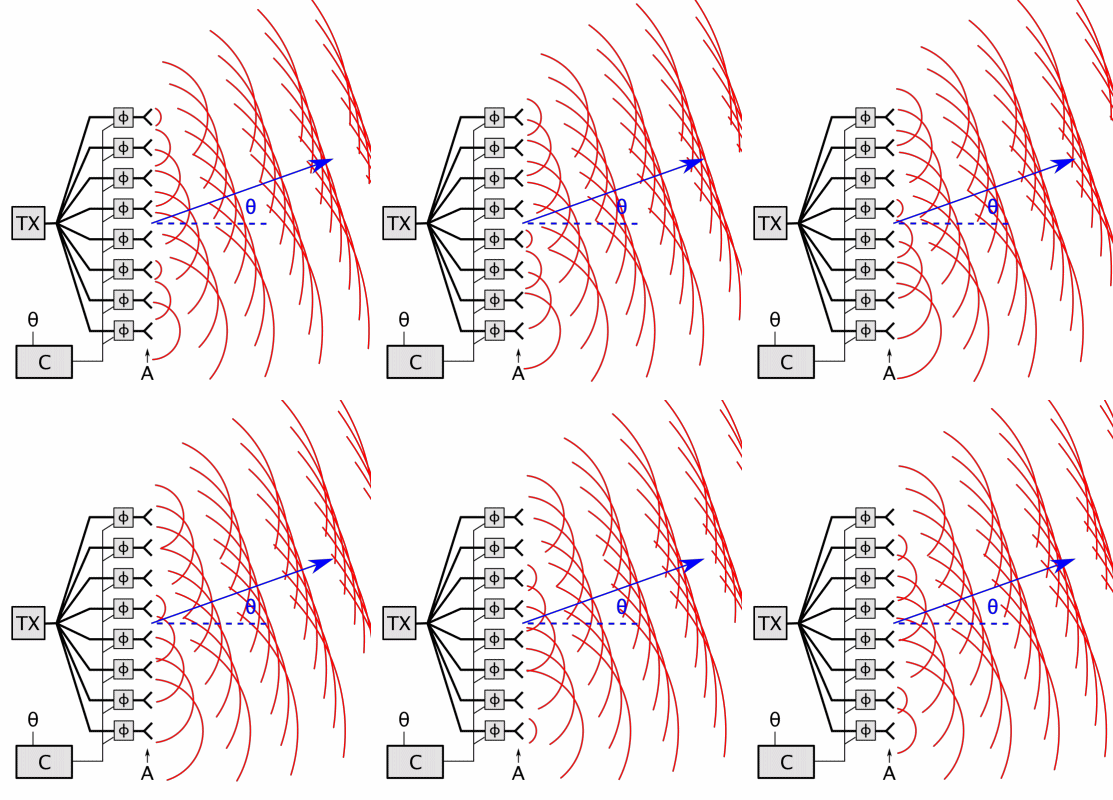
- Create uniform phase distribution over aperture -> how we get G
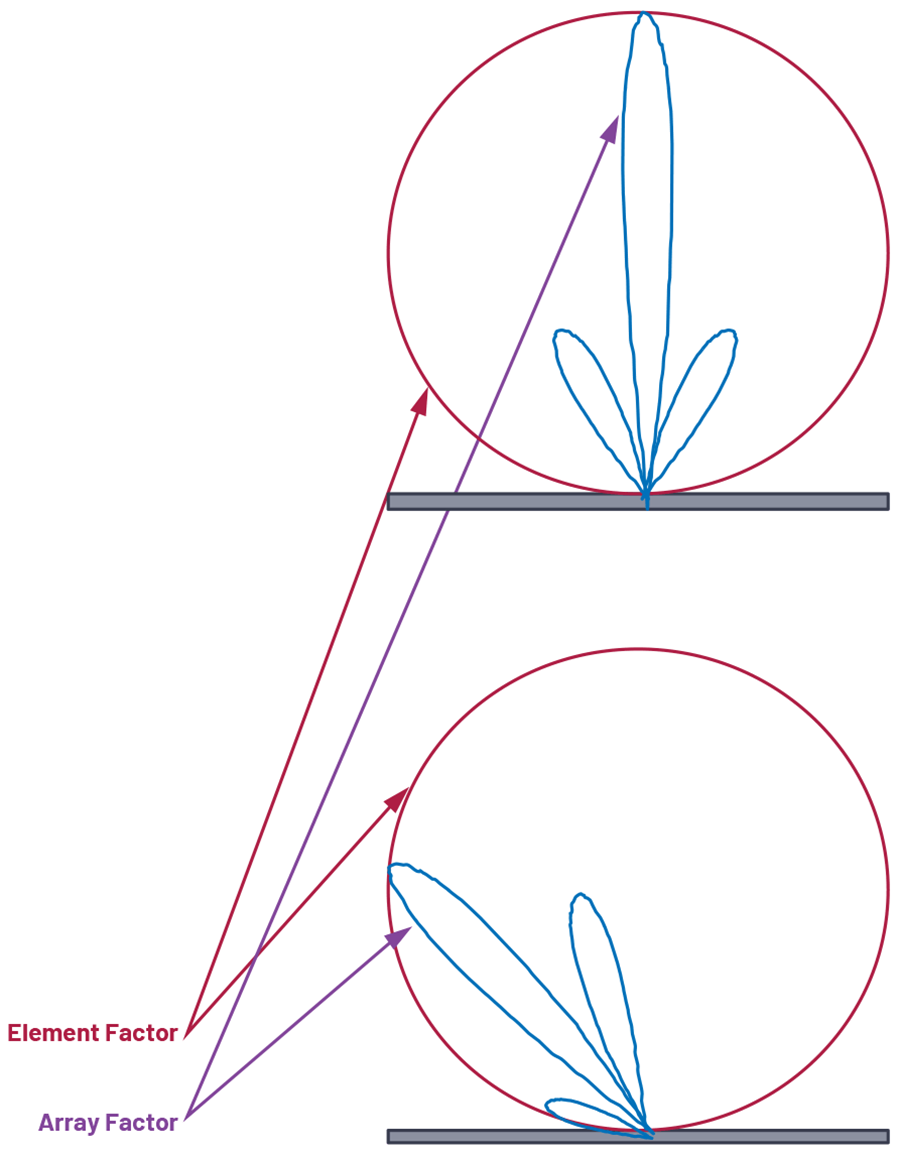
- Far-field pattern has main lobe and side lobes
## Antenna Pattern
Pattern
: directional dependence of the strength of the radio waves form the source
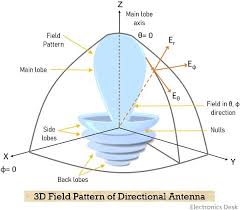
* Can be three-directional or two-directional
Beamwidth
: measured between -3 dB (half of power) points of antenna pattern
$$
\theta = \frac{51 ^ \circ \lambda}{D} \sim \frac{ 75 ^ \circ \lambda}{D} \varpropto \frac{\lambda}{D}
$$
# Gain and Directivity
Directivity
: Maximum power density $P(\theta, \phi)_{max}$ to its average value over a sphere as observed in the far field of an antenna
$$
D = \frac{4 \pi}{\Omega_A}
$$
* A_e is 60% ~ 65%
:::info
Apporoximate formula for G(empirical)
:::
$$
G = \frac{33000}{\theta_a \theta_b}
$$
where $\theta_a$ and $\theta_b$ are antenna beamwidths in degrees in two orthogonal panes
# Propagation
- free space follows path loss law
- is proportional to **square of distance** from transmitter
- Additional losses occur if link is not on line of sight (LOS)
- Mobile radio (cellphones) and indoor wireless systems (Wi-Fim WLans) suffer *multipath* and blockage
$\Rightarrow$ Leads to comples propagation models
:::warning
- Most links at microwave frequencies (> 1GHz rely on LOS propagation)
- Cellular phone designers use R^4^ law (path loss $\varpropto$ R^4^) with statistical variation to account for multipath
- Atmospheric losses occur at microwave frequencies
- Rain is most important factor above 10 GHz
:::
## In Earth's Atmosphere
- Designed to withstand a specific attenuation
- Maximum permitted attenuation is called **link margin**
- attenuation excceds link margin -> suffers an outage(inaccessible)
- Percentage time for which signal is above minimal link margin is called **link availability**
# Link budgets
- usually tabulated in dB
- tabulated in a similar way as a financial budget
- parameters left
- value right
- Bottom line
- P~r~ for received power budget
- P~n~ for noise power budget
:::danger
Keep **received power** and **noise power** budgets separate
:::
- Then calculate C/N = P~t~/P~n~ in dB
## Example
:::info
Geo Satellite:
- Altitude = 40,000km
- Downlink at wavelength $\lambda = 0.075 (m), 4GHz$
Satellite:
- P~t~ = 20W or 13 dBW
- G~t~ = 20dB
Earth Station:
- G~r~ = 40dB
Path:
- Atmospheric loss in clear air = 0.3dB
- Miscellaneous losses = 0.5dB
:::
$$
\begin{aligned}
L_p = (\frac{4 \pi R}{\lambda})^2 = (\frac{4 \pi \cdot 4 \times 10 ^ 7}{7.5 \times 10 ^ {-2}})^2 \sim 4.5 \times 10 ^ {19} (W) = 10 \times log_{10}(4.5 \times 10 ^{19}) dBW \sim 196.5 dBW
\end{aligned}
$$
| Parameter | Value |
| --------- | ------- |
| P~t~ | 13dB |
| G~t~ | 20dB |
| G~r~ | 40dB |
| L~p~ | -196.5dB |
| L~a~ | -0.3dB |
| L~m~ | -0.5dB |
| Sum | -124.3dB |
# Summary
## No Loss
$$
P_r = P_t + G_t + G_r - L_p \text{ (dBW)}
$$
## With Loss
$$
P_r = P_t + G_t + G_r - L_p - L_a - L_{ta} - L_{ra} \text{ (dBW)}
$$
## EIRP
:::warning
with no lost
:::
### Watts
$$
EIRP = P_t \times G_t \\[1em]
P_r = \frac{EIRP \times G_r}{L_p}
$$
### dBW
$$
EIRP = P_t + G_t \\[1em]
P_r = EIRP + G_r - L_p
$$
## Antennas

# Extra
## Effective Aperture (TBD)

 Sign in via Google
 Sign in via Facebook
 Sign in via X(Twitter)
 Sign in via GitHub
 Sign in via Dropbox
 Sign in with Wallet
Connect another wallet
Sign in with Wallet
Connect another wallet