機器學習 入門(X 認識(O 01
===
---
前言
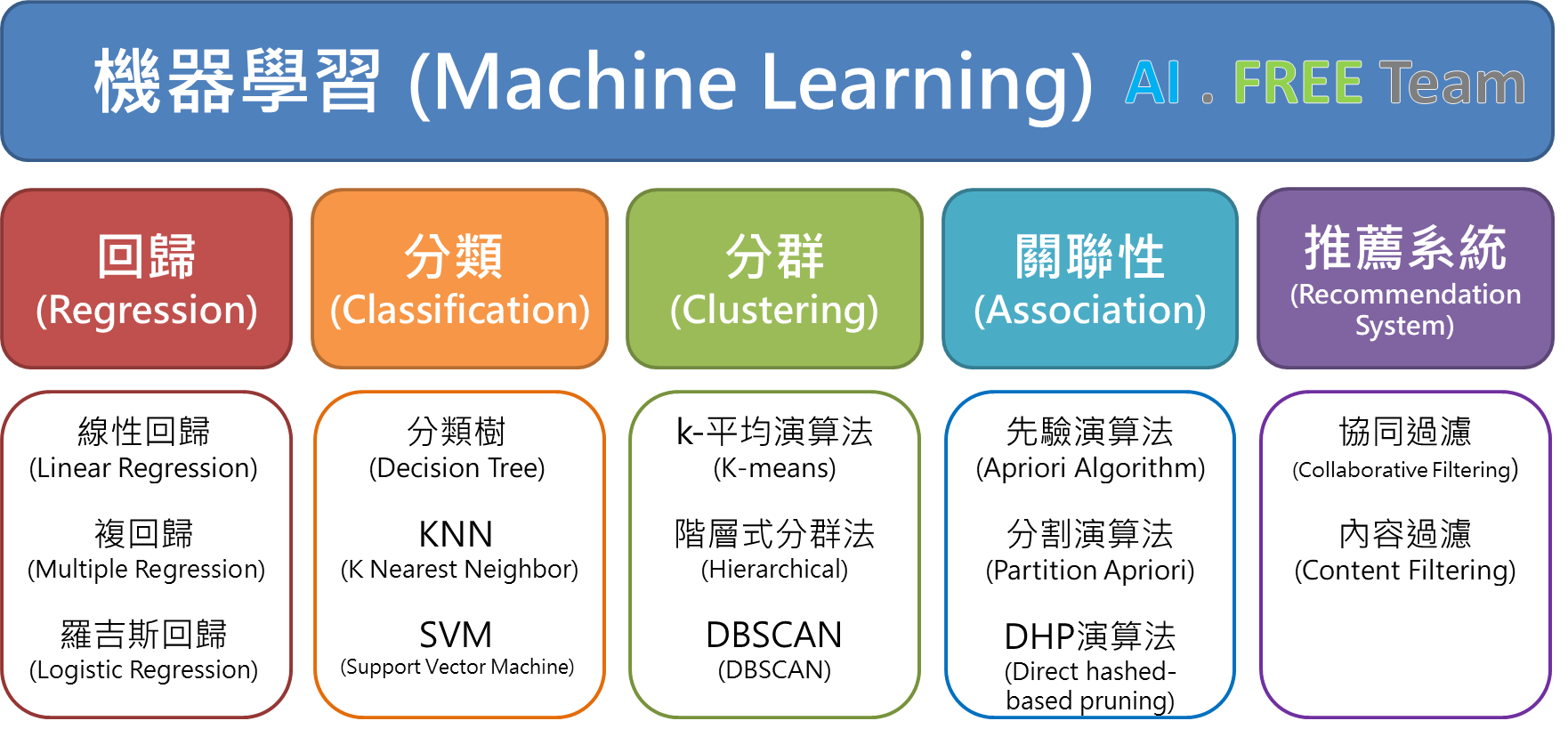
machine learning 的歷史從20世紀初就開始了,並且在多項領域中........
~~好,剩下自己google!~~
___

---

___
___
# 名詞解釋
supervised learning
training data
testing data
feature
lable
regression
classification
reinforcement learning
---
# 機器要學甚麼(正則化演算法)
簡而言之
從model中找出特定的function
而我們的工作就是替機器設定model和找function的方法
那model和function又是甚麼呢?
---
### function
自我們從國中開始
$f(x)$
就是我們"人生"中不可或缺的東西了
$f(x)$ 就是function
輸入>functio>輸出
---
### model
the set of function
一堆funtio組在一起
例如
$y=ax+b ,a,b∈R$
就是一種model
你們可能會在別的地方看到的:
線性function:$y=Ax$
註:$y$和$x$都是向量
---
# 如何達成
我們要根據我們的認知來設定model
並且定義好"好"function的定義
接下來,我會以"以身高估算體重(成年人)"的例子為例來解釋
---
## set model
先思考一下
$假設0:$也許每個人都有一些基本的體重
$假設1:$也許身高的一次方對體重存在某種關係
$假設2:$也許身高的二次方對體重也存在某種關係
若以x來表示身高,f(x)為體重的話
$f(x)=w_2(x^2) + w_1(x) + w_0$ ,w∈$R$
會是我們的model
$w_2$,$w_1$,$w_0$ 就是各自的權重
----
### leanier
線性的定義
$Ax=b$
$A(x_1+x_2)=Ax_1+Ax_2$
以上面為例
$A$就是[$w_2$,$w_1$,$w_0$]
$x$就是[$x^2$,$x$,$1$]$^T$
---
## fit function
首先,如何知道我們要找的是甚麼function?
好的function產生的結果應該要跟label誤差不大
我們在這邊會決定一個loss function來估算某個function產稱的誤差
loss $l(y,f(x))$
---
### training/testing data
用以訓練model的資料
用以測試model的資料
---
### loss function
在這邊$y'$為實際的體重數值、y為預測的值、$l(y',y)$為loss function
我們這邊以差的平方為loss function
$l(y',y)=(y'-y)^2$
loss function越大 則代表誤差(lost)越大
----
對所有training data 計算loss 則可計算出averge loss(total loss)
而我們的目標則是想辦法讓loss降低(find the mininum of loss)。如果是簡單的funtion我們可以直接用數學的方法直接找到mimum。這邊的例子應該也可以,不過我們這邊用另外一個方法叫gradient descent
一樣目標是要找到total loss的最小值
---
### gradient descent
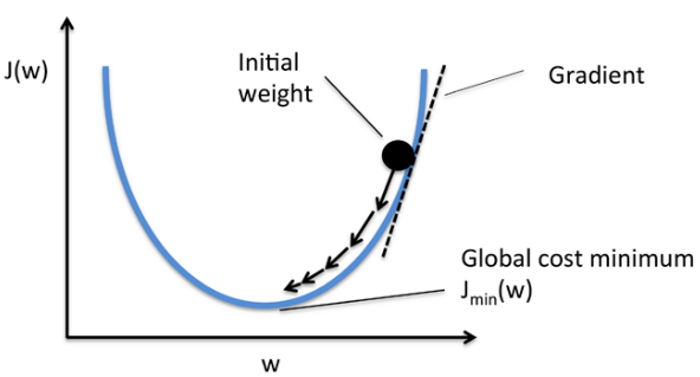
對每一筆training data計算loss,然後算averge loss
$al(w)=\dfrac{1}{n}\sum_{i}^{n}(y'^i-y^i)^2$
帶入$y^i=f(x^i)=w_2x^2 + w_1x + w_0$
$al(w)=\dfrac{1}{n}\sum_{i}^{n}(y'^i-f(x^i))^2$
我們修改$w$使其下降
---
我們要做的就是更新$w$ 已縮小a
1
$w_2'=w_2-η\dfrac{∂al(w)}{∂w_2}=w_2-η\dfrac{∂al(w)}{∂f(x)}\dfrac{∂f(x)}{∂w_2}$
2
$w_2'=w_2-η(\dfrac{1}{n}\sum_{i}^{n}2(y'^i-f(x^i))\cdot -1\cdot\dfrac{∂f(x^i)}{∂w_2})$
3
$w_2'=w_2-η(\dfrac{1}{n}\sum_{i}^{n}2(y'^i-f(x^i))\cdot -1\cdot (x^i)^2)$
---
### learning rate
$η$?????
別擔心,只是一個係數
雖然在設定這個係數大有學問
不過我們這邊就先固定用一個小小的值就好
---
# 實戰
## 目標
由身高預測體重
training dataset : 300筆 (身高、體重)
[男性](https://drive.google.com/file/d/1ccow5l_IgJicsvoC6v30lvBi5thbkCfl/view?usp=sharing)
[女性](https://drive.google.com/file/d/1fJJ4FtmyPy8-AklRZCLwULjlCcEGqbs_/view?usp=sharing)
---
## 流程
step1 載入資料:
>複製程式碼
```python=
# =====載入資料=====
import numpy as np
import pandas
from google.colab import files
uploaded = files.upload()
df=pandas.read_csv('data.csv')#data.csv為檔名
high=df[['hi']].to_numpy()
weight=df[['weight']].to_numpy()
train_x=high[:250]
train_y=weight[:250]
test_x=high[250:]
test_y=weight[250:]
print('OK!')
```
step2 定義我們的model
>使用function來完成
```python=
def f(x):
global w0,w1,w2
return (x**2)*w2+x*w1+w0
```
step3 定義loss function
>使用function來完成
```python=
def lose(x,y):
sum=0
n=len(x)
for i in range(n):
sum+=(y[i]-f(x[i]))**2
return sum/n
```
step4 計算 loss function對 weight 的微分
>使用function來完成
```python=
def lose_dw0(x,y):
sum=0
n=len(x)
for i in range(n):
sum+=-2*(y[i]-f(x[i]))
return sum/n
def lose_dw1(x,y):
sum=0
n=len(x)
for i in range(n):
sum+=-2*(y[i]-f(x[i]))*x[i]
return sum/n
def lose_dw2(x,y):
sum=0
n=len(x)
for i in range(n):
sum+=-2*(y[i]-f(x[i]))*(x[i]**2)
return sum/n
```
step5 初始化 weight ,learning rate,epoch
> 隨意設定
```python=
w0=5
w1=5
w2=0
learning_rate=0.01
ep=2000
```
step6 更新 weight
>使用for 迴圈重複執行
```python=
for i in range(ep):
new_w0=w0-lose_dw0(train_x,train_y)*learning_rate
new_w1=w1-lose_dw1(train_x,train_y)*learning_rate
new_w2=w2-lose_dw2(train_x,train_y)*learning_rate
w0=new_w0
w1=new_w1
w2=new_w2
```
step7 測試結果
>使用test data
```python=
print(lose(train_x,train_y))
print(lose(test_x,test_y))
```
step8 have fun!!
```python=
import matplotlib.pyplot as plt
fig, ax = plt.subplots(figsize=(8, 4))
ax.scatter(train_x, train_y)
ax.plot(train_x, w2*train_x*train_x+w1*train_x+w0)
fig.suptitle('Scatter with regression')
plt.show()
```
# 問題思考
### weight 的初值是否對最終的結果產生影響?
### learning rate 真的只能是固定的?
### 找一次lost是否需要把全部的資料用上?
```python=
print(f('要預測體重的身高'))
# 預測的體重
```
# 正解
```python=
def lose(x,y):
sum=0
n=len(x)
for i in range(n):
sum+=(y[i]-f(x[i]))**2
return sum/n
def llose(x,y):
sum=0
n=len(x)
for i in range(n):
sum+=(y[i]-ff(x[i]))**2
return sum/n
def f(x):
global w0,w1,w2
return w2*x*x+w1*x+w0
def ff(x):
return 22.6*x*x
def lose_dw0(x,y):
sum=-2*(y-f(x))
return sum
def lose_dw1(x,y):
sum=-2*(y-f(x))*x
return sum
def lose_dw2(x,y):
sum=-2*(y-f(x))*x*x
return sum
def sr_mean(x):
n=len(x)
m=0
for item in x:
m+=item**2
# print((m/n)**0.5)
return (m/n)**0.5
w0=1
w1=2
w2=3
learning_rate_0=0.001
learning_rate_1=0.001
learning_rate_2=0.001
leariniglist=[[],[],[]]
ep=200
print(lose(train_x,train_y))
for i in range(ep):
n=len(train_x)
for j in range(n):
w0=w0-lose_dw0(train_x[j],train_y[j])*learning_rate_0
w1=w1-lose_dw1(train_x[j],train_y[j])*learning_rate_1
w2=w2-lose_dw2(train_x[j],train_y[j])*learning_rate_2
# w0=new_w0
# w1=new_w1
# w2=new_w2
print(w0,w1,w2)
print(lose(train_x,train_y))
print(llose(train_x,train_y))
print(lose(test_x,test_y))
print(llose(test_x,test_y))
print(f(test_x[6]),test_y[6])
```
{"metaMigratedAt":"2023-06-15T11:34:05.156Z","metaMigratedFrom":"YAML","title":"機器學習 入門(X 認識(O 01","breaks":true,"contributors":"[{\"id\":\"6d6e3ba2-6820-4c6f-9117-f09bccc7f7aa\",\"add\":18,\"del\":0},{\"id\":\"4c23290c-4304-45d6-9c21-163639f3ac69\",\"add\":7929,\"del\":2287}]"}