---
tags: BuddySystem
title: 'No.1 Buddies'
---
<style>
h1 {color:rgb(0,195,130); font-family: Impact, Charcoal, sans-serif;}
p {color:;}
body {
background-image: url(https://64.media.tumblr.com/5d20cb9d224eb97fab488a8ca5b38d33/tumblr_nsocqzECoE1sjmeczo1_540.gif);
background-repeat: no-repeat;
background-position: right bottom;
background-size: ;
}
</style>
# Welcome to No.1 Buddies

**Who now?** Anne, Rikke, Margrete & Mark.
[[List of all groups](https://hackmd.io/Apx4l5mWRn2Zd5KpmocDIg)] [[Google Drive Folder](https://drive.google.com/drive/folders/1mq-6wYoE1mTBiC77f2RqdmP_L9ZQfMmp?usp=sharing)] [[Digital Culture Curriculum](https://hackmd.io/@siusoon/dc2020)]
:arrow_left: Please use the content list to the left for faster navigation of our page. Or just scroll down and enjoy.
## :star2:Link to Synopsis Drafts :star2:
### [Anne](https://hackmd.io/@w92XkApGRuey204ecdMjdA/HyfC5dicw)
### [Rikke](https://hackmd.io/bHf4wRunQPCqvFF41uulhg?view)
### [Mark](https://hackmd.io/PrmYL74DTB68RCkNhTtonQ?view)
### [Margrete](https://hackmd.io/5AEmw57BRcy5_n_JD0bg4w)
___
## [MX001](https://hackmd.io/QD0td-VfRKGDgDy2ldRwIw)
## [MX002](https://hackmd.io/t9W5tax7TnKXstaI1Fzqlw)
## [MX003](https://hackmd.io/gVhOJyFeQleT1FMdXHxdfA)
## [MX004](https://hackmd.io/ew48OE_aRvuNIEwF22e3yw)
## [MX005](https://hackmd.io/6qibyZawSs-05Jdn2xG6sw?both#MX005---Cookies- )
---
## :fire:Block Assignment 1 - The Immaterial Data
Through the past week’s 1-bit computing workshops, we’ve built different logic gates which are the fundamentals of computation. These logic gates consist of wires and transistors that transfer electricity through the circuit in a particular way. This triggers one of two states, these being on or off, or, 1 or 0 in binary. By building these logic gates in certain ways, we obtain different logics for the computation—AND, OR, NOR, NOT and so on. By combining these logics, it’s possible to make more complex computers. The picture below shows a SR NOR Latch, which is a combination of two NOR gates feeding information to each other. In this way, the logic gate is able to remember the state it was previously in. This is an example of basic computational memory, which works as long as the circuit has electricity.

Technical drawing of the SR NOR Latch:

Through building logic gates and our prototype of a SR NOR Latch, we have expanded our understanding of the physicality and functionality of data and computers in general. The workshop also let us reflect on data materiality by building clumsy and huge computational components, which actually could have been a part of a computer back in the early age of ENIAC.
### (Im)Materiality
The logic gates are the building blocks of computer chips and the computational power, which in modern smartphones and laptops are hidden away behind smooth surfaces, not to be opened by lay people—and even if people open up a computer, the small size of the parts makes it impossible to observe what goes on or how the parts are composed.
In the case of our constructed logic gate, its materiality came from the explanation of its functionality, meaning we were made to understand its purpose by making it ourselves. Much of digital culture as we know it today is intangible to the average person and thus hard to grasp. One of the reasons for this is that it evolves at too quickly a rate for its effects to be properly observed, as its nature is ever changing to the point where it becomes difficult to grasp its purpose and properties. The immaterial has an effect on how we see and use technology. Within digital data, part of the power of the intangible comes from the fact that its evolution, and sometimes purpose, is invisible to the user. The less the user is aware of it, the more it can act as an influence for the user’s actions, inserting a sort of “normative” behavior without inviting critical thought. As stated by anthropologist Daniel Miller, “[Immaterial objects] determine what takes place to the extent that [the users] are unconscious of their capacity to do so” (Miller 2005, 5).
Part of this immateriality is supported by the constant technological advancements. One way to theorize this rapid development is through Moore’s Law, which states that the number of transistors in microchips doubles every two years, mainly due to transistors becoming smaller and smaller (Moore 1965, 2). This material ‘shrinkage’ over time gives us faster and more powerful processors. But the materiality has its limits: many predict that in 5 years it won’t be physically possible to make transistors smaller, and therefore the increase in computational power would need to rely on new methods. This poses important questions about our digital culture: why do we need faster computation? What is the driving force behind this eager, rapid development? And what do we wish to achieve by it? What consequences does it have for the experience of our lives, and how does its production impact our environment?
This project allowed us to look at a minute area of data materiality and it came to represent not only its own construction but its atom-sized role in the digital culture as a whole. As stated by Hayles: “Materiality thus marks a junction between physical reality and human intention” (Hayles 2014, 3). Though the concept of logic gates can represent the greater role they play in a digital culture, this culture is so vast that their part appears minute or even insignificant to the common person, and then its importance may in turn be forgotten. With this design-oriented practice, we were able to reflect critically on the materiality of data and how it affects our lives and the world around us. We thus use the critical making approach in the sense that we emphasize our engagement with the material. Not just by building the technology but also by linking this practice with social matters. In Ratto’s terms: ”turning the relationship between technology and society from a "matter of fact" into a "matter of concern"”(Ratto 2019, 20). By making the logic gate tangible, by bringing the “atom” to our attention, we can get a greater technical understanding of the digital whole. And by working with the material components and understanding the important part they play, greater critical thinking about the involvement of materiality within digital culture may be achieved.
Characters: 4890
### Literature
- Hayles, N. Katherine. 2005. “Prologue: Computing Kin” in *My Mother Was a Computer: Digital Subjects and Literary Texts.* Chicago: University of Chicago Press.
- Miller, Daniel. (Ed.) 2005. *Materiality*. Durham, NC: Duke University Press.
- Moore, Gordon E., 1965. “Cramming More Components Onto Integrated Circuits” *Electronics Magazine*.
- Ratto, Matt & Hertz, Garnet. 2019. “Critical Making and Interdisciplinary Learning: Making as a Bridge between Art, Science, Engineering and Social Interventions” In Bogers, Loes, and Letizia Chiappini, eds. *The Critical Makers Reader: (Un)Learning Technology*. the Institute of Network Cultures, Amsterdam.
---
## [MX006](https://hackmd.io/WytPrdhrSY2UakqM-mwKBg)
## [MX007](https://hackmd.io/cijBi2WcQ2ug7G7tqSqNPA)
## [MX008](https://hackmd.io/HldWuWlaTjy2pZdYPuudzw)
## [MX009](https://hackmd.io/EGdSS27yQxmCs0I_bOYstA)
## [MX010](https://hackmd.io/yz9MuJ_BRE-ozYqPl7lmBQ)
## [MX011](https://hackmd.io/DZlp-KnRRnu61fymFkWILg)
---
## :fire:Block Assignment 2 - Internet Backroads
When exploring a city, the best way to get to know it is to get lost. Too often, we get stuck in the monotony of day-to-day routines, muscle memory making us walk the same and often fastest route.
Our behavior on the Internet is similar. Our day-to-day online traffic is often visiting the same sites, and the Internet highway brings us effectively from A to B. This is partly because big companies are predominating the web and pushing us towards the use of their internet services, keeping us within their curated and rewarding content sphere. Furthermore, many sites are designed for effective usability with a streamlined look, which offers frequent users no surprises or challenges when surfing. There is no longer a need, or want, for exploration, as these “standard” sites are offering plenty of fulfillment entertainmentwise. With the Internet Backroads (IB), we are bringing attention to this lack of exploration through intervention of users’ navigation through the Internet.
### Exploration and Anti-Efficiency
IB is a Chrome extension that adds a small turnsign to the website you are currently on. This sign isn’t always immediately obvious and may be hidden somewhere on the page, and it is up to the user to find it. If they find and click the sign, it takes the user to a completely unrelated, random site, which the user might have never chosen to visit or even knew existed. On this site, the turnsign appears again, serving as a continuous guide for the user to explore deeper and deeper into the lost roads of the Internet. Ideally, IB should have a near infinite amount of sites a user could randomly access, but for this prototype 36 “random” websites were instead handpicked by us.

This way of exploring the Internet puts attention to multiple facets of how the Internet operates. The monotony of using, seeing, and interacting with the same sites over and over is directly disrupted by IB as it guides the user far away from the site they were originally on. IB thereby removes the user from the echo chamber that has been put before them through their usual web usage, a “dark pattern” of interaction based on a user’s cookie data (Nouwens et al 2020). The “corporate web” is not interested in the user migrating away from their sites and will do all they can to keep users invested in their particular site’s content. With IB, we bring about the concept of anti-efficiency and wild exploration. IB doesn’t offer any means to search for particular themes or tags, but instead breaks users free of the same old routines and solid infrastructures that bind them and numb their curiosity.
Olia Lialina has written much about the vernacular web, where amateurs with little to no economic motivation build their own home pages with external links to other websites. The characteristic look of those pages are now mostly seen as retro and unorganised, even messy, when compared to our modern web 2.0 sites, as defined by Tim O’Reilly (1995). The internet was a culture you could play around with, break, and where you had the option to be different (Lialina 2005). With web 2.0 and its growing economic interests and advancement in search engines, the web changed and became organized in a hierarchy dominated by business models, resulting in a mainstream web where “users jump back and forth between search engines“ (ibid).
By disrupting this effective and organized web, the IB road sign acts as a friendly reminder to the person scrolling through their unending SoMe feed that the internet is full of mysteries and new adventures that exist outside of their usual routine. By this we don’t mean that the mainstream web doesn’t have mysteries and surprises to offer, since, at its core, IB is just yet-another-content-provider that brings users from place to place. But by not telling the user where IB will take them and thus creating a sort of rabbithole, we want the user to reflect on the curatorial practice of the web content that is laid out before them in their day-to-day life. How is this content selected and provided to us, and by whom? What is the difference between discovering and consuming content? To which extent are we contributing to the content that we’re consuming?
### Conclusion
The purpose of IB is to exist in opposition with the Internet highway. The huge corporate sites seeing millions of users each day have no interest in the user leaving their web sphere. The Internet highway is meant to represent the user’s ability to quickly move between platforms and between curated content, but this has become less true in recent years with the emergence of “dark patterns”. IB allows an escape from the stream of monotonous content users find themselves engaging in, however, it isn’t a perfect response since currently the sites available were also curated; by us. Ideally, IB should consist entirely of random sites so that each time the user goes “off road” they end up in a new, rarely visited location somewhere on the Internet outskirts.
Characters: 4993
### Literature
- O’Reilly, Tim. 1995. “What is Web 2.0” web: https://www.oreilly.com/pub/a/web2/archive/what-is-web-20.html
- Lialina, Olia. 2005. “A Vernacular Web: The Indigenous and The Barbarians”, web: http://art.teleportacia.org/observation/vernacular/
- Nouwens et al. 2020. “Dark Patterns Post-GDPR: Scraping Consent Interface Designs and Demonstrating their Influence”, in Proceedings of the 2020 CHI Conference on Human Factors in Computing Systems.
https://discovery.ucl.ac.uk/id/eprint/10088400/1/CHI1912.pdf
### Try Internet Backroads
#### 1. Download plugin folder from github as a zip: https://github.com/MOSN97/InternetBackroads2, and unzip the folder on your computer

#### 2. Open chrome, click the three dots → more tools → extensions

#### 3. In the extensions panel, activate developer mode in the upper right corner

#### 4. Click "load unpacked" and select the folder “InternetBackroad” (NOT THE MAIN FOLDER FROM GITHUB)


#### 5. The Internet Backroad plugin should now appear in your collection of extensions (make sure it’s activated in its lower right corner):

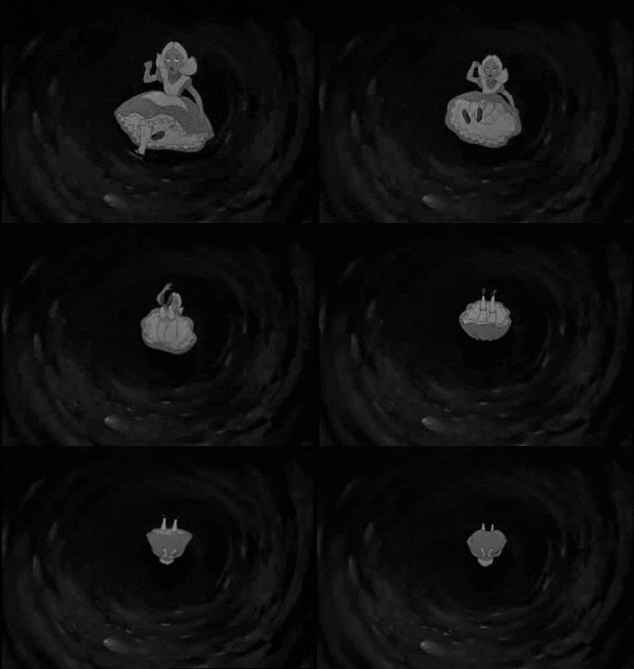
#### 6. Go to a random webpage, and you should see the backroadsign at a random location. Down the rabbithole you go. :hole: :rabbit2:
---
## [MX012](https://hackmd.io/fG6U8SimTEapvtqqO6OcOg)
## [MX013](https://hackmd.io/CdAzLL9ZSeWtJlpUC4-_JA)
---
## :fire:Block Assignment 3 - The Wikicast

**Listen to our podcast here:**
<div><iframe width="300" height="60" src="https://vocaroo.com/embed/15p7Q8viVycG" frameborder="0"></iframe><br><a href="https://voca.ro/15p7Q8viVycG" title="FLOSS podcast" target="_blank"></a></div>
As an open source encyclopedia, Wikipedia is considered the go-to hub for free, online information, containing millions of articles written by thousands of users from all walks of life (Wikipedia: Statistics). Wikipedia authors can be experts and laymen alike; the only thing they need to have in common is a desire to share information with the world. At least, that’s the intent of Wikipedia, but like any tool made available to the public it can be misused and even abused.
In this paper we will look into the openness in Wikipedia as both a strength and a weakness. Specifically, we’ll look at how entities such as companies can use the platform to forward their own agenda through vandalism, thereby risking to damage the trustworthy reputation of Wikipedia as a whole. We further discuss the notion of knowledge production, and how Wikipedia’s guidelines for articles can be contradictory to the inclusive and posthuman ideologies of commoning.
Wikipedia is based on a trust in people to understand, value, and contribute through the openness of Wikipedia, but also that this openness should be organized with care and guarded as a treasure. Here, the community spirit is crucial: it has to be big and dedicated enough to keep this project alive, relevant, and ‘valid’, according to Wikipedia guidelines. The openness and no-cost accessibility is dependent on volunteers to provide information by creating and editing articles themselves, but a strong core of the community is also needed for creating a reliable infrastructure within Wikipedia.
An example of misusing the openness of Wikipedia is the marketing stunt by The North Face, as mentioned in the podcast, where they switched photos of geographical places to photos including their products. They were widely criticized for this product placement method, including by Wikipedia themselves (wikimedia 2019). Here, The North Face saw an opportunity to manipulate the digital common good of Wikipedia by misusing the openness that is its foundation. This shows that economic agendas can sneak into Wikipedia and shake the users’ trust in its validity. As Mansoux and Abbing also mentions: “[...] these open systems were also open to capture by the market and exposed to the predatory culture of corporations” (Mansoux & Abbing 2020, p. 128). The other examples mentioned in the podcast further show how other personal or political agendas also can appear on Wikipedia, which can disturb its good intentions of being open source. Thankfully these often get corrected relatively fast, and credit goes to Wikipedia’s robust and loyal community, who set a good example of the great potentials of commoning.

*The North Face [marketing stunt](https://www.highsnobiety.com/p/north-face-wikipedia-marketing-stunt/)*
Besides its reliability on a trustworthy community for providing proper and correct knowledge on Wikipedia, the assumed existence of trustworthy, reliable and neutral knowledge itself is also an interesting topic to dive into. We as master students of arts have been schooled in an epistemology that acknowledges how knowledge is always situated (Haraway 1988), and that we therefore need to take into account the complex contexts of knowledge and also to value pluralism. This open mindset of knowledge and accounting for situated knowledge can contradict the way Wikipedia streamlines articles with their guidelines (Wikipedia: guidelines). To dictate what is ‘good’ knowledge is to say that some knowledge is truer than other knowledge. But in the context of commoning, which at its core can be said to be “always already posthuman” (Tyzlik-Carver 2017), the ideology should strive to be inclusive and not afraid of being introduced to other values. So from a commoning-as-posthumanistic standpoint it’s interesting to ask questions such as: How does Wikipedia decide what is true and not contradictory to the information already there? Do they acknowledge contradictions and pluralism? To what extent can knowledge production be open, when some form of knowledge is considered and prioritized over others?
This is not to say that Wikipedia as a common should accept all knowledge blindly and be without restrictions. A set of maintained guidelines based on static rules and ethical consideration is crucial to preserve its integrity and validity. But what Haraway warns against is to *play the God trick*, making everything look clean and perfect, and hide the messy parts. Rather, we should be better at seeing from below “where partiality and not universality is the condition of being heard to make rational knowledge claims” (Haraway 1988, 589). By *seeing from below*, from the complex lived lives, we are then able to make kin with each other in unexpected combinations and collaborations in hot compost piles (Haraway 2017). In the practice of commoning on Wikipedia this can mean opening up for new kinds of knowledge, which can give new values and surprising combos never thought of before. But again, this should be done with care and by being responsible to the decisions made (Snelting & Spideralex 2019).
Characters: 4979
[FEEDBACK FROM GROUP 4](https://hackmd.io/9mpXNWpKQ2SXyn-Z--6eWg?fbclid=IwAR1cRLdEg5xkByZs5W-udBsDXVSk0xhp1ineS6wuEBcWRjx6DTjUkJBXos0)
### Literature
- Haraway, Donna. (1988). “Situated knowledges: The science question in feminism and the privilege of partial perspective.” Feminist studies, 14(3), 575-599.
- Haraway, Donna. (2017). Staying with the Trouble. https://www.youtube.com/watch?v=GrYA7sMQaBQ [Video]
- Magda Tyżlik-Carver, 2017, Posthuman Common/s, Interview with Magda Tyżlik-Carver by Cornelia Sollfrank https://vimeo.com/220839488 [Video]
- Mansoux, Aymeric & Abbing, Roel R. (2020). “Seven Theses on The Fediverse and The Becoming of FLOSS” in Gansing, K & Luchs, I (eds) The Eternal Network, Institute of network cultures & transmediale/art&digitalculture.
- Snelting, Femke & Spideralex, 2019, Forms of Ongoingness, interview with Femke Snelting and Spideralex https://vimeo.com/302087898 [Video]
- Wikipedia: Statistics: https://en.wikipedia.org/wiki/Wikipedia:Statistics
- Wikipedia: Guidelines: “Good article criteria” https://en.wikipedia.org/wiki/Wikipedia:Good_article_criteria (accessed 11.7.2020).
- Wikimedia Foundation, 2019: “Let’s talk about The North Face defacing Wikipedia” 5.29.2019 (accessed 11.5.2020) https://wikimediafoundation.org/news/2019/05/29/lets-talk-about-the-north-face-defacing-wikipedia/
---
## [MX14](https://hackmd.io/Upka9dCsRRGOD40u6HMGfA?both)
[Class exercise: FLOSS brain dump](https://hackmd.io/hh1-PCs8QOuTqHEMjprvUg)
## [MX15](https://hackmd.io/19Ace1qRQ3K-FqpajJYrOw)
## [MX16](https://hackmd.io/OLTTEJ5ITcaTrXbX7T5CxA)
---
## :fire:Block Assignment 4
**What is 23andme?**
23andMe is a service that provides detailed analysis of your genetics based on a saliva sample. Through this sample and an opt-in/opt-out function of their website, you can learn various details about your genetic makeup. This includes information about your ancestry composition and timeline, health predispositions and general wellness, and even physical features such as hair color, taste and smell senses, and how likely you are to have freckles.
23andMe specifically states that they will not sell, lease, or rent individual-level information to any third parties for research purposes without your explicit consent, but also make clear that they do use and share information with third parties in order to perform business development and other similar activities.
**What is its relation to predictive culture?**
We argue that 23andme is a part of predictive culture, since a machine has been taught to ‘read’ your DNA and compare it with samplings/datasets in order to output information and calculations. Furthermore, it can use your data to make the machine more accurate.
This kind of machine learning that quantifies our lives reflects the culture of what Beniger calls “the "control revolution " that arguably has, since the late 19th century, reconfigured production, distribution, consumption, and bureaucracy by tabulating, calculating, and increasingly communicating events and operations.” (Beniger 1986 in Mackenzie 2017, s7)
In this predictive culture, where control is strived for, we often see scientific data as reliable truths. What is interesting then, is how these quantified data can push us towards certain life decisions such as healthier lifestyles or making contact with new found relatives. One’s identity can thus be anchored in a set of information made by a machine. But as Amoore advocates, “some potential futures are being ‘ruled out’” (Amoore 2010 in Mackenzie 2017, s7) when decisions are affected by quantified data.
**Research problem**
We are studying the quantifying of the self through 23andMe’s genetic data, because we want to find out how predictive data has the power to affect one’s behavior, identity and lifestyle, since it is embedded in our digital culture to perceive scientific data as true.
This is relevant in order to understand how our digital culture is ruled by black box data processing.
**Evaluation**
It’s good that we have an object of analysis (www.23andme.com), as this focuses our research, and also gives credibility to the effect of predictive data on a person’s behavior. The problem statement also leans more into the realm of a research question rather than a practical one, as it attempts to understand rather than solve.
In terms of our contextualisation in relation to the theme “predictive culture”:
* We have been quite clear in how we see 23andme as machine learning. But this could be discussed further, since it is perhaps not machine learning like we are familiar with in digital culture. Digital culture on different levels could also be investigated further (machines analyzing genetic materials, the interface of the web-page, the community of people within 23andme, the influencers showing tests online).
* Good that we have used theories from Beniger and Amoore to problematize predictive culture.
“Since it is embedded in our digital culture to perceive scientific data as true” is a claim with no specific sources and based on our own assumptions. We need to find out how this can be backed up academically and how it can be contextualized for our line of inquiry.
* This claim could be backed up by historical/philosophic turns to positivism and naturalism.
* We believe it’s a claim that applies to the general public, but there will always be people who go in the opposite direction and think otherwise (fx. conspiracy theorists). We could either narrow our claim to the general public, or be critical about our claim and include other ways of thinking (also because science is never neutral).
The ‘relevance’ part is too abstract and could be focused by turning the focus towards:
* How algorithms are always biased because they are made by humans, or because their work reinforces structures already in society.
* How this quantification shapes us as individuals and our ways of thinking.
Our problem statement would likely change when faced with more research, methods, and data. But we think the topic opens a range of theories and discussions from the course:
* Personalization, as it is based on the user’s own genes. How quantification (or filter bubbles) groups us and places us in relations we didn’t know of before.
* Data and data visualisation investigates how quantification is produced and interpreted.
* How commercialization, capitalism, and individualism affects the relationship between the information and the user.
* Databases and servers, as it relates to questions of privacy and ownership.
Characters: 4866
---
## [MX017](https://hackmd.io/xFqsCPEwSUiUl4QakjU3ZA)
 Sign in with Wallet
Connect another wallet
Sign in with Wallet
Connect another wallet