# HMM(Hidden Markov Model)
參考資料:
[pansci](http://pansci.asia/archives/43586)
[wiki hmm](https://zh.wikipedia.org/wiki/%E9%9A%90%E9%A9%AC%E5%B0%94%E5%8F%AF%E5%A4%AB%E6%A8%A1%E5%9E%8B)
[youtube](https://hackmd.io/IwDghiDGwMwGwFoAmAmAnAIwQFgAweARG0gFYEUB2YAMzDjjDSUpCA==)
---
### 歷史:
- DNN 出現之前重要的 ML model (1980s~2000s)
### 用於:
- 基因解碼
- 語音辨識
- 股價預測
- etc
---
原理:

x — 隱含狀態
y — 可觀察的輸出
a — 轉換機率(transition probabilities)
b — 輸出機率(output probabilities)

若滿足Markov property:${\mathbb {P}}(X_{n}=x_{n}|X_{{n-1}}=x_{{n-1}},\dots ,X_{0}=x_{0})={\mathbb {P}}(X_{n}=x_{n}|X_{{n-1}}=x_{{n-1}}).$
模型複雜度:O(NM^2)
N - observed state 數量
M - hidden state 數量
$Y=y(0),y(1),...,y(L-1)$ observed variable sequence
$X=x(0),x(1),...,x(L-1)$ hidden variable sequence
$P(Y)=\sum_{X}P(Y\mid X)P(X)\,)$ model, sequence長度為 ${\displaystyle L}$
---
## 三個典型問題
- 預測
${\displaystyle P(x(t)\ |\ y(1),\dots ,y(t))}$ use forward algorithm
- 平滑化
${\displaystyle P(x(k)\ |\ y(1),\dots ,y(t)),k<t}$ use forward-backward algorithm
- 解碼
${\displaystyle P([x(1)\dots x(t)]|[y(1)\dots ,y(t)])\,}$ use Viterbi algorithm
- 統計語意分析
-
---
## Viterbi ALgorithm
假設給定隱式馬可夫模型(HMM)狀態空間 ${\displaystyle S}$,共有$k$個狀態,初始狀態 ${\displaystyle i}$ 的機率為 ${\displaystyle \pi _{i}}$ ,從狀態 ${\displaystyle i}$到狀態${\displaystyle j}$ 的轉移機率為 ${\displaystyle a_{i,j}}$。 令觀察到的輸出為 ${\displaystyle y_{1},\dots ,y_{T}}$。 產生觀察結果的最有可能的狀態序列 ${\displaystyle x_{1},\dots ,x_{T}}$由遞迴關係給出:
$\begin{array}{rcl}V_{1,k}&=&\mathrm {P} {\big (}y_{1}\ |\ k{\big )}\cdot \pi _{k}\\V_{t,k}&=&\mathrm {P} {\big (}y_{t}\ |\ k{\big )}\cdot \max _{x\in S}\left(a_{x,k}\cdot V_{t-1,x}\right)\end{array}$
此處 ${\displaystyle V_{t,k}}$ 是前 ${\displaystyle t}$ 個最終狀態為 ${\displaystyle k}$的觀測結果最有可能對應的狀態序列的機率。 通過儲存向後指標記住在第二個等式中用到的狀態 ${\displaystyle x}$ 可以獲得維特比路徑。聲明一個函式 ${\displaystyle \mathrm {Ptr} (k,t)}$ ,它返回若 ${\displaystyle t>1}$時計算 ${\displaystyle V_{t,k}}$用到的${\displaystyle x}$值 或若 ${\displaystyle t=1}$時的 ${\displaystyle k}$. 這樣:
$\begin{array}{rcl}x_{T}&=&\arg \max _{x\in S}(V_{T,x})\\x_{t-1}&=&\mathrm {Ptr} (x_{t},t)\end{array}$
這裡我們使用了$arg max$的標準定義 演算法複雜度為 $O(T\times \left|{S}\right|^{2})$
---
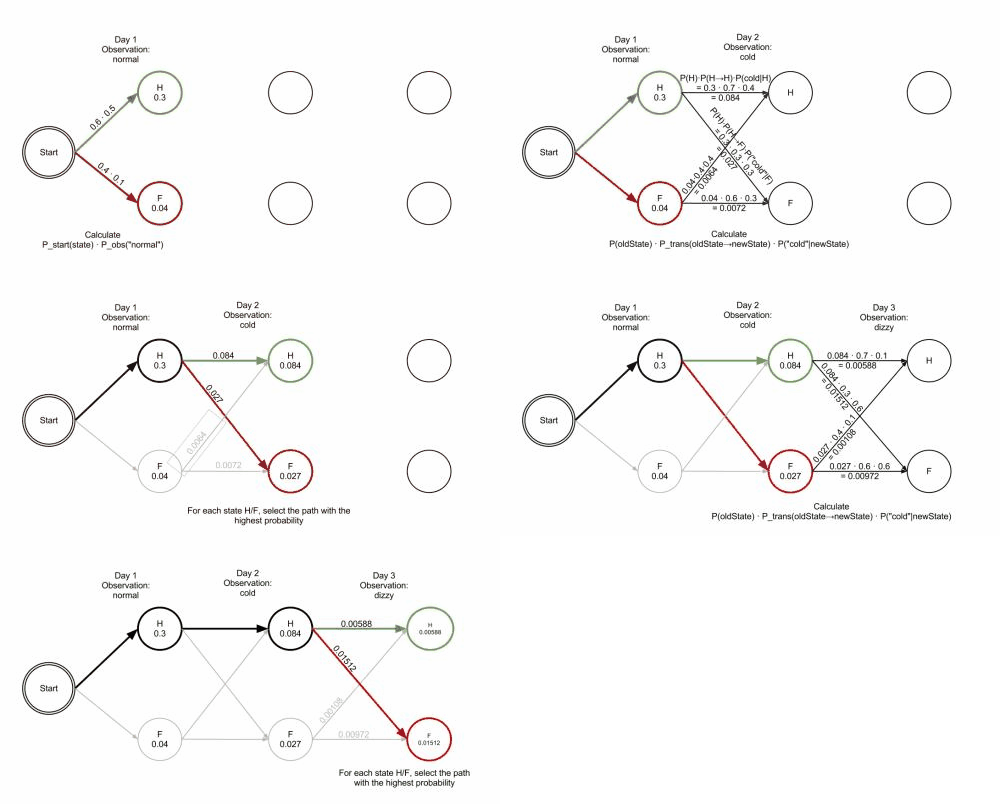
## Example
```python = 1
states = ('Healthy', 'Fever')
observations = ('normal', 'cold', 'dizzy')
start_probability = {'Healthy': 0.6, 'Fever': 0.4}
transition_probability = {
'Healthy' : {'Healthy': 0.7, 'Fever': 0.3},
'Fever' : {'Healthy': 0.4, 'Fever': 0.6},
}
emission_probability = {
'Healthy' : {'normal': 0.5, 'cold': 0.4, 'dizzy': 0.1},
'Fever' : {'normal': 0.1, 'cold': 0.3, 'dizzy': 0.6},
}
```
用狀態機表示:

```python =+
# Helps visualize the steps of Viterbi.
def print_dptable(V):
print " ",
for i in range(len(V)): print "%7d" % i,
print
for y in V[0].keys():
print "%.5s: " % y,
for t in range(len(V)):
print "%.7s" % ("%f" % V[t][y]),
print
def viterbi(obs, states, start_p, trans_p, emit_p):
V = [{}]
path = {}
# Initialize base cases (t == 0)
for y in states:
V[0][y] = start_p[y] * emit_p[y][obs[0]]
path[y] = [y]
# Run Viterbi for t > 0
for t in range(1,len(obs)):
V.append({})
newpath = {}
for y in states:
(prob, state) = max([(V[t-1][y0] * trans_p[y0][y] * emit_p[y][obs[t]], y0) for y0 in states])
V[t][y] = prob
newpath[y] = path[state] + [y]
# Don't need to remember the old paths
path = newpath
print_dptable(V)
(prob, state) = max([(V[len(obs) - 1][y], y) for y in states])
return (prob, path[state])
```
``` python =+
def example():
return viterbi(observations,
states,
start_probability,
transition_probability,
emission_probability)
print example()
```
---
## Baidu Jieba
 Sign in via Google
 Sign in via Facebook
 Sign in via X(Twitter)
 Sign in via GitHub
 Sign in via Dropbox
 Sign in with Wallet
Connect another wallet
Sign in with Wallet
Connect another wallet