## Multi-agent design patterns
| Design pattern | Description | classification | real-life analogy |
| --- | --- | :---: | --- |
| Blackboard Pattern | agents write, read, and work with the information on a shared data centre (blackboard) | :handshake: | experts collaborating around a blackboard |
| Contract Net Protocol | leader agent launches auction and determines the winner(s) to assign tasks, while the winner will report the results after done | :handshake: | frealancers bid for cases |
| Market-Based Pattern | agents cope with the mission as per market mechanism regarding their resource | :handshake: | capitalism |
| Hierarchical Organisation | agents work in super-subordinate relationship | :classical_building: | traditional company structure |
| Flat Organisation | agents work in equal colleagues relationship | :classical_building: | a teacher (leader) and students (peers) |
| Holonic Organisation | agents dynamically form sub-groups, and sub-groups coordinate as a big individual for certain goal | :classical_building: | _Dictyostelium discoideum_ |
| Federated Organisation | agents form groups and groups form ferderation | :classical_building: | relationship between state governments |
| Coalition organisation | agents form temporal and dynatic groups for common goal | :classical_building: | artistes under the same management company |
| Role assignment pattern | agents play and\/or switch their roles as per predefined pattern to conduct assigned tasks | :performing_arts: | cosplayer |
| Teamwork Pattern | agents team up by predefined rules for specialisation | :performing_arts: | Straw Hat Pirates |
| Belief-Desire-Intention (BDI) Architecture | belief-driven agents scheme their plan to achieve desires (assigned missions) | :thought_balloon: | sweet-craving kids |
Legend:
* :handshake:: Coordination-based
* :classical_building: Organisation-based
* :performing_arts: Role-based
* :thought_balloon: Cognition-based
* _The last column is the analogy to [organisational structure in business](https://hackmd.io/QoAugV3oTcC-sEncEBNaGg?both#Organisational-structure-in-business)_
---
### Classification
#### Coordination-Based:
* blackboard pattern:
all agents use the same blackboard to collaborate and share information
* blackboard is a shared data centre
* agents conduct tasks via reading and writing with the blackboard
* blackboard will be dynamically updated until problem solved
* Contract Net Protocol
An agent manager launches a mission (contract), and all agents bid for it based on their own resource and expertise --`auction raiser`-> judges and assigns the task --`executor`-> does the work and reports results
* contract: the mission to be dealt with
* agent manager: raises auctions (contract) and assigns tasks to the most suitable agent to perform
* executor: the competent agent wins the contract
* Market-Based Pattern
agents are traders in free market, buying and selling resources to achieve tasks
* market mechanism
* high abstract level
* Contract Net Protocol is a low-level implementation
* e.g.
* Auction (Contract Net Protocol)
* Bargaining
* Coalition Formation
#### Organisation-Based:
* Hierarchical Organisation
just like a company, some agents manage others in order-control relationship
* some are superordinates
* some are subordinates ~~to be bullied~~
* Flat Organisation
agents are at similar or same level, no obvious superordinate or subordinate
* colleagues without affiliation
* Holonic Organisation
agents **dynamically** form holons while holons form holarchy, holon can be flat or hierarchical, while holarchy is hierarchical
* holon: a group of agents
* holarchy: the collection of holons
* Federated Organisation
agents communicate with their facilitator (manager) within the same group, while the groups form decentralised federation
* facilitator: superordinate
* agent: subordinate, and they won't talk to each other (communication is facilitated by facilitators instead)

<span style='font-size: 0.64em;'>Shehory, Onn. (1999). Architectural Properties of Multi-Agent Systems.</span>
* Coalition organisation
agents **dynamically** and **temporarily** form coalition to share information and resources for common goal
* coalition: **temporary** team of agents with shared goal
* agents share resource and cooperate in a coalition
* agents abide by predefined rules (e.g. game theory) to group up or leave a coalition, and coalition can also be long-term

* (a) centralised
* (b) decentralised
* \(c\) hierarchical
* (d) holonic
* (e) coalition
<span style='font-size: 0.64em;'>Izmirlioglu, Y., Pham, L., Son, T. C., & Pontelli, E. (2024). A Survey of Multi-Agent Systems for Smartgrids. Energies, 17(15), 3620. https://doi.org/10.3390/en17153620 </span>
#### Role-based:
* role assignment pattern
define the role-play and role-switching rules for agents to perform
* agents will switch/play their role by predefined rules

<span style='font-size: 0.64em;'>Ghazal, Rubina & Malik, Ahmad & Raza, Basit & Qadeer, Nauman & Qamar, Nafees & Bhatia, Sajal. (2021). Agent-Based Semantic Role Mining for Intelligent Access Control in Multi-Domain Collaborative Applications of Smart Cities. Sensors. 21. 4253. 10.3390/s21134253. </span>
* Teamwork Pattern
define the **specialised** team-organising rules for agents to perform
* agents will team up as per predefined rules
* emphasise **specialisation**
#### Cognition-Based
* Belief-Desire-Intention (BDI) Architecture
agents have desire based on their belief, and choose some desires to fulfil by intent actions
* agents perceive their environment to generate **B**elief
* choose goal(s), i.e. desires to achieve
* scheme some plans (intention) to perform in order to reach the goals

<span style='font-size: 0.64em;'>Ghazouani, Mohamed & Medromi, Hicham & Boulafdour, Brahim & Sayouti, Adil. (2013). A model for an Information security management system (ISMS Tool) based multi agent system.</span>
<br>
---
<br>
The content below is a brief introduction for common organisational structures in business
### Organisational structure in business
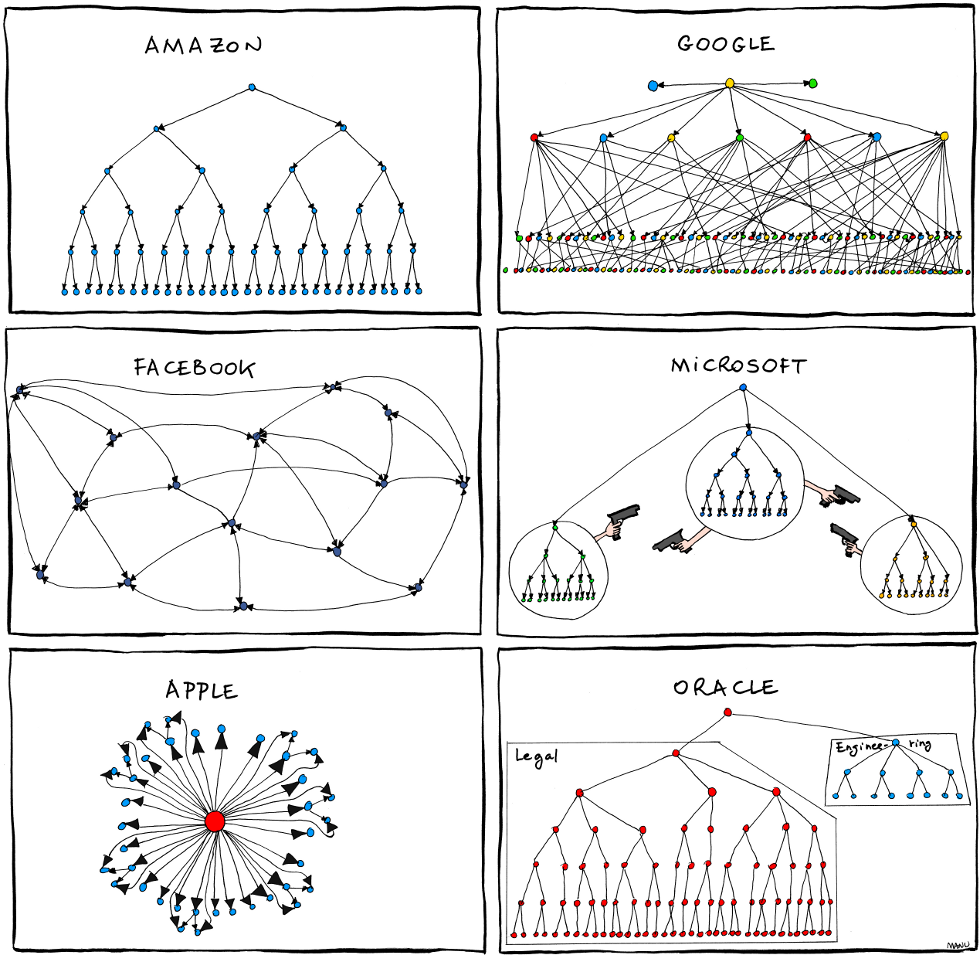
<span style='font-size: 0.64em;'>Microsoft Overhauls, the Apple Way, NICK WINGFIELD, NYT, July 11, 2013 http://www.nytimes.com/2013/07/12/technology/microsoft-revamps-structure-and-management.html</span>
* Amazon: Hierarchical
* Google: Matrix
* Facebook: Network
* Microsoft: ~~Rivalry~~ Divisional
* Apple: ~~Jobs-cored~~ Circular
* Oracle: ~~Suing~~ Functional
---
#### Commom organisational structure:
* Hierarchical
literally a structure with affiliative hierarchy

<span style='font-size: 0.64em;'>source: Ibi, i.e. me</span>
* Functional
organised by function

<span style='font-size: 0.64em;'>source: Ibi, i.e. me</span>
* Divisional
organised by orientation (e.g. product, service or market, etc.)
* Matrix
cross-functional teams occasionally work for other projects
* Line
small sized organisation only having vertical structure
* Horizontal (or flat)
flat structure with or without a superordinate

<span style='font-size: 0.64em;'>source: Ibi, i.e. me</span>
* Network
core member \+ satellite offices and cooperators
_open communication rather than hierarchy_

<span style='font-size: 0.64em;'>source: Ibi, i.e. me</span>
* Circular
leader in the centre instead of top, passing message outwards but not downwards the people chain
_more efficient than hierarchical one_
* Process-based
organised by sequential process

<span style='font-size: 0.64em;'>source: Ibi, i.e. me</span>
* Team-based
organised as a team, focus on problem-solving and goal-achieving
* tiger team
expert team for certain objective
* Scrum team
one-sprint-one-goal iterative progression
`for sprint in goals: sprint.yield(increment)`
* Product owner:
* formulate the project direction
* list product backlog
* Scrum master:
* facilitate teamwork
* supervision and consultation
* Developer (s):
* project execution
* self-organisation
* activities:
* Sprint Planning: scheme goal and backlog
* Daily Scrum: **Daily Stand-up Meeting** for progress and issues report
* Sprint Review: feedback request to product owner and stakeholders
* Sprint Retrospective: reflection
---
#### building organisational structures with multi-agent system design patterns:
_Not all structures are able to be constructed with multi-agent design patterns_
| Organisational structure in business | Multi-agent design patterns | Notes |
| --- | --- | --- |
| Hierarchical structure | Hierarchical Organisation | direct match |
| Functional Structure | Hierarchical Organisation | function-departmented hierarchical structure |
| Divisional Structure | Hierarchical Organisation | orientation-departmented hierarchical structure |
| Matrix Structure | Hierarchical Organisation \+ blackboard | matrix structure still has hierarchy, while criss-cross info sharing resembling the blackboard |
| Line Structure | Hierarchical Organisation | the simplest hierarchical structure |
| Horizontal \/ Flat Structure | Flat Organisation | direct match |
| Network Structure | Federated Organisation \+ Market-Based Pattern \+ hierarchical structure | satellite offices $\approx$ federation in market, while the core is hierarchical structure |
| Circular Structure | Flat Organisation \+ Blackboard Pattern | central leader with flat structure, while the leader serves as the info centre resembling the blackboard |
| Process-based Structure | role assignment pattern \+ Blackboard Pattern | specialised roles for different processes, and the shared info can be deemed the blackboard |
| Team-based Structure | Teamwork Pattern | direct match |
| Tiger Team | Teamwork Pattern | goal-oriented teamwork pattern |
| Scrum Team | Teamwork Pattern \+ role assignment pattern \+ Belief-Desire-Intention (BDI) Architecture | team with assigned roles, while continual feedback mechanism matches BDI |
Reference:
* [Lucidchart organisational structures](https://www.lucidchart.com/blog/types-of-organizational-structures)
* [Whatfix organisation architecture](https://whatfix.com/blog/organizational-structure/)
* [Business Thinking Academy](https://bizthinking.com.tw/2021/07/01/organization-architecture/)
 Sign in via Google
 Sign in via Facebook
 Sign in via X(Twitter)
 Sign in via GitHub
 Sign in via Dropbox
 Sign in with Wallet
Connect another wallet
Sign in with Wallet
Connect another wallet