<!-- #### [總覽](https://jasmine880809.medium.com/recommender-system-%E6%8E%A8%E8%96%A6%E7%B3%BB%E7%B5%B1-content-based-filtering-and-collaborative-filtering-9d338b7b22bd)
[MS](https://learn.microsoft.com/en-us/fabric/data-science/retail-recommend-model) -->
## Recommendation system
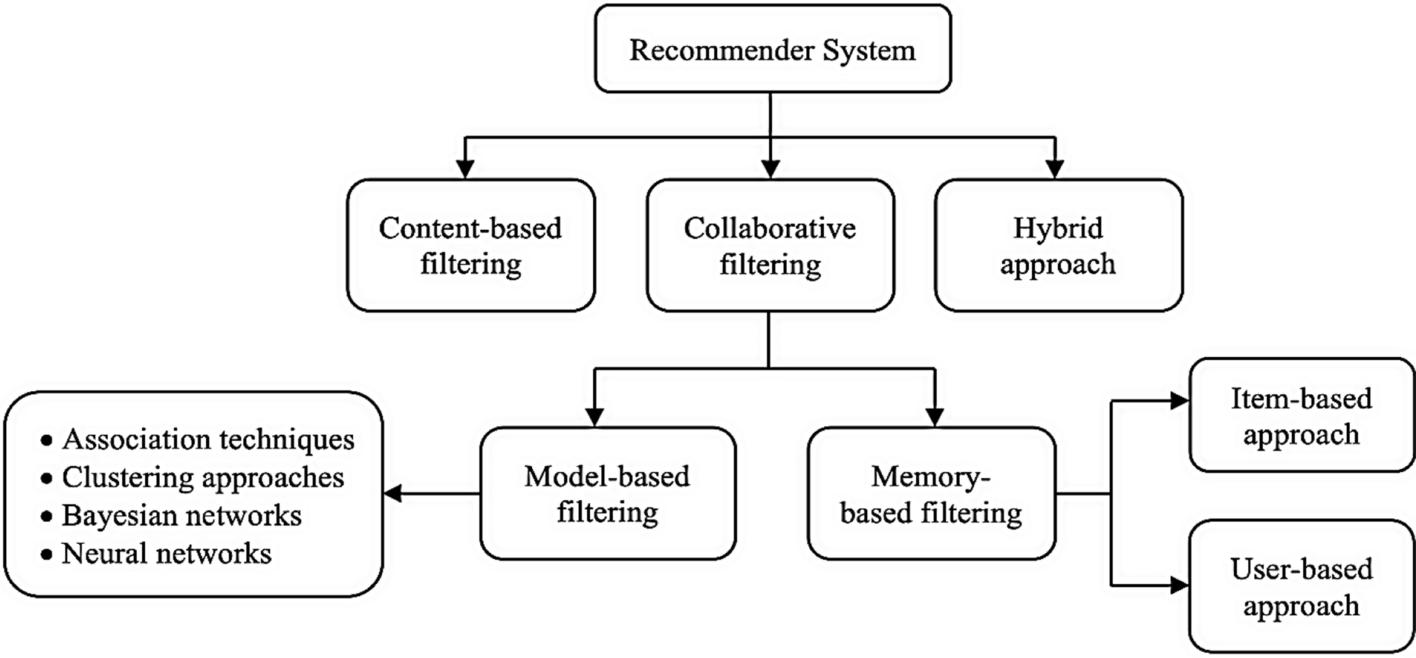
<span style='font-size: 0.64em;'>Roy, D., Dutta, M. A systematic review and research perspective on recommender systems. J Big Data 9, 59 (2022). https://doi.org/10.1186/s40537-022-00592-5</span>
Recommendtion/recommender system:
* content-based filtering
* collaborative filtering
* memory-based filtering
* item-based approach
* user-based approach
* model-based filtering
Recommender systems
| type | filtering basis | |
| --- | --- | --- |
| content-based filtering | product content | |
| collaborative filtering | other user's behaviour | |
<!-- | | | |
| | | |
| | | | -->
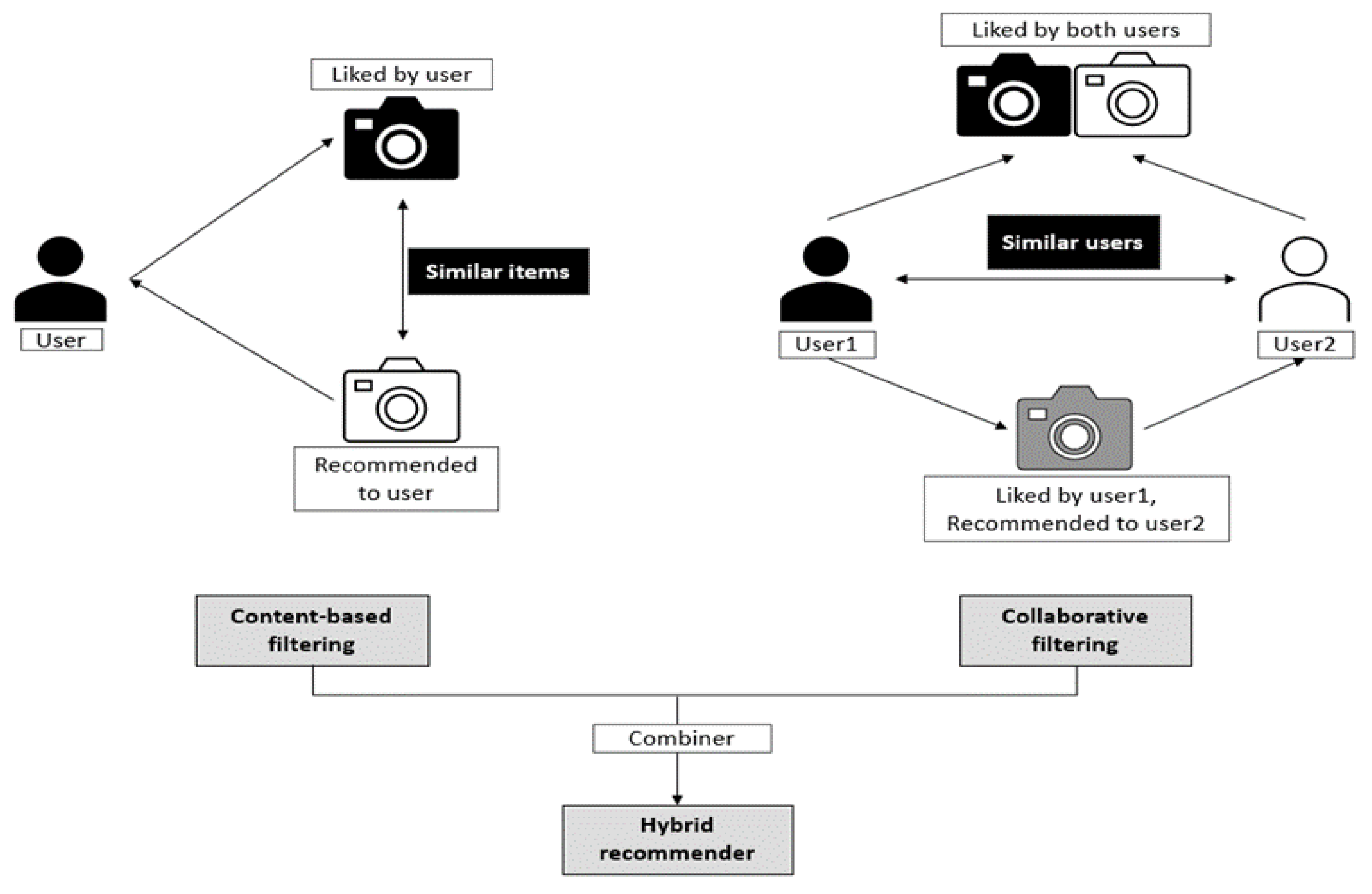
<span style ='font-size: 0.64em;'>He, X., Liu, Q., & Jung, S. (2024). The Impact of Recommendation System on User Satisfaction: A Moderated Mediation Approach. Journal of Theoretical and Applied Electronic Commerce Research, 19(1), 448-466. https://doi.org/10.3390/jtaer19010024</span>
---
### content-based filtering
recommend similar things based on user's previous choice
i.e. recommend a product similar to what user has watched\/used
* e.g.
* If I've wathed 'Queen Cleopatra' on a streaming service, it may recommend me other films with excessive political correctness
* If I bought 'Sapiens: A Brief History of Humankind' from bookshop, then I'm likely to be recommended related books such as 'Homo Deus:The Brief History of Tomorrow'

<span style='font-size: 0.64em;'>Kalra, Mamta & Sangwan, Suman. (2021). Design Engineering A Literature Review on Ontology-based and Deep Learning-based Recommendation System. Design Engineering. 2021. 13898 - 13906.</span>
### collaborative filtering
recommend things based on **other users' behaviour**
* memory-based filtering
filtering based on users' previous behaviour
* item-based approach:
If most users like an item and also like another item, then these two items are considered 'similar' to be recommended
* e.g.
If most people read 'Facing Up: Science and Its Cultural Adversaries' also read 'On the Origin of Species', then the system will recommend the latter to a customer who has just read the former
* user-based approach:
analyse an user's historical behaviour to find other similar users, and then recommend the user based on similar users' choice
* e.g.
Most people wathed Hsuan-Tien Lin's channel also watched Hung-yi Lee's one -> recommending Hung-yi Lee to those who just watched Hsuan-Tien Lin's video
* pros: intuitive, easy to implement
* cons:
* low computational efficiency
* poor performance upon sparse data
<a href='https://www.researchgate.net/figure/Concepts-of-user-based-and-item-based-filtering_fig1_340361119'><img src='https://www.researchgate.net/publication/340361119/figure/fig1/AS:962178941214731@1606412744374/Concepts-of-user-based-and-item-based-filtering.png' alt='Concepts of user-based and item-based filtering'/></a>
<span style='font-size: 0.64em;'>Chen, Yi-Cheng & Hui, Lin & Thaipisutikul, Tipajin. (2021). A collaborative filtering recommendation system with dynamic time decay. The Journal of Supercomputing. 77. 10.1007/s11227-020-03266-2.</span>
* model-based filtering
train a model based on historical behaviour, and use the model prediction to perform recommendation
* common approaches:
* Matrix Factorisation
_[details here](https://developers.google.com/machine-learning/recommendation/collaborative/matrix)_
* KNN
* Deep learning
* ...
* pros:
* able to cope with sparse data
* complex relationship handling
* extensible
* cons:
* model training requires huge computational resource
* lower explainability (usually)
### content-based and collaborative filtering comparison:
<a href='https://www.researchgate.net/figure/Content-based-filtering-and-Collaborative-filtering-recommendation_fig3_331063850'><img src='https://www.researchgate.net/profile/Marwa-Mohamed-54/publication/331063850/figure/fig3/AS:729493727621125@1550936266704/Content-based-filtering-and-Collaborative-filtering-recommendation.ppm' alt='Content-based filtering and Collaborative filtering recommendation.'/></a>
<span style='font-size: 0.64em;'>Mohamed, Marwa & Khafagy, Mohamed & Ibrahim, Mohamed. (2019). Recommender Systems Challenges and Solutions Survey. 10.1109/ITCE.2019.8646645.</span>
### Hybrid
Namely, the combination of collaborative and content-based filtering
pre-clustering -> searching the most similar cluster only (efficient)
<span style='font-size: 0.64em;'></span>
 Sign in via Google
 Sign in via Facebook
 Sign in via X(Twitter)
 Sign in via GitHub
 Sign in via Dropbox
 Sign in with Wallet
Connect another wallet
Sign in with Wallet
Connect another wallet