# 北軟107 problemA
###### tags: `北軟107`
## 題目:
給你一個字串,請你列出字串中的字元的所有可能組合。
## 想法:
這題我們可以用遞迴,會比較直觀。
例如下圖即為遞迴樹狀圖。
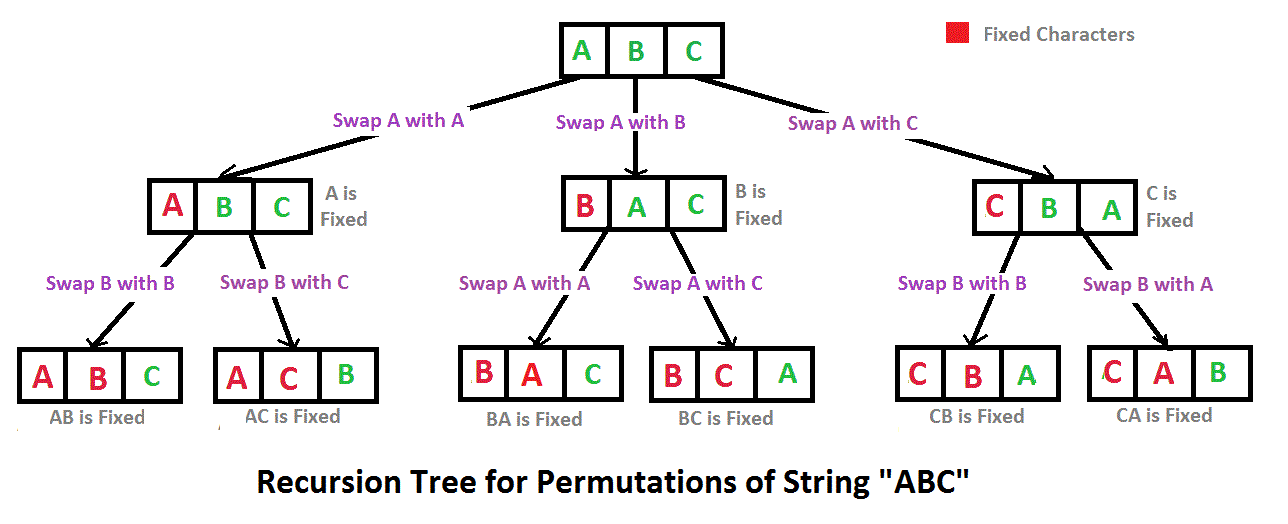
假設給你的字串有A個字元。
先放入第一個字元,我們可以產生A種遞迴的結果,然後針對於所有數量的結果,依序放入第二個字元,可以產生A-1種結果,然後第三個,可以產生A-2種結果,如果依序放入後,result字串的長度為A,則輸出。
數量即為$\mathop{\Pi_{c=0}^{c=A-1}}(A-c) = A!$
因此,我們就可以開始依照概念寫程式了。
## 模板(C++)
```cpp
#include <bits/stdc++.h>
#define INF 1e6
using namespace std;
void printPermutation(int n,string str, string result, int complete){
if(complete == n){
cout << result << endl;
return;
}
vector<char> vec(str.begin(),str.end());
for(int i = 0; i < str.length(); i++){
result[complete] = str[i];
string remake = "";
for(int j = 0; j < str.length(); j++){
if(i == j) continue;
remake += vec[j];
}
printPermutation(n,remake,result,complete+1);
}
}
int main(){
string str = "ABCDEFGH"; //遞迴字串
string result = "";
//我們先預設result有str.length()個字元,會比較好處理
for(int i = 0; i < str.length(); result += 'x', i++);
printPermutation(str.length(),str,result,0);
}
```
接下來,寫出模板之後,就可以開始寫C#的程式了
## 程式碼(C#)
```CSharp
using System;
using System.Collections.Generic;
using System.ComponentModel;
using System.Data;
using System.Drawing;
using System.Linq;
using System.Text;
using System.Threading.Tasks;
using System.Windows.Forms;
namespace problemA
{
public partial class Form1 : Form
{
public Form1()
{
InitializeComponent();
}
private void printPermutation(int n, string str, string result, int complete)
{
if (complete == n)
{
listBox1.Items.Add(result);
return;
}
char[] vec = str.ToCharArray();
char[] rst = result.ToCharArray();
for(int i = 0; i < vec.Length; i++)
{
rst[complete] = str[i];
string remake = "";
List<char> list = str.ToList<char>();
list.RemoveAt(i);
remake = String.Join("", list);
result = String.Join("", rst);
printPermutation(n, remake, result, complete + 1);
}
}
private void button1_Click(object sender, EventArgs e)
{
listBox1.Items.Clear();
String str = textBox1.Text;
printPermutation(str.Length, str, "".PadLeft(str.Length, 'X'), 0);
textBox2.Text = listBox1.Items.Count + "";
}
}
}
```
 Sign in with Wallet
Connect another wallet
Sign in with Wallet
Connect another wallet